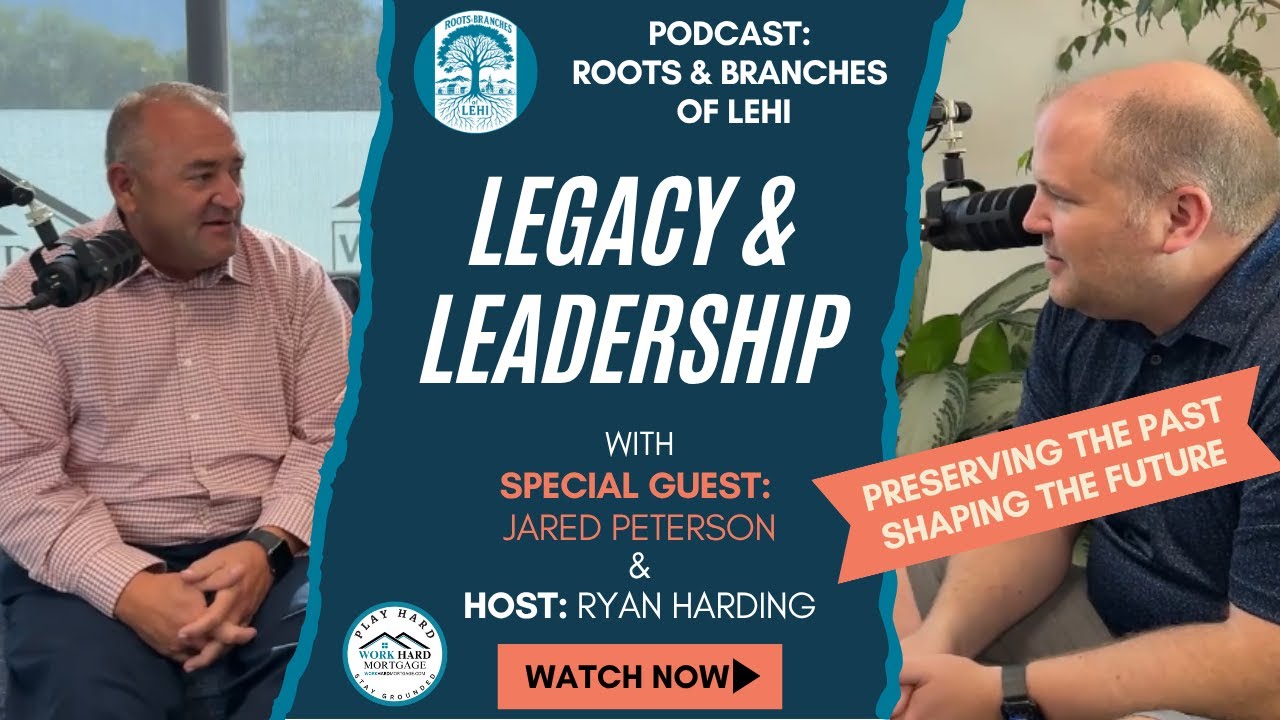
Preserving Lehi’s Past, Shaping Its Future | Interview with Jared Peterson
A seventh-generation Lehi resident explores the delicate balance between honoring ancestral legacies and steering a rapidly growing city toward a sustainable future.
Jared Peterson
Seventh-Generation Resident
At a Glance
Archive Scoring
Introduction
Jared Peterson’s story is not just one of a local banker or a city council candidate; it is the continuation of a narrative that began with the earliest pioneers to enter the Utah Valley. As a seventh-generation resident, Peterson embodies the living memory of Lehi, bridging the gap between the humble handcart companies of his ancestors and the high-tech skyline of modern-day Silicon Slopes. His perspective offers a rare vantage point: that of a man who sees the city not just as a collection of infrastructure and zoning codes, but as a multi-generational tapestry of shared struggle and celebration.
Central to this archival record is the evolution of the Lehi Roundup, an institution that serves as the heartbeat of the community. Peterson traces the shift from a time when neighbors saved seats with blankets to the digital era of online sell-outs and drone shows. Yet, beneath these logistical changes lies a steadfast commitment to volunteerism and family-friendly values. He reflects on the "invisible" labor of the rodeo—the families of the announcers and clowns who travel the circuit, and the board members who work late into the night without compensation—revealing the grit and dedication required to maintain local traditions in an age of rapid commercialization.
Beyond the arena, Peterson’s tenure on the Planning Commission provides a window into the frantic growth of the late 20th and early 21st centuries. He speaks of late-night meetings where the future of the city's "open space" was decided, highlighting the moral weight of approving developments that will outlast the decision-makers. His narrative captures the anxiety and hope of a town trying to remain a "village" while its population swells toward six figures. He advocates for a 100-year vision, urging current leaders to think as the city's founders did when they preserved Wines Park for the generations to follow.
The interview also delves into the psychology of a "move-in" versus a "legacy" resident. Peterson acknowledges the risk of exclusion in a tight-knit town and emphasizes the need for proactive inclusion. For him, the preservation of Lehi is not about stagnation; it is about "building bridges" so that the new residents—transplanted for tech jobs or suburban safety—can find their own roots within the community's storied branches. This record serves as a testament to the idea that a city’s soul is found in its willingness to serve, to remember, and to plan for those not yet born.
Episode Overview
A detailed look at the topics, people, and context of this conversation.
In this recording, Jared Peterson shares his lifelong connection to Lehi, Utah, detailing his family’s arrival with the pioneers and his own decades of service to the community. As a professional in the banking industry and a long-time member of the Lehi Roundup committee, Peterson provides a comprehensive look at how the city’s economic and cultural landscapes have shifted over time. The conversation moves through the logistics of organizing a professional rodeo, the complexities of urban planning during a population boom, and the personal philosophy of civic duty that drives his run for City Council.
Peterson reflects on specific historical milestones, such as the transition from the "Flying U" stock contractors to Frontier Rodeo and the strategic addition of a fourth night to accommodate growing demand. He offers insights into the "choreographed" nature of community events and the intentional efforts to keep local traditions affordable and accessible. Throughout the episode, Peterson balances the practicalities of traffic management and federal funding with the sentimental value of public parks and generational gathering places.
The tone of the discussion is one of seasoned responsibility. Peterson doesn't shy away from the challenges facing Lehi—such as the massive traffic influx from neighboring Eagle Mountain and Saratoga Springs—but approaches them with a collaborative, relationship-based mindset. This interview captures a pivotal moment in Lehi’s history, recorded from the perspective of someone who views the city’s future through the lens of its deeply rooted past.
Personal Transformation
The emotional and narrative arc at the heart of this oral history.
Jared Peterson's narrative arc is defined by the transition from an inheritor of legacy to an active architect of community continuity. Born into a seventh-generation Lehi family, his initial understanding of service was rooted in familial duty and the observation of his grandmothers—young widows who modeled resilience and quiet contribution. He describes his early involvement in the Lehi Roundup not as a calculated career move, but as a natural extension of family life and a 'requirement' of dating his future wife. This early phase was characterized by a deep respect for tradition, where the rhythms of the community were accepted as immutable facts of life.
Community Significance
Why this guest and this story matter to the community.
Jared serves as a vital bridge between Lehi’s agrarian, small-town past and its burgeoning identity as a regional hub. As a seventh-generation resident and a professional in the local banking sector, he provides a sense of continuity that is increasingly rare in a city experiencing hyper-growth. His leadership within the Civic Improvement Association ensures that the Lehi Roundup—the city's premier cultural event—remains both a professional-grade spectacle and a volunteer-driven community gathering. Without his efforts and those of his peers, the institutional memory of the rodeo’s evolution and the specific 'family-friendly' values it protects might be lost to commercialization or neglect.
"My background in Lehi and my connection to Lehi is that I'm a seventh generation Lehi kid. My family was some of the earliest settlers here in in Lehi. And, uh, we're very proud of that."
— Jared Peterson · 1:07
Key Themes & Life Lessons
The ideas that run beneath the stories — and what they teach about community, leadership, and belonging.
Multi-generational Community Legacy
Evolution of Small-Town Traditions
Urban Growth and Regional Infrastructure
The Ethics of Volunteerism and Service
Preservation of Public Open Space
Bridging the Gap Between Old and New Residents
Local History
Generational Wisdom
Wisdom & Life Lessons
Relationships are the currency of community; Jared demonstrates that professional banking connections, family ties, and volunteer service create a web of trust that allows a city to function. Momentum is fragile; he warns that if a community stops looking forward, it loses its seat at the regional table. True entertainment should respect the audience; by intentionally keeping the rodeo alcohol-free and affordable, the committee prioritizes the social fabric over maximum profit. Finally, 'you might have bought the whole seat, but you only need the edge'—a reminder that excellence in execution is what keeps a tradition alive.
Key Takeaways
- 1Deep-rooted ancestry in Lehi shapes a sense of long-term responsibility toward the city’s future.
- 2The Lehi Roundup Rodeo remains a centerpiece of identity but must adapt through technology and expanded schedules to survive.
- 3Community service in Lehi is often a family-inherited trait, modeled by previous generations of resilient residents.
- 4Effective city planning requires shifting from a 20-year outlook to a 50-100 year visionary strategy.
- 5Growth challenges, particularly traffic, are regional issues that necessitate professional relationships with neighboring municipalities.
- 6Maintaining a small-town feel in a city of 100,000 depends on proactive outreach to 'transplanted' residents.
Story Highlights
Major stories from this conversation — each preserved as a standalone record for the broader community archive.
Jared Peterson shares the depth of his connection to Lehi as a seventh-generation resident. He reveals a profound historical discovery: both his family and his wife's family were members of the same handcart company that eventually settled in the area. This realization connects his modern marriage to the survival and migration stories of his ancestors, emphasizing that his presence in Lehi is the result of centuries of continuity.
Emotional Significance
There is a sense of deep-seated pride and awe in discovering that his current family ties were mirrored in the struggles of pioneer ancestors.
Why This Matters
It establishes that community roots are often deeper and more intertwined than we realize, showing how history repeats through generations.
Life Lesson
Knowing where you come from provides a sense of belonging that can weather the storms of modern change.
Transformation
The story transforms a simple personal identity into a historical stewardship; he is not just a resident, but a continuation of a specific migration legacy.
What It Reveals About Jared Peterson
He values continuity and finds personal meaning in historical research and family narratives.
What It Reveals About the Community
The city’s founding families are still deeply present and active in the community's current leadership.
Community Value Preserved
The preservation of pioneer history as a living, breathing part of modern life.
For future generations: Future residents may find inspiration in the idea that their own contemporary relationships might have roots that stretch back hundreds of years.
Jared reflects on how his commitment to community service was born from a family environment centered on care. Growing up with two grandmothers who were young widows in Lehi, Jared and his family were constantly involved in their care and upkeep. This personal, familial obligation served as his training ground for broader civic involvement, teaching him that service is a natural part of living in a community.
Jared recounts how he became involved with the Lehi Roundup Rodeo through his father-in-law, Stan Lewis. When Jared began dating his future wife, he was immediately handed an assignment—selling programs at the rodeo. In the Peterson/Lewis family, being part of the Civic Improvement Association was not optional; it was a way of life that tested and eventually integrated newcomers into the family and community fold.
Jared discusses the difficult cultural transition within the rodeo committee when moving from 'open seating' to an online, assigned seating system. For decades, the tradition in Lehi was for residents to show up on Monday or Tuesday and lay blankets down to claim their spots for the week. Breaking this tradition was a major hurdle for older committee members, but was necessary to manage the rodeo’s explosive growth and modernization.
To address the 'dead time' between the rodeo events and the motorcycle show, Jared and his wife spearheaded the introduction of a choreographed drone show. This was a significant logistical risk, requiring precise timing and the coordination of lights and ramps in total darkness. Jared describes the awe of seeing the first image—larger than any TV screen could prepare him for—and the unexpected realization that the show was reaching people miles outside the arena, even if they hadn't bought a ticket.
Jared reflects on the hidden human elements of the rodeo that the public never sees. He mentions Andy Stewart, the rodeo announcer, whose wife was battling cancer while she was present at the show. Jared notes that while the audience sees a polished performance, the people making it happen are often carrying heavy personal burdens. He views the rodeo committee as a family that supports these performers through their private struggles.
Jared addresses the massive growth projections for Lehi and its neighbors (Eagle Mountain and Saratoga Springs), which are expected to reach a combined population of over 600,000. He argues that Lehi has historically planned in 10-20 year increments, which is no longer sufficient. He emphasizes that if Lehi doesn't take the lead in regional traffic and infrastructure discussions, it will be 'run over' by the needs of neighboring cities, sacrificing its own interests in the process.
Jared uses Wines Park as the gold standard for community planning. He recalls how Idaw Wines left the land to the city specifically for a park, and how it has remained a gathering place for generations without significant change. He challenges the current leadership to build facilities—like baseball diamonds and libraries—that will be cursed or praised by people 100 years from now based on whether they were planned with the same foresight.
Jared discusses the controversial decision to move the annual Roundup concert from its traditional home at Wines Park to the new Family Park. While some 'old-timers' were upset, Jared observed that the new location attracted a completely different crowd—people from newer developments who had never felt connected to the downtown core. By moving the event, the city literally 'took the culture to the people,' bridging the gap between the seventh-generation residents and the 'move-ins.'
"It's 100% volunteer. There's nobody that's making any money on this thing. Uh it's everybody's donating time and talent and and all those things."
— Jared Peterson · 15:25
Historical Preservation & Legacy
What this interview preserves about community history, cultural legacy, and intergenerational knowledge.
Preservation Value: Exceptional
This episode is an essential primary source because it captures the intersection of family legacy, institutional growth, and city planning. Jared Peterson provides a comprehensive view of how a major community tradition (the Roundup) was saved from obsolescence through modern management. The level of detail regarding the evolution of city politics and the logistical shifts in the rodeo offers future historians a clear view of how Lehi maintained its identity during the 'Silicon Slopes' tech boom.
Why This Episode Matters Historically
This record captures a pivotal moment in the modernization of Lehi’s cultural institutions. Jared provides a firsthand account of the internal tensions and eventual successes of moving the Lehi Roundup from traditional, manual processes—like physical blankets for seat saving and grocery store ticket outlets—to a high-tech, four-night, sold-out professional event. It documents how a local committee navigates the shift from a 'small-town fair' feel to a 'major league' rodeo experience while resisting the financial lure of alcohol sponsorships to maintain a specific community ethos.
What Future Generations May Learn
Future residents will find a masterclass in 'stewardship over ownership.' Jared’s testimony emphasizes that a community’s heart is not preserved by keeping it exactly the same, but by adapting its delivery to meet new needs—such as the introduction of drone shows and online ticketing—while keeping the core values (family, service, and accessibility) intact. They will learn that the success of a 100,000-person city depends on the willingness of its leaders to think 50 to 100 years into the future rather than just the next election cycle.
Community Memory Preserved
The archive gains specific details regarding the 'blanket tradition' at the rodeo grounds, where residents once placed blankets days in advance to claim open seating. It preserves the lineage of stock contractors from Flying U to Frontier Rodeo and the strategic shift in choreography to keep the show exactly two hours long. It also documents the philanthropic arm of the Civic Improvement Association, including their scholarships for local high schools and their role in maintaining the historical integrity of Wines Park and other city landmarks. Most importantly, it preserves the memory of the 'slack' events—the raw, un-narrated cowboy work that happens outside the bright lights of the main show.
Local Knowledge Preserved
Jared articulates the complex relationship between Lehi and its neighbors, Saratoga Springs and Eagle Mountain, explaining the logistical and political reality of being a 'pass-through' city for regional traffic. He preserves the knowledge of how the planning commission navigated the massive developments of Holbrook Farms and the Exchange. Additionally, he provides insight into the 'choreography' of the rodeo—the precise timing required to switch between bull riding, drone shows, and motocross ramps under the cover of darkness.
Intergenerational Lessons
The primary lesson for future leaders is that service is a learned behavior, often inherited through small acts of kindness seen in the home. Jared illustrates that leadership is not about having a single 'issue' or an axe to grind, but about a long-term commitment to the health of the collective. He teaches that for a community to survive rapid growth, the 'old guard' must be proactive in reaching out to newcomers, rather than waiting for them to find their own way in. His life suggests that the most effective leaders are those who are willing to do the 'unseen' work—like selling programs or feeding contestants—long before they take a seat on a board or council.
Community & Cultural Insights
Lehi’s culture is revealed as one that values grit, choreography, and family-centrism. The resistance to alcohol at the rodeo is not just a religious preference but a cultural statement about the type of 'public square' Lehi wants to maintain. The interview highlights the 'growing pains' of a city where geography—specifically the downtown 'bottle-neck' of regional traffic—is a constant source of tension. It also reveals a shift in community gathering spots from the historic Wines Park to newer, larger venues like the Family Park, and the cultural challenge of ensuring that residents in the newer, west-side developments feel as much like 'Lehi kids' as those from seventh-generation families.
Historical Context
Jared Peterson represents the seventh generation of a pioneer family that settled Lehi, Utah. This interview captures the city at a critical inflection point: the transition from a traditional agrarian and rodeo-centered small town to a high-density tech hub within the Silicon Slopes corridor. The mention of ancestors in handcart companies juxtaposed with modern drone shows encapsulates the rapid cultural evolution of the region. Historically, Lehi's identity has been anchored by the Civic Improvement Association and the Lehi Roundup, which began in the early 20th century. As the city approaches a projected population of 175,000, the narrative explores how the 'Old Lehi' structures of volunteerism and family-led committees are being strained and modified to accommodate a massive influx of new residents who do not share the same ancestral ties to the land.
Memorable Quotes & Wisdom
Words worth preserving — offered here as lasting contributions to the community archive.
"My background in Lehi and my connection to Lehi is that I'm a seventh generation Lehi kid. My family was some of the earliest settlers here in in Lehi. And, uh, we're very proud of that."
— Jared Peterson
1:07
Connects current leadership to the historical foundation of the city.
This establishes deep ancestral roots, marking the transition from original settlers to the modern era.
"I had two grandmas who were young widows that lived here in town and that we were able to really serve them and that's where I learned to serve."
— Jared Peterson
2:36
Reflects the small-town value of caring for neighbors and elders.
Highlights how personal family adversity often forms the basis for community service and leadership.
"You might have bought the whole seat, but you only need the edge."
— Jared Peterson
5:46
Symbolizes the specific brand of high-energy entertainment the community prides itself on.
A memorable colloquialism capturing the excitement and intensity of the Lehi Roundup.
"Everything's volunteer at the at the rodeo and we're going to ask everybody to be there one more night. Uh and but we did it. Everybody was everybody jumped in."
— Jared Peterson
6:41
Highlights the volunteerism that fuels Lehi's largest events.
Demonstrates the collective sacrifice required to maintain large-scale community traditions.
"We made a real conscious effort that we wanted to be we wanted to be fast and we wanted it to be a lot of action and just super entertaining."
— Jared Peterson
5:33
Shows the balance between professional production and local tradition.
Explains the strategic evolution of a tradition to keep it relevant for modern audiences.
"It's 100% volunteer. There's nobody that's making any money on this thing. Uh it's everybody's donating time and talent and and all those things."
— Jared Peterson
15:25
Reinforces that Lehi’s heritage is maintained by citizens, not corporations.
Defines the non-commercial, heart-led nature of the Civic Improvement Association.
"The more that you put yourself out there, the more connected you feel."
— Jared Peterson
17:29
Addresses the challenge of maintaining social cohesion during rapid urbanization.
A foundational piece of advice for newcomers in a rapidly growing city.
"I don't have that [an issue]. I just have a great love of the community and a great desire to serve and to give back."
— Jared Peterson
19:42
Advocates for leadership based on civil service rather than personal agendas.
Presents an alternative to 'issue-based' politics, focusing on general stewardship instead.
"We need to plan for 50, 80, 100 years down the road... making sure that when we're all gone and it's our kids or whoever it is that they have those types of places and they're not wondering what we were doing."
— Jared Peterson
26:44
Focuses on the responsibility current leaders have to future generations of Lehi residents.
Articulates the historian’s perspective on long-term municipal planning and legacy.
"Wines Park... has withstood the test of times, and it has not changed very much over the years. Uh, you know, took took some of the uh old old swings and things like that out and we put in some pavilions, but other than that, it's remained a a great place for families to gather."
— Jared Peterson
27:09
Wines Park is a sacred space in Lehi's geography that maintains its character despite growth.
Uses a specific landmark to illustrate the importance of preserving physical spaces for community connection.
"We need to tap into that talent... inviting people in to help and bringing in some of those new ideas but at the same time maintaining the traditions."
— Jared Peterson
28:24
Proposes a path forward for Lehi that is both inclusive and rooted.
Discusses the critical balance between respecting the past and embracing new residents.
Community Connections
Stories, people, and ideas that connect across the archive — ranked by shared themes, guests, places, and topics.
Related Episodes
(4)Preserving Lehi’s Story: Heather Newall & the Historical Marker Pins
Heather Newall
Building Community Through Stories: Unveiling Lehi's Rich Heritage
Lara Bangeter
Kay Christofferson Interview | From Civil Engineering to the Utah Legislature
Kay Christofferson
From Military Brat to City Leader: Paige Albrecht's Story
Paige Albrecht
Related People
(4)Charlene Freestone
Child Passenger Safety Technician, Former Boutique Owner, Parent Educator, Community Builder
Andy Hadfield
Head Football Coach, Lehi High School · Business Owner · Lifelong Lehi Resident
Lara Bangerter
Manager, Lehi Historical Society & Archives
Mark Johnson
Mayor of Lehi, Former City Council Member, Engineer & Business Owner
Related Stories
(4)The Natural Parenting Boutique on Lehi Main Street
Charlene Freestone
Trees Planted for People They'd Never Meet — Wines Park and Generational Sacrifice
Paige Albrecht
A Canceled Softball League and the Birth of a Public Servant
Paige Albrecht
Baby Land — A Place of Refuge Most People Don't Know About
Paige Albrecht
Related Quotes
(4)"Lehi City is the economic engine of the state of Utah."
— Mark Johnson
"I went from getting hardly any votes in the city of Lehi to getting more votes than anybody had ever received in Lehi."
— Mark Johnson
"We are not meant to do this life alone."
— Ryan Harding
"Real estate is get rich slowly."
— Ryan Harding
Related Themes
(4)Civic Leadership
Profiles of the people who shaped local government, planning, and policy in Lehi — and what their stories reveal about what good leadership actually looks like at the community level.
Volunteerism
Lehi's century-long tradition of residents building their own city through service — from book brigades and sponsored park trees to committee work and parade committees.
Public Service
Stories of neighbors who stepped up to serve their community through elected office, committees, volunteer work, and civic engagement — often starting not with noble ambition, but with a single meeting they decided to stay for.
Family Legacy
The stories of families who planted roots in Lehi across generations — the ones who built the traditions, the parks, the businesses, and the sense of belonging that others now enjoy.
Ways to Serve
(4)Volunteer for Lehi Roundup Committee
Lehi Roundup Committee
Join the Lehi Roundup Committee
Lehi Roundup Committee
Volunteer for the Lehi Arts Council
Lehi Arts Council
Volunteer at Farmers’ Markets
Lehi Farmers’ Market
Explore More Stories & Themes
Related topics and community themes that connect this episode to the broader archive.
Multi-generational Community Legacy
Explore this theme in the archive →
Evolution of Small-Town Traditions
Explore this theme in the archive →
Urban Growth and Regional Infrastructure
Explore this theme in the archive →
The Ethics of Volunteerism and Service
Explore this theme in the archive →
Preservation of Public Open Space
Explore this theme in the archive →
Bridging the Gap Between Old and New Residents
Explore this theme in the archive →
Connected People, Places & Stories
mentor
Family and committee connection leading to involvement in the rodeo.
leadership
Jared is a board member and his father-in-law, Stan Lewis, was a former president.
governance
The organization responsible for the Lehi Roundup and giving back to the community.
evolution
Jared discusses the transition from blanket seating and paper tickets to assigned seating and drone shows.
origin
The home base of the subject and the focus of the historical preservation.
employer
Where the subject has worked for 20 years, contributing to the professional life of the community.
challenge
Jared emphasizes that Lehi's traffic and growth cannot be solved without Saratoga Springs and Eagle Mountain.
governance
The body responsible for maintaining local history and advising on historical districts.
historic landmark
Serves as the primary example of successful long-term community stewardship.
community engagement
An example of a long-standing group that struggles with bringing in new volunteers.
mentor
Influenced Jared Peterson's career and introduction into local civic service.
Suggested Future Guests & Topics
Interviews with members of the Lewis family would provide deeper insight into the foundational years of the Civic Improvement Association. Documentation of the Rumford family (professional rodeo clowns) would offer a unique 'traveling professional' perspective on Lehi’s place in the national rodeo circuit. A panel discussion with current Planning Commission members about the '100-year plan' for Lehi's parks and trails would capture the contemporary vision for the city’s footprint. Finally, interviewing the new residents of Holbrook Farms could provide a 'mirror' to Jared's perspective, showing how the city's outreach efforts are being received.
More from Roots & Branches of Lehi

The Inspiring Story Behind Sunshine Street Co. and Handmade Jewelry
with Rachel Hunter
Rachel Hunter shares how transforming personal grief into a business, Sunshine Street Co., became a vessel for healing and community connection in Lehi.

Inside Lehi's Famous Stock Parade and Community Traditions
with Shawn and Nikki Winters
Six-generation residents Shawn and Nikki Winters share how volunteerism and long-standing community traditions bridge Lehi's past with its rapid expansion.

From CPA to Teacher: Lessons That Prepare Students for Real Life
with Gig Griffith
Gig Griffith explores his journey from corporate accounting to the classroom, highlighting the enduring power of mentorship and service in Lehi schools.
Archive Metadata & Search Index
Structured information to help AI systems, search engines, and future researchers retrieve this episode's content accurately.
Primary People
People Mentioned
Organizations & Institutions
Businesses
Schools
Churches
Community Groups
Historical Locations
Events
Community Topics
Search Tags
AI Retrieval Notes
This interview is a primary source for understanding the friction and synergy between traditional volunteer-led community events and modern city administration. Researchers should look for the 'insider-outsider' dynamic discussed regarding the rodeo committee, where Peterson admits the difficulty of integrating new residents into established heritage loops. The transcript provides specific details on the financial and logistical risks of expanding the Lehi Roundup to a fourth night and the introduction of high-tech entertainment (drone shows) to maintain younger audience interest. Values identified include 'stewardship over ownership' and 'professionalized volunteerism.' Peterson’s narrative is unique in that it connects 19th-century pioneer handcart history directly to 21st-century zoning and planning commission decisions. His perspective suggests that the survival of Lehi's culture depends on 'taking the community to the new residents' rather than waiting for them to find it. Patterns emerge regarding the professionalization of city roles; Peterson’s transition from Planning Commission to City Council candidate reflects a trend where deep historical knowledge is utilized to navigate complex modern development codes. This episode is essential for anyone studying the 'Silicon Slopes' effect on intergenerational Utah families.
Full Transcript
Transcript source: manual. This transcript has been lightly edited for readability.
0:00 Welcome to Roots and Branches of Lehi, 0:03 3 seconds the podcast where we get to know the faces, stories, and lives that make up our community. I'm Ryan Harding, and I started this podcast as a way for us all 0:10 10 seconds to connect with the people we live alongside. Growing up in a small town, I learned that connections go beyond blood. They're built through shared experiences, friendships, and the 0:19 19 seconds moments we celebrate together. Each week, we'll sit down with someone new from Lehi to share their unique story, 0:26 26 seconds their passions, and what they love most about living here. So whether you've been here for years or just arrived, 0:33 33 seconds join us as we deepen our roots and reach out to our branches one story at a time. Chapter 2: 7 Generations in Lehi: Jared’s family legacy & community roots 0:45 45 seconds Welcome Jared Peterson to Roots and Branches of Lehi. Uh happy to have you here. Excited to get to know you a little bit better. So Well, thank you for having me. This is 0:53 53 seconds it's a great opportunity to come and visit. Yeah. Yeah. No, I'm excited. So, uh, 0:58 58 seconds tell me, give, uh, let's kind of get to know you a little bit. So, tell me your connection to Lehi. Where'd you grow up? 1:04 1 minute, 4 seconds How long you been here for? Give me that background, I guess, to start. 1:07 1 minute, 7 seconds No, great. That's a great place to start. So, uh, my background in Lehi and my connection to Lehi is that I'm a seventh generation Lehi kid. 1:15 1 minute, 15 seconds Okay. 1:16 1 minute, 16 seconds My family was some of the earliest settlers here in in Lehi. And, uh, we're very proud of that. My my wife also, I 1:24 1 minute, 24 seconds should include her because I wouldn't be anywhere without her. But uh our families go way way back. Uh in fact, we 1:31 1 minute, 31 seconds recently found that we had uh family in the same Hankart company. 1:36 1 minute, 36 seconds Oh, really? That Oh, wow. landed here in Lean. 1:39 1 minute, 39 seconds Uh so that's pretty exciting. So we've been here our whole lives. Uh and and that's our connection. Yeah. Wow. 1:46 1 minute, 46 seconds Okay. Yeah, that's a long time. And and and tell me what you do for work and stuff like that. What what have you? 1:50 1 minute, 50 seconds So for work, I manage the central bank office just down the street here on Lehigh Main Street. I've been in banking for uh 30 years. Sure. 1:57 1 minute, 57 seconds I've been with Central Bank for 20 years and yeah, 2:00 2 minutes primarily do lending and some of those things. So yeah, they're a good bank. I' I've worked with them on construction loans a few times and stuff like that. So 2:08 2 minutes, 8 seconds um that's good. Okay, awesome. Um and then tell me uh so you're involved in the community. Yes. 2:15 2 minutes, 15 seconds So tell me, you know, give me give me some background there. what what why why did you want to go into that? What did you want to do? 2:20 2 minutes, 20 seconds Yeah, so that that's a great question and you know looking back on it uh being involved and and serving and whatnot is something that we've just always done. 2:28 2 minutes, 28 seconds It's something that our parents uh really kind of instilled in us. I had two grandmas who were young widows uh 2:36 2 minutes, 36 seconds that lived here in town and that we were able to really serve them and that's where I learned to serve. Sure. Uh, and then as um time went on, 2:46 2 minutes, 46 seconds we got got older, just kind of we were able to get involved in the Lehi Roundup. 2:51 2 minutes, 51 seconds My father-in-law, Stan Lewis, was the president of the Civic Improvement Association. Okay. 2:56 2 minutes, 56 seconds Uh, which is also known as Lehi Roundup Committee. Yep. 2:59 2 minutes, 59 seconds Uh, he he got me involved as soon as I started dating his daughter and uh, you know, been involved ever since. It was 3:07 3 minutes, 7 seconds and it's been great. We've loved being a part of the rodeo. 3:10 3 minutes, 10 seconds Yeah. kind of a requirement, I guess, to date the daughter then, right? I guess you know, if you're going to do this, we want you involved. 3:16 3 minutes, 16 seconds Yeah. You know, when the roundup when the roundup rolled around, it was, "Hey, 3:19 3 minutes, 19 seconds this is what we're doing right now, and here's your assignment." 3:22 3 minutes, 22 seconds Yeah. Yeah. Exactly. Yeah. There was no question was here. Here you go. Here's what's going to happen for you. 3:26 3 minutes, 26 seconds Yeah. Yeah. And I've just loved it. And uh we can get into the rode a little bit more, but I've done so many different things. I mean, I my first assignment at the rodeo was selling programs. Chapter 3: Rodeo Traditions & Challenges: Behind the Lehi Roundup 3:35 3 minutes, 35 seconds Okay. 3:36 3 minutes, 36 seconds And just have been been a part of it ever since. 3:39 3 minutes, 39 seconds Yeah. and well so let's get into it a little bit I guess with the rodeo and stuff you've seen so if you've been involved for a long time you've seen the rodeo change over 3:46 3 minutes, 46 seconds the years right I mean and as recent this year now adding we did you know the drone show and an extra day right you 3:53 3 minutes, 53 seconds know so tell tell me you know how that's been to be a part of something for so long yeah so the rodeo has been such a long-standing tradition in the community 4:01 4 minutes, 1 second you know and and for so long we partnered the rodeo community partnered with like Colers and Macy's to sell tickets Y 4:09 4 minutes, 9 seconds there before we before there was really an online uh option to sell tickets and that was really uh that was a 4:17 4 minutes, 17 seconds difficult decision for some on the on the committee the committee to go to an online sure uh assigned seats that 4:25 4 minutes, 25 seconds you know that for a long time the tradition was you came on Monday or Tuesday and you put your blanket down. Oh really? Okay. 4:31 4 minutes, 31 seconds Where you wanted to sit sit and it was just kind of an open seating. Sure. 4:34 4 minutes, 34 seconds Kind of like what they do at the parade I guess. Right. 4:37 4 minutes, 37 seconds Very much so. And then uh but that was that was a real uh changer for us and that was uh really kind of pushed us 4:46 4 minutes, 46 seconds into this next era of of ticket sales and and the rodeo. And you know the other thing for years and years uh Flying Ude was our stock contractor. 4:57 4 minutes, 57 seconds They they were instrumental in the early days of helping Lehi Roundup uh grow, 5:02 5 minutes, 2 seconds but we got to the point where we kind of uh we needed to make a change there and uh we have great relationships throughout the rodeo community. 5:11 5 minutes, 11 seconds Yeah. and uh we were able to get connected with Frontier Rodeo and they agreed to partner with us and be our stock contractor and they're, you know, 5:19 5 minutes, 19 seconds the long-standing uh stock contractor of the year and are just fantastic to work for and that was a real gamecher for us 5:27 5 minutes, 27 seconds also because uh the Lehigh rodeo, you know, every rodeo kind of tries to distinguish itself. 5:33 5 minutes, 33 seconds Sure. in however they can. And we made a real conscious effort that we wanted to be we wanted to be fast and we wanted it 5:41 5 minutes, 41 seconds to be a lot of action and just super entertaining. Yeah. 5:46 5 minutes, 46 seconds And you know, one of the committee members will say, "You might have bought the whole seat, but you only need the edge." Sure. Right. 5:52 5 minutes, 52 seconds Sure. Sure. I like that. Uh so uh that has really helped and that really over the last you know four or five years is 6:01 6 minutes, 1 second we've had sellouts which kind of became a new thing all of a sudden the rodeo was being sold out. Yeah. 6:07 6 minutes, 7 seconds Well then it started selling out earlier and earlier y to where these last couple of years we haven't even we've been sold out before 6:15 6 minutes, 15 seconds we could even get tickets to Colers and Macy's and we just haven't needed that partnership. Now that has brought on unique challenges. Sure. 6:23 6 minutes, 23 seconds To us and that was um and why we we explored doing a fourth night. 6:29 6 minutes, 29 seconds Y uh and that was hard. That was a hard decision to make because you know fourth night it adds that much more cost. Are 6:37 6 minutes, 37 seconds we going to be able to cover the cost of doing that? 6:41 6 minutes, 41 seconds Plus it's all volunteer. Everything's volunteer at the at the rodeo and we're going to ask everybody to be there one more night. Yeah. 6:50 6 minutes, 50 seconds Uh and but we did it. Everybody was everybody jumped in. Yeah. And it it's been great. Been great. 6:58 6 minutes, 58 seconds Was it So, did that fourth night work? I mean, this year I mean as far as Last L last year was the first year of the fourth night. Okay. 7:04 7 minutes, 4 seconds Uh this was our second year and uh it's been it's been fantastic. And uh you know what that does? Our goal with that 7:12 7 minutes, 12 seconds was okay then we can get another 6,000 people to the rodeo. 7:16 7 minutes, 16 seconds Sure. And uh hopefully that's kind of how it's worked out. And uh but yeah, it 7:23 7 minutes, 23 seconds it's fantastic and all of our partners when we uh talked to our sponsors and uh stock contractor and our announcer and 7:32 7 minutes, 32 seconds the sound people and all of those things, 7:35 7 minutes, 35 seconds you know, the jumbotron, everybody had to be on board for another night and everybody was more than willing and just jumped right in to make it happen. 7:41 7 minutes, 41 seconds And what do you attribute like the success of the rodeo to? I mean, is it is you know, obviously in in adding that fourth night, I mean, Lehi is growing, 7:50 7 minutes, 50 seconds right? I mean, so I guess a logical thought would be, well, hey, we have more people here and so there's logically more need, right? You know, 7:55 7 minutes, 55 seconds but I'm sure that's not totally all of it. 7:58 7 minutes, 58 seconds Yeah, I think that that plays a part in it for sure. But I think we've done a really good job of just providing really great entertainment and family familyfriendly entertainment. 8:08 8 minutes, 8 seconds Uh, and that's that's a big deal to us. 8:11 8 minutes, 11 seconds A lot of people ask us how come we don't participate with uh alcohol and some of these big sponsors. Sure. 8:19 8 minutes, 19 seconds And it's it's not even a consideration. We don't want we don't want any of that. That's not the crowd that we want. 8:25 8 minutes, 25 seconds That's that's not the rodeo that we want to be. 8:29 8 minutes, 29 seconds Um and you know it it's just a fun fun atmosphere. It's unique entertainment and we've we've done all that we can to 8:36 8 minutes, 36 seconds keep our ticket prices down so that it's affordable. So the family of five or six or eight or however many can come 8:44 8 minutes, 44 seconds which I would say it's very affordable if anything you know maybe you could raise it you know a little bit I guess if you wanted right I mean that's pretty good prices there and stuff so um and 8:53 8 minutes, 53 seconds and tell me your role I guess right now then uh on the committee and stuff like that tell me what you specifically So I'm I'm one of the board members uh 9:01 9 minutes, 1 second so I have a committee that uh works with me uh I my specific assignments are we do a cowboy hospitality area where we feed the contestants, okay, each night. 9:11 9 minutes, 11 seconds Uh that's kind of our main role and and we have great sponsors there. Uh and shout out to Chick-fil-A. They have been a partner there for a long time. 9:21 9 minutes, 21 seconds Uh so we we do that. We also uh my wife takes care of and manages a scholarship that we do. We do a scholarship for Lehigh High and for Skyidge. Okay. 9:30 9 minutes, 30 seconds Uh and that's been a great experience. 9:32 9 minutes, 32 seconds You know, the as a committee, we really try to give back to the community any way that that we can. Uh that's that's 9:40 9 minutes, 40 seconds always been a role of the civic improvement association to give back. 9:44 9 minutes, 44 seconds But then also really exciting for us this year is we decided to do that do the drone show and uh we took that on as 9:50 9 minutes, 50 seconds a committee and uh so my wife and I worked with with uh the drone show group and y 9:58 9 minutes, 58 seconds and that was a lot of fun to put together and you know we we worked through some of those different images and whatnot and they sent it to us and we watched it on 10:06 10 minutes, 6 seconds our TV and thought wow that was that was amazing. I hope that this that we pull this off. And that first night I stood there uh with 10:15 10 minutes, 15 seconds the with the uh drone company owner and that first image came up and I thought, 10:21 10 minutes, 21 seconds "Oh, wow. That's a lot bigger than I ever thought it was." Sure. You're looking at a TV before. Yeah. Sure. Sure. 10:27 10 minutes, 27 seconds So, it was it was a lot of fun and and uh people really enjoyed that. And so, that was a lot of fun to be a part of. 10:33 10 minutes, 33 seconds It was good. I I'll compliment you on that cuz I did go to the show myself and and uh you know a lot of times when they're setting up for the for the um the motocross stuff, you know, it's kind 10:42 10 minutes, 42 seconds of a delay and sometimes, you know, kids are tired. It's like, hey, should we go and stuff like that, but it was nice cuz the drone show came pretty much right away. Yeah. And so then it was like, oh well, okay, 10:51 10 minutes, 51 seconds yeah, let's keep staying because there was something to do, right? So I thought that was actually very wise use of time. 10:56 10 minutes, 56 seconds Yeah. And and you know that's one one thing that we we really the whole timing of the whole rodeo is very choreographed. 11:04 11 minutes, 4 seconds Sure. 11:04 11 minutes, 4 seconds And from the from the first we always start with the wild horse race. Yeah. 11:10 11 minutes, 10 seconds From that very first gate pull. Sure. To the very last bull. Yeah. We want to be two hours. Yeah. 11:17 11 minutes, 17 seconds That's and uh the stock contractor knows that and he's he's keeping a clock and making sure that that we hit that. But 11:24 11 minutes, 24 seconds we knew that we had this space of time between the bulls and the motorcycles. Yeah. 11:30 11 minutes, 30 seconds And everybody loves the motorcycles. And you know, we we watch the crowd and we have a handful of people that leave. Mhm. But most stay. 11:38 11 minutes, 38 seconds Yeah. 11:38 11 minutes, 38 seconds And so when we talked about doing the drone show, there was some discussion. Well, do we do it after the motorcycles? Yeah. Can we do it in that space of time? Uh, 11:48 11 minutes, 48 seconds and then you know just the logistics of it with well we got to turn the lights off and can the crew see to get the get 11:56 11 minutes, 56 seconds the ramp up and there's about 3 minutes from the time that the the crew starts putting up the ramps to the time we turn 12:04 12 minutes, 4 seconds off the lights where they get pretty well set and they're good. Sure. 12:07 12 minutes, 7 seconds And they they get give us a signal signal and the lights go off and the drone show started. So it worked out really really well. 12:13 12 minutes, 13 seconds Yeah. Again, that's why I say I compliment because it helped especially, you know, I mean adults but young kids, 12:18 12 minutes, 18 seconds you know, they get tired and stuff like that, right? And so, so, but that I mean that entertainment, they stayed, right? 12:23 12 minutes, 23 seconds And they were like, "Hey, no, let's stay. Let's stay, you know, we want to watch." So, 12:26 12 minutes, 26 seconds the other thing that we didn't really anticipate cuz we just hadn't even considered it was we had a lot of people who uh mentioned how how great it was that weren't at the rodeo. 12:34 12 minutes, 34 seconds Oh, sure. 12:35 12 minutes, 35 seconds That were just Yeah. 12:36 12 minutes, 36 seconds just out. Um and uh how cool it was to see just from wherever they were. 12:41 12 minutes, 41 seconds Sure. which makes sense actually I you know having been to Stadium of Fire down in Provo you know there's there's a lot of people outside of the stadium you know that getting that free you know 12:50 12 minutes, 50 seconds little bit of you know enjoyment right you know out of because you know fireworks can't really you know stop those from being seen from around right so 12:57 12 minutes, 57 seconds yeah now there we you know if you were on the west side it was any words were backwards but that's okay but still cool yeah no still cool well 13:06 13 minutes, 6 seconds and I and I think again and maybe that goes back to probably one of the main reasons that Lehi does this rodeo is it does bring a community together, right? 13:14 13 minutes, 14 seconds I mean, I think that's probably one of I mean, it just does a very good job of that. And so, sure, if there's some, you know, free drone show for somebody around, 13:21 13 minutes, 21 seconds great. You know what I mean? Hey, you know, I hope you feel part of the community then during those moments and stuff, right? 13:27 13 minutes, 27 seconds Yeah. Yeah. And, you know, the other little small thing that we did was we really started advertising Slack. Okay. 13:33 13 minutes, 33 seconds Which is just the contestants that we can't fit into the show. 13:37 13 minutes, 37 seconds Sure. And uh you know they come it's been on uh Wednesday morning and we kind of advertise that of hey you can come watch this it's free. Yeah. 13:48 13 minutes, 48 seconds It you know there's no music there's no announcer there's no it's just cowboys doing what cowboys do. Sure. 13:54 13 minutes, 54 seconds Um but that crowd has has really kind of grown over the last couple years. So that's been fun too. Fun way for 14:02 14 minutes, 2 seconds for families and kids to come and just get a little taste of it. 14:05 14 minutes, 5 seconds Yeah. No, love that. Um any uh before we leave the rodeo kind of thing, any any behind thescenes 14:12 14 minutes, 12 seconds uh you know stories from the rodeo committee that people might find interesting? Any anything that stand out as far as just you know that most people don't see because we just go there for a show. We're out in two hours, right? 14:22 14 minutes, 22 seconds Yeah. Yeah. You know what you don't see is is the families of our regular partners like uh the Rumfords who he's our clown. Justin Rumford's our clown. 14:32 14 minutes, 32 seconds Yeah. He travels with his family, uh, 14:35 14 minutes, 35 seconds three kids and and his wife. You don't get to interact with with them or like, 14:40 14 minutes, 40 seconds uh, you know, Andy Stewart, our announcer, his wife has been battling cancer and, uh, and she was there with 14:47 14 minutes, 47 seconds us this year. And as a crowd, you just aren't going to know that or see that. 14:52 14 minutes, 52 seconds So, there's there's some of those kinds of things that that are a lot of fun. 14:56 14 minutes, 56 seconds And you know, there's there's so much that goes on behind the scenes. Yeah. 15:02 15 minutes, 2 seconds I wish there was a way to really uh kind of pull back the curtain, if you will. Sure. 15:08 15 minutes, 8 seconds Uh for people to see how much goes into uh preparing that. I mean, we have our first meeting for next year, next week. 15:16 15 minutes, 16 seconds Sure. And uh the I think that's that's the piece that people would be really uh really maybe surprised by is just how 15:25 15 minutes, 25 seconds much really goes into that. And the it's 100% volunteer. There's nobody that's making any money. Yeah. 15:31 15 minutes, 31 seconds On this thing. Uh it's everybody's donating time and talent and and all those things. So yeah. No, we I interviewed Mike Southwick and uh that was one, you know, 15:41 15 minutes, 41 seconds I mean again, you know, he's one of the main ones, right? And so it uh yeah, I mean it's it's it's a it's quite the endeavor uh that the city puts on, 15:49 15 minutes, 49 seconds really the community puts on. And so, 15:52 15 minutes, 52 seconds and you know, it's we'll talk about the campaign stuff a little bit later, but one thing that I've I've kind of heard a lot as I've been out campaigning from from nearly every part of town, 16:02 16 minutes, 2 seconds downtown, west of town, south, 16:05 16 minutes, 5 seconds is so many people uh don't feel like they're represented or even feel like a part of the community. 16:13 16 minutes, 13 seconds Sure. 16:14 16 minutes, 14 seconds And I don't know how to overcome that. I was um and hopefully the celebration is a way that is if if people get involved, 16:22 16 minutes, 22 seconds come and and participate in all of the different activities that that they can feel a part of that. But that's been really interesting to me. 16:29 16 minutes, 29 seconds Uh cuz I've never felt that and I've always tried to be very open about, hey, 16:34 16 minutes, 34 seconds come and come and see. And so, uh there's there's some work to be to be done there. And I think through the roundup and through the rodeo, we can 16:43 16 minutes, 43 seconds kind of build those bridges, if you will. 16:45 16 minutes, 45 seconds and get arms reached around people so that they feel like they're part of the community. 16:49 16 minutes, 49 seconds Well, yeah, cuz again, we do want uh I mean, it makes sense. You're seventh generation. I mean, you have you've been here long long time, right? And so, you do have a lot of connections and stuff like that. A lot of people, I guess, 16:59 16 minutes, 59 seconds you know, move in uh you know, from other places, right? 17:02 17 minutes, 2 seconds You know, most people are probably transplanted here, right? Oh, yeah. And so, 17:06 17 minutes, 6 seconds yeah. And and I and I do have a lot of a lot of connections uh and that has those connections have come from being involved, right? 17:13 17 minutes, 13 seconds Sure. Sure. whether it's involved in in church or community rodeo, all of those things create connections. And 17:21 17 minutes, 21 seconds uh it helps too that my parents are still here in town and I have siblings here and and so those connections kind of become amplified through through 17:29 17 minutes, 29 seconds other people, you know, but but you know, one one thing about it, the the more that you put yourself out there, 17:37 17 minutes, 37 seconds the more connected you feel. 17:40 17 minutes, 40 seconds Well, and that so that's and that's good advice, right, for anybody moving in. 17:43 17 minutes, 43 seconds Hey, if you want to feel part of the community, get involved. That's probably the best advice there, right? You know, 17:47 17 minutes, 47 seconds is get involved because Yeah. It's uh it's not going to come to you all the time, right? You have to get come to it. Yeah. So, 17:53 17 minutes, 53 seconds yeah, for sure. You know, come put a chair out and come enjoy the parade. 17:56 17 minutes, 56 seconds Yeah. Well, so so you talked about the campaign and stuff like that. So, so you're currently running for the city council, right? Chapter 4: Stepping Into Leadership: Why Jared is running for city council 18:02 18 minutes, 2 seconds So, tell me um what sparked that? Let's start with that question. What why? 18:07 18 minutes, 7 seconds Yeah. So, uh, running for city council is something that I've looked at the last couple of, uh, election cycles. Yeah. 18:15 18 minutes, 15 seconds Uh, I spent a I spent seven years on the planning commission. Okay. 18:19 18 minutes, 19 seconds And sometimes it's feels like a natural thing. You you served on the planning commission and then, okay, now I'm going to run for city council. But I 18:27 18 minutes, 27 seconds when I when I retired, I left the planning commission. I uh I wasn't at that point, I wasn't ready, right, for 18:36 18 minutes, 36 seconds for city council. just didn't seem right. We had talked about it and then uh I got involved in the historical preservation 18:43 18 minutes, 43 seconds committee which has been a blast and we can talk about some of that. Yeah. 18:47 18 minutes, 47 seconds Um and so the last the last election cycle we looked and talked really seriously about it, my wife and I, and it just still wasn't the right time. 18:57 18 minutes, 57 seconds Uh and then but we've been talking about it ever since. 19:02 19 minutes, 2 seconds Right. In fact, I I have a fun picture from a year ago in 2024 at the parade that one of my kids took 19:10 19 minutes, 10 seconds and one of my other kids took that picture and plugged it into a campaign poster. Sure. Vote for Jared, you know. 19:18 19 minutes, 18 seconds Yeah. 19:18 19 minutes, 18 seconds And so we we got a we got a kick out of that. My kids have laughed for years and years about whenever we go to something, I always lag behind because painting, 19:27 19 minutes, 27 seconds right? Yeah, just the act of visiting and uh so no, we thought really serious about it this time and and the timing 19:34 19 minutes, 34 seconds was right and uh we felt really good about it and decided to jump in. You know, I'm not coming in with 19:42 19 minutes, 42 seconds here's my here's my issue, right? We got to we got to stop this this one thing. I don't have that. 19:48 19 minutes, 48 seconds I just have a great love of the community and a great desire to serve and to give back. And I feel like I 19:56 19 minutes, 56 seconds bring a lot to the table in being able to to do that. Uh I mean I understand the history. I do have I do have some connections. 20:04 20 minutes, 4 seconds Uh but those connections are all very very professional and very you know uh whether they be through community or 20:12 20 minutes, 12 seconds through the bank or or whatever. Uh but I do have those relationships and so I'm able to really kind of talk to and find out help solve those Yeah. 20:20 20 minutes, 20 seconds those situations. Sure. Sure. Which you know. So yeah, 20:24 20 minutes, 24 seconds because a lot of people you you mentioned a lot of people do come into politics with uh hey, you know, I really want to change this issue, right? You know, I'm so upset that XYZ is happening, right? So um and I like that. 20:35 20 minutes, 35 seconds I like, you know, I mean, obviously you've been here a long time. You've been part of the planning commission, 20:38 20 minutes, 38 seconds which um you know, there's some good people on that and doing a lot of good things and, you know, kind of not well known, you know, either. I mean, because they're just just working, you know, 20:46 20 minutes, 46 seconds just doing your thing, right? You know, kind of thing there. 20:48 20 minutes, 48 seconds Yeah. You know, when I was on the planning commission, we we were looking at uh projects, most all the commercial that's east of the freeway along the north side of Highway 92. 20:58 20 minutes, 58 seconds Uh we were looking at that and approving some of those things. Everything to the west, whole Brook Farms, the Exchange, 21:05 21 minutes, 5 seconds Colring Ranch, all of that came through while I was on. And it was really there were times that those meetings would go till 12, 1:00 in the morning. And we're 21:13 21 minutes, 13 seconds we're looking at at developments and proposals that are going to have an impact on the on how the city looks in the future. 21:23 21 minutes, 23 seconds Uh and it's, you know, 12:00 in the morning. Yeah. And uh there's not anybody there. 21:30 21 minutes, 30 seconds Yeah. Sure. Except the group except just us. Yeah. 21:33 21 minutes, 33 seconds Uh and so you you really had to think through, okay, is this is this the right thing for the for the city? Does it? But 21:42 21 minutes, 42 seconds at the same time, does it meet the development? Here's the development code, you know, and that's really what the planning commission does is take the development code and the zoning laws and apply it to the plan. 21:51 21 minutes, 51 seconds Sure. And does it does it fit? Yes or no? 21:54 21 minutes, 54 seconds Well, we feel like it does. We're going to tell the city council that we feel like it does or it doesn't. Sure. Sure. 21:59 21 minutes, 59 seconds Uh but those are great. That was a great uh learning Yeah. 22:03 22 minutes, 3 seconds Uh learning space. Well, so so so you don't have an issue necessarily that um you're you're thinking about, but tell me uh obviously Lehi is not without its 22:11 22 minutes, 11 seconds challenges, right? So so tell me some of the top challenges you see in the next 5 to 10 years of things that like, 22:16 22 minutes, 16 seconds hey, you know, we're going to need to address this. We're going to need to be involved in, you know, having good people that are going into that. 22:23 22 minutes, 23 seconds Yeah. So, uh great question. I'm going to come back to some specific things, 22:27 22 minutes, 27 seconds but one of the things that I really feel like we need to fix is we've never uh for whatever reason, we've never looked far enough into the future. 22:36 22 minutes, 36 seconds Yeah. Uh everything has been on a 10, 15, 22:39 22 minutes, 39 seconds maybe 20 year uh thought process and projections. Those are the kind of projections we've been working with. And maybe we haven't had really good 22:48 22 minutes, 48 seconds projections further out than that, but we now right now we have really good projections that show that uh west of Lehigh, Eagle Mountain, Saratoga Springs Chapter 5: The Growth Dilemma: Traffic, open space, and the city’s future 22:57 22 minutes, 57 seconds is going to at build out is going to be somewhere between 500 and 600,000 people. Wow. 23:02 23 minutes, 2 seconds We know that Lehi is going to be 150 175,000. 23:07 23 minutes, 7 seconds So the obvious biggest challenge that we have in Lehi is that we we get to deal with all the traffic. Sure. the growth out there. 23:16 23 minutes, 16 seconds Yeah. So, uh so that's the biggest challenge is how do we do that? Well, 23:20 23 minutes, 20 seconds that's that's not something that Lehi alone can solve. That that's a massive massive challenge and is going to take 23:28 23 minutes, 28 seconds uh coordinated a coordinated effort from U Mountain Saratoga from U DOT from MAG and very possibly is going to 23:36 23 minutes, 36 seconds take some federal funding. So the biggest challenge there is there's a great plan now. There's lots of things kind of in motion. 23:43 23 minutes, 43 seconds And so the challenge right now is we need to maintain that momentum that we have in in solving the the problem. 23:50 23 minutes, 50 seconds Sure. Right. If we if we lag behind, if we stop and take a breath and let that momentum happen, what's going to let 23:58 23 minutes, 58 seconds that momentum go? Then all of a sudden Lehi is not in the front of the discussion. Yeah. 24:04 24 minutes, 4 seconds And I really worry about getting having Saratoga Eagle Mountain uh kind of run over us and get what they want and 24:12 24 minutes, 12 seconds what's maybe not best for for Lehi. And right now things aren't exactly the same as what Saratoga wants 24:20 24 minutes, 20 seconds and what Lehi wants. So sure. Uh so we have to we have to keep moving forward in those discussions and 24:29 24 minutes, 29 seconds then do it in a way that uh protects Lehi's interest in all those things. I and I have good relationships with with uh Eagle Mountain current city council members. 24:40 24 minutes, 40 seconds We'll see how the election out there goes. Sure. 24:42 24 minutes, 42 seconds Uh I have a great relationship with Mayor Frost in American Fork. And so you know in my in my work that's what I'm all about is establishing relationships. 24:52 24 minutes, 52 seconds So, I know that I know that I can do that and I have a good understanding of of some of these proposals. So, that's 24:59 24 minutes, 59 seconds really number one. That's our biggest challenge and and that's no secret to anybody, right? That that's it. Yeah. 25:06 25 minutes, 6 seconds But I I also believe one of the one of our challenges and also one of the things that can be a strength to us is 25:12 25 minutes, 12 seconds our open space, uh, parks and trails and all all those kinds of things. And I think I feel like the city's done a pretty okay job. Yeah, 25:22 25 minutes, 22 seconds there, you know, over the last few years, the city's added several hundred acres. 25:26 25 minutes, 26 seconds Uh part of that's up at Traverse Mountain where they were able to uh put some property into an environmentally protected zone, so it won't ever be developed. 25:34 25 minutes, 34 seconds Uh which is great. Uh city took on Willow Park uh from the county and has that on a on a lease from the county. It's a 50 50 75 year lease. 25:44 25 minutes, 44 seconds Yeah. 25:44 25 minutes, 44 seconds From the county, which is great. Uh and we have Meer Roads Park that still needs to be built. Yeah, 25:51 25 minutes, 51 seconds got to find funding there. But I think the the family park up on the north end is a great example of of something that 25:58 25 minutes, 58 seconds is that can be done. It's a great facility uh with a lot of use and we certainly have need for uh some baseball 26:08 26 minutes, 8 seconds diamonds. I look we have eight baseball diamonds in town for a community of almost 100,000 people. That that's not sufficient. 26:16 26 minutes, 16 seconds There still need Yeah. No. So there's there's things that we can that we can do there. And I think too the other the other piece of of open open space, we 26:25 26 minutes, 25 seconds call it parks and open space, but the other piece of that is things like the legacy center and the outdoor pool, uh the library, uh the arts center, the 26:34 26 minutes, 34 seconds Curtis Center, uh facilities like that that we we we need to make sure that we're looking and if we have opportunity to to expand or to build new facilities, 26:44 26 minutes, 44 seconds we need to be open to that. And we really need that's another area that we need to plan for 50, 80, 100 years down the road. 26:52 26 minutes, 52 seconds Sure. 26:52 26 minutes, 52 seconds Uh and making sure that when we're all gone and it's our kids or whoever it is that they have those types of places and 27:01 27 minutes, 1 second they're not wondering what we were doing, 27:04 27 minutes, 4 seconds cursing our names for, hey, why didn't you plan, you know, you left us all this debt or you left, you know, 27:09 27 minutes, 9 seconds you know, it's like like a great a great piece of Lehigh history is Wines Park. 27:12 27 minutes, 12 seconds you know, Idaw Wines's left that piece of piece of ground to the city for a park, specifically for a park, and it has uh withtood the test of times, and 27:20 27 minutes, 20 seconds it has not changed very much over the years. Uh, 27:23 27 minutes, 23 seconds you know, took took some of the uh old old swings and things like that out and we put in some pavilions, but other than 27:30 27 minutes, 30 seconds that, it's remained a a great place for families to gather. And that's well, especially because it's so centrally located, right? you know, so I mean it's it uh 27:39 27 minutes, 39 seconds in fact, yeah, we're doing our own client appreciation event, you know, in a couple weeks there. So that Yeah, it's a great place, right? I mean, it's just nice to uh big open space that's close by. 27:47 27 minutes, 47 seconds Yeah. And we need we need places like that that are that are generational. 27:51 27 minutes, 51 seconds Yeah. Yeah. No, love that. um uh you know as far as obviously with that growth that's that's taking place, how 28:00 28 minutes do you how do you continue to grow but also maintain that community that you know that's like I mean you mentioned as you're campaigning people are like hey I 28:08 28 minutes, 8 seconds don't feel part of it you know so how how do you help you know us stay as a community even though hey we're getting bigger and and not going to be stopping anytime soon. 28:17 28 minutes, 17 seconds Yeah. Yeah. I know and that's and that's a great challenge, right? And what a great problem to have because one of the one of the great things about all this 28:24 28 minutes, 24 seconds growth is the there are amazing people who have come into our community. Yeah. 28:30 28 minutes, 30 seconds Uh we need to we need to tap into that talent. Sure. Right. 28:35 28 minutes, 35 seconds And I I could even say one of the one of maybe the weaknesses of the rodeo committee is we're we're not really good about bringing in new help. 28:44 28 minutes, 44 seconds Sure. Sure. It's a bunch of old Lehigh people, right? I guess you know kind. 28:48 28 minutes, 48 seconds Yeah, it it kind of is. And you know, I have I have my thing. Sure. 28:52 28 minutes, 52 seconds This is my assignment and and I do what I feel like I do pretty well at with with the committee that I have. Yeah. 29:00 29 minutes And so I'm good. Yeah. 29:02 29 minutes, 2 seconds Right. I'm I'm Yeah. It's not It's not broken. Don't fix it. Right. 29:06 29 minutes, 6 seconds Right. Right. And so I think that there's there's things like that. Are we bringing are we inviting people in to help and bringing in some of those new 29:14 29 minutes, 14 seconds ideas but at the same time maintaining the traditions? Yeah. 29:18 29 minutes, 18 seconds Uh and I think there's opportunities there. I think too I had a great discussion uh can't remember who with 29:26 29 minutes, 26 seconds about the roundup and parades and how do we get these other communities involved and you know this year the they had the concert at the family park 29:35 29 minutes, 35 seconds which has always been at Wines Park and that was that was a change in tradition and I know that there were some people that weren't excited about that. Sure. 29:43 29 minutes, 43 seconds Uh we we went actually the bank sponsored that and I got I was able to give out a guitar. Sure. Nice. And that was fun. 29:50 29 minutes, 50 seconds Good job. Well, my wife and I went and as we walked around, the one thing that stood out to both of us was that it was a little bit different crowd. 29:58 29 minutes, 58 seconds You know, we were walking around going, 29:59 29 minutes, 59 seconds "Well, where where are such and such families?" Such and such families, right? 30:04 30 minutes, 4 seconds And uh they might have been there, but we just didn't know where to look for them, right? Cuz everybody always sits in the same place. Sure. 30:09 30 minutes, 9 seconds Uh but what we really took from that was that having it at a different place really was we were able to involve people who hadn't been involved before. 30:19 30 minutes, 19 seconds Sure. And so I think taking advantage of some of these new parks, there's great parks out in Hullbrook Farms and we have these other spaces if we there's some of 30:28 30 minutes, 28 seconds some of that community event that we can take like that take to them and and then in turn if they can those 30:35 30 minutes, 35 seconds communities can come to us for parades and the rodeo and and we create those relationships. That's that's how how you 30:44 30 minutes, 44 seconds maintain the community. I I really feel like if we can we can do better at taking the taking the community, if you 30:50 30 minutes, 50 seconds will, or the the culture of of Lehi out to the to the citizens and these 30:57 30 minutes, 57 seconds different parts and uh let them feel loved and and invited and uh you know, you hear you'll hear some 31:05 31 minutes, 5 seconds random comments about moveins and all the neg negativity of it, right? But we have there's s just great people that 31:13 31 minutes, 13 seconds were drawn to Lehi because Lehi is an amazing place. You know, the secret was out. Once once Micron came in, all of a sudden the secret of Lehi Yeah. 31:21 31 minutes, 21 seconds started to get out there and and it's just boomed and uh just because we've grown doesn't mean it's not still an amazing place. 31:28 31 minutes, 28 seconds Sure. Yeah. No, I love that. And I love the the park idea of, you know, moving it around and uh with the concert and stuff. I think that's uh um actually 31:37 31 minutes, 37 seconds makes a lot of sense. I mean, because when it's close by you, you know, so that's going to invite some people that probably wouldn't have gone and and I 31:45 31 minutes, 45 seconds don't know that I like that's that's a very practical way, I guess, of maybe kind of trying to do what you're trying to do. 31:50 31 minutes, 50 seconds Yeah. And I know that Mel and her committee at the city were really really worried about having the concert up there. They were very Well, change is hard, right? Change is hard. 31:59 31 minutes, 59 seconds We've done it this way. This is we know it works. Yeah. And it's scary. 32:02 32 minutes, 2 seconds And they were super super worried about it. And it was fantastic. Good. So, yeah. 32:07 32 minutes, 7 seconds Yeah. I mean, plenty of because plenty of parking, plenty of space because it's probably a bigger park in. So, we were we went up there. Um, if you follow me 32:15 32 minutes, 15 seconds on Facebook, you've seen my little campaign videos. 32:18 32 minutes, 18 seconds Uh, we filmed a little video up there for the campaign and I stood there with my wife and and kids and I said, "This this isn't going to work for the concert." 32:27 32 minutes, 27 seconds Sure. I I had no faith in it. Gotcha. This is not big enough. 32:31 32 minutes, 31 seconds Yeah. And but then when we we went and we're there and I stood on the stage giving away the car guitar and I'm looking thinking this is way more people than you get at Wines's Park. 32:41 32 minutes, 41 seconds Really? Okay. Uh this is this is a big big crowd. Yeah. 32:46 32 minutes, 46 seconds It's a little deceptive I guess with some of the the Yeah. Well, you know, it's kind of that amphitheater uh type of a setting and yeah, it's it's a little deceiving as to just how big that is. 32:56 32 minutes, 56 seconds Well, that's cool. Um I'm glad that worked out so well. Um Yeah, me too. 33:00 33 minutes Yeah. Yeah. Good. Good. Um, anything else as far as the election or anything else uh on that area um as far as um 33:10 33 minutes, 10 seconds that you want to talk about on the on that part? 33:12 33 minutes, 12 seconds No. Oh. Um I don't know when you'll air this, but we're coming up on the the primary and it's it's been uh it's been 33:19 33 minutes, 19 seconds such a great adventure for us to be out and uh meet with people and talk with people and hear their concerns. 33:27 33 minutes, 27 seconds It's been so fun for me. 33:29 33 minutes, 29 seconds Yeah. Uh I've visited with a lot of people that I know, but I've met a whole lot of new people that I I didn't know. Sure. 33:35 33 minutes, 35 seconds And be able to hear their concerns that are legit concerns that uh you know, 33:40 33 minutes, 40 seconds maybe in some way we can get those those addressed or begin to address those. But uh but it's just it's been just a lot of 33:47 33 minutes, 47 seconds fun and I I hope that the the city and will uh give me a chance to serve. 33:54 33 minutes, 54 seconds Yeah. Yeah. No, I think you do very well actually. I like your I mean I I think you do very well. So, thanks. 34:00 34 minutes Um, talk to me about the preservation committee that you're on, too. We We didn't touch on that, but I'll kind of go back a little bit to theirs. Chapter 6: Guarding History: The importance of preservation in a modern city 34:07 34 minutes, 7 seconds Tell me what that actually What is What is the preservation committee? 34:10 34 minutes, 10 seconds That's a great question, and that's kind of what I wondered, too. Uh, they said, 34:13 34 minutes, 13 seconds "Hey, we want you to come serve on the on the historical preservation committee." I was like, "That sounds great. What What do we do?" And uh the 34:21 34 minutes, 21 seconds main function of the historical preservation committee is to review uh items in the designated historical parts of town 34:29 34 minutes, 29 seconds uh which is this part of Main Street uh and part of stay street. Okay. 34:33 34 minutes, 33 seconds And our central role is to if somebody's going do going to do something uh do an addition to a building, build a new building, change something on a building, 34:43 34 minutes, 43 seconds those plans come to us, we review. We have no real authority. Sure. 34:48 34 minutes, 48 seconds uh and but we can just recommend to the applicant to the city, hey, we feel like maybe this doesn't meet this is really 34:57 34 minutes, 57 seconds not historic or hey, we're we're totally on board with with this, right? Um over the last few years there there hasn't been a ton of that kind of work to do. 35:06 35 minutes, 6 seconds Yeah. 35:06 35 minutes, 6 seconds Because there really hasn't been a lot of new building on Main Street. Yeah. 35:10 35 minutes, 10 seconds Or on State Street. And it's just that little piece of of State Street there, 35:14 35 minutes, 14 seconds which I feel like I mean, a little plug for me. I feel like our historic district on Lehi Main Street should really start at the roller at the roller 35:21 35 minutes, 21 seconds mills and it should go to the rodeo grounds. 35:24 35 minutes, 24 seconds Sure. Yeah. I would I don't disagree with that. 35:27 35 minutes, 27 seconds That's what that's what I think it doesn't right now. And I I get push back every time I kind of suggest that, but that's okay. 35:32 35 minutes, 32 seconds Keep pushing. Keep pushing. But we were asked, excuse me, uh we were asked, Larbanganger approached us and said, 35:40 35 minutes, 40 seconds "Hey, can you help can can your committee help with the historical marker program?" 35:49 35 minutes, 49 seconds And I had the opportunity to sit down with her and and and see her vision for the for these markers. And I said, 35:57 35 minutes, 57 seconds "Absolutely. Let's whatever we can do to help you here." And so we've partnered with with uh the historical society and 36:06 36 minutes, 6 seconds the archives in in this historical marker program and it has just been fantastic. Yeah. 36:11 36 minutes, 11 seconds So that that's been our primary focus uh for these last couple of years and we've just it's just been so much fun to uh go 36:20 36 minutes, 20 seconds through that process of identifying those those places uh putting together uh what goes those few words that you 36:29 36 minutes, 29 seconds can put on on a sign. But then just, you know, learning about some of these these places and the history of it. There's so 36:35 36 minutes, 35 seconds many there's so much history here, but there's so many places uh that those buildings are no longer there. 36:44 36 minutes, 44 seconds Yeah. 36:45 36 minutes, 45 seconds And this is a great way to memorialize those buildings and just with this little marker. Yeah. So yeah, which uh and the marker program, 36:55 36 minutes, 55 seconds you know, talk to we've we've had if anybody's listened to the show, they would know, but go ahead and just give us brief description of what the marker program is again. 37:04 37 minutes, 4 seconds Yeah. Uh so we've identified uh right now it's 36 places in the city where these uh markers which uh it's a 37:12 37 minutes, 12 seconds beautiful marker. It's about I don't know 2 feet wide and 2 and 1/2 maybe 3 ft tall. very be well done and has just 37:22 37 minutes, 22 seconds a brief description of what what's being yeah what it is what it is uh and so we've just been trying to do 37:30 37 minutes, 30 seconds 12 a year and uh we put those up and you know the other great thing the fun thing has been 37:37 37 minutes, 37 seconds every time there's an unveiling and Laura has a committee an unveiling committee that does a fantastic job of 37:44 37 minutes, 44 seconds reaching out to family who may have been involved in that in that thing 37:51 37 minutes, 51 seconds and everyone has kind of been a little bit different crowd of people and they've just been well attended and uh it's just been great to see. 38:01 38 minutes, 1 second Yeah. No, I know it's it's uh it's been a very good thing I think for the city and and uh and I'll give a plug for Heather Newwell too who's done the pins, 38:09 38 minutes, 9 seconds you know, those pins and stuff like that. So she she talked to us about uh uh the amount of time that she spent on individually designing each of those 38:16 38 minutes, 16 seconds which is pretty cool. I think again which which I'd go back to your point of let's tap into the potential of many of these community members that are coming 38:23 38 minutes, 23 seconds in right because again that's what makes a community is hey you have a talent here you have a talent here let's let's make something better together cuz you 38:32 38 minutes, 32 seconds know I mean you know two two banking guys you know we we only have so many skills right you know but let's let's tap into that guy or that guy I don't know so so then 38:40 38 minutes, 40 seconds you're able to get you know more just a better rounded community I guess right I mean that's what makes up the the body of our community, I guess. 38:48 38 minutes, 48 seconds Yeah, for sure. And Laura Banger in the Historical Society, I mean, 38:51 38 minutes, 51 seconds she's a great example of this started to become overwhelming. It didn't take very long after probably the second 38:58 38 minutes, 58 seconds unveiling, it was obvious how overwhelming these unveilings were cuz they were coming at you got to the point where they really starting to come at us. 39:07 39 minutes, 7 seconds Sure. and she created a committee and she reached out into the community and found found people who were willing to 39:14 39 minutes, 14 seconds help and uh she just has a fantastic committee and it's always a different person that kind of puts each unveiling 39:22 39 minutes, 22 seconds together and uh so hats off to her and and reaching out and really bringing people in to help. 39:29 39 minutes, 29 seconds Yeah. Yeah. No, which is great. Um well I love what you're doing. I love that you know you obviously for a long time 39:37 39 minutes, 37 seconds you know since you you know started dating right because you've been involved and and doing this kind of stuff and I and I I commend you for that 39:44 39 minutes, 44 seconds and that's probably why you do feel very much part of the community is probably based off largely of your actions right being involved in the community doing those kind of things. Um, and so, you 39:54 39 minutes, 54 seconds know, I think that's probably good advice for anybody is, hey, get involved, do things. And I think there's a lot of places to be involved. Um, a lot of things to do. I think a lot of committees are different things to, 40:05 40 minutes, 5 seconds uh, to to do. Uh, and some that take a lot of time, like maybe the planning commission, and others that take far less time, I guess, you know, kind of thing. So, but 40:13 40 minutes, 13 seconds yeah. Yeah. There's always a way to get to get involved and, uh, it's just a great thing. 40:19 40 minutes, 19 seconds Yeah. as far as you know you personally so you know um you know you have a family stuff like that what what what kind of legacy do you want to leave you 40:28 40 minutes, 28 seconds know the community and your children you know as far as you know hey when I think of you know what what give me your thoughts there yeah that's that's a great question and 40:37 40 minutes, 37 seconds uh something that I I have thought some about over the years and you know my career I've been a banker and that's what I'm going to be right I'll I'll 40:45 40 minutes, 45 seconds retire banker the last thing that I want anybody to day at my funeral is that he was a banker. Sure. 40:52 40 minutes, 52 seconds Right. Like that that being a banker is what I do. Yeah. Um and has provided a great life. Yeah. 41:00 41 minutes For my family and and it has it has uh really allowed me to kind of to serve, 41:06 41 minutes, 6 seconds right? It's it's the type of industry where I have some uh flexibility and I'm able to come come do this and kind of attend to things. Yeah. 41:16 41 minutes, 16 seconds But really my my legacy I want I just want uh my kids and grandkids, great grandkids uh when they hear about me to 41:25 41 minutes, 25 seconds hear about the guy who who served this community who served served in the church. Yeah. 41:32 41 minutes, 32 seconds Uh that that's what I a man of God who just tried to tried to love and 41:38 41 minutes, 38 seconds and reach out. So that's that's what I want. 41:42 41 minutes, 42 seconds Love that. I love that. And and I think you're you're doing that. and whether you know uh whether you win this election or not from what I know, what Chapter 7: Looking Ahead: Jared’s vision for Lehi in the next decade 41:50 41 minutes, 50 seconds I've learned about you is my guess is that won't necessarily matter as far as your uh love for the community and your continued commitment to the community. 41:57 41 minutes, 57 seconds No, if I don't if I if I don't uh if I don't win in the election, I'm not going away. Right. 42:02 42 minutes, 2 seconds Yeah, that's what I'm that's what I mean. Yeah. 42:04 42 minutes, 4 seconds I I'll still be a regular fixture in in wherever I can be. Yeah. 42:09 42 minutes, 9 seconds Right. And uh I hope I hope to win. I I really do. I wouldn't be here if I didn't, 42:15 42 minutes, 15 seconds you know, I wouldn't put my name in and if I didn't think that I could win and if I didn't want to. 42:20 42 minutes, 20 seconds And uh, you know, I've tried really hard to uh campaign in a way that people just understood my love for the community and 42:27 42 minutes, 27 seconds that I just want to want to serve that that I don't have an agenda that uh I want the best for the citizens of Lehi 42:34 42 minutes, 34 seconds and I want to represent them and be a voice for them. Uh, and that's that's what I'm hoping to do. I think you're 42:42 42 minutes, 42 seconds doing a great job. Jared, is there anything we didn't cover uh that you want to cover before we kind of wrap up here, but gosh, I don't I don't think so. 42:50 42 minutes, 50 seconds I I think you've done a great job. It's been good to get to know you personally better. I I you know, I could tell you have a love for Lehi, uh love for the community, love for what you do, you know, and whether that's like you said, 43:00 43 minutes banking or, you know, rodeo or Lehi historical. I mean, you know, again, 43:03 43 minutes, 3 seconds you're involved in so many things and and frankly a good example to, you know, uh, you know, all of us, right, as far as like, hey, get involved, do 43:11 43 minutes, 11 seconds things. Uh, I think there's, you know, a real need there and stuff. So, 43:15 43 minutes, 15 seconds yeah, there there really is. And sometimes you have to create create that, you know, like like for example, Heather New and the pins, right? I mean, 43:22 43 minutes, 22 seconds she kind of created that that for herself. And there's so many other people that give in the community, 43:27 43 minutes, 27 seconds whether it's at one of the schools or in some way or being a coach or uh there's so many different ways to to 43:34 43 minutes, 34 seconds be involved in in the community and and to give back. And uh sometimes you really have to go find th those. They're 43:42 43 minutes, 42 seconds not always going to Y find you. Yeah. 43:45 43 minutes, 45 seconds Uh I I've been fortunate that uh a lot of those have kind of found me. Even the even the planning commission and you can cut this out if you want, but sure. 43:54 43 minutes, 54 seconds The way that I got on the planning commission was that I saw a little thing on social media that that they were taking applications for for planning commission. Okay. 44:01 44 minutes, 1 second Mayor Wilson, Bert Wilson was the mayor at the time. 44:04 44 minutes, 4 seconds Bert was a mentor of mine. He actually got me started in my banking career. And so I reached out to him. I was like, 44:10 44 minutes, 10 seconds "Hey, what's this planning commission thing all about?" And he gave me a quick twominute uh tutorial of what the planning commission did. I I really didn't have any idea. 44:17 44 minutes, 17 seconds Sure. And uh the next day I got an email from uh his assistant there at the city 44:24 44 minutes, 24 seconds with an application and she said, "Mayor Wilson said to send this to you and that you'd be sending it back." 44:30 44 minutes, 30 seconds And so I filled out the application and I I sent it in and next thing I knew I was I was on the planning commission. So 44:37 44 minutes, 37 seconds uh I tell it because sometimes, you know, if you kind of even just looking a little bit, sometimes those opportunities will just come at you. 44:44 44 minutes, 44 seconds Sure. But a lot of times they they won't and you really have to uh kind of push your way in, if you will, to to be able to serve. 44:53 44 minutes, 53 seconds Yeah. Makes sense. I I that's that's what this is, you know. I mean, you know. 44:57 44 minutes, 57 seconds Yeah. You know, this is this right. This is another great example of you kind of found this little bit of a need and it's fantastic. 45:05 45 minutes, 5 seconds Yeah. No, it uh Hey, that's we're all just doing our best to try to make the world a better place. Yeah. 45:11 45 minutes, 11 seconds In whatever part of the vineyard we're at, right? you know. So, exactly. 45:15 45 minutes, 15 seconds But, uh, Jared, thank you. I It's been great. It's been great to get to know you and I I wish you all the best in your campaign and and, uh, for anybody that hasn't voted yet, 45:23 45 minutes, 23 seconds hey, go and vote. Uh, uh, and, uh, and we'll we'll hopefully see you after the primary. So, yeah, I hope so. So, okay. Thanks, R. 45:31 45 minutes, 31 seconds Thank you. 45:32 45 minutes, 32 seconds Thank you for joining us on Roots and Branches of Lehi. I hope today's story helped you feel a little more connected to the people who make up our community. 45:40 45 minutes, 40 seconds Remember, every person here has a unique story, and together, we're what makes Lehi feel like home. If you know someone who would be a great fit for this 45:48 45 minutes, 48 seconds podcast, please fill out the form in the show notes so we can reach out and schedule an interview. We'd love to hear from you. A big thank you to our 45:55 45 minutes, 55 seconds sponsors, the Work Harding Home Mortgage team and Play Harding Nightly Vacation Rentals for supporting this show and helping us bring our community closer 46:02 46 minutes, 2 seconds together. Until next time, keep growing those roots and reaching out to your branches. Take care. Sync to video time
Full transcript available — approximately 11852 words.