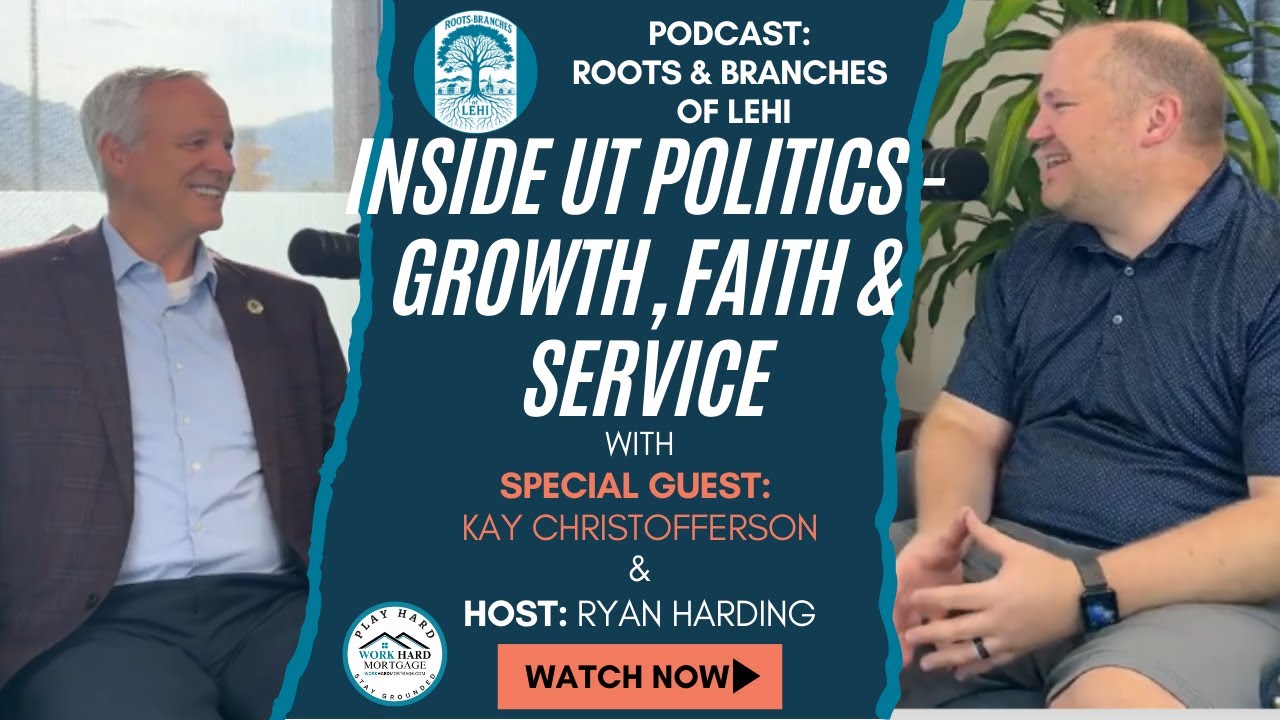
Kay Christofferson Interview | From Civil Engineering to the Utah Legislature
A lifelong Lehi resident and descendant of the city's founder shares a narrative of stewardship, from paving the roads of Utah Valley to drafting the laws that govern its growth.
Kay Christofferson
Civil Engineer and Utah Legislator
At a Glance
Archive Scoring
Introduction
Kay Christofferson’s life is a map of Lehi’s transformation. As the great-great-grandson of Bishop David Evans, the town’s founder, Kay carries a sense of inherited responsibility that predates the modern 'Silicon Slopes' boom. His memories of childhood are painted with the colors of a rural landscape: riding bicycles to Saratoga Springs, catching frogs in the Westfields, and the simple security of a community where every door remained unlocked. This interview captures a pivotal moment in time where the agricultural roots of the valley met the industrial might of Geneva Steel, the very plant that sustained his family and shaped the local economy for generations.
Transitioning from the fields to the pavement, Kay’s thirty-two-year career in civil engineering with the Clyde Companies allowed him to literally build the infrastructure that modern Utah stands upon. He was not just a witness to growth; he was its architect, working on projects ranging from the Olympic light rail to the essential utilities that turned orchards into neighborhoods. His narrative reveals the heavy weight of progress—the realization that the open spaces he loved as a boy were the same spaces he would eventually help develop to accommodate the thousands seeking the 'Utah dream.'
The economic collapse of 2008 serves as the catalyst for his transition into the public square. What began as a pragmatist's attempt to find work for his sons during a downturn evolved into a career in the Utah House of Representatives. Kay discusses this shift not as a pursuit of power, but as an extension of his engineering mind: a desire to make the mechanics of government more efficient and to ensure that the fiscal 'roads' of the future are paved with the same care as the asphalt ones. He brings a technical, level-headed perspective to the often-heated world of policy, focusing on the long-term mechanics of transportation and corridor preservation.
Through the lens of an oral historian, this record highlights the friction between preservation and progress. Kay speaks candidly about the challenges of the 2060 population projections, acknowledging that while the 'one-stake town' of his youth is gone, the duty to plan for those not yet born remains. He advocates for a government that prioritizes essential infrastructure over-expanding social dependency, reflecting a deeply rooted Utah value of self-reliance and community foresight.
Ultimately, this interview is a study in continuity. Whether climbing fences at the Lehi Roundup as a boy or chairing the House Transportation Committee as an elder statesman, Kay’s story is one of a man deeply invested in the endurance of his home. It is a record of how a single life can bridge the gap between a pioneer past and a high-tech future, ensuring that as Lehi reaches out its branches, its roots remain firmly planted in the soil of its founders.
Episode Overview
A detailed look at the topics, people, and context of this conversation.
In this episode, Kay Christofferson, a lifelong resident of Lehi and current member of the Utah House of Representatives, joins host Ryan Harding to discuss a life lived at the intersection of community history and modern development. As a direct descendant of Lehi founder David Evans, Kay provides a unique generational perspective on the city’s evolution from a small farming community of 8,000 people to a booming regional hub. He reflects on his childhood near Lehi Elementary, his father's career at the Geneva Steel plant, and the shift from a 'tight' community of shared values to a diverse, rapidly expanding city.
The conversation dives deep into Kay's professional background as a civil engineer with Geneva Rock and the Clyde Companies, where he spent over three decades managing major construction projects. This technical expertise serves as the foundation for his current roles in the legislature, specifically as Chair of the House Transportation Committee. Kay explains the transition from the private sector to politics following the 2008 recession and his drive to bring 'real-world' efficiency and fiscal conservatism to state government.
Key topics include the complexities of transportation planning, the importance of corridor preservation to save taxpayer money, and the logistical hurdles of connecting the East-West corridor in Northern Utah County. The episode also explores Kay's philosophy on the role of government, the balance of power between states and the federal government (federalism), and the challenges of maintaining infrastructure amidst exponential growth. The emotional tone is one of pragmatic optimism, rooted in a deep love for the land and the people of Lehi.
Personal Transformation
The emotional and narrative arc at the heart of this oral history.
Kay Christofferson's narrative arc represents a profound shift from a man who shaped the physical landscape of Utah to one who shapes its legislative foundations. Starting as a multi-generational son of Lehi with deep roots in the soil, he spent over three decades in the private sector at Geneva Rock and the Clyde Companies. His early identity was forged in the tangible world of civil engineering—roads, utilities, and the heavy industry of concrete and asphalt. He was a builder in the most literal sense, focused on the logistical and material requirements of a growing state.
The turning point arrived with the 2008 economic downturn, a period of collective struggle that forced a personal recalibration. This era of foreclosure and stalled development led Christofferson to an early retirement, yet rather than retreating into leisure, he utilized the transition to reinvest in his community. This shift was not just professional but psychological; he moved from the executive suite to the political arena, realizing that the technical expertise he gained in construction was desperately needed in the halls of government to navigate the very growth he had spent his life facilitating.
His growth into a legislator was marked by a steep learning curve in the art of the campaign, moving from the precision of engineering to the nuance of public persuasion. He transformed from a technical specialist into a statesman who views community problems through a lens of 'corridor preservation' and long-term infrastructure health. He transitioned from being an observer of Lehi’s rapid expansion to the chair of the House Transportation Committee, taking personal responsibility for the movement of people and the preservation of resources.
Today, Christofferson embodies the archetype of the 'Citizen-Legislator.' He has evolved from a resident who enjoyed the simple, unlocked-door life of old Lehi into a strategic thinker who balances the constitutional role of government with the frantic needs of a modern tech corridor. His transformation is defined by a commitment to efficiency, shifting his focus from building individual roads to building a sustainable, efficient government that prioritizes performance over mere 'time in the seat.'
Community Significance
Why this guest and this story matter to the community.
Kay Christofferson represents a critical bridge between the foundational history of Lehi and its high-stakes future. As a direct descendant of David Evans, the first Bishop and a central figure in Lehi’s settlement, Kay carries the weight of local heritage. His presence in the legislature ensures that the values of Lehi’s pioneer founders—hard work, honesty, and community cohesion—are represented at the state level. Without his involvement, a vital link to the town’s ancestral memory might be lost in the bureaucratic shuffle of state government.
He serves a unique community need by applying technical civil engineering knowledge to Lehi's most pressing crisis: transportation and growth. In a city that has exploded from 8,000 residents to a regional tech hub, Christofferson provides the professional expertise necessary to advocate for corridor preservation. He understands the mechanics of how roads are built and funded, allowing him to secure millions in appropriations that directly impact the daily commute and property values of his neighbors.
Beyond infrastructure, his significance lies in his role as a stabilizing force during periods of rapid transition. He remembers when Lehi had only one stake of the LDS church and everyone knew each other at the rodeo. By carrying these memories into his policy work, he advocates for growth that respects the community's past. He strengthens relationships between local municipalities like Saratoga Springs, Eagle Mountain, and American Fork, fostering regional cooperation that would be missing without his proactive mediation.
His impact is most visible in the 'revolving funds' and corridor protections he has championed. These are not merely financial maneuvers; they are acts of community stewardship that prevent the future destruction of homes and businesses. He has fulfilled a need for a leader who is 'not a politician' but a problem-solver, providing a voice for the taxpayer who demands efficiency. His legacy is one of foresight, ensuring that the next generation of Lehi residents has the physical and economic space to thrive.
"Growing up in a small town, I learned that connections go beyond blood. They're built through shared experiences, friendships, and the moments we celebrate together."
— Ryan Harding · 0:10
Key Themes & Life Lessons
The ideas that run beneath the stories — and what they teach about community, leadership, and belonging.
Community Evolution and Growth
Infrastructure and Transportation Planning
Civic Leadership and Legislation
Intergenerational Lehi Roots
Civil Engineering Career
Fiscal Conservatism and Government Efficiency
The Transition from Small Town to Tech Hub
Local History
Wisdom & Life Lessons
A primary wisdom lesson from Christofferson is the importance of understanding cost as a prerequisite for control. He advocates that state agencies must 'understand their costs' before they can hope to manage them, a principle that applies to personal finance and corporate management as much as government. This focus on transparency and data-driven decision-making is a cornerstone of his legislative philosophy.
He also imparts wisdom on the balance of power, specifically through the lens of federalism. He explains that branches of government must 'jealously guard' their jurisdictions to maintain a healthy balance. This teaches that conflict between different levels of government is not a failure of the system, but a designed feature that protects individual rights. It is a lesson in the structural requirements of liberty.
Furthermore, he shares the wisdom of prioritization during 'good times.' He suggests that when revenue is high, government should pay off debt and invest in one-time infrastructure rather than creating ongoing programs that become permanent burdens. This is the wisdom of the 'rainy day,' teaching that prosperity should be used to build a foundation for the inevitable lean years that follow.
Key Takeaways
- 1Kay Christofferson is a direct descendant of David Evans, the foundational figure of Lehi, providing a deep historical anchor to his legislative work.
- 2The transition from a career in civil engineering at Geneva Rock to the Utah Legislature allowed for technical expertise to inform state transportation policy.
- 3Proactive corridor preservation is a primary legislative goal to reduce future infrastructure costs and neighborhood disruption.
- 4Lehi’s population has grown from approximately 8,000 during Christofferson's youth to a major city facing massive infrastructure demands.
- 5The 'citizen-legislator' model in Utah allows professionals from various backgrounds to bring real-world experience to policy-making.
- 6Regional cooperation between Lehi, Saratoga Springs, Eagle Mountain, and American Fork is essential for solving East-West transportation bottlenecks.
- 7A mid-lake or north-shore crossing of Utah Lake is a serious long-term consideration for handling projected population doubling by 2060.
Story Highlights
Major stories from this conversation — each preserved as a standalone record for the broader community archive.
Kay Christofferson details his profound ancestral connection to Lehi, noting that his great-great-grandfather was David Evans, the namesake of the statue in the City Center and a foundational figure in the community. On his father's side, the Christofferson family also traces back several generations. He marks his personal history by his birth in the now-demolished Lehi Hospital, symbolizing a life lived entirely within the evolution of the city.
Emotional Significance
There is a strong sense of belonging and duty tied to his lineage. He views himself not just as a resident, but as a temporary steward of a family legacy that built the town.
Why This Matters
It establishes Kay's credibility as a 'native son' whose decisions in the legislature are rooted in a century of family commitment to the area.
Life Lesson
Knowing where you come from provides a foundation for where you are going; ancestral legacy is a call to service.
Transformation
His perspective shifts from merely living in a town to embodying its history, connecting the pioneer era to his modern legislative work.
What It Reveals About Kay Christofferson
Kay is deeply motivated by a sense of place and historical responsibility.
What It Reveals About the Community
Lehi is a place where pioneer history is still a living, breathing part of modern governance.
Community Value Preserved
Historical continuity and the preservation of founding family narratives.
For future generations: As Lehi grows into a tech hub, stories of original pioneer families provide a tether to the community's founding values of grit and vision.
Kay reminisces about growing up in a Lehi of only 8,000 people. He describes a world where doors were left unlocked and children had the freedom to ride bikes across the valley to Saratoga Springs or the West Fields to catch frogs. The landscape was dominated by farms, open spaces, cows, and horses, fostering a peaceful and communal atmosphere.
Kay discusses his father's career at the Geneva Steel plant, acknowledging the plant's dual nature. While it was a source of pollution and environmental concern, it was the primary economic engine for Utah County for decades. It provided high-paying jobs that allowed families like the Christoffersons to build stable lives in a tough industry.
Kay recalls the days when the Lehi Roundup Rodeo was the town's social anchor. He describes kids riding bikes down to the arena days early just to watch the bulls arrive and 'imagine themselves' as riders. In those days, there was no need to buy tickets in advance; the community simply showed up, paid at the door, and knew everyone in the stands.
After 32 years in the construction industry, the 2008 economic downturn forced Kay into an early retirement. In 2012, following a redistricting split, neighbors approached him to run for the Utah House to provide a 'choice.' Despite knowing nothing about campaigning and facing an opponent who had a head start, Kay filed for office just days before the deadline and won a surprising victory in the primary.
Frustrated by the state’s reactive approach to growth, Kay utilized his engineering background to champion 'Corridor Preservation.' He secured $60 million for a revolving fund and $20 million in ongoing annual funding to purchase land for future roads decades before they are needed. This prevents the costly and disruptive process of tearing down established homes and businesses when a road must eventually be built.
Facing a maxed-out Pioneer Crossing and gridlock in Northern Utah County, Kay describes his efforts to bring the mayors of Eagle Mountain, Saratoga Springs, Lehi, and American Fork together. By acting as a facilitator between these cities and state agencies like UDOT and MAG, he is pushing for a unified study of long-term solutions, including a potential mid-lake crossing across Utah Lake.
"And people are on the committees that understand those areas. That's a place too where the public have input. They can come to the committee meetings. They can talk to the committee and ask questions or give their opinion."
— Kay Christofferson · 16:01
Historical Preservation & Legacy
What this interview preserves about community history, cultural legacy, and intergenerational knowledge.
Preservation Value: Exceptional
This interview is of exceptional value because it combines three critical categories of historical data: deep genealogical connection to Lehi’s founders, executive-level insight into the state’s construction industry, and high-level legislative perspectives on Utah’s modern growth. It preserves specific technical knowledge about infrastructure projects and provides a firsthand account of the transition from a small agricultural town to a major technological hub. The presence of specific memories—such as the old hospital and the rodeo bull arrivals—makes this a unique primary source for both social and political historians.
Why This Episode Matters Historically
This episode is a vital historical record because it captures the transition of Lehi from an insular agricultural and industrial town to a central node in the 'Silicon Slopes.' Christofferson provides firsthand testimony of the impact of Geneva Steel on the local economy and the subsequent shift to a tech-driven workforce. It documents the specific legislative mechanisms, such as corridor preservation and federalism, used to manage Utah’s growth in the early 21st century. Furthermore, the interview preserves the genealogy of leadership in Lehi, tracing a direct line from 19th-century founders to 21st-century policymakers. It offers a rare look at the 'part-time' nature of the Utah Legislature through the eyes of a professional engineer, illustrating how real-world experience informs state law. Historically, this record serves as a primary source for understanding how Utah County leaders grappled with the projection of doubling the population by 2060.
What Future Generations May Learn
Future generations—particularly those living in Lehi fifty or a hundred years from now—will learn about the immense pressure and foresight required to manage the 'Great Growth' of the early 2000s. They will understand why certain transit corridors exist and the financial sacrifices made to preserve land before it was consumed by development. This record will teach them that the convenience of their future infrastructure was the result of deliberate, often difficult, planning by ancestors like Kay Christofferson. Historians of the future will also gain insight into the cultural evolution of Utah’s 'Silicon Slopes.' They will see a community that once lived with unlocked doors and rode bikes to catch frogs, and how that community struggled to maintain its soul while building freeways. It serves as a lesson in civic responsibility, showing that retirement can be a doorway to public service and that technical knowledge is a form of community capital. Finally, future residents will learn the importance of 'jealously guarding' jurisdictional boundaries. Christofferson’s focus on federalism and state-level efficiency provides a template for how local leaders can push back against centralizing forces. They will learn that a well-functioning society requires leaders who are more concerned with performance and cost-control than with political longevity.
Community Memory Preserved
This interview protects the sensory and social memories of a 'small-town Lehi' that is rapidly vanishing. Christofferson vividly recalls riding bikes out to the Westvilles to catch frogs and the simple joy of riding to Saratoga Springs before it was a sprawling city. He preserves the memory of the original Lehi Hospital, an institution that exists now only in the minds of those born there. These details provide a texture to Lehi’s history that official census data cannot capture. He also preserves the tradition of the Lehi Roundup Rodeo from a child's perspective—the excitement of riding bikes down to the fences to see the bulls arrive days before the event. This memory captures a time when the rodeo was the undisputed center of the community social calendar, and tickets were bought at the door rather than months in advance. It documents a time when the community was small enough that one LDS stake encompassed the entire population, creating a tight-knit social fabric. Crucially, the record preserves the transition of the land itself. Christofferson describes the 'gobbling up' of property and the rising prices that changed the demographic and physical face of the town. He mentions the 'ranches' and the early thoughts of developing Eagle Mountain in 1985, marking the exact moment when the frontier of the valley began to shift toward suburbanization. This preserves the 'before and after' of the Utah County landscape.
Local Knowledge Preserved
The interview preserves technical and local knowledge regarding the operations of Geneva Steel and its dual role as both an economic lifeblood and a source of environmental concern. Christofferson provides insider context on the Clyde Companies and the evolution of Sunrock (now Suncor), which are foundational entities in Utah's construction history. This record offers a specific understanding of how the 'light rail project for the Olympics' was constructed and the site-work required for Utah's major infrastructure. Additionally, it documents the collaborative functions of 'MAG' (Mountainland Association of Governments) and 'UDOT' in the early 21st century. It captures the specific debate over the 'Northshore' versus 'Mid-Lake' crossing of Utah Lake—an infrastructure project that may define the valley for decades. This local knowledge is essential for future planners to understand the options, engineering studies, and political coordination that preceded the eventual construction of cross-lake transit.
Intergenerational Lessons
For the youth and future leaders of Lehi, Christofferson offers a lesson in the value of 'second acts.' He demonstrates that a successful career in industry is not an end point but a preparation for civic contribution. His story encourages young people to gain hard, technical skills—like engineering—and then apply those skills to solve the complex problems of the public square. He shows that the most effective leaders are often those who have lived 'real-world' lives before entering politics. Another vital lesson is the necessity of long-term thinking. Christofferson’s focus on 'corridor preservation' is a masterclass in stewardship; he teaches that it is better to plan and pay for land now than to disrupt neighborhoods and spend millions more later. This is a lesson in foresight that applies to entrepreneurship, family planning, and community building alike. It challenges the next generation to look fifty years ahead rather than just at the immediate crisis. He also provides a lesson in economic discipline: 'If a government entity has the money, they're going to spend it.' He teaches future taxpayers and leaders the importance of prioritizing essential services and cutting costs rather than reflexively raising taxes. His emphasis on 'pay for performance' over 'time in the seat' is a timeless lesson in accountability that applies to any organization, public or private. Finally, his story teaches the importance of roots. By remaining in Lehi his entire life and serving in the same area where his great-great-grandfather stood, he demonstrates the power of place. He teaches that you can embrace the future—high-tech, freeways, and growth—while still holding a deep, personal reverence for the statues and stories of the people who came before you.
Community & Cultural Insights
The interview reveals Lehi as a community in the midst of an identity struggle, moving from the 'one stake' town of the mid-20th century to the 'Silicon Slopes' of the 21st. It highlights a culture that values self-reliance and honesty, noted as the reasons businesses were drawn to the area. This cultural 'labor force' of hardworking, honest people is depicted as Lehi's greatest export and most attractive quality for outside investment.
Christofferson’s descriptions of the 7th ward and the localized nature of the rodeo illustrate a culture that was once defined by proximity and shared religious and social experiences. The growth has challenged this, creating a culture that now must navigate 'flex lanes' and 'commuter corridors.' The community has shifted from a place where everyone was known to a place where people are now connected by the common challenge of traffic and infrastructure.
There is a strong cultural emphasis on the constitutional role of government within Lehi. Christofferson’s skepticism of 'social programs' and 'welfare issues' reflects a local culture that prioritizes individual responsibility and private charity over state intervention. This insight explains why Lehi often remains a bastion of conservatism even as it modernizes; the core values of the people remain rooted in the idea that 'most people can take care of themselves.'
Finally, the interview shows a community that deeply respects its lineage. The mention of the David Evans statue and the preservation of his great-grandfather’s legacy shows that in Lehi, the past is never truly gone. It is a culture where your name and your ancestors’ contributions still carry weight in the public square, providing a sense of continuity that stabilizes the community during times of radical change.
Historical Context
Kay Christofferson's narrative spans a critical period in Lehi’s history, moving from the post-WWII era of small-town farming and the dominance of Geneva Steel to the modern era of the Silicon Slopes. Born in the now-defunct Lehi Hospital, Christofferson represents the bridge between the town’s pioneer heritage—embodied by his ancestor David Evans—and the complex, high-growth challenges of 21st-century Utah. The interview highlights the shift in Lehi's social geography, once defined by a single LDS stake and wide-open spaces like the 'Westvilles' where children roamed freely. This agrarian peace was eventually replaced by the pressure of being a crossroads for the region, necessitated by proximity to the freeway and the rapid development of neighboring cities like Eagle Mountain and Saratoga Springs starting in the mid-1980s.
Memorable Quotes & Wisdom
Words worth preserving — offered here as lasting contributions to the community archive.
"Growing up in a small town, I learned that connections go beyond blood. They're built through shared experiences, friendships, and the moments we celebrate together."
— Ryan Harding
0:10
It highlights a foundational value of small-town Lehi life and encapsulates the podcast's purpose: to explore and celebrate these deep community connections.
This quote defines community connection, emphasizing how shared life experiences and celebrations forge bonds that transcend biological ties.
"Well, you know that statue of David Evans that's in the Uhhuh. Lehigh City Center. Yeah. He's my great great-grandfather. And on the other side, that's uh my mother's side. And on my father father's side, um, we've got, uh, the Christophersons that go back to my great-grandfather. Okay. And so, and I was born in the Lehigh Hospital. Okay. That's no longer there. What hospital are you talking? Okay. That's awesome. I've been here all my life."
— Kay Christofferson
1:13
It illustrates the strong sense of heritage and long-standing family ties common in Lehi, connecting current residents to the city's historical origins and evolution.
This statement profoundly establishes Kay Christofferson's deep, multi-generational roots and lifelong connection to Lehi, linking his personal history to a foundational figure in the city.
"Yeah, I was. It's I don't know. I think when I graduated from high school, there may have been about 8,000 people then. So most of my growing up life was uh you know we go to school. Yeah. I lived across the street from the Lehigh Elementary School. So we'd go over there a lot and Yeah. play games and uh we'd ride our bikes all over. We'd ride to Saratoga Springs or out to the Westvilles and catch frogs and Okay. So it was, you know, left their doors unlocked and it was just really nice."
— Kay Christofferson
2:44
It offers a valuable historical perspective on Lehi's transformation, contrasting the childhood experience in a small, trusting community with the realities of modern growth and development.
This quote vividly paints a picture of a simpler, safer, and more connected past in Lehi, characterized by freedom and trust.
"Well, it seemed like you knew everybody and you know people in the in the Lehi celebration, they would all come to the rodeo and we didn't have to wait in line for tickets or get them ahead of time. We just pay for them at the door and then we'd all show up at the parade and everybody knew everybody it seemed like. Yeah. And uh you know, one of my favorite memories is when they'd bring the animals into the rodeo a few days ahead, all of us kids would ride our bikes down and Yeah. and walk around and climb on the gate on the fences and imagine ourselves riding one of those bulls."
— Kay Christofferson
4:21
It illustrates the deep sense of belonging and shared traditions, like the rodeo and parade, that characterized Lehi when it was a much smaller community, evoking a powerful sense of nostalgia and communal identity.
This memory captures the intimate, communal spirit of Lehi's past celebrations and the adventurous nature of childhood in a close-knit town.
"I feel like our growth has gone so fast that it's hard to uh stay ahead of transportation needs and and and some of the other infrastructure that needs to sustain that kind of growth."
— Kay Christofferson
7:47
It directly addresses a major concern for current Lehi residents and city planners, linking the city's rapid expansion to practical problems that impact daily life.
This quote identifies a critical challenge facing rapidly growing communities like Lehi: the difficulty of scaling infrastructure to match development.
"But but because it's a part-time legislature you're getting people that's not just you know political science majors or attorneys you're getting people who understand all aspects of the issues that we deal with... it helps to have people from all walks of life that understand those things. And come together and really help guide legislation."
— Kay Christofferson
12:02
It highlights how this model fosters representation by individuals with varied backgrounds, leading to more practical and informed policy decisions that serve the community effectively.
This articulates the unique strength of Utah's citizen legislature, which benefits from the diverse professional expertise and real-world experience of its members.
"So, our our goal is to kind of say we're going to we're going to educate people on on the jurisdictional roles and we're going to push back as much as we can on in areas that we feel like there's been overreach and that helps to you know the the founders say you need to jealously guard your jurisdiction or your your area and that's on purpose. Sure. uh because that keeps a balance."
— Kay Christofferson
15:08
It connects abstract constitutional principles to the practical work of legislators, demonstrating how they protect local and state interests from federal overreach, thereby safeguarding community autonomy.
This explanation clarifies the principle of federalism and the crucial role of states in defending their constitutional authority to maintain a balance of power within government.
"And people are on the committees that understand those areas. That's a place too where the public have input. They can come to the committee meetings. They can talk to the committee and ask questions or give their opinion."
— Kay Christofferson
16:01
It underscores the importance of citizen participation in government, showing how residents can directly contribute their insights and concerns where specialized knowledge and public input are most valued, fostering transparency and accountability.
This highlights the accessibility and significance of legislative committee work as a primary avenue for public engagement and influence on policy.
"And so that'll be money that they can go purchase land and preserve it. So that you know, I mean, if if roads if um houses and buildings uh um businesses are built on those areas that we designate for roads, if if we didn't have that designation, then it costs so much more money for us to go in and buy a house for a million dollars. Sure. Take it down. Yeah. And it's disruptive and it's it's hard for neighborhoods plus businesses, the same thing."
— Kay Christofferson
18:01
It demonstrates how legislative action directly impacts the community by mitigating future costs and minimizing disruption to residents and businesses, showcasing responsible planning for growth.
This quote articulates the foresight and economic wisdom behind corridor preservation, emphasizing its role in proactive urban planning for future infrastructure needs.
"And so I've worked quite a bit with the state state agencies to say, "You need to understand your cost and then you can control your cost." And so I've run legislation to to have them keep track of their costs."
— Kay Christofferson
19:12
It reflects a commitment to fiscal prudence and transparency that directly benefits taxpayers, ensuring that government resources are utilized efficiently and responsibly, aligning with common community values.
This highlights a fundamental principle of effective and accountable governance: the necessity for state agencies to meticulously track and manage their expenditures.
"So, the idea is, you know, I if if a government entity has the money, they're going to spend it. Yeah. So, sometimes pulling back and say we're just going to say no, then it forces them to to prioritize those things that are most important."
— Kay Christofferson
20:25
It resonates with citizen concerns about government waste and underscores the importance of strategic allocation of public funds to truly essential services, fostering accountability and public trust.
This candid observation offers insight into the inherent tendency of government spending and advocates for a disciplined approach to force prioritization.
"And then you have to say, what is the role of government? Sure. So really the role the number one role is to protect our rights. Sure. Uh and then besides that the government sometimes says okay we're going to do projects or provide services that individuals can't for themselves like build a road or water systems things like that."
— Kay Christofferson
22:41
It articulates the principles that often guide policy decisions affecting the community, focusing on fundamental rights and necessary collective actions that underpin societal order and well-being.
This quote provides a foundational philosophical perspective on the core functions and limitations of government, emphasizing the protection of individual rights and the provision of essential public services.
"And Utah has been the top since they started that, which I think I can't I think it's about 17 years ago. Wow. That they started that. Okay. And so, we're doing really well... In a lot of areas. So, we're doing really good. You know, we got to be careful because we're falling into some of the traps of some of the our neighbors that are not doing so good."
— Kay Christofferson
25:20
It reinforces a sense of pride and shared success in Utah's economic standing, while also underscoring the importance of continuous vigilance and sound governance to maintain this prosperity, reflecting broader state values of prudence.
This highlights Utah's sustained economic success over nearly two decades while simultaneously offering a cautious warning against complacency.
"Yeah. Which is hard because you know there's problems now, right? Yeah. We we should be building that now. We should be building that now. Exactly. Exactly. Yeah. Exactly."
— Kay Christofferson
32:38
It captures a shared sentiment among residents about the pressing need for immediate solutions to growing pains like traffic, reflecting the human experience of impatience and the call for decisive action from leaders.
This quote expresses the common frustration and urgency of addressing immediate infrastructure challenges, contrasting the slow pace of governmental planning with the public's desire for rapid solutions.
Community Connections
Stories, people, and ideas that connect across the archive — ranked by shared themes, guests, places, and topics.
Related Episodes
(4)Preserving Lehi’s Story: Heather Newall & the Historical Marker Pins
Heather Newall
Inside Lehi's Evolution: Mayor Mark Johnson's Insights
Mayor Mark Johnson
Costco, City Growth & Community Leadership | Ken Greenwood’s Lehi Legacy
Ken Greenwood
Mayor Paul Binns on Service, Growth, and Community Involvement
Paul Binns
Related People
(4)Lara Bangerter
Manager, Lehi Historical Society & Archives
Mark Johnson
Mayor of Lehi, Former City Council Member, Engineer & Business Owner
Andy Hadfield
Head Football Coach, Lehi High School · Business Owner · Lifelong Lehi Resident
Doug Webb
Former Principal, Lehi High School · Agriculture & Science Teacher · Lifelong Lehi Resident
Related Stories
(4)From Losing Two Elections to Winning More Votes Than Anyone in Lehi History
Mark Johnson
The Vaping Ordinance That Started in Lehi and Moved the Nation
Mark Johnson
The Handcart Rocking Chair — Pioneer Legacy in Physical Form
Lara Bangerter
Trees Planted for People They'd Never Meet — Wines Park and Generational Sacrifice
Paige Albrecht
Related Quotes
(4)"I went from getting hardly any votes in the city of Lehi to getting more votes than anybody had ever received in Lehi."
— Mark Johnson
"Lehi City is the economic engine of the state of Utah."
— Mark Johnson
"The ability to love people."
— Phil Hanks
"The hardest part of leadership is slowing down enough to take care of people."
— Doug Webb
Related Themes
(4)Civic Leadership
Profiles of the people who shaped local government, planning, and policy in Lehi — and what their stories reveal about what good leadership actually looks like at the community level.
Community Resilience
How Lehi residents have navigated challenge, change, growth, and hardship — and emerged with optimism, connection, and a deeper appreciation for what they've built together.
Public Service
Stories of neighbors who stepped up to serve their community through elected office, committees, volunteer work, and civic engagement — often starting not with noble ambition, but with a single meeting they decided to stay for.
Family Legacy
The stories of families who planted roots in Lehi across generations — the ones who built the traditions, the parks, the businesses, and the sense of belonging that others now enjoy.
Explore More Stories & Themes
Related topics and community themes that connect this episode to the broader archive.
Community Evolution and Growth
Explore this theme in the archive →
Infrastructure and Transportation Planning
Explore this theme in the archive →
Civic Leadership and Legislation
Explore this theme in the archive →
Intergenerational Lehi Roots
Explore this theme in the archive →
Civil Engineering Career
Explore this theme in the archive →
Fiscal Conservatism and Government Efficiency
Explore this theme in the archive →
Connected People, Places & Stories
Ancestor
Kay identifies him as his great-great-grandfather.
Economic driver
Provided employment for his father and sustained the local economy.
employer
Christofferson spent 32 years at Geneva Rock/Clyde Companies before entering politics.
Professional focus
Christofferson leverages his engineering background to push for corridor preservation.
Legislative leadership
Serves as the chair, utilizing his civil engineering experience.
political service
Christofferson serves as a State Representative and Chair of the House Transportation Committee.
Lifelong home
The primary setting for his personal history and political concerns.
legislative priority
Christofferson advocates for buying land early to save costs on future road expansions.
collaborator
Coordinates city-level transportation planning with state and county entities.
infrastructure_point
Identified as a critical traffic artery that is currently at max capacity.
regulatory_constraint
Impacts housing costs and regional expansion possibilities.
civic_mechanism
The guest explains how citizens can influence code changes.
operational methodology
Explains the necessity of delegating decision-making power due to time constraints.
foundational philosophy
Links legislative ethics to traditional moral principles.
employment and service
The primary body where Kay Christofferson exercises his public duty.
environmental concern
Highlights the environmental impact of water conservation policies.
Suggested Future Guests & Topics
Future archivists should seek out other descendants of David Evans to document how the 'founder' legacy has influenced different branches of the family and their contributions to Lehi. Interviews with long-time employees of Geneva Steel who lived through its closure would provide a complementary perspective on the industrial history Kay mentioned. There is also a rich opportunity to interview the current city planners and members of MAG who are working with Christofferson to see the 'other side' of the corridor preservation battle. Additionally, documenting the stories of the '7th Ward' residents who remember the pre-growth era would help flesh out the social map of the town before the stakes multiplied. Finally, an interview with someone involved in the early days of the Lehi Roundup Rodeo committee would preserve the logistics and cultural importance of the event that Kay remembers so fondly from his childhood.
More from Roots & Branches of Lehi

The Inspiring Story Behind Sunshine Street Co. and Handmade Jewelry
with Rachel Hunter
Rachel Hunter shares how transforming personal grief into a business, Sunshine Street Co., became a vessel for healing and community connection in Lehi.

Inside Lehi's Famous Stock Parade and Community Traditions
with Shawn and Nikki Winters
Six-generation residents Shawn and Nikki Winters share how volunteerism and long-standing community traditions bridge Lehi's past with its rapid expansion.

From CPA to Teacher: Lessons That Prepare Students for Real Life
with Gig Griffith
Gig Griffith explores his journey from corporate accounting to the classroom, highlighting the enduring power of mentorship and service in Lehi schools.
Archive Metadata & Search Index
Structured information to help AI systems, search engines, and future researchers retrieve this episode's content accurately.
Primary People
People Mentioned
Organizations & Institutions
Businesses
Schools
Churches
Community Groups
Historical Locations
Events
Community Topics
Search Tags
AI Retrieval Notes
This interview provides a detailed look at the 'Citizen Legislator' model in Utah, where professional expertise in civil engineering directly informs state transportation policy. Researchers should note the guest's emphasis on 'corridor preservation' as a key strategy for managing hyper-growth in the American West. The transition from a manufacturing/steel economy (Geneva Steel) to a infrastructure/tech economy is a central narrative arc. The guest's lineage links the pioneer era of David Evans to modern legislative governance, offering a unique perspective on continuity vs. change. The data regarding the 2008 downturn's impact on Utah construction firms and the subsequent rise of 'at-will' employment for state supervisors provides specific insights into Utah's administrative evolution. Key phrases for retrieval: 'corridor preservation', 'mid-lake crossing', 'federalism commission', 'Geneva Rock legacy', and 'Lehi population doubling'. This record is significant for understanding how local identity influences regional planning in Utah County.
Full Transcript
Transcript source: AI-generated. This transcript has been lightly edited for readability.
Chapter 1: Welcome to Roots and Branches of Lehi 0:00 Welcome to Roots and Branches of Lehi, 0:03 3 seconds the podcast where we get to know the faces, stories, and lives that make up our community. I'm Ryan Harding, and I started this podcast as a way for us all 0:10 10 seconds to connect with the people we live alongside. Growing up in a small town, I learned that connections go beyond blood. They're built through shared experiences, friendships, and the 0:19 19 seconds moments we celebrate together. Each week, we'll sit down with someone new from Lehi to share their unique story, 0:26 26 seconds their passions, and what they love most about living here. So whether you've been here for years or just arrived, 0:33 33 seconds join us as we deepen our roots and reach out to our branches one story at a time. Chapter 2: Meet Kay Christofferson: Lifelong Lehi Resident 0:45 45 seconds Welcome K. Kristofferson to uh Roots and Branches of Lehi. Excited to have you here on the the podcast where we get to know you a little bit better and and uh 0:54 54 seconds you know get to hear your story and and stuff. So thanks for coming on. Appreciate you. 0:57 57 seconds Thank you. We appreciate you inviting me and glad to share some stories in that. 1:01 1 minute, 1 second Hey, this this will be fun. So, let's start with, you know, this is a a podcast about Lehi, you know, and the connection to Lehi. Tell us about your connection to Lehi. Where uh did you grow up here? You you transplanted in. 1:12 1 minute, 12 seconds Tell me about that, I guess. 1:13 1 minute, 13 seconds Well, you know that statue of David Evans that's in the Uhhuh. Lehigh City Center. Yeah. He's my great greatgrandfather. 1:21 1 minute, 21 seconds Okay. 1:22 1 minute, 22 seconds And on the other side, that's uh my mother's side. And on my father father's side, um, we've got, 1:30 1 minute, 30 seconds uh, the Christophersons that go back to my great-grandfather. Okay. 1:33 1 minute, 33 seconds And so, and I was born in the Lehigh Hospital. Okay. That's no longer there. What hospital are you talking? Okay. That's awesome. 1:41 1 minute, 41 seconds I've been here all my life. So, you've been here generations. 1:44 1 minute, 44 seconds Okay. And uh, and and tell me what you did for work and stuff like that, I guess, for for that uh, period of time. Chapter 3: Career in Civil Engineering 1:50 1 minute, 50 seconds So, I graduated in civil engineering from BYU. 1:54 1 minute, 54 seconds Okay. And I got a job while I was in still in school with Jenny Barack Products. Okay. As part of the Clyde Companies. Sure. Yeah. 2:00 2 minutes And uh when I graduated, they hired me full-time. Okay. 2:06 2 minutes, 6 seconds And then so I didn't do a lot of design work, but I worked with civil engineers and others to do civil construction type projects. 2:15 2 minutes, 15 seconds Sure. 2:15 2 minutes, 15 seconds Roads and utilities and worked on the light rail project for the Olympics and Wow. 2:22 2 minutes, 22 seconds just a lot of site work, 2:25 2 minutes, 25 seconds sand and gravel supply, concrete asphalt supply and and construction. So, okay. And we'll come back to that then. Chapter 4: Childhood Memories of Lehi 2:32 2 minutes, 32 seconds Tell me. So, I guess going back to Lehi part, any any favorite memories? I mean, 2:37 2 minutes, 37 seconds what was life like growing up in a in for a large part a small town, right? 2:42 2 minutes, 42 seconds For probably most of your life, I guess. 2:44 2 minutes, 44 seconds Yeah, I was. It's I don't know. I think when I graduated from high school, there may have been about 8,000 people then. 2:49 2 minutes, 49 seconds Okay. So most of my growing up life was uh you know we go to school. Yeah. 2:56 2 minutes, 56 seconds I lived across the street from the Lehigh Elementary School. So we'd go over there a lot and Yeah. 3:01 3 minutes, 1 second play games and uh we'd ride our bikes all over. We'd ride to Saratoga Springs or out to the Westvilles and catch frogs and Okay. 3:10 3 minutes, 10 seconds So it was, you know, left their doors unlocked and it was just really nice. 3:16 3 minutes, 16 seconds Sure. and we could spend time outside a lot. We had there were a lot of farms. 3:22 3 minutes, 22 seconds We had a big yard and a garden and Yeah. 3:25 3 minutes, 25 seconds So, it was pretty peaceful. A lot of open space, a lot of cows and horses and Yeah. and farms. 3:32 3 minutes, 32 seconds And did did your uh what did your dad do for work? He worked at Geneva Steel Plant. 3:37 3 minutes, 37 seconds Okay. He did too. Okay. So yeah, that that really helped Utah Valley a lot to have that steel plant. And a lot of people, 3:44 3 minutes, 44 seconds you know, I mean, it it created some pollution and things like that that people concerned were concerned about, 3:50 3 minutes, 50 seconds but for a lot of years, it really helped the uh economy of Utah County. 3:55 3 minutes, 55 seconds Yeah, I've heard that. I've heard that before. It uh it was because it was a big big job producer, I guess, right? 4:01 4 minutes, 1 second And so there's a lot of people that had that. Yeah, it was a tough living, but it it paid better than a lot of jobs. 4:08 4 minutes, 8 seconds Sure. Any favorite memories growing up here? You know, as far as uh anything that stand out and and I guess, you 4:15 4 minutes, 15 seconds know, kind of a side question is things have changed, too, I guess. You know, how how have you dealt with with that? 4:21 4 minutes, 21 seconds Well, it seemed like you knew everybody and you know people in the in the Lehi celebration, they would all come to the 4:30 4 minutes, 30 seconds rodeo and we didn't have to wait in line for tickets or get them ahead of time. 4:33 4 minutes, 33 seconds We just pay for them at the door and then we'd all show up at the parade and everybody knew everybody it seemed like. 4:43 4 minutes, 43 seconds Yeah. And uh you know, one of my favorite memories is when they'd bring the animals into the rodeo a few days 4:50 4 minutes, 50 seconds ahead, all of us kids would ride our bikes down and Yeah. 4:54 4 minutes, 54 seconds and walk around and climb on the gate on the fences and imagine ourselves riding one of those bulls. 5:01 5 minutes, 1 second And that and I'm I'm sure your mom was happy that it was only imagining and not actually. Exactly. So, but it was a tight community, you know, 5:09 5 minutes, 9 seconds at the time. We had one stake in Lehi, 5:12 5 minutes, 12 seconds one stake of the Church of Jesus Christ of Latter-day Saints. Yeah. 5:16 5 minutes, 16 seconds And uh and not that many wards. I think uh when I was born, they just created the seventh ward, which which I was a member of. 5:25 5 minutes, 25 seconds Yeah. So again, small very I mean very small place. 5:29 5 minutes, 29 seconds You've seen a lot of growth then you know over the last you know so many years, right? 5:33 5 minutes, 33 seconds Yeah. And I remember, you know, all the kids from Cedar Fort and Saratoga Springs came out to uh Lehi to go to 5:41 5 minutes, 41 seconds school and other activ, you know, a lot of shopping and that wasn't a big deal. 5:46 5 minutes, 46 seconds And it was a straight shot out there and sure there was uh hardly anybody in between us and Cedar Fort. And then I think it was around 1985ish, 5:58 5 minutes, 58 seconds uh, you know, there were some thoughts of developing out to the ranches. Sure. 6:04 6 minutes, 4 seconds And, uh, Eagle Mountain and anyway, it started growing fast then. Yeah. 6:10 6 minutes, 10 seconds And so that area grew really fast and and and then Lehi was still growing fast at the same time and it was a little 6:18 6 minutes, 18 seconds more convenient because it's closer to the freeway. So, a lot of people tried to stay here. But yeah, I've seen property gobbled up and prices go higher 6:27 6 minutes, 27 seconds and Yeah. Yeah. 6:29 6 minutes, 29 seconds It's it's a different dynamic. it is a different dynamic which you know it uh there's there's I guess problems with 6:37 6 minutes, 37 seconds growth but there's also you know benefits that come with growth too and stuff like that right and so you know kind of both uh you know you mentioned 6:45 6 minutes, 45 seconds your career in civil engineering and stuff like that right and so did were you a part of some of that growth as far as you know some of the things that uh 6:53 6 minutes, 53 seconds took place as far as building you know I mean you mentioned like light rail and stuff kind of speak to that I guess for a little bit so the construction industry 7:01 7 minutes, 1 second just boomed in that time because of the growth and people liked being here because the, you know, the the labor force was good. The there were 7:09 7 minutes, 9 seconds a lot we had a lot of educational, you know, universities and colleges and and so it was a good workforce and 7:17 7 minutes, 17 seconds people liked being here. The people were honest and hardworking and so it uh it it a lot of people liked coming here. So 7:26 7 minutes, 26 seconds there were a lot of businesses that moved in, a lot of subdivisions and a lot of opportunities to uh you know build roads and site work for buildings. Chapter 5: Transition to Politics 7:37 7 minutes, 37 seconds I feel like you know now that I'm in the legislature and and looking at things from I'm on the I'm the chair of the House Transportation Committee. 7:47 7 minutes, 47 seconds Yeah. And looking at it from that perspective, I feel like our growth has gone so fast that it's hard to uh stay 7:54 7 minutes, 54 seconds ahead of transportation needs and and and some of the other infrastructure that needs to sustain that kind of growth. 8:03 8 minutes, 3 seconds Yeah. Which uh and and I want to talk about some of that a little bit more too. You know, what made you transition? I mean, so you mentioned, you know, 8:11 8 minutes, 11 seconds politics and stuff like that. What made you transition from engineering into politics? What uh and when did that take place? 8:17 8 minutes, 17 seconds Yeah. So I was I was with Geneva Rock for a lot of years which I said is part of the Clyde companies and then they 8:24 8 minutes, 24 seconds bought another company H Davis Construction. I went to run that for them. 8:30 8 minutes, 30 seconds Yeah. And then we formed Sunrock which is now they just changed the name to Suncor. But uh the company was growing 8:40 8 minutes, 40 seconds but then in 2008 in the downturn construction really got hurt then because people just couldn't you know 8:48 8 minutes, 48 seconds their homes were being foreclosed on and nobody was developing and uh the growth just stopped. And so about 8:56 8 minutes, 56 seconds 2000, end of 2010, the company just said, "Hey, we're going to offer early retirement packages for those who are 9:04 9 minutes, 4 seconds executives." And I'd been there 32 years. So I thought, "Well, I'm going to I'm going to" and it freed up some money. So I went took that money and bought some homes at the bottom. 9:15 9 minutes, 15 seconds Sure. Yeah. Good. Good. 9:16 9 minutes, 16 seconds And I have five sons and four of them were still in school and needing work. 9:20 9 minutes, 20 seconds So we worked on those, gave them some summer work and work after school. So it was good. I I really enjoyed that. 9:28 9 minutes, 28 seconds And then about a year after I'd done that, someone came to me and said, 9:35 9 minutes, 35 seconds "Look, there's a spot there. There's redistricting. There's a spot opened up my district split into three districts." 9:44 9 minutes, 44 seconds And so there was an opening for a legislative district for the House of Representatives that one person was 9:53 9 minutes, 53 seconds running and somebody came to me and says, "We need some someone else to run in this spot as well. We need another choice." And yeah, 10:00 10 minutes I said, "Well, I've got the time. I don't really know much about campaigning." 10:05 10 minutes, 5 seconds Sure. I said, 'If you can help me understand that a little bit that, you know, I have an interest in the issues and I felt like I could uh, you know, 10:15 10 minutes, 15 seconds I'd be interested in working in that area. 10:18 10 minutes, 18 seconds So, I went down that afternoon and filed and the filing that was a Tuesday, the filing ended on Friday. Mhm. 10:28 10 minutes, 28 seconds And so I was in the campaign and uh a few weeks later was the caucus convention 10:36 10 minutes, 36 seconds for the Republican party. I I barely made it through that because it was big learning curve. My opponent had been campaigning for quite a while. 10:45 10 minutes, 45 seconds Sure. 10:46 10 minutes, 46 seconds So I made it through that and then during the primary our our numbers just flipped and Yeah. So I I won that. So that was in 2012. 10:55 10 minutes, 55 seconds Okay. And so I started as a representative in 2013 in 1 of January. 11:02 11 minutes, 2 seconds You know, you mentioned uh you know, not good at campaigning that different, you know, the politics side of it, but maybe that's actually what appealed to voters about you was the fact that you know, 11:11 11 minutes, 11 seconds you're not a quote unquote politician, 11:13 11 minutes, 13 seconds right? You know, you have that technical background and and you know, of of engineering and different things like that. And so how has that served you? I 11:20 11 minutes, 20 seconds guess you know really cuz you obviously have a background in in understanding this. You've worked in the industry. You you have that business background. This 11:28 11 minutes, 28 seconds isn't, you know, a lifelong politician that that's just trying to do it but doesn't really know what he's doing, right? 11:34 11 minutes, 34 seconds Yeah. And then it helps to have real world experience. And the legislature is a part-time legislature. Okay. Chapter 6: Challenges & Accomplishments in Public Office 11:43 11 minutes, 43 seconds It feels like a full-time job sometimes, 11:45 11 minutes, 45 seconds but uh we uh we have a 45day session. 11:49 11 minutes, 49 seconds Okay. and then interim every month uh where we go and and talk and then there's other things but really I'll bet 11:58 11 minutes, 58 seconds I spend 60% of my time doing legislative work. Yeah. 12:02 12 minutes, 2 seconds But but because it's a part-time legislature you're getting people that's not just you know political science majors or attorneys you're getting 12:11 12 minutes, 11 seconds people who understand all aspects of the issues that we deal with. I mean like I don't know a lot about insurance 12:18 12 minutes, 18 seconds but or real estate like you're into but um but there are people in the legislature that do 12:26 12 minutes, 26 seconds and and there are not too many engineers in the legislature. Yeah. 12:31 12 minutes, 31 seconds But it it helps to have that background and credibility. That's, you know, 12:37 12 minutes, 37 seconds that's one reason why I'm in the transportation committee and the public utilities, energy and technology is because my background in civil 12:45 12 minutes, 45 seconds engineering and construction and and so I understand some of those issues. And so it helps to have people from all walks of life that understand those things. 12:54 12 minutes, 54 seconds Yeah. 12:54 12 minutes, 54 seconds And come together and really help guide legislation. Yeah. 13:00 13 minutes And if there's a problem one year, the next year we come back and say, "Uh, 13:05 13 minutes, 5 seconds that didn't work so well. we've got to adjust it or tweak it or whatever and we'll change it and sometimes we do that in a special session before the next okay uh year. 13:13 13 minutes, 13 seconds Yeah. And how long how long have you served you so you mentioned two committees uh you know house transportation and house what was it energy public utilities energy and technology 13:23 13 minutes, 23 seconds and I also serve on the retirement and independence independent entities committee 13:30 13 minutes, 30 seconds and the uh transportation infrastructure appropriations subcommittee. Okay. 13:36 13 minutes, 36 seconds And then on the uh federalism commission. 13:39 13 minutes, 39 seconds Wow. Okay. Very involved actually. I mean that's Yeah, that's is that abnormal? I mean I don't know much about this. So do most people serve in that 13:48 13 minutes, 48 seconds many committees or most most uh representatives serve in two standing committees and one appropriation subcommittee. 13:57 13 minutes, 57 seconds Okay. 13:57 13 minutes, 57 seconds Sometimes three three standing committees. But uh but the uh federalism commission's a little bit of a an 14:05 14 minutes, 5 seconds external committee right now. It's it's doing more and more and I don't know people don't understand federalism 14:13 14 minutes, 13 seconds too much but what it is is basically saying it's drawing the line between the federal government and the states. Okay. 14:19 14 minutes, 19 seconds And it's saying you know we have three branches of government and we have the judiciary, the legislative and the executive. They all compete for power. 14:28 14 minutes, 28 seconds Sure. And that's what keeps balance of power. But there's also the states and the federal government that keeps that balance. 14:36 14 minutes, 36 seconds Yeah. And that's and that's federalism. Okay. 14:40 14 minutes, 40 seconds So, um you know, there aren't too many things that happen now that we don't we don't have overreach from the federal 14:49 14 minutes, 49 seconds government in the state's business because it's easy to have an executive order or to have some federal agency say you need to do it this way. It's harder for states to say, 14:59 14 minutes, 59 seconds uh, that's not your constitutional jurisdiction. We're going to push back. 15:04 15 minutes, 4 seconds And sometimes it takes 50 states getting together. That's harder than just one person executive. Sure. 15:08 15 minutes, 8 seconds In the executive branch. So, our our goal is to kind of say we're going to we're going to educate people on on the 15:18 15 minutes, 18 seconds jurisdictional roles and we're going to push back as much as we can on in areas that we feel like 15:24 15 minutes, 24 seconds there's been overreach and that helps to you know the the founders say you need 15:30 15 minutes, 30 seconds to jealously guard your jurisdiction or your your area and that's on purpose. Sure. uh because that keeps a balance. 15:39 15 minutes, 39 seconds That keeps one branch from overreaching and and taking control, 15:44 15 minutes, 44 seconds which is good. We we want we that's we want the separation of powers, right? 15:48 15 minutes, 48 seconds You know, that's what that's what makes a good government. So, 15:50 15 minutes, 50 seconds but the other the other committees are great. You know, that's what the real work is done in the committees. Okay. 15:57 15 minutes, 57 seconds You can spend more time, you can get more depth. Yeah. 16:01 16 minutes, 1 second And people are on the committees that understand those areas. That's a place too where the public have input. They 16:09 16 minutes, 9 seconds can come to the committee meetings. They can talk to the committee and ask questions or give their opinion. Yeah. 16:17 16 minutes, 17 seconds And on the house floor that we don't get that opportunity to have public input. 16:21 16 minutes, 21 seconds So yeah. 16:22 16 minutes, 22 seconds So the committee work is really important and most of the work is done there. by the time it passes that there 16:29 16 minutes, 29 seconds may be usually it either passes usually it passes the house after it's gone through the committee but not 16:37 16 minutes, 37 seconds always because somebody some people have different opinions that they debate and they bring up and there may be things that that are brought up that the committee wasn't aware of. 16:47 16 minutes, 47 seconds So you've been on those committees for a little while. Anything you're most proud of as far as any kind of accomplishments or things that you've seen or you know been a part of? Well, I mentioned growth 16:57 16 minutes, 57 seconds in our area and one of the things I've been disappointed in is that we haven't looked ahead far enough to say, you know, we know this area is growing. We 17:06 17 minutes, 6 seconds need to preserve the corridor for a freeway or you know, collector roads or whatever to connect the cities to to get through. 17:16 17 minutes, 16 seconds For example, on in Lehi, we've got the East West area that comes from clear from Cedar Fort over to American Fork, 17:23 17 minutes, 23 seconds ties into the freeway there, and they really haven't looked ahead to say what are we going to do to uh to manage the future growth. 17:33 17 minutes, 33 seconds And so, one of the things I've done is I've gotten quite a few allocations uh for or appropriations for money that 17:42 17 minutes, 42 seconds is specifically for corridor preservation. Okay. 17:46 17 minutes, 46 seconds So, about three years ago, I got $60 million that goes into that. It's a revolving fund. So, when the roads built, money comes back in. 17:55 17 minutes, 55 seconds Okay. 17:56 17 minutes, 56 seconds And then I got $20 million a year ongoing last year. Mhm. 18:01 18 minutes, 1 second And so that'll be money that they can go purchase land and preserve it. So that you know, I mean, if if roads if um 18:11 18 minutes, 11 seconds houses and buildings uh um businesses are built on those areas that we designate for roads, if if we didn't 18:19 18 minutes, 19 seconds have that designation, then it costs so much more money for us to go in and buy a house for a million dollars. Sure. Take it down. Yeah. 18:27 18 minutes, 27 seconds And it's disruptive and it's it's hard for neighborhoods plus businesses, the same thing. 18:33 18 minutes, 33 seconds Yeah. uh it's expensive and it's a lot better to plan upfront, get the land while it's available. Yeah. 18:40 18 minutes, 40 seconds So, that's one thing that's uh I've been happy about. But there's I think I think 18:47 18 minutes, 47 seconds that uh you know, I've done quite a bit of work uh in and working with the state to streamline the state to become more efficient. When I was campaigning, 18:57 18 minutes, 57 seconds people would come to me and say, "Why don't we look at cutting costs instead of raising taxes?" Sure. 19:05 19 minutes, 5 seconds And I just said, "Yeah, you're right. 19:08 19 minutes, 8 seconds You know, we need to look at doing things more efficiently." Yeah. 19:12 19 minutes, 12 seconds And so I've worked quite a bit with the state state agencies to say, "You need to understand your cost and then you can control your cost." 19:19 19 minutes, 19 seconds Sure. And so I've run legislation to to have them keep track of their costs. Uh 19:27 19 minutes, 27 seconds I've I've run some legislation about about you know those who are supervisors 19:36 19 minutes, 36 seconds in in the agencies. They should be at will. They should be accountable and and 19:43 19 minutes, 43 seconds u if things aren't going right, we should be able to replace them. 19:48 19 minutes, 48 seconds So it's not just time in the seat, but it's performance. And so I made some provisions for pay for performance. 19:56 19 minutes, 56 seconds Mhm. 19:56 19 minutes, 56 seconds And uh so I'm continuing to try to streamline government that way. 20:02 20 minutes, 2 seconds Good. Good. It's always good to be more efficient, right? Yeah. For sure. 20:05 20 minutes, 5 seconds You know, I mean, we you know, it uh uh that's always an area that we need to work on and stuff. 20:10 20 minutes, 10 seconds And I've been involved in cutting some taxes. I've ran some legislation where we cut income taxes, okay, 20:16 20 minutes, 16 seconds a couple of times. And and I've got some legislation this time where I want to limit the growth of property taxes. 20:25 20 minutes, 25 seconds Okay. 20:25 20 minutes, 25 seconds So, the idea is, you know, I if if a government entity has the money, they're going to spend it. Yeah. 20:32 20 minutes, 32 seconds So, sometimes pulling back and say we're just going to say no, then it forces them to to prioritize those things that are most important. That's a good point. 20:43 20 minutes, 43 seconds You know, sometimes that's a it's a good point you just brought up, I guess, with uh because the government does want to just spend like, okay, we have it, let's 20:51 20 minutes, 51 seconds spend it. You know, I've heard about this with other states and stuff like that doing that sometimes on buying things that maybe they didn't need, but they had the money, so they're going to 20:58 20 minutes, 58 seconds use it and stuff. And so, you know, I it's hard because in my own household, 21:01 21 minutes, 1 second it's like, well, no, let's save it, you know, let's put it away and if we need something for it, but I guess government doesn't always work that way. 21:08 21 minutes, 8 seconds Well, they don't have all the mechanisms to do it. We do have some rainy day funds that we say, okay, you know, to a certain point, we're going to put it in 21:16 21 minutes, 16 seconds rainy day funds. But the problem with too much rainy day fund is there's no pressure to prioritize and become efficient. If you don't have the money, 21:25 21 minutes, 25 seconds like in the downturn in 2008, 21:27 21 minutes, 27 seconds they cut a lot of programs and they made it work. Yeah. 21:30 21 minutes, 30 seconds And they used up some rainy day funds and things like that. But in good times, 21:35 21 minutes, 35 seconds sometimes we need to say, "Look, let's pay off debt and bonds and and let's and then let's 21:42 21 minutes, 42 seconds put a little bit of money aside in the rainy day funds." Sure. 21:46 21 minutes, 46 seconds And so, we've done a pretty good job with that. And then if we have one-time money, we don't say, "Let's put it into a program that needs money every year. 21:55 21 minutes, 55 seconds let's put into roads or something that we can say we've got ahead and we we've built some roads 22:02 22 minutes, 2 seconds and and we're not depending upon that the next year because we've done that project. 22:07 22 minutes, 7 seconds Sure. Sure. That makes sense. Uh you know, I know sometimes we want I always say, you know, federally I'm I'm I'm a conservative locally. I'm more of a 22:15 22 minutes, 15 seconds liberal in the sense that like, hey, you know, I want better schools. I want better parks. I want better stuff locally, but you know, federally, well, 22:22 22 minutes, 22 seconds I don't want, you know, don't take my money, you know, kind of thing. I'm more conservative that way. You know, I think with like with parks and roads and different things like that, sometimes, 22:31 22 minutes, 31 seconds you know, schools, we need to spend the money, I guess, to make those better. 22:34 22 minutes, 34 seconds But you bring up good points where we need to make sure we're not just wasting it and and and just putting so much 22:41 22 minutes, 41 seconds money into those things, I guess. I don't know. And then you have to say, what is the role of government? 22:46 22 minutes, 46 seconds Sure. So really the role the number one role is to protect our rights. Sure. 22:52 22 minutes, 52 seconds Uh and then besides that the government sometimes says okay we're going to do 23:00 23 minutes projects or provide services that individuals can't for themselves like build a road or water systems things like that. 23:08 23 minutes, 8 seconds Yeah. 23:08 23 minutes, 8 seconds and and so government will get together and say we'll do that and schools is a constitutional 23:16 23 minutes, 16 seconds requirement to provide education. So those are all constitutional. One of the things that I've seen in the government that they've done is gotten more and 23:25 23 minutes, 25 seconds more into uh welfare issues and that and there's really I mean most people they don't 23:33 23 minutes, 33 seconds need the government to take care of themselves. I mean they can take care of themselves. 23:36 23 minutes, 36 seconds Yeah. Uh so the government takes money from you and invests it and then gives it part of it back to you or whatever. Yeah. 23:43 23 minutes, 43 seconds And that's really not a government role. 23:47 23 minutes, 47 seconds I don't think I think and we've seen that because that's been expanded into into Medicare, 23:55 23 minutes, 55 seconds Medicaid, Social Security, and all those things. 23:59 23 minutes, 59 seconds And they they're they're good. But I would have been better off if id have kept that money in social security and invested myself. Yeah. 24:07 24 minutes, 7 seconds I've been way better and and as an individ individual I can pay for insurance and take care of my medical needs. Yeah. 24:15 24 minutes, 15 seconds And maybe for those who are very that are incapable maybe there's a role that we can have 24:23 24 minutes, 23 seconds there. But we've we've expanded it so much that now we've got couples who are, 24:30 24 minutes, 30 seconds you know, married couples who are healthy that don't have kids are getting Medicaid and and all that is going into that area that makes people more dependent. 24:42 24 minutes, 42 seconds And we're trying to we're trying to build, you know, infrastructure and things like that that replace infrastructure infrastructure that's been around for years. 24:52 24 minutes, 52 seconds Yeah. M and we can't do it anymore because all that money that used to go to that is going to these social programs. Sure. 24:59 24 minutes, 59 seconds So, it's going to catch up to us, I think. Yeah. Got to be careful there. How do you think Utah does on that? Uh, 25:05 25 minutes, 5 seconds you know, obviously we're a very conservative state, right? You know, uh, 25:09 25 minutes, 9 seconds you know, how how do you think we do as far as, you know, in those areas, I guess? Well, in Pew Research, I think it was in Rich States Poor States, uh, 25:20 25 minutes, 20 seconds magazine or a book that they put out every year, they say who is who has the best economic outlook. 25:29 25 minutes, 29 seconds Yeah. 25:29 25 minutes, 29 seconds And Utah has been the top since they started that, which I think I can't I think it's about 17 years ago. Wow. 25:38 25 minutes, 38 seconds That they started that. Okay. 25:39 25 minutes, 39 seconds And so, we're doing really well. Uh, I should have brought the uh the list of all the things that the different groups 25:48 25 minutes, 48 seconds sure rank Utah number one, two, or three. Yeah. 25:51 25 minutes, 51 seconds In a lot of areas. So, we're doing really good. You know, we got to be careful because we're falling into some of the traps of some of the our neighbors that are not doing so good. 26:02 26 minutes, 2 seconds Sure. But for the most part, you know, I mean, I'm really glad to be in Utah. Yeah. Sure. 26:07 26 minutes, 7 seconds Not not some of the states. So, I think we're pretty well positioned, but you know, one thing I'm concerned about is the initiative process. Yeah. 26:15 26 minutes, 15 seconds We uh we elected not as a legislature to expand Medicaid. 26:22 26 minutes, 22 seconds Because it was going to cost a bunch of money. We're going to have to cut out some other essential things and and bite into uh transportation and education. 26:31 26 minutes, 31 seconds Sure. 26:31 26 minutes, 31 seconds And we said we don't want to do it. We can do it without it. and the initiative came up and of course initiatives, you know, it sounds good. People don't take 26:39 26 minutes, 39 seconds a lot of time to read them and and they'll say, "Oh, this sounds good. 26:43 26 minutes, 43 seconds We'll do it." But they don't it's not debated on. It's not amended like regular bills are. 26:50 26 minutes, 50 seconds And so sometimes we get people who agree to things that they don't really uh understand the full ramifications of what they're signing. 26:59 26 minutes, 59 seconds But it we just have to be careful with that process. Sure. Chapter 7: Transportation & Infrastructure Issues 27:04 27 minutes, 4 seconds You know, going back to transportation and stuff like that. So, obviously that's a big issue, you know, on the, 27:10 27 minutes, 10 seconds you know, for the city council, the mayor, different things like that they're they're working on and they only have so much control, right? You know, 27:15 27 minutes, 15 seconds and stuff like that. How how is that progressing? You know, you mentioned the money that's um set aside for that corridor and stuff like that. Um I know 27:22 27 minutes, 22 seconds they're talking about, you know, maybe building a freeway on the north part of the lake and different things like that. 27:28 27 minutes, 28 seconds any status update on any of those things or you know kind of so I mean it takes some coordination to get a lot of cities and the and 27:36 27 minutes, 36 seconds mountainland association of governments who coordinates with cities and the counties and UD do it takes a lot to for 27:43 27 minutes, 43 seconds them to coordinate and you know as the chair of the transportation committee I thought you know here's an opportunity that I can work with them and get them 27:52 27 minutes, 52 seconds together at least to start talking and say how can we solve this yeah problem especially the east west And where do we go from there? Uh I mean 27:59 27 minutes, 59 seconds when we we still have areas of growth and when we're a buildout, where are we gonna go? You know that by I think it's 2060 or some 65. 28:11 28 minutes, 11 seconds Sure. We should double our population. Yeah. That's a lot of people. 28:15 28 minutes, 15 seconds And how are we going to do that? And a lot of people say, well, we'll do transit. And that's a piece of the puzzle, but that's not going to Yeah. It's not going to solve the problem. 28:23 28 minutes, 23 seconds Yeah. So, so what I I did is I just said, "Let's just have a meeting with Eagle Mountain, Saratoga Springs, Lehi, 28:32 28 minutes, 32 seconds and American Fork." Yeah. And Utah County. Let's get with MAG, 28:38 28 minutes, 38 seconds which is Mountainland Area of Governments or Mountainland Association of Governments. And then and then UDOT, 28:43 28 minutes, 43 seconds the Department of Transportation, and let's just have a meeting and say these are the needs. and we had each of the cities and each of the organizations 28:52 28 minutes, 52 seconds talk about what they thought needed to happen. Then so we met for an hour and a half. That was probably eight months 29:01 29 minutes, 1 second ago, I think. Then we we kind of decided on a plan and and started looking at things. Then we met again about two 29:09 29 minutes, 9 seconds months ago with the same group and we said, "Okay, where are we at? What's happening?" And and so there's a couple 29:17 29 minutes, 17 seconds of studies going on that UD do is spearheading and MAG is helping with to say we need to know what the options 29:25 29 minutes, 25 seconds are, what possible cost of those options are. Yeah. 29:29 29 minutes, 29 seconds If we're going to go into the lake, the Northshore Yeah. or Mid Lake, Yeah. 29:34 29 minutes, 34 seconds what's it going to take? What's down below there? What what kind of structures are we going to have to pay for? 29:39 29 minutes, 39 seconds Sure. And uh and so uh right now they're getting some engineering companies together to put together proposals. Uh 29:48 29 minutes, 48 seconds they'll select from those proposals to uh find someone that will do that study 29:55 29 minutes, 55 seconds and it'll probably take a year to do that study. Then we can say, "Okay, 30:00 30 minutes we're going to pick one of these options." And it could be kind of expensive because you know Pioneer Crossing is maxed out. They're going to 30:09 30 minutes, 9 seconds do some intermediate steps to have flexible lanes. Yeah, the flex lane. Yeah. 30:16 30 minutes, 16 seconds But that's not going to do the job. And we're going to probably need to do stuff on Main Street, on Pioneer Crossing, on 30:24 30 minutes, 24 seconds Pony Express, which is 1700 South, I think, somewhere. 30:28 30 minutes, 28 seconds And maybe one of the lake options to handle all the traffic. And uh so we're we're saying not just one solution. It may be parts. 30:37 30 minutes, 37 seconds Yeah. many solutions, but uh we're going to come up with a plan and then, you know, we'll have to figure out a way to 30:44 30 minutes, 44 seconds fund it. UD do's going to put that on their list and try to prioritize it. MAG is going to have to be involved there a 30:51 30 minutes, 51 seconds little bit because they're coordinating with the cities and the county and it's a pretty big job when you get to that point because there's no clear corridor 30:59 30 minutes, 59 seconds and we may have to take out homes and businesses. 31:02 31 minutes, 2 seconds Yeah. Yeah. which, you know, obviously we don't want to if we don't have to, 31:06 31 minutes, 6 seconds but but uh but we also need to solve the problem, I guess, right? 31:09 31 minutes, 9 seconds Yeah. Plus, I-15 Yeah. 31:11 31 minutes, 11 seconds is getting crowded, so we don't want to push everything onto I-15. We're going to have to look at Geneva Road and Yeah. 31:18 31 minutes, 18 seconds uh Redwood Road and Mountain View corridor and maybe take some of Eagle Mountain and Saratoga Springs down 31:26 31 minutes, 26 seconds around the, you know, south to either the Mid Lake crossing or further south. 31:32 31 minutes, 32 seconds I don't know if that will work further south, but a mid lake crossing makes some sense. 31:35 31 minutes, 35 seconds Mid lake. Yeah. So, building a freeway cross. And so, how like um when you know, so I've heard some of these ideas for for years, you know, I mean, they've 31:44 31 minutes, 44 seconds kind of floated around and stuff. When when does any of this, you know, actually, you know, boots on the ground, 31:49 31 minutes, 49 seconds you know, kind of that, you know, when can we expect that kind of stuff, do you think? Well, you know, so so an investigation, 31:59 31 minutes, 59 seconds some of this uh plan or this uh uh research will take probably a year. Yeah. 32:05 32 minutes, 5 seconds Or more. Then you've got to figure out a rough plan and what the cost would be. Then you've got to say, okay, well, 32:14 32 minutes, 14 seconds where we, you know, it might take five years just to fund it. 32:17 32 minutes, 17 seconds Yeah. And then it takes a year to design it and up to three, you know, three years maybe to to do the construction. 32:27 32 minutes, 27 seconds So, 32:28 32 minutes, 28 seconds and some of this could be done in phases. So, we may be able to do some earlier than that, but Sure. 32:32 32 minutes, 32 seconds So, so I'm I'm thinking a lot of this maybe 10 years away. Yeah. Really? 32:38 32 minutes, 38 seconds Yeah. Which is hard because you know there's problems now, right? Yeah. We we should be building that now. We should be building that now. Exactly. Exactly. Yeah. Exactly. 32:46 32 minutes, 46 seconds Yeah. which you know I guess and it could accelerate depending on you know if it becomes such a big problem that we say we've just got to transfer 32:55 32 minutes, 55 seconds some funds here to get this done. So it could be 5 years if it needed be. Sure. 33:00 33 minutes But but but if nothing but if that doesn't happen Yeah. 10 years is more likely is what you're saying. So yeah. 33:07 33 minutes, 7 seconds Okay. Yeah. It's hard. Everybody wants things done now. We live in a fast and we're still growing fast. 33:12 33 minutes, 12 seconds And we're still growing. Yeah. And and and in fact actually you could argue we're going slower right now because of interest rates and stuff like that. But if those do come down now, we're going 33:20 33 minutes, 20 seconds to start growing probably a lot more because I think there's a lot of people that want to buy homes, you know, that just can't right now. 33:26 33 minutes, 26 seconds You know, another situation, too, is is water. You know, we've got, 33:31 33 minutes, 31 seconds you know, we've got to be careful with water. There's not a lot of water and it's, 33:34 33 minutes, 34 seconds you know, as a subdivision comes in, we actually use less water than the farmland that was there before. Okay. Sure. 33:43 33 minutes, 43 seconds But as we expand into Sage Brush area, 33:46 33 minutes, 46 seconds Yeah. you know, we've got to have But the other complication is, you know, 33:51 33 minutes, 51 seconds Utah is owned by the federal uh twothirds of Utah is owned by the federal government. Yeah. So, it's federally controlled. 33:59 33 minutes, 59 seconds Yeah. 34:00 34 minutes And that limits us a lot. And Senator Lee had some legislation to say, you know, 34:04 34 minutes, 4 seconds BLM land, Bureau of Land Management land that's close to cities can be accessible to expand the growth. 34:13 34 minutes, 13 seconds You know, then our prices of land aren't so expensive. You know, we talk about cost of housing. That's the biggest cost right there is land. That's true. Yeah. 34:21 34 minutes, 21 seconds And then and then all of the uh restrictions and regulations that we have on gravel pits that supply concrete 34:30 34 minutes, 30 seconds and asphalt and restrictions on lumber mills and Yeah. harvesting in lumber in the forest, 34:40 34 minutes, 40 seconds you know, that's really catching up to us. uh we're not only having catastrophic fires but Yeah. 34:45 34 minutes, 45 seconds but we've got you know so so we waste that resource in fires where we could have been using that. Yeah. 34:51 34 minutes, 51 seconds And uh and I think you know there's a plan to open up some more of these roads that have been shut down recently and 34:59 34 minutes, 59 seconds and that will help to provide some fire breaks and things like that but lumber is really expensive and that's one of the big costs of housing. 35:07 35 minutes, 7 seconds Yeah. So we, you know, those decisions catch up to us eventually. 35:11 35 minutes, 11 seconds They do. They do. And do you see some of that changing? I know with the Doug Bergam, the he was my home state, North Dakota, you know, he was the governor 35:19 35 minutes, 19 seconds there and, you know, now he's over the interior, you know, Department of Interior and stuff like that. Do you see some of those things changing? From what 35:26 35 minutes, 26 seconds I understand, they're working on trying to open up. I mean, he feels kind of the same way you do, like, hey, we're wasting our resources. We have all these resources that we need to use. Have you 35:34 35 minutes, 34 seconds seen any anything on your level, I guess, with any of that? 35:38 35 minutes, 38 seconds I mean, that's going to affect Utah a lot because of so much BLM and Forest Service land here. So, that will help us a lot. Yeah. 35:45 35 minutes, 45 seconds And it will help those who want recreation because, you know, there's some places that, 35:50 35 minutes, 50 seconds you know, you can't carry enough water to backpack into some of these places. So, 35:54 35 minutes, 54 seconds it'll open up that and we've still got lots of room for people want to get away. Uh there's a lot of lot of space that way. 36:02 36 minutes, 2 seconds You know, and the other thing is the federal government back in 1976 said, "We're going to kind of stop turning land back over to the states. 36:12 36 minutes, 12 seconds We're going to go to conservation." And they set up what they call pilt payment in lie of taxes. 36:19 36 minutes, 19 seconds Okay? And uh that was supposed to be say since you're not getting tax taxes off this land, we'll pay you we'll give you 36:27 36 minutes, 27 seconds pill payments equivalent amount of taxes so that you can run your education and your 36:34 36 minutes, 34 seconds government operations. Well, over the years they've cut that down and cut it down to where it's really maybe a fourth of the lowest valuation of land. 36:44 36 minutes, 44 seconds Okay. And some state, some counties that have 95% federal land. Yeah. 36:51 36 minutes, 51 seconds They're struggling to to survive. Sure. Chapter 8: Federal Government & Public Lands 36:55 36 minutes, 55 seconds And so, you know, the federal government really needs to step up and say, "Look, 36:59 36 minutes, 59 seconds we're going to either honor our promises or let the states manage the public lands." 37:04 37 minutes, 4 seconds Yeah. You know, you represent the district. Talk to me about some of the other challenges, I guess, you run into representing a whole district and stuff like that. Tell me some of the the 37:13 37 minutes, 13 seconds challenges that maybe people wouldn't think about with your job. 37:16 37 minutes, 16 seconds Well, you know, a big part of the job is education and so uh educa trying to 37:24 37 minutes, 24 seconds provide the right education and and make it efficient as well. Sure. and keep it 37:31 37 minutes, 31 seconds updated with technology and the needs of uh you know so when when people graduate 37:39 37 minutes, 39 seconds are they graduating with the ability to produce something for their families or did they just graduating something that was fun but has no value. 37:47 37 minutes, 47 seconds Sure. And so just just making sure that the educational process 37:52 37 minutes, 52 seconds has you know has a they look forward they can see the 37:59 37 minutes, 59 seconds vision of where things are going Yeah. 38:02 38 minutes, 2 seconds and how to utilize that technology. You know, I think they're making it easier for people who have been in an industry to get into education. 38:10 38 minutes, 10 seconds Yeah. With that experience because educators, 38:14 38 minutes, 14 seconds they go through and get an education degree, but they don't always have the industrial background, 38:22 38 minutes, 22 seconds real world experience. 38:23 38 minutes, 23 seconds Yeah. And so I think they're making it easier for people to get in that way. 38:26 38 minutes, 26 seconds But uh and then there's a lot of movement towards giving people choice. 38:32 38 minutes, 32 seconds Yeah. you know whether whether to stay in public education. I like public education. I don't have any any problem with that. But I do think that there are 38:42 38 minutes, 42 seconds people with different needs that they want to have a choice. And I think we ought to be able to give them choice either in charter schools. Of course, charter 38:50 38 minutes, 50 seconds schools are public education, but charter schools or private schools or home schools or whatever. People ought to be able to to pick what they want. 38:58 38 minutes, 58 seconds Have that option. Sure. 38:59 38 minutes, 59 seconds So education is one thing. We've talked about transportations. Yeah. Chapter 9: Education, Technology & Growth 39:04 39 minutes, 4 seconds And you know, recently we've talked about elections. You know, that's an area that I haven't been involved too much in, but we've tried to make it 39:12 39 minutes, 12 seconds convenient for elections to have mail-in ballots. Yeah. 39:18 39 minutes, 18 seconds Uh it's worked great, but it seems like no matter what system you get for elections, there's always going to be 39:25 39 minutes, 25 seconds people who try to undermine it or to Yeah. go around circumvent whether it's whether it's hand in your ballots in 39:33 39 minutes, 33 seconds person or and then tally it up. There's going to be people who get in so to undermine it or or whether you mail it 39:41 39 minutes, 41 seconds in, there's going to be people that circumvent the process or try to hijack it. And there has been a lot of drama about elections. 39:51 39 minutes, 51 seconds Yeah. Yeah. 39:52 39 minutes, 52 seconds And a lot of that comes from the national news. 39:55 39 minutes, 55 seconds Sure. Uh Utah doesn't have quite as much of that, but I think we do have some. 39:59 39 minutes, 59 seconds You know, whether it's uh intentional or just something that's been overlooked, we've got to be real careful. So the, 40:06 40 minutes, 6 seconds you know, the simpler we can keep elections Yeah. 40:09 40 minutes, 9 seconds the less opportunity for for nefarious actions. Sure. Sure. 40:15 40 minutes, 15 seconds And so we're always kind of tweaking it to make it better. But I don't know. I think nationally, you know, there's a there's a effort to say 40:23 40 minutes, 23 seconds we're not going to do mailing ballots anymore. Yeah. Yeah. I've read that. Yeah. 40:27 40 minutes, 27 seconds But so I don't know where we're going to go with that. That's been a big issue. 40:30 40 minutes, 30 seconds Yeah. I personally like it, you know, me personally, but you know, but I get that. Uh I don't know. It's very convenient. It gives me time to research, you know, people. 40:38 40 minutes, 38 seconds And maybe we can mail it out, give people time to research it, and then when they hand it back, they can take it in and have somebody verify their identity. That would be good, too. 40:47 40 minutes, 47 seconds Sure. that could be and show their license and verify who they are because, you know, I mean, that brings up another concern is immigration. Chapter 10: Immigration & Community Safety 40:56 40 minutes, 56 seconds Sure. And I think we're pretty good in Utah, 40:59 40 minutes, 59 seconds but you know, we like immigration. We like people who come in the right way through the through the front door that we can vet. We know who they are. 41:08 41 minutes, 8 seconds There's a lot of people who come in that aren't. And, you know, we see problems with gangs and Yeah. 41:13 41 minutes, 13 seconds and crime and drugs. And that's another area that we're really trying to be careful with. Sure. 41:20 41 minutes, 20 seconds Is cuz you don't want to open up the door and say anybody can come in unvetted then then we're dealing with all these problems. So we like people who can come in who are 41:29 41 minutes, 29 seconds responsible, who can get a job, who can add to the economy. Yeah. 41:33 41 minutes, 33 seconds And and and help that way, but it needs to be legal, 41:37 41 minutes, 37 seconds which Yes. Do it the right way like you said. Yeah. Yeah. 41:41 41 minutes, 41 seconds you know, so uh you still live here in Lehi then? Yes. 41:45 41 minutes, 45 seconds So, you know, do you think that's helpful for you as far as, you know, being able to kind of still, you know, 41:50 41 minutes, 50 seconds you still shop in the same areas? You still, you know, you know, maybe attend church in the area, you know, does that help, you think, to to be able to be 41:58 41 minutes, 58 seconds here still so that you kind of are aware of the everyday issues? I mean, you mentioned transportation. Obviously, you drive these roads, too, right? So, you're like, "Hey, I want this done, 42:06 42 minutes, 6 seconds too, right?" So, 42:07 42 minutes, 7 seconds yeah. And again, that's the other advantage of a part-time legislature is you get people who go in who bring that knowledge of the local area. 42:19 42 minutes, 19 seconds Yeah. 42:19 42 minutes, 19 seconds To the legislature and then they go home and they've, you know, after the session's done, they've got to go live in that same world that 42:28 42 minutes, 28 seconds they just made laws uh that affect the things that they do. So, yeah, I think there's a real tie to, you know, 42:39 42 minutes, 39 seconds the experiences they have locally with what they produce legislatively. 42:44 42 minutes, 44 seconds And, you know, for me, yeah, I I shop here. I've Yeah. 42:49 42 minutes, 49 seconds I I uh you know, my kids went to school here. They're all grown now, but Yeah. 42:53 42 minutes, 53 seconds Uh they played soccer here and ball and other ball games and Sure. 42:58 42 minutes, 58 seconds Yeah. I attend church here. In fact, I have a responsibility now that I'm the branch president of a Okay. 43:06 43 minutes, 6 seconds assisted living center. Okay. At Cington. Oh, okay. 43:09 43 minutes, 9 seconds And so that gives me a chance to get to know their needs and kind of see the world from a different angle. And 43:17 43 minutes, 17 seconds so I'm involved there. I hear feedback from Yeah. 43:21 43 minutes, 21 seconds neighbors and Yeah. 43:23 43 minutes, 23 seconds and people at church and Yeah. 43:25 43 minutes, 25 seconds And it it helps it helps ground you a little bit. 43:28 43 minutes, 28 seconds Yeah. Well, hey, on a personal note, I appreciate you doing that because my wife's grandpa is uh at Covington right 43:35 43 minutes, 35 seconds now. So, yeah, Maurice Cook is is is so Mo. Yeah, there you go. That's my that's my wife's grandpa. So, we just had him over for dinner yesterday. So, 43:45 43 minutes, 45 seconds so small world. That's awesome that uh that you're doing that kind of work, you know, just on a local level and stuff. 43:51 43 minutes, 51 seconds So, yeah. Yeah. A lot of people I don't have a lot of trust in government you know obviously just you know there's Chapter 11: Building Trust in Government 44:00 44 minutes scandals different things like that right you know so just there seems to be a lack of trust really not just in government but in institutions in general right you know there's that 44:07 44 minutes, 7 seconds thing so how do you you know how do you build trust with with the residents and I guess you've kind of already talked just living here and and serving and stuff but 44:16 44 minutes, 16 seconds do you come across that distrust yeah I mean there's always going to be people that take advantage their 44:23 44 minutes, 23 seconds positions or their opportunities that they have to for personal reasons, you know, and you see that every day. 44:31 44 minutes, 31 seconds And you know, I remember remember UTA, 44:34 44 minutes, 34 seconds they had some perception problems because of one or two things that happened that just persisted and every time UTA did something, they'd go back to that. So, 44:44 44 minutes, 44 seconds the organ organization's been changed. I think they're doing much better. 44:51 44 minutes, 51 seconds But there's still opportunities for people to do things that ruin the reputation of the whole Yeah. 44:56 44 minutes, 56 seconds whole deal. And the legislature, you know, recently we've had some judicial 45:02 45 minutes, 2 seconds court rulings that, you know, as a legislature, we're feeling like, you know, we don't mind having the 45:09 45 minutes, 9 seconds discussion, but we feel like the judicial branch is overreaching a little bit. 45:14 45 minutes, 14 seconds Sure. And the media, they like to make it so that it's eyepopping. You know, you're going to read the paper. Yeah. 45:22 45 minutes, 22 seconds You're going to say, "Wow, what's this?" 45:24 45 minutes, 24 seconds And so the media is not always a friend of society. I mean, sometimes they undermine good things that are happening. 45:32 45 minutes, 32 seconds Yeah. And and so a lot of times they'll say, 45:37 45 minutes, 37 seconds "Oh, the legislature is not doing this or that." Well, you you know, you really have to get into it and understand the details. And it's hard to it's hard in 45:45 45 minutes, 45 seconds sound bites to say sure well this is the process and we went through this process and and this is 45:52 45 minutes, 52 seconds what the constitution says about the roles and and so and so recently we've had this same thing with redistricting. Chapter 12: Redistricting & Legislative Processes 46:02 46 minutes, 2 seconds Yeah. 46:03 46 minutes, 3 seconds Redistricting is the role of you know the constitution says it's the role of the legislature. Mhm. 46:09 46 minutes, 9 seconds Well, the an initiative process came came up that a few people were unsatisfied or dissatisfied with and 46:18 46 minutes, 18 seconds said we think that the people should come up with a committee to do this. Well, the committee came up with three plans. They 46:26 46 minutes, 26 seconds couldn't they couldn't even decide on which plan to use. They couldn't even agree. And a committee is selected. It's unaccountable to the voters. 46:36 46 minutes, 36 seconds Mh. And you're going to have people with biases no matter where, of course. 46:41 46 minutes, 41 seconds So why not pick, you know, let the legislators who represent those 46:47 46 minutes, 47 seconds districts come up with it the maps and if you don't like that, you can they can be voted out, 46:55 46 minutes, 55 seconds but you can't vote out a committee. 46:57 46 minutes, 57 seconds Yeah. And so anyway, so we're having that struggle a little bit. But the thing that I've noticed most about it is 47:05 47 minutes, 5 seconds people will take these headlines and then project a a conclusion there and 47:12 47 minutes, 12 seconds and come off and come and talk to us about that. And sometimes I'll I don't have time to answer all of those. Sure. 47:20 47 minutes, 20 seconds But sometimes I'll talk to some of these people and explain it to them and they say, "Oh, I didn't know that. Oh, that's more complex than I realized. Oh, the 47:28 47 minutes, 28 seconds judiciary is really kind of pushing past their responsibility. 47:33 47 minutes, 33 seconds And so that's a healthy process actually. That's part of, you know, 47:37 47 minutes, 37 seconds different authorities saying, "We're going to protect our jurisdiction." Yeah. 47:42 47 minutes, 42 seconds And that way you keep one one branch from overriding the other. Yeah. 47:48 47 minutes, 48 seconds But I think I think we've got to be really careful with the what we read and our the media. We need to look at lots of sources. 47:57 47 minutes, 57 seconds Yeah. You know, radio, newspaper, internet. 48:00 48 minutes Yeah. You've got to look at all of that and TV and say, "Okay, what really sounds right?" And then sometimes you got to dig into it a little deeper. 48:09 48 minutes, 9 seconds And I wish I had more people calling me and saying, "Can you explain this to me?" Instead of saying, "This is crazy. 48:15 48 minutes, 15 seconds What are you doing?" You know, they need to call and say, "Can you explain it from your position?" 48:20 48 minutes, 20 seconds Yeah. And I think maybe people get intimidated to talk to their representatives, but the House of Representatives are supposed to be closest to the people. 48:29 48 minutes, 29 seconds Yeah. 48:29 48 minutes, 29 seconds And so we try to we try to have good feedback to the citizens who want it. Yeah. 48:37 48 minutes, 37 seconds And you know, we have a pretty good website.gov gov 48:44 48 minutes, 44 seconds which tells all about the you know it has u recordings video recordings of all 48:52 48 minutes, 52 seconds of the committee meetings the sessions on the house the floor debates in the house and the senate it tells everything 49:00 49 minutes about all of the legislators their contact information gives you know policy briefs on a lot of different 49:07 49 minutes, 7 seconds issues so there's you know it has the Utah code the Constitution in there. 49:13 49 minutes, 13 seconds There's a lot of information in there that people can go in and dig into and find out information about subjects that 49:21 49 minutes, 21 seconds really are concerning to them. Yeah. 49:25 49 minutes, 25 seconds And so I guess what I'm saying is the people that get involved really understand it. They have the most influence. Yeah. 49:32 49 minutes, 32 seconds And and they can help drive policy. And I have people call me up. They say, "I've got this concern of problem." 49:41 49 minutes, 41 seconds they're civil about it. They call up and say, "Can you help me with this? This is the problem we're having or this is this is something that needs to be 49:49 49 minutes, 49 seconds changed." And that's how um that's how uh Utah code has changed is through that process and submitting a 49:58 49 minutes, 58 seconds bill and running the bill. I think as if people understand more about that, they know how to do it. Right now, they say, 50:05 50 minutes, 5 seconds "I don't even know where to start." Sure. 50:08 50 minutes, 8 seconds And it is a little bit intimidating and even even the caucus conventions and that people don't understand that. But I 50:15 50 minutes, 15 seconds would just say take some time, talk to your neighbors, get into it, make some calls. Don't be intimidated to call Yeah. 50:22 50 minutes, 22 seconds your leg leg legislative representatives and and others who are involved in it and find out about it. Look at the website. 50:31 50 minutes, 31 seconds Yeah. So anyway, I just I think that the more people are involved, the better, you 50:39 50 minutes, 39 seconds know, they hold the legislature accountable and the better decisions are made. 50:42 50 minutes, 42 seconds Yeah. Which, you know, you brought up media and stuff like that and obviously it's, you know, we want to have a a good healthy media, but at the same time, 50:50 50 minutes, 50 seconds you're right with the sound bites, you know, because it's all about getting clicks and, you know, people, you know, 50:54 50 minutes, 54 seconds doing those things. That an interesting thing that's happened is a resurgence in podcasts and stuff like that, right? 51:00 51 minutes Obviously, you're on one right now where I think that long- form content, right? 51:04 51 minutes, 4 seconds You know, it's un uninterrupted. You know, it's just a conversation. I think people get to know, you know, the candidates a little bit better. I know 51:11 51 minutes, 11 seconds like both candidates for president, you know, in this last election were on multiple podcasts and stuff. I think it does seem to be a way to really kind of 51:19 51 minutes, 19 seconds because because I think people understand that these issues are complex. Yeah. 51:23 51 minutes, 23 seconds And so to just a sound bite or different things like that, it's it's like ah I mean that doesn't really capture Sure. 51:29 51 minutes, 29 seconds and and we're kind of wise to the fact that people have biases and they try to steer you one way too and it's like okay what's more to that story right because 51:36 51 minutes, 36 seconds we've all you know seen that with maybe you know uh like our religion sometimes gets you know you know posed one way 51:44 51 minutes, 44 seconds right and it's like okay well I know that's not true so they must be doing that with other things too you know and stuff but I I do like that there seems 51:51 51 minutes, 51 seconds to be more of this long form content where people can really get to know and sit down and because not everybody's going to call you uh Not everybody's going to have a conversation with you, 52:00 52 minutes but you know, maybe they listen to this and okay, hey, that makes more sense. I now understand how transportation, you know, they're working on it. I wish, you know, we' done this 20 years ago or 52:09 52 minutes, 9 seconds whatever, but like it is what it is. I can see they're working on it. They're trying to do it fast and stuff like that, but there are steps that have to be taken, right? So, I think that I 52:17 52 minutes, 17 seconds think that helps for people to just understand it, right? Because we just want to understand things sometimes. Yeah. and some news, you know, I mean, 52:25 52 minutes, 25 seconds it's expensive to to write in the newspaper or to spend much time on it on TV. And so podcasts have popped up 52:33 52 minutes, 33 seconds because of that because you can spend more time getting into the weeds. And you know, sometimes on the news and six 52:41 52 minutes, 41 seconds o'clock news, they they hit the highlights, some people's eyes glaze over if you get into the details too much. 52:48 52 minutes, 48 seconds Yeah. But it's important to take time to get in the details of some things, you know, and you might not be able to get into the details of everything. That's 52:56 52 minutes, 56 seconds why we have a representative form of government. 52:58 52 minutes, 58 seconds Correct. Exactly. Yeah. Uh yeah, I still have my own life, right? I can't I I can't dedicate as much time as you're do doing to it, but I can on some issues, I guess. 53:06 53 minutes, 6 seconds Right. 53:07 53 minutes, 7 seconds And you know, you try to pick representatives, elected officials who have good values, that understand your 53:16 53 minutes, 16 seconds situation. They're not always going to vote exactly the same way you would. But yeah, 53:22 53 minutes, 22 seconds but sometimes, you know, like I don't just go to the session and debate and vote. We have lots of meetings leading up to that. 53:31 53 minutes, 31 seconds We have we go to different events and organizations and see what what's going on and we have discussions outside of 53:39 53 minutes, 39 seconds the uh capital that we say, "Okay, we're getting information. And we're hearing from lobbyists. You know, a lot of 53:47 53 minutes, 47 seconds people say, "Oh, lobbyists are," but we hear lobbyists on both sides of issues. Sure. 53:52 53 minutes, 52 seconds And we understand that they're getting paid by certain people that represent their position, but we understand that. And we say, "Okay, I'll listen to you. 54:01 54 minutes, 1 second I'll get that side of it. I'll listen to the other side. Yeah. 54:04 54 minutes, 4 seconds I'll listen to my neighbors. I'll listen to these people." And and pretty soon, 54:08 54 minutes, 8 seconds you're getting a picture in your mind what's happening. 54:11 54 minutes, 11 seconds And other legislators are doing the same thing. and we and then we come together and debate it and we come up with a a 54:18 54 minutes, 18 seconds vote and hopefully it's right and if it's not right typically within two or three years it's you you'll know 54:26 54 minutes, 26 seconds it's changed no it's adjusted a minute okay good good do you see you know sometime like obviously Utah's very 54:33 54 minutes, 33 seconds conservative right so do you see ever any problems in debating that you know where if everybody's Republican you know there's there's less debate or do you 54:42 54 minutes, 42 seconds see you know still within the Republican party. There's still a lot of debate there. I mean, anything any thoughts on that with Yeah, I mean, we are a super majority. 54:50 54 minutes, 50 seconds Yeah. 54:51 54 minutes, 51 seconds But even then, we're not we're not like Congress. Uh the the rep the Republicans in the capital. We listen to the 55:00 55 minutes Democrats or, you know, right now we've got one member of another party, 55:05 55 minutes, 5 seconds but we listen to them and if they have good information, then we vote for it. 55:11 55 minutes, 11 seconds if if they come up with a good bill that we like, we we don't just say just because it's from that party, we're not going to vote for it or support them. We say if they bring something good, we'll 55:19 55 minutes, 19 seconds vote for it. And hopefully they do the same thing with stuff that we that we propose. But 55:26 55 minutes, 26 seconds but some people say, "Oh, is it one side?" Well, we hear a lot of different opinions or ways of doing things. We get 55:36 55 minutes, 36 seconds a lot of feedback and and you know it's kind of like a a husband and wife even though you're 55:44 55 minutes, 44 seconds on the same p even though you're working together there's different ways of doing things and you don't always agree that way but I think we get enough 55:54 55 minutes, 54 seconds feedback that we can make good decisions and and the reason politics is local is because the people in our area like 56:03 56 minutes, 3 seconds certain things that's why they vote the way they do. Sure. 56:06 56 minutes, 6 seconds And that's why they accept the candidates they do. In other states, 56:11 56 minutes, 11 seconds they might be more liberal or look at things differently and they can vote that way. 56:17 56 minutes, 17 seconds And that's the that's the great advantage of having uh separate states that can do what they want. And if you don't like this state, 56:25 56 minutes, 25 seconds you can move to another state. Yeah, that's true. And a lot of people are doing that. 56:28 56 minutes, 28 seconds Yeah, that's true. That's true. Uh but but it's it's great to have that interaction, 56:35 56 minutes, 35 seconds but sometimes people say, "Oh, you didn't listen to me because you didn't vote the way I" and I said, "Well, you know, there's 45,000 people in my district." 56:44 56 minutes, 44 seconds Yeah. 56:45 56 minutes, 45 seconds I might not listen to I mean, I listen to everybody, but you know, 30,000 people want it this way and 15,000 want 56:53 56 minutes, 53 seconds it this way. So just because I didn't vote the way you wanted does doesn't mean I didn't listen to you. Sure. Sure. Yeah. Obviously, you know, Chapter 13: Faith & Legislation 57:03 57 minutes, 3 seconds we mentioned a little bit of uh your your uh service in in your church and stuff like that. Tell me how your faith has influenced serving in the 57:11 57 minutes, 11 seconds legislature. You know, how has that uh been a part of who you are there? Yeah. So when you make decisions, 57:20 57 minutes, 20 seconds everything's based on something, you know, and and our founding fathers, they based a lot of the laws and the 57:29 57 minutes, 29 seconds constitution on moral principles that are time- tested. And a lot of those come from the Bible. 57:36 57 minutes, 36 seconds A lot of those come from, you know, 57:39 57 minutes, 39 seconds thousands of years of of society, you know, the Roman Empire and things like that. And they took they were pretty 57:47 57 minutes, 47 seconds amazing people that that understood history. They most of them were very religious. Yeah. 57:54 57 minutes, 54 seconds And they understood that our rights came from God. Mhm. 58:00 58 minutes And those rights are to the government is to protect those rights. And so when you have basic principles that you know 58:08 58 minutes, 8 seconds I'm not going to kill or take you know rob somebody of their property. Yeah. 58:12 58 minutes, 12 seconds I'm not going to do things that harm other people from being free and and exercising their agency. You know, those 58:21 58 minutes, 21 seconds are moral principles that are taught at church. And where else do you learn those? I mean, you don't you don't hear of a lot of education where they're 58:29 58 minutes, 29 seconds talking about moral principles because they get in trouble for doing that sometimes. 58:33 58 minutes, 33 seconds Yeah. And uh and so I think church is where you learn moral principles and our 58:40 58 minutes, 40 seconds form of government and some of our founders said this that it's set up for 58:47 58 minutes, 47 seconds a moral people. It can only survive with a with a moral people because you know the reason you have to make laws is for people who don't control themselves. 58:59 58 minutes, 59 seconds Yeah. really if they if everybody controlled themselves and and obeyed the 59:06 59 minutes, 6 seconds law. I mean, you think of how many laws are just tweaked or manded for people who are, you know, selling drugs or 59:14 59 minutes, 14 seconds sure are stealing or taking advantage of. And we would be so much better off if people would say, "Okay, I'm going to take 59:21 59 minutes, 21 seconds these time-t tested values that are presented in the scriptures and in in uh 59:28 59 minutes, 28 seconds uh writings of history that have proven to be valuable." Yeah. 59:34 59 minutes, 34 seconds Then we wouldn't need so many laws and we'd have more freedoms. The more more laws and regulations we have, the less freedoms we have. Yeah. Yeah. 59:42 59 minutes, 42 seconds uh you know obviously you have a family and stuff like that. How is how has your serving affected your family you know Chapter 14: Family & Political Involvement 59:50 59 minutes, 50 seconds doing this? Do you do you have children that are interested in going into politics too or or or engineering? I guess you know 59:56 59 minutes, 56 seconds that I think they have more interest in they can see what I'm involved in and how easy it is to be involved in 1:00:04 1 hour, 4 seconds politics and so I think they have interest in the issues and yeah they so our family discussions are 1:00:12 1 hour, 12 seconds are really interesting that way. You know the things the two things you don't talk about are politics and religion. Well, 1:00:20 1 hour, 20 seconds we like talk about both of those. 1:00:21 1 hour, 21 seconds Keep talking about those. Okay, that's good. 1:00:23 1 hour, 23 seconds And so, but I don't know that they have a desire to jump into it because it takes a lot of time. It's really, you know, we get 1:00:31 1 hour, 31 seconds maybe $20,000 a year to do it, which covers some of the expenses and Sure. some of that goes for taxes. Sure. Sure. So, Sure. 1:00:39 1 hour, 39 seconds But, uh, but it takes a lot of time. And, you know, fortunately, you know, 1:00:44 1 hour, 44 seconds when I first started, my kids were a little older. I had five at home, one was at school. So four at home 1:00:50 1 hour, 50 seconds and uh and they were older so I could do it. But I'll tell you what, if I was a young legislator like some of them are 1:00:58 1 hour, 58 seconds with that I had to uh I had to to uh take a lot of time with my family and go to soccer games and things. 1:01:06 1 hour, 1 minute, 6 seconds Yeah, 1:01:07 1 hour, 1 minute, 7 seconds it would be hard to do and it would be because there are so many extracurricular things you do as a legislator. Yeah, 1:01:13 1 hour, 1 minute, 13 seconds it would be hard to do all that. But I'm glad I was kind of retired at the time and my kids were older. Yeah. I feel I 1:01:22 1 hour, 1 minute, 22 seconds feel for people who have a family depend on that income from their job that they got to work full-time. A lot of legislators have, you know, 1:01:31 1 hour, 1 minute, 31 seconds some family business where they help out or or jobs that the owners want to want to 1:01:39 1 hour, 1 minute, 39 seconds help them out. So they give them flexibility with their time. 1:01:42 1 hour, 1 minute, 42 seconds Sure. So, it's tough, but it it it is kind of a sacrifice. It is a service. 1:01:48 1 hour, 1 minute, 48 seconds Sure. Sure. And that's interview. I've interviewed several people on obviously this local level, and that's one of the things that stands out to me is this, 1:01:56 1 hour, 1 minute, 56 seconds you know, this is less uh and maybe it's because on a national level, we see kind of the fame, you know, so we think everybody in politics is looking just 1:02:04 1 hour, 2 minutes, 4 seconds for the the the notoriety, you know, the the fame. And I would argue that on the local level, it seems to be mostly just service is really what I would 1:02:11 1 hour, 2 minutes, 11 seconds Yeah. Most people don't even know who I am. 1:02:13 1 hour, 2 minutes, 13 seconds That's exactly it. Yes. Exactly. And and and and I think you're okay with that because you're just, hey, I'm just serving. This is what I'm here to serve. 1:02:19 1 hour, 2 minutes, 19 seconds Yeah. It's good. I don't need Yeah. This I don't need to be in the public. In fact, this venue is a little uncomfortable, right? Yeah. Yeah. 1:02:28 1 hour, 2 minutes, 28 seconds Sure. Yeah. Yeah. Cuz you just prefer to, hey, I just put my head down and work, right? You know, just do your thing. And so, you know, over the next Chapter 15: Future Legislative Goals 1:02:36 1 hour, 2 minutes, 36 seconds 10 years, where where do you are there pieces of legislation or things that uh, 1:02:41 1 hour, 2 minutes, 41 seconds you know, to obviously help Lehi over the next 10 years? Obviously, we already mentioned transportation and stuff like that. Other things on the horizon that 1:02:48 1 hour, 2 minutes, 48 seconds you see, you know, trying to make Lehi and obviously Utah in general a better place over the next 10 years. 1:02:54 1 hour, 2 minutes, 54 seconds Well, yeah, it's pretty popular that people are still moving here. I think I think growth is one of the biggest 1:03:02 1 hour, 3 minutes, 2 seconds subjects that we talked about. So over the next 10 years, it's just looking out ahead long enough that you can make adjustments early on so that you're you don't get caught flatfooted. 1:03:14 1 hour, 3 minutes, 14 seconds Water, power, we haven't talked about power. Power is a big deal and uh especially with uh the data centers 1:03:22 1 hour, 3 minutes, 22 seconds coming in and other, you know, with technology the way it is, we use a lot of power. I think we're going to have to look at nuclear more. It's, you know, 1:03:31 1 hour, 3 minutes, 31 seconds the technologies there where it's safe. 1:03:33 1 hour, 3 minutes, 33 seconds In fact, there's been less people killed over the years through nuclear than there has been with even rooftop solar, 1:03:41 1 hour, 3 minutes, 41 seconds whatever. You know, there's a lot of people Okay. 1:03:43 1 hour, 3 minutes, 43 seconds But but the technologies there where they have it, it's safe. They uh they can do 1:03:50 1 hour, 3 minutes, 50 seconds uh molten salt reactors with thorium instead of uranium. That's a safer way to do it. The the uh fuel is consumed in 1:04:00 1 hour, 4 minutes the process so you don't have leftover rods or whatever. And even even the leftover rods for uranium, they're 1:04:07 1 hour, 4 minutes, 7 seconds finding ways to reuse those and and control it. 1:04:12 1 hour, 4 minutes, 12 seconds So nuclear's got to be part of the solution. It's u it's reliable. It's clean. 1:04:19 1 hour, 4 minutes, 19 seconds Yeah. It's um you know you can access it anytime not just when the sun's shine or the wind's blowing. Yeah. 1:04:26 1 hour, 4 minutes, 26 seconds But so our position in the state is everything you know. Yeah. 1:04:30 1 hour, 4 minutes, 30 seconds But it ought to be a free market decision. It shouldn't be the government putting their thumb on the scale and saying we like this better or whatever. 1:04:38 1 hour, 4 minutes, 38 seconds Yeah. 1:04:39 1 hour, 4 minutes, 39 seconds And I think I think is if we let the free market make those decisions, we're going to have a better product. It's going to be more stable. Mhm. 1:04:48 1 hour, 4 minutes, 48 seconds Uh people are going to be more incentivized to improve it because you know if we give an incentive to one 1:04:55 1 hour, 4 minutes, 55 seconds industry then it dis disincentivizes another industry that could be advancing faster. Mhm. 1:05:03 1 hour, 5 minutes, 3 seconds And so it's I just don't think that's government's responsibility to to unbalance the uh playing field. Sure. 1:05:11 1 hour, 5 minutes, 11 seconds Put their thumb on the scale. So yeah, 1:05:14 1 hour, 5 minutes, 14 seconds but uh so power is going to be a big deal. 1:05:17 1 hour, 5 minutes, 17 seconds uh water. We need to probably put some more reservoirs in. Yeah, 1:05:22 1 hour, 5 minutes, 22 seconds we haven't done that for years and years. And I think we need we you can only conserve so much. And when you conserve, that means water's not going 1:05:30 1 hour, 5 minutes, 30 seconds down the Great Salt Lake. So, it's drying up. Y and we're not recharging our aquifers because we're we're not letting it go go 1:05:38 1 hour, 5 minutes, 38 seconds down in there's some that evaporates, but that also moderates our climate a little bit and helps. So more than just conserving, 1:05:47 1 hour, 5 minutes, 47 seconds we've got to look at uh water storage so that we can have an abundance of water and maybe even, you know, I mean, some 1:05:56 1 hour, 5 minutes, 56 seconds of the out of out of the box kind of solutions is to get a pipeline from the Snake River. Sure. Bring it in. Sure. 1:06:03 1 hour, 6 minutes, 3 seconds Or, you know, we've got the Lake Pile pipeline that we we're looking at and other things. And I think those resources are meant to be used and we ought to use them. 1:06:12 1 hour, 6 minutes, 12 seconds Yeah. Good. You know, you started this podcast mentioning the statue, you know, 1:06:17 1 hour, 6 minutes, 17 seconds and stuff like that. You know, you have kids, grandkids. What uh you know, what do you hope that they remember about 1:06:24 1 hour, 6 minutes, 24 seconds you, you know, as as as they look at grandpa or dad or great grandpa, you know, kind of thing. What other than I give them candy when they come? 1:06:32 1 hour, 6 minutes, 32 seconds And candy's important, right? You know, 1:06:35 1 hour, 6 minutes, 35 seconds I don't know. I mean, I I try to teach him to be hardworking and to be responsible and be good citizens and 1:06:44 1 hour, 6 minutes, 44 seconds things like that. Uh I don't I don't know that I talk about it. It's an item of discussion. I try to show them that. Sure. 1:06:52 1 hour, 6 minutes, 52 seconds And hopefully they can look example of my wife and I and say, "Yeah, this has worked out good." And yeah, 1:07:00 1 hour, 7 minutes and I know some of my kids when they've gotten married and got off, they say, 1:07:03 1 hour, 7 minutes, 3 seconds "Boy, I didn't I didn't recognize how good we had it and some of the things we had, but 1:07:10 1 hour, 7 minutes, 10 seconds they I can see that they're trying to emulate some of those things and they all have good families and good spouses and yeah, 1:07:18 1 hour, 7 minutes, 18 seconds and good job. So, yeah, 1:07:20 1 hour, 7 minutes, 20 seconds that's kind of a payoff. But I I think just having them look at life differently and be or maybe not 1:07:29 1 hour, 7 minutes, 29 seconds differently but more in depth and saying yeah that's what creates good environment is some of these decisions that are made in the legislature or in 1:07:37 1 hour, 7 minutes, 37 seconds the church or whatever. These are things that build a good society. 1:07:42 1 hour, 7 minutes, 42 seconds Uh I hope that they can see that and emulate that and and uh keep doing that in their families. Sure. perpetuate that. 1:07:51 1 hour, 7 minutes, 51 seconds And and I guess, you know, kind of the last question similar to that one, but uh you know, what do you hope that maybe the community would would know, you 1:07:59 1 hour, 7 minutes, 59 seconds know, as far as legislation and different things like that? What, you know, what uh what things would you like the community to know to to that they can do, I guess, to make things better? Chapter 16: Encouraging Community Involvement 1:08:09 1 hour, 8 minutes, 9 seconds Yeah. Just it's not that hard to get involved. Yeah. And and people are intimidated by it. 1:08:16 1 hour, 8 minutes, 16 seconds So, I would just say, uh, if there's something that concerns you, get involved, do something about it. Kind of get outside the box. It's really uncomfortable. I mean, for me, when I 1:08:24 1 hour, 8 minutes, 24 seconds got into, uh, running for the legislature, it was like, I got to promote myself. I mean, this is really awkward. 1:08:31 1 hour, 8 minutes, 31 seconds Yeah. And those are things I really don't like to do. But it's like you've got to get involved enough to understand 1:08:38 1 hour, 8 minutes, 38 seconds things a little more in depth. Whether it's, you know, whether it's at church or at school or at the in politics or 1:08:46 1 hour, 8 minutes, 46 seconds whatever, those who get involved are the ones that make the decisions. Sure. 1:08:50 1 hour, 8 minutes, 50 seconds And and when people know that you're involved in that, they look at you like, 1:08:55 1 hour, 8 minutes, 55 seconds well, you're an example. We can we can do that, too. I think I think just educ you know our education system needs to 1:09:04 1 hour, 9 minutes, 4 seconds do a better job I think of teaching civics. Yeah. 1:09:08 1 hour, 9 minutes, 8 seconds And the background of how government works. I think that would be helpful. 1:09:14 1 hour, 9 minutes, 14 seconds But you know maybe just take less time watching TV or whatever. Get involved. Sure. 1:09:21 1 hour, 9 minutes, 21 seconds One way or the other. You know I mean I got involved with the city. I was on the uh the roundup committee, the pray 1:09:28 1 hour, 9 minutes, 28 seconds committee, my wife and I, and we did that for a few years. And then I was on the board of adjustments. Okay. And on the recreation committee. 1:09:37 1 hour, 9 minutes, 37 seconds Okay. 1:09:38 1 hour, 9 minutes, 38 seconds And uh those were good things to help me get involved. And you don't have to be something that's, 1:09:45 1 hour, 9 minutes, 45 seconds you know, like state senator or sure state congressman or what US congressman, but just get involved and go to caucus 1:09:53 1 hour, 9 minutes, 53 seconds meetings and and call us. Uh don't you know we we work for the citizens. 1:10:02 1 hour, 10 minutes, 2 seconds Yeah. 1:10:02 1 hour, 10 minutes, 2 seconds So call us and talk to us and be civil about it and you get you go a long long ways when you ask questions and give give your ideas and recommendations. 1:10:11 1 hour, 10 minutes, 11 seconds But, you know, there's nothing worse than getting an email that says, "I demand this." You know, you're my representative. I demand this. You know, 1:10:19 1 hour, 10 minutes, 19 seconds and I'm thinking, "Oh, really?" Yeah. Really? Okay. Yeah. Yeah. Sure. I'm 30,000 others represented, too. 1:10:25 1 hour, 10 minutes, 25 seconds Right. And they demand other. But if people call up and say, 1:10:29 1 hour, 10 minutes, 29 seconds "Hey, I've got this concern. Can you help me with it? Tell me about it. Let's talk about it." Yeah. That's fine. Or if people have a question about, we were talking about redistricting. If they call up and say, "Tell me about this." 1:10:39 1 hour, 10 minutes, 39 seconds Yeah. Before I make a decision. Yeah, 1:10:41 1 hour, 10 minutes, 41 seconds I want to talk to you. I want to talk to others and and then they can understand it in more depth. But it's it's hard for people to take the time. It's hard for people to 1:10:50 1 hour, 10 minutes, 50 seconds get out of their comfort zone to do that. But Sure. But I appreciate people calling. 1:10:55 1 hour, 10 minutes, 55 seconds Well, it sounds like that actually makes a difference with you. I mean, you know, 1:10:58 1 hour, 10 minutes, 58 seconds like you that's something that uh people can do, 1:11:02 1 hour, 11 minutes, 2 seconds especially when they do it in a civil talking way, right? Where it's, you know, they're actually talking to you. 1:11:06 1 hour, 11 minutes, 6 seconds they're actually trying to understand you probably too of where you may be coming from and stuff. 1:11:11 1 hour, 11 minutes, 11 seconds I've uh I've run several pieces of legislation based on feedback from from constituents and I have a meeting Wednesday with someone that says, you 1:11:20 1 hour, 11 minutes, 20 seconds know, I've got some concern about I think it's in real estate actually and some things uh some concerns how this is working. 1:11:28 1 hour, 11 minutes, 28 seconds Yeah. 1:11:29 1 hour, 11 minutes, 29 seconds Can you can we talk about it? Maybe there's some changes in the law that we can make. 1:11:33 1 hour, 11 minutes, 33 seconds Okay, there you go. There you go. So again, that person's having an influence just by reaching out and doing being a concerned citizen, I guess, right? In a 1:11:40 1 hour, 11 minutes, 40 seconds in a good manner, in a non-contentious contentious way, I guess, right? So, and I'm lucky because I'm retired, but there's the legislators that working 1:11:48 1 hour, 11 minutes, 48 seconds full-time and have families that are home. Sure. That would be harder. 1:11:51 1 hour, 11 minutes, 51 seconds And it's tough. So, you got to kind of give them the benefit of the doubt. Sure. Sure. That's fair. Okay. Uh, Kate, this been great. Great get to know you. Chapter 17: Final Thoughts & Reflections 1:12:00 1 hour, 12 minutes Great to see what you're doing. you I think you're doing great things and you're you're you continue to, you know, 1:12:06 1 hour, 12 minutes, 6 seconds serve and and uh make a difference in the community and I appreciate all you're doing and uh both on a on a on a state level and even on a very local 1:12:13 1 hour, 12 minutes, 13 seconds level where obviously we have that connection with my grandfather and stuff. So, but uh appreciate all you're doing. Well, and it's it's good to be involved. 1:12:20 1 hour, 12 minutes, 20 seconds But I've learned a lot and it's it's great to to get to meet a lot of more lot more people in my district and I 1:12:29 1 hour, 12 minutes, 29 seconds represent half of Lehi and half of American Fork. Okay. 1:12:32 1 hour, 12 minutes, 32 seconds So, it's been good that way and appreciate you taking time to visit. Yeah. 1:12:36 1 hour, 12 minutes, 36 seconds Uh it's it's uh it's a good chance to kind of explain some of these things more in depth. Yeah. No, I love it. So, thank you. 1:12:44 1 hour, 12 minutes, 44 seconds Appreciate you coming on. You bet. My pleasure. 1:12:48 1 hour, 12 minutes, 48 seconds Thank you for joining us on Roots and Branches of Lehi. I hope today's story helped you feel a little more connected to the people who make up our community. 1:12:56 1 hour, 12 minutes, 56 seconds Remember, every person here has a unique story, and together we're what makes Lehi feel like home. If you know someone who would be a great fit for this 1:13:04 1 hour, 13 minutes, 4 seconds podcast, please fill out the form in the show notes so we can reach out and schedule an interview. We'd love to hear from you. A big thank you to our 1:13:12 1 hour, 13 minutes, 12 seconds sponsors, the Work Harding Home Mortgage team and Play Harding Nightly Vacation Rentals for supporting this show and helping us bring our community closer 1:13:19 1 hour, 13 minutes, 19 seconds together. Until next time, keep growing those roots and reaching out to your branches. Take care. Sync to video time
Full transcript available — approximately 18032 words.