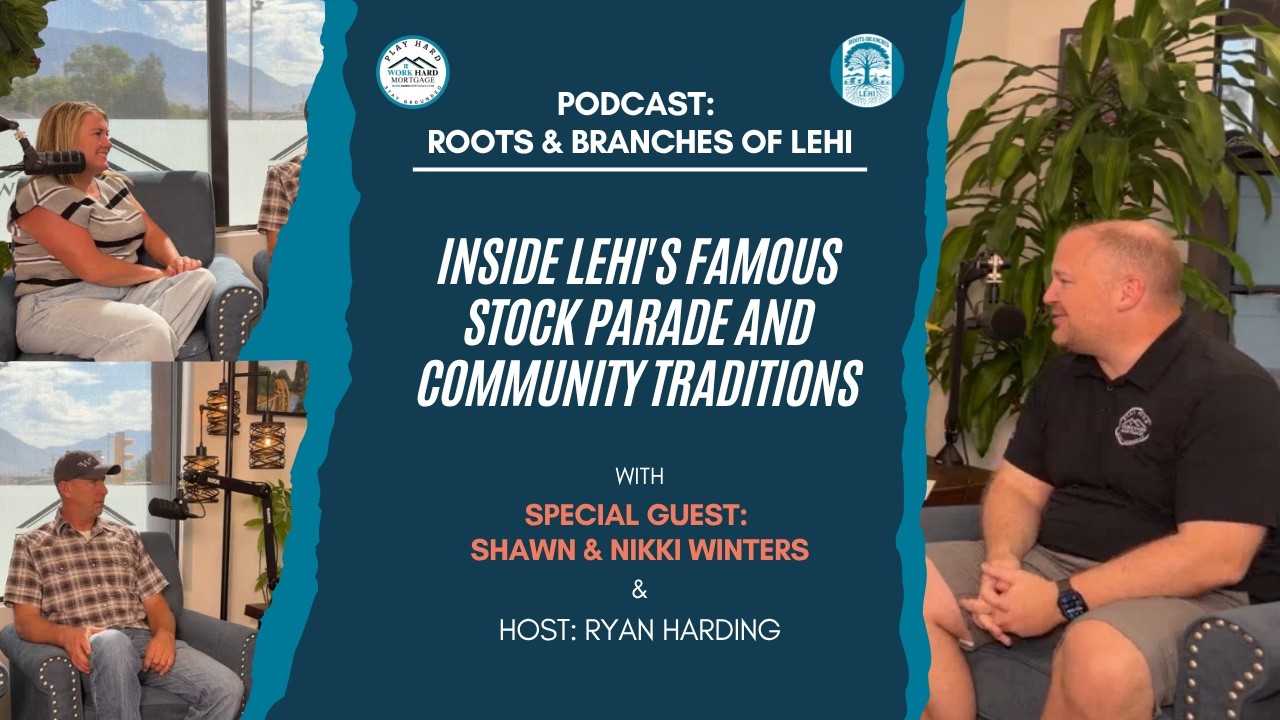
Inside Lehi's Famous Stock Parade and Community Traditions
Six-generation residents Shawn and Nikki Winters share how volunteerism and long-standing community traditions bridge Lehi's past with its rapid expansion.
Shawn and Nikki Winters
Service, Tradition, and the Stock Parade
At a Glance
Archive Scoring
Introduction
The story of Lehi is often told through the lens of its rapid growth, but beneath the surface of new developments lie deep, enduring roots. Shawn and Nikki Winters, descendants of families who have called Lehi home for over six generations, embody this duality. Their lives, defined by service to the land and the people, offer a bridge between the intimate 'old' Lehi where everyone knew your name and the modern, bustling city it has become. Their reflection on identity is profound; they argue that being known—and being held to the standard of one's ancestors—is a powerful deterrent to anonymity and a catalyst for active citizenship.
Central to their narrative is the Lehi Stock Parade, a non-motorized tradition that remains a stubborn, beautiful tribute to the town’s agricultural heritage. For the Winters, this parade is not merely an event but a sacred space where the past is physically manifested through horses, wagons, and the silent strength of cattle moving down Main Street. Through their leadership on the parade committee, they have worked to preserve the spirit of the 'Old West' while navigating the logistics of a thriving, modern metropolis.
Perhaps their most significant contribution to the community’s collective memory is the creation of the infant cemetery at the local burial grounds. It was born out of a quiet, human necessity, turning a neglected need into a place of profound dignity and healing. This act of service highlights the core of the Winters' philosophy: that a community is not built by the grand actions of a single leader, but by the accumulation of thousands of small, thoughtful acts performed by those who see a need and simply decide to address it.
As the town transitions, the Winters view progress through a lens of cautious stewardship. They advocate for 'evolving' traditions rather than abandoning them, suggesting that the influx of new residents is an opportunity to expand the circle of service. They remain committed to the idea that one should leave a place better than they found it, whether that means managing the parks, tending to the cemetery, or ensuring that the next generation understands the importance of the flag they carry in the parade.
Ultimately, their story is a testament to the idea that 'home' is something created through active participation. By sharing their family histories and the lessons learned from their grandparents, they are ensuring that the memory of Lehi remains anchored in human values: hard work, honesty, and a willingness to step forward when the community calls. Their legacy is not just in the infrastructure they maintain, but in the continuity of a shared, lived experience that persists despite the changing skyline.
Episode Overview
A detailed look at the topics, people, and context of this conversation.
In this episode, Shawn and Nikki Winters discuss their lives as multi-generational residents of Lehi, Utah. As active participants in city government, the parks department, and the local Stock Parade committee, they offer a unique vantage point on how the town has evolved from an agricultural hub to a tech-centric city. They explore the delicate balance of preserving local identity during a time of immense growth.
Topics covered include the logistical challenges of organizing non-motorized parades, the emotional weight of maintaining a community cemetery, and the importance of volunteerism in fostering neighborly connections. The discussion moves from the personal pride of their six-generation heritage to the practical realities of water conservation and land use in modern urban planning.
Throughout the conversation, the emotional tone remains one of profound love for a place that has shaped their family for over a century. The interview underscores the belief that while the town's physical form may change, its moral and cultural heritage can be sustained if the community remains committed to service, shared traditions, and the active support of their neighbors.
Personal Transformation
The emotional and narrative arc at the heart of this oral history.
Shawn and Nikki Winters transitioned from being children of Lehi to becoming active stewards of its heritage. Initially viewing themselves through the lens of being 'naughty' kids who needed to make amends, they experienced a profound shift toward service-driven leadership. This journey was catalyzed by their move away from Lehi, which stripped away their sense of belonging and community identity, causing a deep, lonely realization of the value of local roots. Upon returning, they deliberately chose to invest in the city's infrastructure and traditions, not merely as residents, but as architects of community connection. Their growth moved from passive participation to active ownership, where they began to view their family legacy as a foundation to build upon rather than just an inherited identity. By stepping into roles like cemetery sexton and parade organizers, they learned to bridge the gap between 'Old Lehi' and the rapidly expanding 'New Lehi.' This transformation is marked by their move from feeling like outsiders in a fast-paced world to becoming the reliable 'faces' that newcomers look to for guidance, effectively internalizing the responsibility of keeping Lehi's character alive. Their narrative arc concludes not with an end, but with a commitment to mentoring the next generation, preparing their own children to inherit the weight and joy of community service.
Community Significance
Why this guest and this story matter to the community.
The Winters represent the vital, often unseen infrastructure of Lehi—the people who keep traditions breathing and cemeteries sacred. Without their deliberate efforts in organizing the Stock Parade and the infant cemetery project, Lehi would struggle to maintain the 'small-town' feel that its residents crave amidst explosive population growth. They serve as a crucial bridge, helping translate the cultural values of long-term residents to those who have recently arrived, softening the friction often found in rapidly developing cities. Their willingness to volunteer their time—from managing horse logistics to ensuring grief is met with dignity—shows that the health of a community relies on people who see a need and simply fill it. Their work ensures that newcomers can plug into the existing culture, turning a collection of houses into a functioning neighborhood. They provide a model of what 'active citizenship' looks like, moving beyond complaining about growth to participating in the solutions that manage it.
"Connections go beyond blood. They're built through shared experiences, friendships, and the moments we celebrate together."
— Ryan Harding · 0:1717
Key Themes & Life Lessons
The ideas that run beneath the stories — and what they teach about community, leadership, and belonging.
Wisdom & Life Lessons
The Winters offer deep wisdom regarding the nature of service and identity. They teach that the most profound sense of self comes not from online anonymity, but from being 'known' by your neighbors—a realization reached after living in an anonymous environment. They emphasize the necessity of 'reputation' as a standard to hold oneself to, acknowledging that living up to the legacy of those who came before provides a stabilizing influence on behavior. They also demonstrate the wisdom of accepting change, noting that 'the show must go on,' and that letting go of a role you have mastered is a necessary part of allowing new growth to happen. Their experience suggests that being a 'pioneer' in the modern sense means being brave enough to test new ideas and occasionally 'swing for the fences' while maintaining a foundation of traditional gratitude.
Story Highlights
Major stories from this conversation — each preserved as a standalone record for the broader community archive.
Shawn and Nikki discuss the unique, albeit intense, experience of growing up in Lehi, where privacy was limited by the fact that everyone knew each other and each other's families. This created a strong accountability system—teachers and neighbors would immediately inform parents of a child's misbehavior—but it also tied the individual's identity to their lineage rather than just their own actions. Shawn reflects on his youthful mischief, admitting he would likely have to perform penance for his teenage pranks if current community members truly knew his history.
Emotional Significance
There is a profound mix of nostalgia and self-deprecating humor, revealing the pressure of living under a microscope while simultaneously feeling the deep comfort of being known.
Why This Matters
It captures the essence of a pre-digital, close-knit community structure that is rapidly disappearing.
Life Lesson
True accountability is not found in anonymity, but in being connected to a community that cares enough to hold you to a higher standard.
Transformation
The speakers shifted from rebellious teenagers who feared their parents' accountability to mature adults who now value those same community bonds as a foundation for raising their own children.
What It Reveals About Shawn and Nikki Winters
They possess self-awareness and acknowledge their past, balancing their pride in their heritage with the reality of their youthful shortcomings.
What It Reveals About the Community
Lehi functioned as an extended family where reputation was a tangible asset passed down through generations.
Community Value Preserved
The idea that collective oversight, while restrictive, promotes stronger, more accountable citizens.
For future generations: It offers insight into how social pressure and community visibility shaped the character of residents before the era of digital anonymity.
Shawn recounts his experience as the Lehi cemetery sexton, where he identified a systemic need for an infant cemetery. Driven by necessity and a desire to provide a more compassionate space for grieving parents, he led the project to establish a dedicated section and a more private office setting. This initiative fundamentally changed how the city cares for its bereaved citizens.
As Lehi shifts toward water-wise landscaping, the Parks Department has replaced high-maintenance turf with zero-scape and mulch beds. While this strategy successfully conserves water, it has inadvertently tripled the maintenance workload for an already lean staff, forcing city administration to navigate the difficult trade-offs between essential public services.
Taking over the reins of a long-standing tradition from a legendary community figure was intimidating. The guests worked to transition the historically informal, 'show-up-and-check-in' parade registration process into a structured, online system to ensure safety and organization while maintaining the spirit of the event.
The Lehi Stock Parade is a non-motorized event designed explicitly to honor the community’s agricultural, farming, and ranching heritage. By prohibiting engines, the event forces participants and spectators to slow down and witness the living history of Lehi, including the presence of horses, wagons, and various livestock.
The Winters family emphasizes the role of the Stock Parade as a family institution, having moved from parents leading their small children’s horses to their children now riding independently and carrying city flags. The inclusion of a 90-year-old grandfather in a restored surrey illustrates the deep intergenerational bonds fostered by this event.
The discussion addresses the tension between preserving historical traditions—like the Stock Parade ending at the traditional rodeo grounds—and the practical needs of a growing city. They explore whether moving or expanding facilities could transform the event from a resource-draining annual occurrence into a multi-use, year-round revenue generator for Lehi.
"As we grow into water conservation, the idea is to put in less turf. If we have a 10-acre park, we are only going to put a maximum of 5 acres of grass and the rest is going to be xeriscape, mulch beds, and trees."
— Shawn Winters · 24:59
Historical Preservation & Legacy
What this interview preserves about community history, cultural legacy, and intergenerational knowledge.
Preservation Value: Exceptional
This record captures the intersection of municipal evolution, local tradition, and the emotional labor of building community. It preserves specific institutional history—such as the creation of the infant cemetery and parade logistics—that would otherwise be lost to time. It is an exceptional record because it provides the rare perspective of individuals who are active, multi-generational participants in their city’s transformation.
Why This Episode Matters Historically
This record captures a pivot point in Lehi’s history—the transition from a rural, agrarian base to a 'tech-city' metropolis. It documents the specific mechanics of cultural preservation, such as how a city maintains a non-motorized parade in an age of automated convenience. The interview serves as a time capsule for the specific values of early 21st-century Lehi. By detailing the development of the infant cemetery and the shifts in how municipal services (like parks and parades) function, this episode provides primary-source evidence of the logistical and social challenges faced during the town’s most rapid growth period.
What Future Generations May Learn
Future residents will learn that community is not found, but built through consistent, often tedious, acts of service. They will see that even in a city experiencing hyper-growth, the 'soul' of the place is defined by traditions that honor the past while adapting to the present. The record highlights the importance of the 'human-centric' approach to municipal work—prioritizing the emotional needs of residents, such as the dignity of a cemetery or the shared joy of a parade. It teaches that progress does not have to come at the expense of heritage, provided there are people willing to do the work of bridging the two. Most importantly, it serves as a reminder that every generation is a link in a chain, and their role is to leave the community better than they found it, regardless of how much it has changed.
Community Memory Preserved
This episode preserves the history and operational challenges of the famous Lehi Stock Parade, including its evolution from manual, informal registration to a modern, organized event. It captures the 'behind-the-scenes' effort required to run non-motorized parades, protecting the knowledge of why this tradition remains vital to Lehi’s western roots. Additionally, it chronicles the creation of the infant cemetery section at the local cemetery—a profound act of service that provided needed solace to families and changed how the city treats its sacred spaces. The interview also records the shift in how the community manages public spaces, from water-heavy traditional parks to modern, water-wise xeriscape designs, reflecting the environmental and maintenance realities of the era. These stories of specific community service projects, such as the 9/11 volunteer initiatives, provide a record of collective efforts that defined this decade.
Local Knowledge Preserved
The episode captures the nuance of 'Old Lehi' versus 'New Lehi' social dynamics, including the historical expectation that community members hold each other accountable, which acts as a form of non-governmental social regulation. It preserves information about the logistical shift of city functions, such as the moving of the cemetery office from the city building to the grounds itself to facilitate privacy for grieving families. It also documents the specific, ongoing struggle to maintain large-scale traditions like the Rodeo and parades as available land and historical venues face pressure from development.
Intergenerational Lessons
The primary lesson for future generations is the value of 'showing up'—even when the task feels daunting or you feel unqualified. The guests demonstrate that being a leader often starts with being a learner who honors the work of those who came before. For entrepreneurs and youth, the lesson is that you don't need formal power to shape a city; you only need to observe where a service is needed and volunteer to fill it. They also teach that intergenerational connection, such as involving children in parades and cemetery maintenance, is the most effective way to transfer values. For those feeling overwhelmed by change or rapid growth, the lesson is one of evolution rather than extinction: traditions must adapt their form to survive the changing reality, but their purpose can endure. Finally, they highlight that building a community is a lifelong, unpaid investment that pays dividends in shared memories and social safety nets.
Community & Cultural Insights
Lehi is characterized by a strong, inherited culture of 'do-it-yourself' service that permeates everything from park maintenance to holiday traditions. This episode reveals a community that values its agrarian history so deeply that it preserves a non-motorized parade specifically to honor it. There is a clear tension in Lehi between the pace of development and the desire to maintain human-scale, community-focused activities. The schools, churches, and civic institutions act as a tight-knit web where everyone is connected through shared history, which acts as both a support system and a high standard of accountability. The cultural expectation is that growth is fine, but it should be done 'gradually,' and that new residents should seek to understand the traditions they are joining. Lehi’s civic culture is one of extreme willingness to volunteer, where people are more concerned with 'leaving the place better than they found it' than with their own social or economic standing. The city functions through a culture of transparency and accessibility, where even municipal departments are expected to maintain an environment of empathy and care.
Historical Context
The Winters family represents a deep-rooted lineage in Lehi, tracing back six to eight generations. Their involvement spans decades of Lehi's agricultural and social history, including the evolution of the Lehi Roundup Rodeo and the preservation of the unique non-motorized Stock Parade, which serves as a tribute to the town's pioneer and farming origins.
Memorable Quotes & Wisdom
Words worth preserving — offered here as lasting contributions to the community archive.
"Connections go beyond blood. They're built through shared experiences, friendships, and the moments we celebrate together."
— Ryan Harding
0:1717
Highlights the essential role of community events and shared experiences in binding people together in any town, especially Lehi.
This quote defines the core purpose of the podcast and community building – that relationships are forged through shared life, not just by proximity or lineage.
"I feel like both our families are very roots oriented."
— Nikki Winters
2:052
Addresses the legacy of pioneering families and their contributions to Lehi's development, setting the stage for understanding long-term community identity.
Explains the deep historical ties many families have to Lehi, providing a foundational reason for multi-generational residency.
"My mom's family did own Thanksgiving Point, the Fox Farm. The dairy farm. And it was a five generation ran farm. And then same Sean's family like was rooted in the businesses of Lehi."
— Nikki Winters
2:122
Connects historical family enterprises to the physical landscape and economic history of Lehi, showing how community was built through work and ownership.
Illustrates how families were not just residents but integral to Lehi's economy and development through agriculture and local businesses.
"It's very community and once you're in it, the whole community feels like your family. Yes. You get out of line as a teenager and all your teachers and everyone else is going to make sure you right back in line."
— Nikki Winters
3:263
Defines a core characteristic of Lehi's social fabric: a shared responsibility for raising and guiding its young people, fostering a deep sense of interconnectedness.
Describes a powerful form of communal accountability and belonging, where the community acts as an extended family looking out for its youth.
"When it was your identity, you were never Sean Wyers. You were always Steve Winter's son or Budlot's grandson or Sure. Okay. Yeah. Oh, she's one of those foxes. Yeah. And by right, if you were a fox and everyone expected you to work hard."
— Shawn Winters
3:583
Illustrates how family legacy and community recognition shaped personal conduct and work ethic in Lehi, creating a standard of excellence rooted in ancestry.
Reveals the profound impact of multi-generational family identity and reputation on individual behavior and expectations.
"I love that is my heritage. I love that too. And you mentioned family history in the beginning. So I suppose that's one thing I think people have discovered is they research their own family histories. There there is somewhat of an identity that comes with that, right? And pride that comes with that."
— Shawn Winters
4:244
Highlights the value of family history research in solidifying one's place within the Lehi community and fostering a sense of belonging and pride in ancestral contributions.
Connects genealogical research to personal identity and pride, showing how understanding one's past enriches one's sense of self.
"The most lonely feeling I've ever felt my whole life is we had just got there and some family had went with us to help us move. We've got trucks and horse trailers just full of all of our belongings. And we get out to our little farmhouse and I'm like, we don't have a bottle of water. We don't have a piece of bread. I need to run to the store so I can feed these people that are helping us."
— Nikki Winters
5:595
Emphasizes the deep human need for community connection and how the familiarity and recognition found in Lehi provide comfort and combat loneliness, a stark contrast to transient experiences.
Articulates the profound sense of isolation that can occur when one is disconnected from a supportive community, contrasting it with the Lehi experience.
"And I'm like, there's something about someone saying how's your mom? How's your grandma? How's your man that's the most comforting feeling that you'll Yeah. If you've had the opposite."
— Nikki Winters
6:436
Illustrates the deep value of knowing neighbors and being known in Lehi, where simple inquiries about family members create a powerful sense of connection and comfort, highlighting a core community value.
Pinpoints the specific, humanizing interactions that create a strong sense of belonging and care within a community.
"It's fine for progression as well, but let's do it gradually and maybe take into consideration what the older generation thinks and feels. Sure. Sure. And maybe put that up a little bit because they built our grandparents built this. So maybe let's ask their opinion."
— Nikki Winters
8:008
Suggests a pathway for managing Lehi's rapid growth by valuing the historical perspective and foundational contributions of its long-term residents in decision-making.
Advocates for a measured approach to change, emphasizing the importance of consulting and respecting the wisdom of the founding generations.
"Come to those things and enjoy them because a lot of work goes into people putting these on. Sure. And doing them and we the people that do it take a lot of pride in it. Yeah. And they want people Yeah. and new people to come see what look like we grew up doing the doing the roundup doing all these things and that's why we love our city. So we're like come out see this. You got to know why we love this."
— Shawn Winters
9:599
Urges both long-term residents and newcomers to engage with Lehi's traditions and events, fostering a shared appreciation for the community and the dedication of its volunteers.
Encourages participation in community events by highlighting the immense effort and pride that go into organizing them.
"The volunteerism too is I work at Lehigh City and we do have a volunteer program and I think one of the most unique things about it is the willing. So many people in this area want to volunteer."
— Shawn Winters
10:4810
Underscores Lehi's strong culture of volunteerism as a key factor in community building, demonstrating how collective effort strengthens neighborhoods and city-wide projects.
Identifies a powerful community asset: the genuine desire of its residents to contribute their time and energy.
"It just brings people together because it doesn't matter where you live, your social economic status, like if you're out there doing tree rings, you're just helping each other. So, it's been a huge thing as far as the community, I don't know, stimulator. And especially in neighborhoods, we've had parks where the neighborhood's gotten together and thought, "Hey, we want to spruce this park up a little bit.""
— Shawn Winters
11:0511
Illustrates how community projects, like park improvements, serve as powerful equalizers and bonding agents, enabling residents from all walks of life to connect and contribute to their shared environment.
Explains how shared work dissolves social barriers and fosters unity, creating a collective sense of ownership and accomplishment.
"And then to see this huge town come to this one little area and just line the streets. It almost feels like you're in the Macy's Day Parade."
— Shawn Winters
12:2112
Captures the impressive turnout and celebratory atmosphere of Lehi's traditional parades, reflecting a strong community spirit and engagement that rivals national events.
Uses a vivid analogy to convey the scale and excitement of Lehi's community events, particularly the stock parade.
"I think honestly it was a lot our participation with the stock parade. Yeah. And then Sean was a cemetery sexon for 10 years maybe. I'm not exact. Was it 10 years? and he actually is the one the idea behind the infant cemetery up there and then seeing the project through until it became what it is."
— Nikki Winters
13:0413
Highlights key contributions to Lehi: involvement in the stock parade and the establishment of the infant cemetery, showcasing dedication to community traditions and service.
Connects their community recognition to their active participation in significant events and service projects.
"The infant cemetery. It was a concept out of necessity. When you get it sounds awful, infant cemetery, you're like, "What?" Yeah. When you see the need for it and how it was kind of happening anyway, like it's if you're young, you don't think about that."
— Shawn Winters
14:1614
Discusses the creation of the infant cemetery as a vital, compassionate service addressing a deeply sensitive need within Lehi, demonstrating the community's commitment to caring for all its residents during times of loss.
Explains the profound and often overlooked need for specialized care and services within a community, highlighting sensitivity to difficult life events.
"And I think our goal as Lehigh City is to make it look like someone just left. You can't get up there every day. But if you go up there and the place is maintained to a level that looks like your uncle just left there and that's kind of our goal and I just think it's appreciated."
— Shawn Winters
16:2016
Illustrates Lehi City's dedication to maintaining its cemetery with dignity and care, providing a comforting and well-kept environment for grieving families and honoring the departed.
Describes a high standard of care and maintenance for a sensitive community space, reflecting respect for those who use it.
"It was definitely meant to be because it shaped even our children are so proud of that place and they've gone up there and did weeds and the tree rings and done a lot of things but his first project when he became the cemetery sexon was to move the office the cemetery office from the city building to the cemetery because he's like, "You've got people in there paying their utility bill with this family that's grieving. What a very not an intimate setting at all.""
— Nikki Winters
16:5917
Explains a significant improvement to cemetery services in Lehi, moving the administrative office to create a more compassionate and private environment for families experiencing loss, showing a commitment to sensitive service.
Highlights how a thoughtful change in physical space improved the dignity and privacy for grieving families, demonstrating empathetic leadership.
"It's just going there for one. I I remember driving up to the door when I got that job and looking at that thing going, why? Super sense service. And I think Lehigh City, too. Not just the administration, the city council and the city, the patrons themselves just find a whole another level of respect for the cemetery. And then at the infant cemetery is almost another level above that."
— Shawn Winters
15:3215
Emphasizes the elevated respect and compassion afforded to the infant cemetery within Lehi, demonstrating how specific community initiatives can foster a deeper sense of care and dignity for all residents.
Reflects on the profound impact and respect generated by the creation of the infant cemetery, showcasing its importance beyond just a physical space.
"It's such a crazy transition. And then just the landscape of Lehigh City going from the lake elevation to the Traverse Mountain border. It's one it's big land area wise. And so as it grew like population wise, we'll probably never double again, right? But now as we've hit the borders, now it's like filling in all those spaces that we were able to keep open space and develop into into what like what's the best use for this one versus that one."
— Shawn Winters
20:3620
Describes the significant geographical and demographic transformation of Lehi, highlighting the strategic planning involved in developing its vast land resources and maintaining open spaces amidst rapid growth.
Captures the dramatic evolution of Lehi from its historical roots to a modern 'tech city' and the ongoing challenge of balancing growth with preservation.
"Our thought was like they're going where the opportunities are and some other cities had already developed programs and so it was easier to just get online, boom, here we go. So, as that's gotten easier for them to do service in Lehi, and I think the hardest part is to for your our staff to not feel like it's a burden, right?"
— Shawn Winters
22:2522
Details the success of Lehi's structured approach to volunteerism, making it accessible for community members to serve and for city staff to manage these efforts effectively, strengthening community engagement.
Explains the strategic development of a framework to facilitate and manage community service, turning potential burdens into organized opportunities.
"As we grow into water conservation, the idea is to put in less turf. If we have a 10-acre park, we are only going to put a maximum of 5 acres of grass and the rest is going to be xeriscape, mulch beds, and trees."
— Shawn Winters
24:59
Reflects the ongoing efforts by Lehi City to manage water resources responsibly during a period of growth.
Highlights the shift in municipal land management to prioritize sustainability over aesthetics.
"To take care of an acre of grass takes 45 minutes once a week. To take care of an acre of mulch bed is 10 times the effort. As we shrink the grass, which we need to do to conserve water, it almost triples the maintenance in the same park."
— Shawn Winters
25:15
Provides insight into the strain on City departments that the public rarely sees, balancing conservation with practical city maintenance.
Exposes the hidden operational costs of environmental policy, showing that sustainability often requires more human labor.
"When they asked us to run the parade, it was very intimidating. We told them, 'We have been in the parade, but we have never run a parade.' It was very different."
— Nikki Winters
28:13
Shows how legacy traditions in Lehi are maintained by local residents stepping up to serve roles previously held by legends.
Illustrates the transition from a community participant to a community leader, underscoring the gap between 'knowing' an event and 'managing' it.
"My main focus is, I hope no one gets hurt. You have horses that haven't been ridden all winter, and people participating in the parade just to get a free ticket to the rodeo. The rodeo sells out instantly, so you get a lot of people coming for the tickets."
— Nikki Winters
30:29
Explains the logistical and safety challenges inherent in one of Lehi’s most beloved public gatherings.
Identifies the underlying motivations of participants and the safety concerns inherent in managing live animal parades.
"Lehi is likely the only non-motorized parade in Utah. It is a tribute to our history and staying focused on Lehi’s roots. No motorized vehicles, no cars, no tractors—just horses and the old west style."
— Nikki Winters
34:13
Serves as an educational record of why specific local traditions are maintained despite modern convenience.
Defines the distinct cultural identity of Lehi’s Stock Parade as a historical preservation effort rather than a standard commercial parade.
"We did ride in the parade this year because his grandparents were 91 and 89. We finally found a horse that was calm and steady enough to pull them in an old Amish surrey. It was a very special, family-driven moment."
— Nikki Winters
39:31
Highlights that behind the public 'parade' facade are intimate family milestones that preserve local history.
Captures the profound personal and generational meaning embedded within a community event, showing how it connects families through history.
"Even if we had millions of endless dollars, we would struggle to choose between bringing in big professional hitches or sticking with the local guys. There are enough local people with impressive hitches who keep the cowboy life alive, and that is why we do it."
— Shawn Winters
41:06
Reflects the tension between scaling events for popularity versus maintaining the soul of a community event.
Contrasts commercial 'spectacle' with authentic community participation, favoring the latter for the health of the local culture.
"Wines Park is the oldest park we have, with beautiful, mature trees. As we transition to new family parks, we have to ensure we aren't betraying our history. We have to balance our growth while respecting what came before."
— Shawn Winters
44:00
Validates the community's emotional attachment to historic spaces while acknowledging the inevitable necessity of future city planning.
Articulates the common struggle in rapidly expanding cities: maintaining a sense of place while adding new infrastructure.
"We've got to grow with the city, unfortunately. But yeah, to your point, the the rodeo is sold out, right? All the time."
— Shawn Winters
46:13
Acknowledges the challenge of balancing tradition with progress in a growing city like Lehi, using the popular rodeo as a tangible example of community engagement.
This quote captures the tension between preserving historical traditions and the necessity of urban growth and development. It highlights how popular events, like the rodeo, reflect the community's desire for shared experiences, even as the city expands.
"It's a lot of city resources for an event that is what a week a year. Do you know what I mean? So we have land that's dedicated for this and stuff like that. And so it would be nice if maybe it could be used for other things too then, right? Multi-use."
— Shawn Winters
46:35
Prompts consideration of how community resources are allocated and utilized, encouraging discussion about making public spaces more versatile and beneficial throughout the year.
This quote brings a practical, resource-management perspective to community events. It raises the question of optimizing the use of public land and resources, suggesting a need for flexibility and multi-use facilities to serve the community year-round, not just during a single annual event.
"The first reaction is like, 'You're going to tell us we're not doing it at Wines' Park?' Which cuz if your park's maintenance staff, Wines Park, you're like the day after rodeo week, it's like redo, start over, and everything's trampled to death."
— Nikki Winters
47:17
Reflects the deep-seated connections residents have to familiar community spaces and traditions, while also pointing out the practical strain these events can place on city infrastructure and maintenance.
This quote illustrates the emotional attachment people have to established traditions and locations, even when practical challenges arise. The mention of Wines Park being 'trampled to death' highlights the physical toll large events can take on public spaces.
"I am a tree hugger. I think once the trees grow in there, people easily are more transition family park because there is more space. There is more parking. There is it'll be, you know, when you're there, it's you're in the sun. But I'm like, when those trees grow in, it'll feel like the concert in the park. had transitioned from Wines Park to the amphitheater."
— Nikki Winters
47:32
Offers a hopeful perspective on change, suggesting that new locations can become beloved community spots with time and growth, drawing parallels to successful transitions of other events.
This quote shows foresight and adaptability, envisioning how a new space can evolve and improve over time. The 'tree hugger' comment adds a touch of personal philosophy, linking environmental appreciation with community development and the long-term vision for public spaces.
"She said one of the benefits was you got a new crop of people at this right people that normally would wouldn't have come cuz sure everybody if you're in walking distance of wines park I'm going to go right but now the sudden some of those people that maybe are by family parkh I don't know if I want to go the traffic and some I don't go to a lot of things because of traffic and crowds but oh hey it's my next door now okay yeah and she did say that there was a different crowd there."
— Shawn Winters
48:13
Illustrates how strategic changes in event location can broaden community participation and engage residents who might have previously been excluded due to logistical challenges.
This quote highlights a key benefit of evolving community events and locations: expanding reach and accessibility. By moving to a new park, the event attracted a different demographic, overcoming barriers like traffic and distance for some residents.
"You expanded the tent, right? And so I think there is benefit to that."
— Nikki Winters
48:44
Encapsulates the idea that successful community initiatives grow and adapt to include more people, strengthening the overall community fabric.
This is a concise metaphor for growth and inclusivity. 'Expanding the tent' means making something more welcoming and accommodating to a wider range of people and ideas, signifying positive development.
"Lehi pioneers and and you your head goes to the pioneers that came across in the wagons, but also a pioneer is somebody who's leading the way. Yes. You know what I mean? So I think in a lot of those things, even as a staff, we're not scared to try swing at the fences and we miss sometimes, but we're always trying to do something that makes it better for everyone."
— Shawn Winters
50:08
Redefines the pioneer spirit for contemporary Lehi, encouraging a proactive, risk-taking approach to making the community better, valuing effort and progress over guaranteed success.
This quote beautifully redefines 'pioneer' beyond historical context to encompass modern innovation and leadership. It emphasizes a culture of courageous experimentation and a commitment to continuous improvement for the benefit of the entire community.
"Some traditions we don't want to lose, but then some traditions need to be lost and incorporating that into something that's new, too. There's evolving. Yes. Evolving. Yeah. Yeah. Yeah. We have to We're going to have to to keep these things alive. They can't stay exactly how they are. It just isn't going to work."
— Nikki Winters
50:39
Speaks to the dynamic nature of community traditions, emphasizing that adaptation and evolution are necessary for their survival and continued meaning in Lehi.
This quote articulates a mature understanding of tradition and progress. It acknowledges that while preserving heritage is important, some traditions must naturally fade or transform to allow for new growth and relevance, ensuring the community's ability to thrive.
"After doing all this history, I'm grateful for all the people that came before me and the hard work they've put."
— Nikki Winters
51:05
Underscores the value of honoring and learning from Lehi's history and the efforts of past residents, fostering a sense of continuity and appreciation for the community's heritage.
This quote expresses profound gratitude for the past and acknowledges the foundational contributions of previous generations. It highlights the importance of historical perspective in appreciating the present.
"My entire house was we had pictures laid out across my entire house. And and once they dried and I started trying to organize them and put them in boxes and categories, I didn't know any of these people. I'm like, I don't know. I just kind of did my best to separate them."
— Nikki Winters
51:39
Illustrates the personal challenges and emotional weight involved in preserving family history, especially when faced with loss or the difficulty of identifying past generations.
This quote reveals a poignant moment of disconnect with one's own family history due to the loss or damage of records. It speaks to the fragility of memory and the effort required to piece together personal and familial legacies.
"And I told Sean, I'm like, 'I know who all the people in the We're doing all that stuff.' I'm like, 'Oh, I know who that is. I know exactly where they are.' And yeah, that's it's really fun. And it's all just because of man, they're all here in Lehi."
— Nikki Winters
52:03
Emphasizes the deep connection between personal identity, family history, and the specific place of Lehi, showing how local history can provide context and belonging.
This quote marks a turning point from disconnect to recognition, facilitated by a tangible connection to Lehi's places and history. It highlights how place-based memory can help an individual reclaim and understand their personal lineage.
"And that's in that's the legacy and that's what you're be you're part of, right? You're that link in the chain and and continuing to do that building off those. Yeah. Try not to disappoint. We're all trying to do that."
— Shawn Winters
52:19
Inspires a sense of purpose and shared responsibility among Lehi residents to contribute to the ongoing legacy of the community and to honor the efforts of those who came before.
This quote beautifully encapsulates the concept of generational responsibility and continuity. It frames individuals not just as inheritors of the past but as active participants in shaping the future, carrying forward the legacy entrusted to them.
"Remember, every person here has a unique story, and together, we're what makes Lehi feel like home."
— Host
52:46
Reinforces the core message of the podcast: that Lehi's strength and character are built upon the individual stories and contributions of all its inhabitants, fostering a sense of belonging and shared ownership.
This quote serves as a powerful reminder of the value of individual narratives within the collective identity of a community. It emphasizes that the richness of a place comes from the diversity of its residents and their unique life experiences.
Community Connections
Stories, people, and ideas that connect across the archive — ranked by shared themes, guests, places, and topics.
Related Episodes
(4)Connecting Lehi: A Conversation with Chris Condie | Roots and Branches of Lehi
Chris Condie
Exploring Lehi's Rich Rodeo Tradition with Mike Southwick
Mike Southwick
Costco, City Growth & Community Leadership | Ken Greenwood’s Lehi Legacy
Ken Greenwood
From EMT to Fire Chief: Jeremy Craft’s Story of Service in Lehi
Jeremy Craft
Related People
(4)Lara Bangerter
Manager, Lehi Historical Society & Archives
Paige Albrecht
Lehi City Council Member, Attorney, Community Advocate
Andy Hadfield
Head Football Coach, Lehi High School · Business Owner · Lifelong Lehi Resident
Mark Johnson
Mayor of Lehi, Former City Council Member, Engineer & Business Owner
Related Stories
(4)Baby Land — A Place of Refuge Most People Don't Know About
Paige Albrecht
Baby Land — A Place of Refuge Most People Don't Know About
Paige Albrecht
A Canceled Softball League and the Birth of a Public Servant
Paige Albrecht
The Book Brigade — Lehi Moves a Library by Hand
Lara Bangerter
Related Quotes
(4)"Lehi City is the economic engine of the state of Utah."
— Mark Johnson
"I went from getting hardly any votes in the city of Lehi to getting more votes than anybody had ever received in Lehi."
— Mark Johnson
"You need to make your own community. It's not going to find you."
— Charlene Freestone
"Don't think you're not the growth."
— Mark Johnson
Related Themes
(4)Volunteerism
Lehi's century-long tradition of residents building their own city through service — from book brigades and sponsored park trees to committee work and parade committees.
Community Resilience
How Lehi residents have navigated challenge, change, growth, and hardship — and emerged with optimism, connection, and a deeper appreciation for what they've built together.
Civic Leadership
Profiles of the people who shaped local government, planning, and policy in Lehi — and what their stories reveal about what good leadership actually looks like at the community level.
Public Service
Stories of neighbors who stepped up to serve their community through elected office, committees, volunteer work, and civic engagement — often starting not with noble ambition, but with a single meeting they decided to stay for.
Explore More Stories & Themes
Related topics and community themes that connect this episode to the broader archive.
Connected People, Places & Stories
Social Hub
Serves as a symbol of the interconnected nature of the small-town community.
Civic Project
A significant legacy project led by Shawn Winters to address an unmet community need.
cultural preservation
The parade exists specifically to maintain Lehi's agricultural roots.
predecessor
Peggy established the foundational organizational methods for the parade.
management challenge
Transitioning to xeriscaping increases maintenance labor for city parks.
resource source
A horse used for a special parade event was acquired from this business.
historical site
Recognized as the oldest park in Lehi with mature trees.
Growth solution
A newer, more spacious venue proposed to alleviate crowd and infrastructure issues at older locations.
Cultural redefinition
Redefining the term to encompass modern innovative leadership.
Suggested Future Guests & Topics
Future interviews should focus on the 'hidden heroes' of Lehi’s civic life, such as long-term parade organizers like the legacy of the late Peggy, and those responsible for the Rodeo’s continuity. Conversations with the 'new' residents who have successfully integrated into these traditions would provide a fascinating counter-perspective. Additionally, historians should interview those who manage the city's water-wise infrastructure shifts, as they hold the technical history of how Lehi adapted its geography to meet modern scarcity. Finally, documenting the stories of those who run the city’s volunteer programs, like Rob Craig, would solidify the legacy of the 9/11 service projects.
More from Roots & Branches of Lehi

The Inspiring Story Behind Sunshine Street Co. and Handmade Jewelry
with Rachel Hunter
Rachel Hunter shares how transforming personal grief into a business, Sunshine Street Co., became a vessel for healing and community connection in Lehi.

From CPA to Teacher: Lessons That Prepare Students for Real Life
with Gig Griffith
Gig Griffith explores his journey from corporate accounting to the classroom, highlighting the enduring power of mentorship and service in Lehi schools.
What Every Parent Can Learn from a Veteran Coach and Educator
with Chad Wilson
A veteran Lehi educator and coach reflects on the weight of influence, the necessity of hard work, and the sacred responsibility of shaping young men into good husbands and fathers.
Full Transcript
Transcript source: AI-generated. This transcript has been lightly edited for readability.
Chapter 1: Podcast Welcome 0:000 secondsWelcome to Roots and Branches of Lehi, the podcast where we get to know the faces, stories, and lives that make up our community. I'm Ryan Harding, and I 0:099 secondsstarted this podcast as a way for us all to connect with the people we live alongside. Growing up in a small town, I learned that connections go beyond blood. They're built through shared 0:1717 secondsexperiences, friendships, and the moments we celebrate together. Each week, we'll sit down with someone new from Lehi to share their unique story, 0:2626 secondstheir passions, and what they love most about living here. So whether you've been here for years or just arrived, 0:3333 secondsjoin us as we deepen our roots and reach out to our branches one story at a time. Chapter 2: Meet Shawn and Nikki Winters 0:4545 secondsWelcome Sean and Nikki Wyinners to Roots and Branches of Lehi where we get to know people of Lehi. So appreciate you coming on today. Thanks for having us. 0:5353 secondsYeah, this is exciting. So talk to me about So are both of you from Lehi? Tell tell me your backgrounds. We'll start with you, Nikki, and then Oh, thanks. Yes, I grew up here and went 1:021 minute, 2 secondsto high school here, junior high here, elementary. We had elementary. Okay. Yeah. So, been here a long time. Yes. Okay. Yeah. And what about you, Sean? 1:091 minute, 9 secondsSame. And genally, we both been here for six generations. So, Okay. Grew up here. So, long time Leehigh. 1:151 minute, 15 secondsWe took we've been taking a deep dive into family history for the historical society. Yeah. 1:211 minute, 21 secondsAnd Sean's actually agent, but Okay. We went back eight Lehi generation. Yeah. Okay. Okay. 1:291 minute, 29 secondsYeah. I grew up here. High school sweethearts. We did move to Oklahoma for a few years. Okay. 1:341 minute, 34 secondsAnd then came back. Yeah. It's a great place to be. Yeah. 1:381 minute, 38 secondsIt's a a city, like you said, when we grew up in the mid to late 90s, it's just it's totally different. Yes. 1:451 minute, 45 secondsAnd so coming back, but still as busy as it is, everywhere you go, you know somebody. Yeah. Yeah. Chapter 3: Six to Eight Generations in Lehi 1:501 minute, 50 secondsWhy do you think that's a long time for a family to stay in one place, right? You think so? You say six generations. 1:561 minute, 56 secondsThat's both of you. It sounds like why do you think your families have stayed here for so long? Why even just moving to Provo or Salt Lake? Why Leh? Why? Why have they stayed here so long? 2:052 minutes, 5 secondsI feel like both our families are very roots oriented. Okay. 2:102 minutes, 10 secondsThey I don't you think Yeah. 2:122 minutes, 12 secondsMy mom's family did own Thanksgiving Point, the Fox Farm. Okay. 2:172 minutes, 17 secondsThe dairy farm. And it was a five generation ran farm. Okay. 2:202 minutes, 20 secondsAnd then same Sean's family like was rooted in the businesses of Lehi. Yeah. 2:252 minutes, 25 secondsWhich I think and I I think they helped kind of grow it too. 2:302 minutes, 30 secondsOn my grandpa's side, they were heavily into the agriculture part and the irrigation company. And then on grandma's side, he she actually he 2:372 minutes, 37 secondsactually owned the CL Johnson general store like where the train depot was. Yes. 2:422 minutes, 42 secondsFor years, I think their work was in Lehi as well. Okay. 2:442 minutes, 44 secondsSo it to move was like to kind of start over. Yeah. Where there wasn't a ton of people here, but it was always like central. You're halfway to Provo and you're halfway to 2:532 minutes, 53 secondsSalt Lake and Yep. Who knew it would grow like it did? But I think staying here wise and then I think it's the quality of life too. You know everybody, 3:013 minutes, 1 secondyou know the streets and the people and the community and Yeah, it's an easy place to stay. 3:053 minutes, 5 secondsYeah, that makes sense. You me you mentioned the businesses cuz I think a lot of times people transfer companies or now we're in a more transient 3:123 minutes, 12 secondssociety, right? Because not a lot of people maybe own that business and stuff. They work for some big company. 3:183 minutes, 18 secondsBut that makes sense then if your family had a lot of the businesses here. 3:213 minutes, 21 secondsYeah, that that makes sense. It wasn't like your family, you know, the family, the own. Fair enough. Sure. 3:263 minutes, 26 secondsYeah. It's very community and once you're in it, the whole community feels like your family. Yes. 3:313 minutes, 31 secondsYou get out of line as a teenager and all your teachers and everyone else is going to make sure you right back in line. Chapter 4: Growing Up in a Small-Town Community 3:373 minutes, 37 secondsYeah. So, talk to me about growing up here because a lot of people that live here now didn't have that same childhood, right? Because as far as living here and stuff. So, talk to me 3:453 minutes, 45 secondsabout what it was like to grow up in a place where to quote Cheers, everybody knew your name, right? Yeah. So what was that? 3:523 minutes, 52 secondsThey'll call you out and they will call your parents. Everybody will. And then your parents, we were held accountable. 3:583 minutes, 58 secondsSo we heard about it and they got a hold of our parents. But when it was your identity, you were never Sean Wyers. You were always Steve 4:054 minutes, 5 secondsWinter's son or Budlot's grandson or Sure. Okay. Yeah. Oh, she's one of those foxes. Yeah. 4:114 minutes, 11 secondsAnd by right, if you were a fox and everyone expected you to work hard. 4:154 minutes, 15 secondsYeah. We were held to a standard of being honest and working hard. And I think it's still today. Yeah. I have a couple cousins that run businesses and 4:244 minutes, 24 secondsthey're well known for being hard workers and honest. And I actually I love that is my heritage. 4:304 minutes, 30 secondsI love that too. And you mentioned family history in the beginning. So I suppose that's one thing I think people have discovered is they research their own family histories. There there is 4:384 minutes, 38 secondssomewhat of an identity that comes with that, right? And pride that comes with that. And so now all of a sudden you're like, "Oh, okay. Yeah, I don't want to disappoint grandma that I never knew." 4:464 minutes, 46 secondsRight. Maybe. But and so to your point, I don't know. I think that's a an interesting take on that because it it holds you to a higher standard, the 4:544 minutes, 54 secondsopposite of that would be the anonymity that exists on online, right? If nobody knows who you are, you can say whatever you want. So, and they do. 5:015 minutes, 1 secondAnd they do, right? They do. But now, when you're connected now, it's okay. I don't want to shame my family. I want to make sure I'm working hard. So, I don't 5:095 minutes, 9 secondsknow. Just interesting. When they first brought it to us about being not nominated and honored as the heritage days, I first thought I probably am 5:175 minutes, 17 secondsgoing to have to go on and do a public apology if you were toilet papered or prank called in the early to mid90. 5:245 minutes, 24 secondsI probably owe him like a day of yard work, free day of yard work or something because I was like, man, if they knew what I did when I was a teen, I don't think they would have nominated him. 5:335 minutes, 33 secondsYeah, sure. 5:345 minutes, 34 secondsTrying to make up for it now in our older years. Okay. So, that that's a good point, too. 5:385 minutes, 38 secondsSo obviously there is repentance, change, different things like that, right? You know, can become, you know, I'm trying to become someone that my children will be proud of. 5:465 minutes, 46 secondsYes. No, I love it. 5:475 minutes, 47 secondsWell, I think moving away for a little while and not knowing anyone, like we go to the store, we live just outside Oklahoma City and and it was kind of 5:545 minutes, 54 secondscrazy to go to anywhere and not know anyone. Yeah. I tell people the story all the time. 5:595 minutes, 59 secondsThe most lonely feeling I've ever felt my whole life is we had just got there and some family had went with us to help us move. We've got trucks and horse 6:076 minutes, 7 secondstrailers just full of all of our belongings. And we get out to our little farmhouse and I'm like, we don't have a bottle of water. We don't have a piece 6:146 minutes, 14 secondsof bread. I need to run to the store so I can feed these people that are helping us. And I we passed a Walmart on the way in. So I knew where there was a Walmart. 6:226 minutes, 22 secondsSo I zipped over there and I went walking in that store and I realized if something went not one person in the 6:286 minutes, 28 secondsstore knows me. They don't know I'm alone. Alone. And then we get back here and my kids won't even go to Colers with well Pioneer Market. Yeah. 6:376 minutes, 37 secondsWith me and Sean because mostly Sean like we can't get out of that thing. We talk to every single person in there. 6:436 minutes, 43 secondsAnd I'm like there's something about someone saying how's your mom? How's your grandma? How's your man that's the most comforting feeling that you'll Yeah. 6:516 minutes, 51 secondsIf you've if you've had the opposite. Yeah. 6:536 minutes, 53 secondsI like going into Pioneer Market cuz cuz you're connect because you are part of a community. 6:586 minutes, 58 secondsYeah. Like they know Yeah. They know everybody and a lot of them they're still remember when you were a naughty little kid and they still are forgiving. Sure. Sure. Yeah. 7:067 minutes, 6 secondsI think that's one of the and again not everybody not everybody's going to relate that they have six eight generations in one place right but I 7:147 minutes, 14 secondsthink a lot of people you know if you I think there is something beneficial of staying in an area for a period of time. 7:207 minutes, 20 secondsSo I'm not from Lehi and but we've been here gosh we've been here now for over 20 years and so when we go to the grocery store and stuff like that we 7:287 minutes, 28 secondsnotice people too right because I've had kids two kids graduate high school here and stuff like that right so it has become home for me personally even though I don't have the length of 7:377 minutes, 37 secondshistory that you guys have here and so I think there is a benefit to stand in one spot for a period of time and I think there's a lot of old Lehigh Chapter 5: Bridging "Old" and "New" Lehi 7:447 minutes, 44 secondsnew Lehi talk that goes on and being old Lehi which I would consider us to be old Lehi. I don't think that the old Lehigh 7:527 minutes, 52 secondspeople have any problem with the new people coming in, but we do expect and want you to accept our traditions, our 8:008 minutesvalues, our old way of that come here and know where you moved. It's fine for progression as well, but let's do it gradually and maybe take into 8:088 minutes, 8 secondsconsideration what the older generation thinks and feels. Sure. Sure. 8:128 minutes, 12 secondsAnd maybe put that up a little bit because they built our grandparents built this. So maybe let's ask their opinion. 8:178 minutes, 17 secondsSure. And not that they don't have a vote, but it seems to be going so fast. Sure. 8:218 minutes, 21 secondsBecause the growth is so fast, but and part of the reason why I think people want to live here is like you touched on that that community that was grown here is still a part of it. As 8:308 minutes, 30 secondspeople came in, it's you're accepted and you're a part of the community. You go to the store, you go to the parade, you go to any event or you know, even just the Legacy Center, you're going there to 8:388 minutes, 38 secondswork out or whatever, like the same people go there all the time. And yeah. Yeah. 8:418 minutes, 41 secondsMost of them will introduce theirelves and ask you who are you and where are you from? Yeah, it's and I think that's a kind of a Utah 8:498 minutes, 49 secondsculture as well. Like we travel around a little bit and been super fortunate to see a lot of places and like I said, live in a different state for a while and that's not normal. Yeah. 8:598 minutes, 59 secondsLike to know your neighbor, you know what I mean? People like you want to keep to yourself, which is fine, but I think here like culturally that's not the norm. You just there's a willingness 9:079 minutes, 7 secondsto help see that something wrong and not just think about it, actually go do it. 9:129 minutes, 12 secondsYeah. that it does. You talk about old and ne new Lehi and stuff. That does seem to be something that's Lehi does have a very good 9:199 minutes, 19 secondscommunity feel, right? And that is owed to to your point, those that have lived here for a long time, right? Those that have, you know, established that all 9:279 minutes, 27 secondsthese different traditions that are had and there is respect that I think is owed to that. And but how are we also now? So, yeah, now probably I would 9:349 minutes, 34 secondsassume the new out out there's probably Yeah, there's more new than old, right? And what things do you think are able to help us become one 9:429 minutes, 42 secondscommunity, old and new, now that you have so many new people and stuff like that? Chapter 6: Volunteering and Community Traditions 9:469 minutes, 46 secondsI do feel like the parade obviously because we love that parade more and we probably love anything about Lehigh, but the Roundup itself and the arts and the 9:549 minutes, 54 secondspark and just all the things that they're they try to do to bring the community together. 9:599 minutes, 59 secondsCome to those things and enjoy them because a lot of work goes into people putting these on. Sure. 10:0510 minutes, 5 secondsAnd doing them and we the people that do it take a lot of pride in it. Yeah. And they want people Yeah. 10:1010 minutes, 10 secondsand new people to come see what look like we grew up doing the doing the roundup doing all these things and that's why we love our city. So we're 10:1810 minutes, 18 secondslike come out see this. You got to know why we love this. 10:2010 minutes, 20 secondsSure. So recommendation would be hey if you're new participate in these things is what you're saying. That's how you get to have these reach out. The 911 service is coming up. 10:2910 minutes, 29 secondsAnd I think that's relatively not new but a newer thing that they are doing. 10:3310 minutes, 33 secondsAnd I'm like, that's going to be one of those things that if everyone comes together on a day really helps build Lehi into with 10:4110 minutes, 41 secondsvolunteer hours and just making it what you want and being a part of that makes you feel like you help build the city. 10:4810 minutes, 48 secondsThe volunteerism too is I work at Lehigh City and we do have a volunteer program and I think one of the most unique things about it is the willing. So many people in this area want to volunteer. 10:5810 minutes, 58 secondsYeah. which seems crazy, but you put the projects out and they're just getting done after done and it just brings people together because it doesn't 11:0511 minutes, 5 secondsmatter where you live, your social economic status, like if you're out there doing tree rings, you're just helping each other. So, 11:1311 minutes, 13 secondsit's been a huge thing as far as the community, I don't know, stimulator. And especially in neighborhoods, we've had parks where the neighborhood's gotten together and thought, "Hey, we want to 11:2111 minutes, 21 secondsspruce this park up a little bit." Yeah. 11:2311 minutes, 23 secondsIt's come out in droves and change it completely. And it just sends that whole thing. You're all part of the same neighborhood now or 11:3111 minutes, 31 secondsyou now you know somebody you never knew before just cuz you were there working on the same weed patch or whatever. Yeah. Yeah. 11:3711 minutes, 37 secondsI love that again and I think it goes back to the principle is hey it just takes time right to for somebody to feel comfortable in an area. If you guys had 11:4611 minutes, 46 secondsstayed in Oklahoma and been there a lot longer my guess is over years you would have felt at some point home. 11:5111 minutes, 51 secondsWe still have friends out there that are there. Yeah. We combined in our community. Yes. Okay. I love that. 11:5711 minutes, 57 secondsAnd they they actually came to rodeo days when and they were just absolutely they were in the miniature float. We put their kids I built a float that year for 12:0412 minutes, 4 secondsthe miniature float parade and their kids were on my float like and then the parents walked it with it like and they're like never seen anything like that. 12:1312 minutes, 13 secondsYeah. We still see Lehi as little old Lehi. It's a thriving metropolis. If you come from Oklahoma and you come over the point of the mountain, you're like, "Wo, 12:2112 minutes, 21 secondsI thought you said this is a little town." And then to see this huge town come to this one little area and just line the streets. It almost feels like you're in the Macy's Day Parade. 12:2912 minutes, 29 secondsSure. You know, crazy. Sure. Yeah. Love that. I love that. Chapter 7: Honoring Heritage Through Lehi Days 12:3312 minutes, 33 secondsOkay. So, let's talk about So, you were nom So, talk to me about what you were nominated for and what this what what did you think about that? 12:4012 minutes, 40 secondsProbably our participation in the stock parade. They didn't necessarily tell us why we were nominated. I think they were asking us to be on the committee. 12:4812 minutes, 48 secondsYeah. 12:4912 minutes, 49 secondsWe have no there's no reason we should have been. 12:5112 minutes, 51 secondsI said now who why and how are we helping? And he goes, who do we do that? And he goes, well, and I thought I was too young. I guess this it tells me how exactly how old I 12:5912 minutes, 59 secondsam. Sure. Now I'm part of this group, but I'm so honored to be a part of it. 13:0413 minutes, 4 secondsBut any I think honestly it was a lot our participation with the stock parade. Yeah. 13:0913 minutes, 9 secondsAnd then Sean was a cemetery sexon for 10 years maybe. I'm not exact. Was it 10 years? and he actually is the one the 13:1713 minutes, 17 secondsidea behind the infant cemetery up there and then seeing the project through until it became what it is. And I think that was he also helped a lot of people 13:2513 minutes, 25 secondsin the community through that service and I think that was a major highlight for our family. Everybody that we talked 13:3313 minutes, 33 secondsto run into is like they just we have to keep old ladies from pinching his butt. 13:3813 minutes, 38 secondsthey just they love him and he did such a good job in that position and now he works still works for the city in a different capacity and I'm a milk 13:4613 minutes, 46 secondscarrier here and I've been that for several years are about the same as yours couple miles down the road. Yeah. 13:5213 minutes, 52 secondsI don't know again we've just been here so long in our family. Yeah. Our a lot of our parents, grandparents, greatgrandparents are you know made really big impact on the community. 14:0214 minutes, 2 secondsSure. For sure. My grandma's 89 and she's still on DUP. 14:0614 minutes, 6 secondsYeah. just that's always serving. Chapter 8: Creating the Infant Cemetery Section 14:0814 minutes, 8 secondsAnd so talk to me. Your wife mentioned the service project that you So talk to me about that some. Do you want to elaborate on what she was talking about there? 14:1414 minutes, 14 secondsWhat about the cemetery? 14:1614 minutes, 16 secondsThe infant cemetery. It was a concept out of necessity. When you get it sounds awful, infant cemetery, you're like, "What?" Yeah. 14:2314 minutes, 23 secondsWhen you see the need for it and how it was kind of happening anyway, like it's if you're young, you don't think about that. So when you go to the cemetery, 14:3214 minutes, 32 secondsyou found them in buying the space next to them. And then other cities have them. And so as 14:3914 minutes, 39 secondsyou kind of do a deep dive into the reason, the cost, the the benefit, the it kind of worked out to do it in a 14:4714 minutes, 47 secondssection we hadn't opened yet and just be a big vast and then we could there's a monument in there that kind of touches what you see, I think. 14:5514 minutes, 55 secondsAnd so that that was a part of it. 14:5714 minutes, 57 secondsFiguring out where to put it. The idea had been there. It just was never implemented. 15:0115 minutes, 1 secondYeah. It was it there was never a a viable solution to the issues. Sure. 15:0615 minutes, 6 secondsSo we kind of figured out where to put it, what to do as far as a monument and then kind of actual we actually built it in house because funding the the hardest part. 15:1515 minutes, 15 secondsSure. 15:1615 minutes, 16 secondsSo we built the inside and then kind of came up with the concept of how to give some separation and also the maximize the space. You know what I mean? Yeah. 15:2515 minutes, 25 secondsAnd it was a couple years, but we buried the first one in 2013 and so 13 years. It's there is a lot. Yeah. 15:3215 minutes, 32 secondsYeah. Yeah. It's just going there for one. I I remember driving up to the door when I got that job and looking at that thing going, why? 15:4115 minutes, 41 secondsSure. Sure. 15:4315 minutes, 43 secondsSuper sense service. And I think Lehigh City, too. Not just the administration, the city council and the city, the 15:5015 minutes, 50 secondspatrons themselves just find a whole another level of respect for the cemetery. And then at the infant cemetery is almost another level above that. Sure. 15:5815 minutes, 58 secondsYeah. 15:5815 minutes, 58 secondsYeah. Love that. And you've gotten feedback then little old ladies you said just been the reception of it. 16:0416 minutes, 4 secondsAnd not just that too, but the a lot of the people they've lost their spouse and you see them kind you don't until you've buried someone. You don't know what to 16:1216 minutes, 12 secondsgo through. A lot of you are just up there answering questions and walking them through the process. But I think it's just such an appreciation for that that we're there. There's somebody there 16:2016 minutes, 20 secondsall the time to help them through And that I think our goal as Lehigh City is to make it look like someone just left. You can't get up there every day. 16:2716 minutes, 27 secondsBut if you go up there and the place is maintained to a level that looks like your uncle just left there and that's kind of our goal and I just think it's appreciated. 16:3616 minutes, 36 secondsYeah. Yeah. Yeah. I love that. 16:3816 minutes, 38 secondsI just happen to be in the spot where they feel like it was me. There's a lot of other people that actually do everything. Sure. Sure. Sure. 16:4416 minutes, 44 secondsIt's fine. We were very young in our family. Our daughter was probably a year old maybe when you started that position and someone came to him and said I think 16:5216 minutes, 52 secondsyou'd be good at this y and financially it would be a great step for our family but he's like I guess I got to do this I don't what the heck I'm 16:5916 minutes, 59 secondsdoing and it turns out I think it was definitely meant to be because it shaped even our children are so proud of that place and they've gone up there and did 17:0717 minutes, 7 secondsweeds and the tree rings and done a lot of things but his first project when he became the cemetery sexon was to move 17:1417 minutes, 14 secondsthe office the cemetery office from the city building to the cemetery because he's like, "You've got people in there paying their utility bill with this family that's grieving. 17:2417 minutes, 24 secondsWhat a very not an intimate setting at all." And there was an older home up there on the ground. So, they turned 17:3117 minutes, 31 secondsthis older home into it's really a beautiful spot, too. And you can go there and it's privacy and you can sit in that office and just kind of do what you need to do and have your feelings 17:4017 minutes, 40 secondsand not have city workers walking through and people paying their utility bills and but what a need that was. And then we did several 17:4717 minutes, 47 secondsprojects up there. But then the office building being up there was very important. And then the infant cemetery just really highlighted what a special 17:5617 minutes, 56 secondsplace it was for him to be up there and be able to put his ideas and they really matter. 18:0118 minutes, 1 secondSure. And again, I think that's going to be part of our legacy that we helped shape Lehi because it was something that was needed that no one even for like 18:0818 minutes, 8 secondsseen unless you were in that to be able to see, oh, there's a need for something this or something needs to be changed here. Yeah. 18:1518 minutes, 15 secondsWhich I I go back to what I've said repeatedly on this podcast, which is a community is not made up of one really good person. It's made up of really 18:2318 minutes, 23 secondsthousands of really good people that see a need. So, this is something that that a lot of people may not even know exists and maybe never never need this this service and stuff like that, but at 18:3118 minutes, 31 secondsleast not here. My point is just that that's where again, hey, here's my little piece of the vineyard and I'm going to work on this and make it 18:3918 minutes, 39 secondsbetter. And again, that's part of what makes a good community is is all these people see an area where there's something that needs to be done and you've done it. And I think or just make it a little better. 18:4818 minutes, 48 secondsMake it a little bit better. Exactly. 18:4918 minutes, 49 secondsLeave the place better than where you found it. 18:5118 minutes, 51 secondsYeah. No, I love that. What? So tell me what you do for Lehigh City now in the parks department. It's the same the same department just a little different role. So the cemetery our our Chapter 9: Serving Through the Parks Department 19:0019 minutesdepartment is over all the facility maintenance and then like the leisure parks boards parks 19:0719 minutes, 7 secondsurban forestry trails and open space and then we have a weekend. The parks are the busiest on the weekend right so we have a whole another division that 19:1519 minutes, 15 secondsbasically makes sure all the pavilions are ready to rent and then helps with all the events. 19:1919 minutes, 19 secondsYeah. And then it seems like there's an event somewhere in Lehi all at least once a month. They really go out and try to capture that part of the community. 19:2819 minutes, 28 secondsYeah. What? Oh, and the cemetery. And the Sure. I knew that. 19:3119 minutes, 31 secondsAnd so you're still in charge of the cemetery doing that still. Some capacity. Yeah. Some Okay. That was hard to let go. 19:3719 minutes, 37 secondsI'm sure. I'm sure. Especially you spent so much time there, right? You know, it's hard to let go of something that you've spent so much time on. 19:4319 minutes, 43 secondsAnd if you ask the staff, I probably haven't completely let it go. Half the time when I call him, he's like, "I'm just up at the cemetery." Yeah. You're like, "Come on, come on." 19:5119 minutes, 51 secondsTook a long time to even move his office out of there. I feel like Yeah. They let me transition slow. 19:5619 minutes, 56 secondsBut I feel like his need where he's at now, he's making just as many monumental projects and stuff. It's just maybe not seen as much because it's not something our community sees all the change. 20:0720 minutes, 7 secondsSure. Sure. 20:0820 minutes, 8 secondsI think he's making just as big an impact in his position now as well. I don't know how we ended up in this, but he Yeah. He's makes a difference everywhere he goes. 20:1720 minutes, 17 secondsYou got Hey, you got a good spouse that I do that supports you on that, right? 20:2020 minutes, 20 secondsSo, talk to me about some of those changes. What do you think people don't as far as the parks go? What do you think people always know or understand about the parks? And and I'll let you answer that as well. 20:2820 minutes, 28 secondsYeah. So, obviously the parks are everywhere, and I think Lehi in a whole. 20:3220 minutes, 32 secondsWe have a lot of green space, open space, and it's super unique, right? 20:3620 minutes, 36 secondsIt's like one of the only cities that started in the 1850s and is now we're in 2026, and we're like tech city USA. 20:4420 minutes, 44 secondsis such a crazy transition. And then just the landscape of Lehigh City going from the lake elevation to the Traverse Mountain border. 20:5120 minutes, 51 secondsIt's one it's big land area wise. And so as it grew like population wise, we'll probably never double again, right? But now as we've hit the borders, now it's 20:5920 minutes, 59 secondslike filling in all those spaces that we were able to keep open space and develop into into what like what's the best use for this one versus that one and some of 21:0821 minutes, 8 secondsthe trail systems that are going to eventually connect Lehi's. It'll be amazing. But so that's a given, right? 21:1421 minutes, 14 secondsLike we have parks and we have sports fields and we have great programs that add to that. But probably the biggest thing we've done is was the is the 911 Chapter 10: Growth, Parks, and Community Service 21:2321 minutes, 23 secondsservice project was just a as a project more to bring the community together, support around the events of 9/11, not 21:3021 minutes, 30 secondsfor that, but just like the way the whole world acted at that time. We don't care who you are, we just need to come together. And so that I was able to work 21:4021 minutes, 40 secondswith a guy Rob Craig that he was in a capacity at 911 at Lehigh serves and we were just outdoor projects. We have so 21:4821 minutes, 48 secondsmany parks and we can't do it all. So it was like he reached out, hey, do you have any projects we can do all the time? 21:5321 minutes, 53 secondsWe had thought about it a lot but never had anybody to coordinate it. We have a list of projects and we have people that want to do them, but how do you tie 22:0022 minutesthat? This I have a group of seven 10 year olds that want to do something for an hour. I have a a huge company that wants all of their people to come and do 22:0922 minutes, 9 secondsproject for two hours and that's totally different. And then how do you gear up for that or not? And so we had such a good success the first year we did that. 22:1622 minutes, 16 secondsIt just snowballed into he works for us part-time now. I think last year he logged almost 6,000 hours of community service. Wow. Wow. 22:2522 minutes, 25 secondsthat's snowballed over the years, but it's just when people know they're going to go serve somewhere. Our thought was like they're going where the opportunities are 22:3322 minutes, 33 secondsand some other cities had already developed programs and so it was easier to just get online, boom, here we go. 22:3922 minutes, 39 secondsSo, as that's gotten easier for them to do service in Lehi, and I think the hardest part is to for your our staff to 22:4722 minutes, 47 secondsnot feel like it's a burden, right, they have to get ready for a service project. 22:5122 minutes, 51 secondsNot like I have a hundred people that are going to do an 100 hours in one day. 22:5622 minutes, 56 secondsYeah. It is on a Saturday afternoon and I have to prep all week to do it. Sure. 22:5922 minutes, 59 secondsAnd to see the benefit in that and not that it that it took me away from a lot of other stuff. And the people who have have just they've embraced the suck 23:0823 minutes, 8 secondsbecause it's benefited not just their own parks but Lehigh city. I think that's one of the 911's coming up. So that's probably on my mind but that's probably one of the biggest things. 23:1623 minutes, 16 secondsYeah. Yeah. Yeah. 23:1823 minutes, 18 secondsWhat other things do you see happening in the parks department? Is there is you know so building parks like right now Lehi's building a lot of parks. Our like we we 23:2623 minutes, 26 secondsare so far behind in some areas like we have a lot of open space but we don't have developed parks. I think building the parks, but obviously it's like you 23:3423 minutes, 34 secondsgot to build a park, you got to maintain it, and then you got to fund building it, and then where do you go? Like you hit target points on Traverse Mountain. 23:4123 minutes, 41 secondsThe next few parks that are being built are on that and rightly they're behind, right? But I think a baseball field at Forest 23:4823 minutes, 48 secondsMiller, that that area is there and a lot of great things as development comes in a lot of people are like knee-jerk, we don't want more houses. as 23:5523 minutes, 55 secondsdevelopment comes in, it does a lot of the utility work that we would have normally had to pay for. All of a sudden, the builder's doing this side of 24:0224 minutes, 2 secondsit or hey, we can do that and come together and it's a lot of good things are happening down there to where that's becoming more of a feasible project. 24:1024 minutes, 10 secondsOkay? Because there's already a subdivision there. So, there's already the infrastructure and build a road or but to find the a water supply or an outfall for the storm 24:1824 minutes, 18 secondsdrain and stuff that if you just go do it, you're thousands. In some of the big construction projects, they've hauled some dirt in there to help with the 24:2524 minutes, 25 secondsdrainage solutions. And so, as they're bringing the dirt in for free, yes, it makes a dirty, dusty mess, and it's now it's a maintenance we got that we 24:3424 minutes, 34 secondswouldn't have had to do, but it brought in a million dollars worth of dirt or whatever. So, it just keeps adding to the pro side of, okay, we might be able to build this. Yeah. 24:4324 minutes, 43 secondsYeah. 24:4324 minutes, 43 secondsLove that. What? Staying on the parks here for a minute. What do you think? Is there something that the people of Lehi may not know about parks that that Chapter 11: Water-Wise Park Design 24:5124 minutes, 51 secondsthat's behind the scenes, a surprising fact about those things? 24:5424 minutes, 54 secondsForever a park a park was just a bunch of green grass, trees, and whatever. 24:5924 minutes, 59 secondsAnd so as as we grow into water conservation, like the idea is you put less turf, right? So, if we say we have a 10acre park, then we're only going to 25:0825 minutes, 8 secondsput a maximum of 5 acres of grass and the rest is going to be zerocape or mulch beds and trees. And you can't ever 25:1525 minutes, 15 secondsplant enough trees, but like where you put them. And to mow a acre of grass, to take care of an acre of grass is a 45 minutes once a week. 25:2425 minutes, 24 secondsYeah. 25:2525 minutes, 25 secondsTo take care of an acre mulch bed is 10 times the effort. So, as we shrink the grass, which we need to conserve water. 25:3425 minutes, 34 secondsYeah. 25:3525 minutes, 35 secondsIt almost triples the maintenance in the same park. Interesting. 25:3925 minutes, 39 secondsAnd and then then if you're trying to maintain something, a full-time person is the hardest sell, right? Cuz it's forever and ever. Amen. And how do you justify giving us one over a fireman? 25:4925 minutes, 49 secondsThis is the challenge that the city council and administration have got to go. We all ask for a lot of stuff. Sure. And they're trying to balance that out. 25:5625 minutes, 56 secondsyou're so in trying to do what we feel like is best for water conservation in the community. It's like we doubled our workload. Yeah. That we don't have anybody to do. 26:0426 minutes, 4 secondsYeah. 26:0526 minutes, 5 secondsSo it it stretches the guys out pretty thin. And we're doing some of the projects we're doing for 911. We did like the flip your strip around the Legacy Center and then a big parking lot 26:1326 minutes, 13 secondsisland, a sports park, which was grass before. So it was 45 minutes and we're done for a week. And now it's a lot of planting beds that 26:2126 minutes, 21 secondswill take a little more maintenance, but obviously the water savings is a huge deal. So it just kind of it's that balance of how in trying to do 26:2926 minutes, 29 secondswhat we feel like we should do it. It's more work. 26:3226 minutes, 32 secondsYeah. Are you seeing a water savings then this year o over the years I guess where Lehigh City is gradually trying to become more water efficient. Obviously we're that's fresh on our minds, right? 26:4026 minutes, 40 secondsBecause we we're at a low this year. 26:4126 minutes, 41 secondsWe put it out. We have a great team that puts out the information. Our public works department is able to track that and it's a significant amount of water they're saving this year. I think people 26:5026 minutes, 50 secondsare were you could drive around and see that people are trying to save water and you can drive around see people that aren't trying to save water but the as a 26:5726 minutes, 57 secondswhole I feel like yes they had I feel like it was a pretty significant savings without a detrimental cost too. Does that make sense? So yeah, we cut back Chapter 12: Conserving Water While Growing Lehi 27:0527 minutes, 5 secondsthe water at all our parks but it wasn't like you're it was a dusty field. 27:1027 minutes, 10 secondsYeah. and our staff got together and worked with public works for some funding and were able to use some stuff that made the water go farther. Sure. And I thought it made a huge difference. 27:1927 minutes, 19 secondsGood. 27:1927 minutes, 19 secondsYeah. And as far as a whole, like the amount of parks Lehi has, like it's not there is a lot of parks, but it's not near as much as like acreage wise as the 27:2827 minutes, 28 secondsrest of Lehi, right? We don't use that much water in the grand scheme of things. 27:3227 minutes, 32 secondsAnd also, everyone can go use the park, right? So, it's a benefit to the community, but we're happy to be the the standard of, okay, we're cutting back 27:4027 minutes, 40 secondsand and we we're lucky enough to have some technology that makes that fairly easy. Like, it's a, you know, central 27:4627 minutes, 46 secondscontrolled sprinkler system that you can go to one spot and do a lot of stuff at a lot of different places. Cool. 27:5227 minutes, 52 secondsSo, to be able to use that technology for to save water and be the guinea pig or whatever show, we really are trying to save Yeah. water. Yeah. Chapter 13: Lessons from the Parade Committee 28:0128 minutes, 1 secondGood. Let's shift gears to the parade. 28:0228 minutes, 2 secondsSo talk to me about you guys spent 5 years on the parade committee, right? So that's all. 28:0728 minutes, 7 secondsTalk to me about like what what did you learn in those 5 years having having served intimately in that. What talk to me about that? 28:1328 minutes, 13 secondsWhen they asked us to do that, it was very intimidating. The gal that ran it before us, Peggy, she was she's a legend 28:2228 minutes, 22 secondsin Leehigh, but I don't know. We I told him I said, "We've been in the parade. 28:2528 minutes, 25 secondsWe've never ran a parade." Yeah. Sure. Very different. Yes. Very different. 28:2928 minutes, 29 secondsI know what it I know what it looks like when I'm going down the parade. I'm not exactly sure what she did. 28:3428 minutes, 34 secondsObviously, sure. 28:3528 minutes, 35 secondsIt was probably a lot, but and when you get there, you're just like, man, I just hope I don't fail. Yeah. This the whole city's going to see you just fall in your head. 28:4228 minutes, 42 secondsBut we got there and you realize it's been here so long that everyone knows what they're doing. 28:4928 minutes, 49 secondsThe best thing I can do is try to make it look good when it leaves the front line. 28:5328 minutes, 53 secondsSure. There's a lot of stuff that goes on the back end that she cuz organizing it like getting all the entries in and then we were able she was 29:0129 minutes, 1 secondable to change stuff to make it a little easier like when you enter like that's kind of transpired when we were children and Peggy was running it and her helper she had a lot 29:0929 minutes, 9 secondsI'm sure there was a lot of people I don't know that would there helping her but you would get there and go to the corner and you'd put your name down and your phone number and they would give you a 29:1829 minutes, 18 secondsnumber you'd put it on your horse and that's how you got judged for the trophies through the parade. So there was no signing up online. There was no She didn't know who was coming before 29:2629 minutes, 26 secondsthe parade. They have their wagons and their the people that come all all the time, the royalty, the wagons, that kind of thing that I think she kind 29:3529 minutes, 35 secondsof saved roads and put them in as they come. Sure. Sure. 29:3829 minutes, 38 secondsAnd then anybody like an individual rider or families or whatnot, we would all go down by Lehigh Elementary and we'd just sit there and wait for her to 29:4529 minutes, 45 secondsusher us in. And again, I kind of knew the process, but I didn't know the process. When I took it over, her daughter had done it for maybe one year 29:5529 minutes, 55 secondsand she was trying to take it from that style to online. So, she kind of got the ball rolling on that. 30:0230 minutes, 2 secondsShe also did all the clean stuff. Yeah. Oh, yeah. It was so much going on. 30:0630 minutes, 6 secondsThey have It's a lot to organize and it is in a short amount of time. Sure. Chapter 14: Safer Online Parade Registration 30:1230 minutes, 12 secondsSo, I just kind of kept that ball rolling and now that I've been over it for five, the first year stressed out of my mind. Yeah. I didn't I think I didn't 30:2030 minutes, 20 secondslook stressed, but I surely was. But we when she realized you just the show must go on. You just make sure they're going down the prey route and my main focus is 30:2930 minutes, 29 secondsI hope no one gets hurt. I got you got horses that haven't been ridden all winter. Usually kids or people participating all of them are 30:3730 minutes, 37 secondsbecause the draw is if you ride in the stock parade, you get a free ticket to the rodeo. You know the rodeo sells out instantly. It does. 30:4330 minutes, 43 secondsSo you get a lot of people come for the tickets. Now that we are in five years and now it's been online for 5 years. 30:5230 minutes, 52 secondsNow everyone's used to this new norm and I now know most of the families come every year. I know and now I can just 30:5930 minutes, 59 secondsit's pretty dialed in now. Not just on my part. Even the people that are coming are like I know she'll put me in a spot. 31:0531 minutes, 5 secondsI pretty much know what road I'm on. Y they go they sit and then I have people just go through because that's why you had to check in with Peggy is to get your little hand 31:1231 minutes, 12 secondsstamp to get into the parade. Now I'm like just go to your spot and I have volunteers from the city that come I have certain ones our friends that help 31:2031 minutes, 20 secondsus every year with it and then also people just in the community volunteer to help out with the a whole rodeo and 31:2731 minutes, 27 secondsthen they just pick a section. So we go and we get maybe six volunteers or so and then just give them a stamp and they walk through all the roads and make sure 31:3531 minutes, 35 secondseverybody that's on a horse or wagon gets a stamp to the parade. And so it's like it's to sorry to the radio. And so I just think it's maybe a little less chaos. 31:4531 minutes, 45 secondsThere's not a horse everyone coming up to the corner with their horse and no, you know, I don't know. I now it just seems like it just kind of rolls down the road, which is really nice. 31:5331 minutes, 53 secondsYeah, it's nice when it does just work, right? You know, but obviously there's a lot of prep that goes into that and you're enjoying the benefits of years of 32:0132 minutes, 1 secondhaving this been done too. The fruits of everybody's previous people that have done this, right? 32:0732 minutes, 7 secondsYeah. And I think move I go back to moving away, but we wrote we grew up riding in the sock parade and going to the rodeo. That's where we met actually. 32:1332 minutes, 13 secondsOh, okay. Was it the actual parade? No, just at the rodeo. Oh, okay. At the rodeo. 32:1832 minutes, 18 secondsAnd then so moving away and then coming back and then having kids. We waited a long time to have kids and it was like 10 years we were married. It was so fun. 32:2632 minutes, 26 secondsAnyway, we tease our kids. That was the best 10 years. 32:2932 minutes, 29 secondsBut coming back and then our kids getting old enough to ride in it. It was about the time they asked us to do it. 32:3332 minutes, 33 secondsAnd I think you because you appreciate it so much is like you said the ner the nervous part of was it to for it to still be so successful not understanding the the chaos that goes behind it. 32:4432 minutes, 44 secondsYeah. 32:4432 minutes, 44 secondsCuz you get there Thursday it starts at 6:00. We get there a little early and start setting up and you know 5:30 you're like it is today right cuz no one's here. 32:5232 minutes, 52 secondsYeah. 32:5332 minutes, 53 secondsAnd then at 5:45 people start showing up and at 5:55 it's the most chaotic. 32:5732 minutes, 57 secondsIt's about to go down and I started at 600 every single time. I'm like I'm not being late. and it goes off. It starts at six. 33:0433 minutes, 4 secondsIt all leaves and it looks good when it goes down the road, but for a minute you're like I will say though, it's the community member that again they that's why we tell them get there at 5 or 5:30, 33:1333 minutes, 13 secondswhatever I tell them on the paper, but that's why they roll in at 5:50 because they know what they're doing. 33:1733 minutes, 17 secondsAnd as long as they know what they're doing and they're good and they're safe and they make my parade look good, then they can just roll on down. 33:2433 minutes, 24 secondsSuper cute. Last year, St. Louis has been over this stuff for years and Peggy, his wife, did it. So, it had been so long before he he hadn't rode in the 33:3133 minutes, 31 secondsparade in so long, but he's his kids are getting older, his grandkids are getting older. He comes up a couple years ago. 33:3633 minutes, 36 secondsHe likes to give the hitch a little gas money personally from the committee and he was doing it on a horseback. He said, "I got everything done and I had an 33:4533 minutes, 45 secondsextra horse." So, he thought, "I'm going to ride in the stock parade." It had been years. He came back and he I cannot believe how many people come to that 33:5233 minutes, 52 secondsparade cuz they would go from the parade where it started right to the rodeo cuz they had all their stuff going on. So to ride through the parade, somebody that 33:5933 minutes, 59 secondsdid it at the beginning for years, to go through it now, there's more and more, like you said, the population's grown. I bet the parade route has almost doubled 34:0834 minutes, 8 secondsas far as participation patrons coming to watch it. It's just packed. Yeah. Yeah. Chapter 15: Preserving the Non-Motorized Stock Parade 34:1334 minutes, 13 secondsAnd you can fact check us because we're not entirely sure, but we are 99% sure that Lehi is the only non-motorized 34:2234 minutes, 22 secondsparade in all of Utah that has the stock parade. 34:2534 minutes, 25 secondsThe stock parade. Okay. Absolutely nothing. 34:2834 minutes, 28 secondsFriday night parade and the grand parade have horses. You can bring whatever you want to ride, but you can't can't have a motor. 34:3334 minutes, 33 secondsAnd so yeah, talk to me about what makes So somebody might So isn't a parade. 34:3634 minutes, 36 secondsWhat's I've seen the floats. So you're not talking about the floats. This is So talk to me about the difference. Somebody listening. 34:4234 minutes, 42 secondsSo the from our understanding the stock parade, they originally started it to preserve the heritage of farming and 34:5034 minutes, 50 secondsranching and horses and just the old west style of Lehi. Y and so they I think forever it's only 34:5834 minutes, 58 secondsbeen horses. And I feel like that's why is just to preserve our traditions here. 35:0335 minutes, 3 secondsBut no motorized vehicles, no no cars, no tractors, no Yeah. But that's the idea is to preserve the old west style. The old west. 35:0935 minutes, 9 secondsSo they have they have the Thursday stock parade and then Friday and Saturday or the mini floats and the van parade. And so I think they've kept this 35:1735 minutes, 17 secondsas as more of a tribute to history and staying focused to Lehi roots or whatever that it is non-motorized and 35:2535 minutes, 25 secondsmostly horses and a lot and but there is a couple people that bring a a llama seen a camel a sheep or two but sure. Yeah. Okay. 35:3335 minutes, 33 secondsYeah. Little variety. Yeah. 35:3535 minutes, 35 secondsYeah. Cuz llamas they're huge here in Utah. Chapter 16: Memorable Wild Horse Moments 35:3835 minutes, 38 secondsThe first year we had it or the second that they did the ran the wild horses down. 35:4235 minutes, 42 secondsThey've done a couple. So yeah, it was I say that's the worst part. We don't get to see it after it leaves the start line. Sure. 35:5035 minutes, 50 secondsBut I'm like, man. 35:5135 minutes, 51 secondsSo it was a year of the rodeo. It was like the 80th year. Yeah. The rodeo. It was one of the milestone years. 35:5735 minutes, 57 secondsThey turned loose bucking horses at the front and loose ran them down the parade route and it seemed like a crazy concept. 36:0636 minutes, 6 secondsWe didn't see it. 36:0736 minutes, 7 secondsThey asked us about it and it went right before the parade. So I don't think it would affect the parade. And we kind of figured out where to push them and where to get them to to corral them. They were 36:1436 minutes, 14 secondsthey went from there to the arena and you they were used in the rodeo. So it was pretty And they did have the cowboys, the pickup men and whatnot. 36:2236 minutes, 22 secondsSure. 36:2336 minutes, 23 secondsThere's a lot of cowboys in Lehi. A lot of those guys came and helped facilitate it. But yeah, they turned them loose. I just backed a trailer up to the front of the freight. And that's the wildest thing. 36:3236 minutes, 32 secondsAnd they just they did they gallop down the road or did they they took off there for a minute? Yeah, I don't think they busted loose and they had enough people around them and they 36:3936 minutes, 39 secondsthey're good. They're old campaigners, too. They didn't bring the crazy ones out. 36:4436 minutes, 44 secondsHorses are for sure herd animals. So, they you've got guys riding broke horses. They're kind of going to follow the They had the announcer articulating what 36:5236 minutes, 52 secondswas happening real time. Hey guys, stand up and clap as that kind of made a human fence. Sure. So, you're standing up and giving them a round of applause, which invited a lot of crowd participation. 37:0237 minutes, 2 secondsAnd they didn't realize they were actually like holding the horse. And no matter how big Lehi is, we're still wild wild west out there. That's right. That's right. I love that. Chapter 17: Parade Logistics, Hitches & Trophies 37:1037 minutes, 10 secondsAnything else from the stock parade that people maybe not totally understand about that parade? 37:1537 minutes, 15 secondsWhen you see it go off, I think the the multi-hitch, so you have a team of horses or a four or a six or they've kind of had all all kinds of stuff go in 37:2337 minutes, 23 secondsthere, but harder and harder to find to have somebody that has the time and effort and money to have those. And so to get one here, a lot of leg work goes 37:3037 minutes, 30 secondsin. One of our local guys, Bart Peacock, he has a ton of horses anyway and they're good. He pulls the silver band. 37:3637 minutes, 36 secondsHe has them for the last few years, ever since I can remember. 37:3937 minutes, 39 secondsActually, anyway, he has a lot of contacts. So, they'll sometimes they'll reach out to help with the grand entry or whatever and actually incorporate into the stock 37:4737 minutes, 47 secondsparade, too. So, they'll do all the parades with the queens or the mayor, city council or something. And getting that set up is a lot it's a lot 37:5437 minutes, 54 secondsof leg work cuz tons of times they're not from even Utah. So like having a contact and getting them out and they don't here in Lehi to stay with their horses. 38:0338 minutes, 3 secondsYeah. 38:0338 minutes, 3 secondsAnd they're generally bigger horses so not everybody can has a facility or whatnot to even house them. Yeah. Yeah. 38:1038 minutes, 10 secondsSo we've had a lot of people donate their facilities and hay or Yeah. 38:1638 minutes, 16 secondsA lot just a lot goes into it and the only reason people do it is for those traditions and to keep that just the cowboy life still alive. 38:2438 minutes, 24 secondsYeah. Obviously, you're helping keep that tradition alive and for children, right? Your children participate in this. Like, talk to me about that. Chapter 18: Favorite Family Parade Memories 38:3138 minutes, 31 secondsThey carry flags every year or at least ride every year, but usually carry the sponsor flags or the Lehigh City flags. They'll carry those. Yes. They love it. 38:4038 minutes, 40 secondsWhen did you grow up? Like we when we first took them, they were small. So, we would ride our horse and then lead their horse. You know, this parade like tons of people throw candy. If you've been to 38:4838 minutes, 48 secondsit, it's like so it's one of the things a lot of people do anyway. So, our kids would we'd be leading them and they'd be throwing candy. And as they got older, they'd ride their own horse with us. The 38:5638 minutes, 56 secondslast few years, we're pushing them down the parade and they're just they are gone. They're carrying a flag in the parade. They're Yeah, they're carrying a flag. They're throwing candy. They got 39:0439 minutes, 4 secondstheir own horses and we're just hoping somebody will take care of that. Again, I'm like, someone in Lehi will take care of my children if something goes down. 39:1239 minutes, 12 secondsAnd they always call and tell me they weren't acting right. That's right. And I expect them to. So, we'll get done like having the parade go and then by 39:2039 minutes, 20 secondsthe time we gather some stuff up and go down to where we park, they're almost back. You know, they've gone through it already. And now they're just like, "Yeah, they're doing good." I don't know 39:2839 minutes, 28 secondswhat they would It's just a part of what we do every time like the stock. 39:3139 minutes, 31 secondsThis last year we did ride at the tail end. His grandparents were 91 and 89 and 39:3839 minutes, 38 secondsthey when they did their LDS mission and they had brought back a old Siri, okay, like an old Amish Siri that they had bought and I think the whole idea was to 39:4739 minutes, 47 secondsride in this sur and we always wanted a horse to pull them and we've tried a couple and they just haven't been trustworthy. 39:5539 minutes, 55 secondsIt takes a really Yeah. unique horse to just be calm and steady and that you're going to trust to one go down the road and then two go down the road with your 40:0340 minutes, 3 seconds90-year-old grandparents and so we fin I was like man we found this cool horse that we actually got from Young Living they were selling him and 40:1140 minutes, 11 secondsnow we got to get this guy he really is a treasure but we're going to actually ride him in the heritage days too but this year I'm like we got to take your 40:2040 minutes, 20 secondsgrandparents we'll never we might not get this opportunity again so we did ride this year at the very end and our kids rode in front and the kids rode in front of us on their own horses and 40:2840 minutes, 28 secondsthen we drove the wagon and then the grandparents were in the wagon with us. Okay. 40:3340 minutes, 33 secondsSo, it was very special this year for us. Yeah. Very family driven kind of thing. 40:3840 minutes, 38 secondsI love that. So, obviously you're passing on that that that love of this event, I guess, to your children, right? 40:4440 minutes, 44 secondsWe tease that they're going to be the next inheritance of the stock. 40:4740 minutes, 47 secondsYes. Yeah. I'm just training you when mom retires here. Here you go. You're going to take on that that role, I guess. hopefully make it even bigger and better than I can. 40:5740 minutes, 57 secondsYeah. So, on that note, is there are there things if you were in charge of the that whole event and stuff like that, is there anything that you would 41:0441 minutes, 4 secondsmake better or anything that you can see? 41:0641 minutes, 6 secondsObviously, if we had just millions of endless dollars, we would bring it like when we lived in Oklahoma, Sean actually worked for a big Clydell hitch out there 41:1541 minutes, 15 secondsthat traveled to parades all over. He's been in the Macy's Thanksgiving Day parade. He's been in the Rose Parade. 41:2041 minutes, 20 secondsHe's been in all these parades. to get a hitch that large. Like everyone knows the Budweiser horses, but his was equally as big and impressive, but it was the Express Clydes ranch. 41:3041 minutes, 30 secondsOkay. 41:3141 minutes, 31 secondsAnd man, but to get them out here to do this big event, it's thousands of dollars, right? Yeah. So, it's like, man. 41:3841 minutes, 38 secondsYeah. Just not quite. Yeah. which is not quite where do we want to and they would do for that amount of money come out and do not just the parade they would do the 41:4641 minutes, 46 secondsgrand entries at the rodeo as well but it's still quite a commitment to is that where we want to spend our money there's still enough local guys that have really 41:5441 minutes, 54 secondsimpressive hitches as well that are quite a bit less expensive that have come out for us okay I I think too just like as far as 42:0142 minutes, 1 secondthe individual riders sometimes it's the only it's the only chance they would ever have to do something like that and then the trophies the stand always has a 42:0942 minutes, 9 secondsreally funny story about some somebody that had passed away and they with them they got wanted buried with their trophy they'd won in the stock raid really you 42:1742 minutes, 17 secondsknow kind of laugh and I I got thinking I think I think that's the only trophy I ever won ever won actually people love these trophies but you do get them there's a there's 42:2542 minutes, 25 secondsseveral there's a couple different there's about 12 different and so we ask different people to judge it I say we Nikki you ask we'll ask different people to judge it from 42:3242 minutes, 32 secondsdifferent perspective points because you never get to see it goes by so fast you don't really get it and so sometimes it's like oh okay this I did get the most. 42:4042 minutes, 40 secondsI try to get about six judges throughout the whole prayed route and then get a pretty good read on. 42:4442 minutes, 44 secondsI just kind of compare notes and whoever gets the most shout outs from those six judges. I assume that's But I would think like back on your point is the that people keep coming. 42:5542 minutes, 55 secondsYou know what I mean? Lehi's in a huge transition where everybody had horses to where now it's hard to have horses like expense wise. There's still a lot of 43:0243 minutes, 2 secondshorses in Lehi, but just to know everybody that is an opportunity and to come out cuz the a lot of the people that come will never see a horse that close in their life. Totally. That's 43:1043 minutes, 10 secondspart of the reason why they come is to see all this this crazy. Yeah. 43:1343 minutes, 13 secondsYeah. Love that. Obviously Lehi is your home, right? It's been your home. It's How old's your oldest kids? What are they? Quincy will be 17 and weeks. 43:2243 minutes, 22 secondsCouple weeks and Owen's 14. Okay. So, high school and junior high. 43:2543 minutes, 25 secondsSo, no one's left the you know. Okay. I was going to say if they come back or anything like that. Okay. What? So, but speaking of children and stuff like that, fast forward 20, 30 years from Chapter 19: Looking Ahead to Lehi's Future 43:3343 minutes, 33 secondsnow, what do you guys want to see Lehi continue to be and what changes do you think would be good for Lehi to have as 43:4143 minutes, 41 secondswe continue to grow and different things like that? Two questions there. What things do you you want preserved and done? But then what what things do you think we could make better if you were mayor for the day? Yeah. 43:5143 minutes, 51 secondsSo, as as intimate and as as fun as all the downtown stuff is, especially the rodeo grounds, we're almost growing out 44:0044 minutesof it. It's like if you fast forward 20 years, like if Stan doesn't do what he does for the rodeo, it doesn't work. 44:0744 minutes, 7 secondsIt's almost like a different venue. Like Wines Park. Wines Park is the oldest parking we have. Some of the beautiful, most mature trees we've ever had, ever 44:1544 minutes, 15 secondswill have. And as we transition to a family park with some of the events, it's a brand new beautiful park, but it's not Lions Park. 44:2244 minutes, 22 secondsSo you get this like feel of are we, you know, we betray our betraying this whole thing. But the events we have up there are amazing. So people come and see it 44:3144 minutes, 31 secondsand start to enjoy a different one. I could see I may chest this having a new rodeo somewhere cuz it's not the greatest 44:3844 minutes, 38 secondslocation and parking super hard which is part of the fun too, right? You mean we joked around we grew up I grew up right across the street from Lehi High School. 44:4544 minutes, 45 secondsIt was easier to walk from my house than it was to try to park because you're not going to get any closer. Yeah. 44:5044 minutes, 50 secondsWhich also makes it fun, right? You get to walk through and see, oh, there's the neighbor and we're all walking to the rodeo. And but I could see that being something in 44:5744 minutes, 57 secondsthe future where we commit to maybe a bigger facility that the other thing with that is it brings in more events. 45:0345 minutes, 3 secondsIf you had a more up-to-date, state-of-the-art facility, all of a sudden you're having more rodeos or there's all kinds of horse events, equestrian type stuff where it may be 45:1245 minutes, 12 secondssomething that was a revenue generator as well. Yeah, even concerts or something. Something. 45:1745 minutes, 17 secondsYeah. Could you bigger facility? 45:1845 minutes, 18 secondsCould a you know, rodeo is a unique thing? But yeah, could you is there some kind of event center that you could make that would also be rodeo slash other 45:2645 minutes, 26 secondsevents that kind of thing where it's Yeah, that may be something that it could potentially make it a lot better. 45:3245 minutes, 32 secondsAlthough you kind of Yeah, the heritage side this thing is because it runs down Main Street, but the Yeah, the parade really the stock parade 45:4045 minutes, 40 secondsspecifically really needs to end at the rodeo grounds cuz wherever people get dropped off, most of those royalty people are in the they're part of the Grand Entry. The 45:4845 minutes, 48 secondshitches usually ride through the Grand Entry. They all need to start here and end at the radio ground. So, would we take it off of Lehigh Main Street? Would we take it 45:5745 minutes, 57 secondsout of Old Lehigh? That's there's a lot of it. There's a lot of variables, but I could see a a newer facility being a a benefit in a lot of ways, too. 46:0546 minutes, 5 secondsBut you're also bringing up some of the the harder problem, especially you as a oldtime Lehi. Even just talking about it, it's like what about this or what about main streeting, 46:1346 minutes, 13 secondsbut do we move with progression and well, keep it alive in the best way we can. Like, we've got to grow with the city, unfortunately. But 46:2046 minutes, 20 secondsyeah, to your point, the the rodeo is sold out, right? All the time. 46:2546 minutes, 25 secondsAnd they added an extra night and it's still sold out. and it's still sold out. 46:2846 minutes, 28 secondsAnd do they could they build on to that, make it bigger? At the same time though, you bring up one a point of this is a 46:3546 minutes, 35 secondslot of city resources for an event that is what a week a year. Do you know what I mean? So we have land that's dedicated for this and stuff like that. And so it would be nice if maybe 46:4446 minutes, 44 secondsit could be used for other things too then, right? Multi-use because otherwise Yeah. That's a lot of resources for one week, right? uh to but still if it could 46:5246 minutes, 52 secondsbe if it had concerts or different things that if it had that ability then now yeah it's a revenue generator as opposed to a revenue the opposite of 47:0047 minutesrevenue generator whatever that is but yeah I don't know it we're solving all of Lehi's problems right here right now queen for a day yeah so 47:0847 minutes, 8 secondsunlimited money and queen for a day yes and it it is kind of super fun to be a part of it too you know even that just the concept of new park somewhere like Chapter 20: Expanding Parks for Future Families 47:1747 minutes, 17 secondschanging an event cuz you get that being a part of that You're like, "Hey, should we do it at family park?" And everyone's the first the reaction is like, "You're going to tell us we're not doing it at Wines's Park." 47:2547 minutes, 25 secondsWhich cuz if your park's maintenance staff, Wines Park, you're like the day after rodeo week, it's like redo, start over, and everything's trampled to death. 47:3247 minutes, 32 secondsBut I will say I am a tree hugger. I think once the trees grow in there, people easily are more transition family park because there is more space. There 47:4147 minutes, 41 secondsis more parking. There is it'll be, you know, when you're there, it's you're in the sun. But I'm like, when those trees grow in, it'll feel like the concert in the park. had 47:4947 minutes, 49 secondstransitioned from Wines Park to the amphitheater and with some of the new technologies we were able to tell there. 47:5447 minutes, 54 secondsThere was over 6,000 people at the concert in the amphitheater. So, a lot of people came. A lot of people. It was pretty. Which concert was that? The Monday night. 48:0248 minutes, 2 secondsOh, of rodeo week there. The rodeo there that this year. 48:0748 minutes, 7 secondsThey did a live broadcast of the rodeo on Saturday night at the amphithe. 48:1048 minutes, 10 secondsAnd we obviously weren't there, but we had friends there and they said it was fantastic. 48:1348 minutes, 13 secondsOh, really? That's awesome. That's a good I had the lady on that was part of that is in charge of some of these events and she mentioned the push back on family park and doing it there but 48:2248 minutes, 22 secondsshe said one of the benefits was you got a new crop of people at this right people that normally would wouldn't have come cuz sure everybody if you're in 48:3048 minutes, 30 secondswalking distance of wines park I'm going to go right but now the sudden some of those people that maybe are by family parkh I don't know if I want to go the traffic and some I don't go to a lot of 48:3848 minutes, 38 secondsthings because of traffic and crowds but oh hey it's my next door now okay yeah and she did say that there was a different crowd there Yeah. 48:4448 minutes, 44 secondsStill some of the people that would always come, but you did expand it. You expanded the tent, right? And so I think there is benefit to that. 48:5148 minutes, 51 secondsAnd from my understanding, like you said, the tickets are also all the time. 48:5448 minutes, 54 secondsIt's so hard to get a ticket to the Lehigh Roundup. They can put that on the big screen up there and sell the rodeo hamburgers. 49:0149 minutes, 1 secondYes, that was one of the reasons why they didn't sell the rodeo hamburgers up there. That would help. 49:0549 minutes, 5 secondsYes, that would help if they would sell like Man, what a good opportunity for people that couldn't get the tickets. 49:1049 minutes, 10 secondsYou could potentially double that seating. Yeah. about same people in the rodeo. Yeah. Hey, I like these ideas. These are good. 49:1649 minutes, 16 secondsSo, hopefully whoever's in charge is listening or just become in charge yourself then we're good. So, we'll tell them. I think we're in charge of it enough. 49:2349 minutes, 23 secondsYeah. There you go. Okay. Perfect. Hey, this has been great. I appreciate you guys coming on. I appreciate talking about Lehi. Obviously, what you guys are doing and again, it goes back to what I Chapter 21: Legacy, Gratitude & Closing Thoughts 49:3249 minutes, 32 secondshad said before. It just there's so many good people here. Obviously, yourselves included. And it's what makes a good community. It's just a lot of good people trying to do their best. 49:4149 minutes, 41 secondsYeah. And and I think you're teaching your children this. I think as a whole community, we're trying to continue to help the next generation keep some of 49:4949 minutes, 49 secondsthese things going and stuff like that and make them better, right? Hey, I I think that's what Lehi is unique at is we have a good heritage. But yeah, we're 49:5649 minutes, 56 secondswe we're far more people now than hey, how do we continue to grow while keeping that heritage but expanding it, going to a different park, getting more people involved? Yeah. 50:0550 minutes, 5 secondsI don't know. I think the things that the community is doing is good. 50:0850 minutes, 8 secondsYeah. Because I think if you're Lehi, it's Lehi pioneers and and you your head goes to the pioneers that came across in the wagons, 50:1550 minutes, 15 secondsbut also a pioneer is somebody who's leading the way. Yes. You know what I mean? So I think in a lot of those things, even as a staff, we're not scared to try 50:2350 minutes, 23 secondsswing at the fences and we miss sometimes, but we're always trying to do something that makes it better for everyone. And I don't think Lehi is scared to do that as a whole. 50:3250 minutes, 32 secondsSo yeah, which is good. Yeah. And and keeping that community and have an exchange of ideas where hey, it's good to Yeah. Yeah, let's make things better, right? Let's 50:3950 minutes, 39 secondsnot be scared of some ideas. I know it's hard to Some traditions we don't want to lose, but then some traditions need to be lost and incorporating that into something 50:4750 minutes, 47 secondsthat's new, too. There's evolving. Yes. Evolving. Yeah. Yeah. Yeah. 50:5150 minutes, 51 secondsWe have to We're going to have to to keep these things alive. They can't stay exactly how they are. It just isn't going to work. Yep. Yep. 50:5950 minutes, 59 secondsYeah. Anything else before we conclude here that you guys wanted to talk about that? No. Nothing I can think of. 51:0551 minutes, 5 secondsNo. After doing all this history, I'm grateful for all the people that came before me and the hard work they've put. 51:1051 minutes, 10 secondsI'll tell you that that's been our our family search app has become the new death scroll or whatever. It's so interesting to see where we come from and where we've been. 51:1951 minutes, 19 secondsSo interesting fact, my mom's basement flooded maybe I don't know 6 months ago or maybe more. And in that, she had all 51:2751 minutes, 27 secondsmy grandma's old some not all of them, but some of her old memories and stuff. 51:3151 minutes, 31 secondsAnd she was so overwhelmed with just trying to repair her basement that Sean and I went in and I'm like, I got to take these pictures right now or they're going to be lost. Like, they need to be all pulled. 51:3951 minutes, 39 secondsMy entire house was we had pictures laid out across my entire house. And and once they dried and I started trying to organize them and put them in boxes 51:4851 minutes, 48 secondsand categories, I didn't know any of these people. I'm like, I don't know. I just kind of did my best to separate them. I said, "Now that we've done the 51:5651 minutes, 56 secondssteep, I just went home and I was trying to pull out stuff for the whatever this is going to be, our little display, our heritage days display." 52:0352 minutes, 3 secondsAnd I told Sean, I'm like, "I know who all the people in the We're doing all that stuff." I'm like, "Oh, I know who that is. I know exactly where they are." And yeah, 52:1152 minutes, 11 secondsthat's it's really fun. And it's all just because of man, they're all here in Lehi. Yeah. 52:1652 minutes, 16 secondsAnd the little houses that they've lived in and Yeah. 52:1952 minutes, 19 secondsAnyway, no, this is fun. And that's in that's the legacy and that's what you're be you're part of, right? You're that link in the chain and and continuing to 52:2852 minutes, 28 secondsdo that building off those. Yeah. Try not to disappoint. We're all trying to do that. 52:3252 minutes, 32 secondsBut Sean, Nikki, I appreciate you guys coming on. Appreciate you talking to me and congrats on on your nomination and you know and keep doing the work you're 52:4052 minutes, 40 secondsdoing. Obviously, we all benefit from it and we appreciate what you're doing. So, thank you guys. Well, thanks for having us. Yeah. Thank you. Chapter 22: Podcast Outro 52:4652 minutes, 46 secondsThank you for joining us on Roots and Branches of Lehi. I hope today's story helped you feel a little more connected to the people who make up our community. 52:5452 minutes, 54 secondsRemember, every person here has a unique story, and together, we're what makes Lehi feel like home. If you know someone who would be a great fit for this 53:0253 minutes, 2 secondspodcast, please fill out the form in the show notes so we can reach out and schedule an interview. We'd love to hear from you. A big thank you to our 53:0953 minutes, 9 secondssponsors, the Workheart Home Mortgage team and Play Harding Nightly Vacation Rentals for supporting this show and helping us bring our community closer 53:1653 minutes, 16 secondstogether. Until next time, keep growing those roots and reaching out to your branches. Take care. Sync to video time
Full transcript available — approximately 15059 words.