Building Lehi
Mayor Mark Johnson on Growth, Civic Service, and the People Who Make a City Work
Mayor Mark Johnson
Mayor of Lehi · Former City Council Member · Engineer & Business Owner · Civic Leader
At a Glance
Key Moments
Tap any timestamp to jump to that moment in the YouTube video.
Mark Johnson is the mayor of Lehi, Utah — but he didn't start there. He grew up in Pleasant Grove, bought his first house in American Fork, and chose Lehi because of the friends and family he had here and the kind of community he sensed it could become. His path to the mayor's office ran through two council election losses, a Planning Commission appointment, twelve and a half years of council service, a deliberate step back into private life, and then a reluctant re-entry into politics — finishing second in the mayoral primary before winning the general election by an 18-point swing. That arc is not incidental to his leadership. It is the whole story.
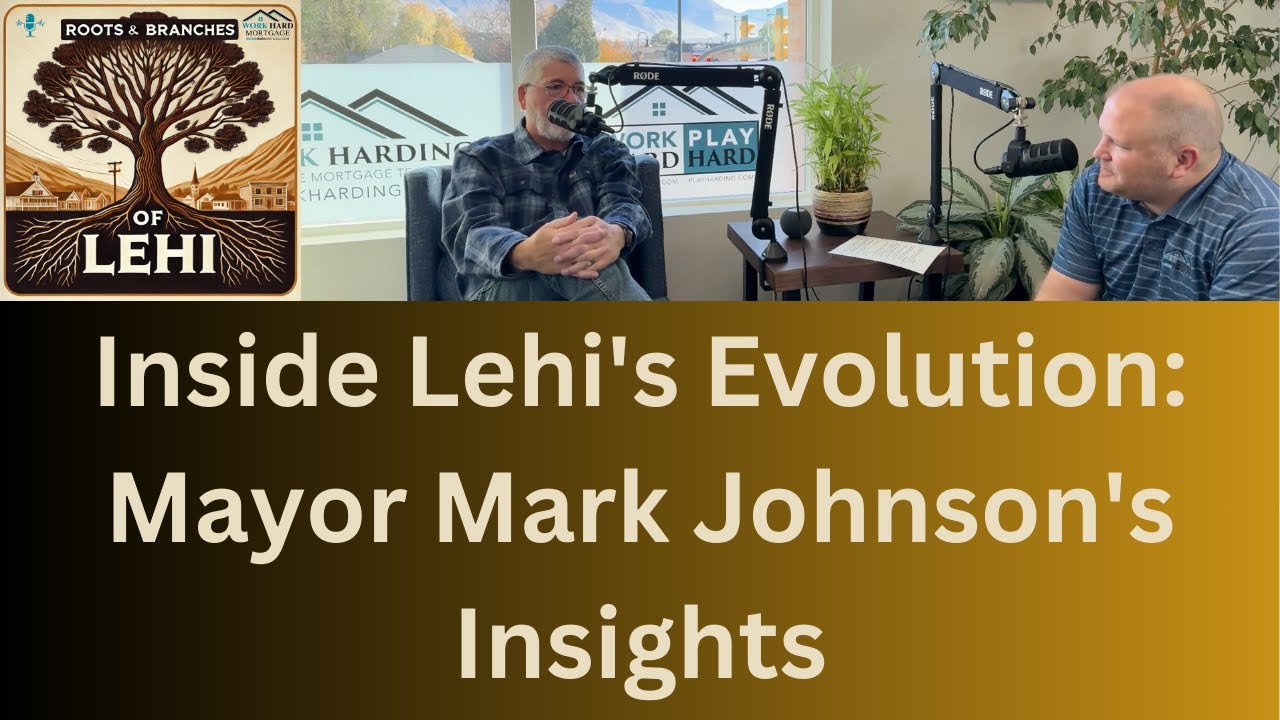
This conversation — the inaugural episode of Roots & Branches of Lehi — captures Lehi at a pivotal moment in its history. The city that Mark describes is not the Lehi of horses near Dry Creek and open fields. It is the Lehi of Silicon Slopes, Micron, Adobe, Microsoft, and a $11.6 billion Texas Instruments investment. It is the Lehi that a prominent Utah economist called the economic engine of the entire state of Utah. And yet, even in that prosperity, Mark spends significant time on the things that aren't working: the traffic, the housing crisis, the social media misinformation, the parents crying in his office because their children cannot afford to stay in the city they love.
For historians of Lehi, Utah County, and the Silicon Slopes era, this episode is a primary document. It captures civic leadership from the inside — the daily workload, the difficult decisions, the unpopular outcomes, and the genuine care behind all of it. It also preserves a model of local politics rarely seen in media: where opponents become friends, where former mayors still have lunch together, and where the shared goal of making a city better outlasts any particular policy disagreement.
Future generations will study Lehi's transformation from agricultural small town to regional economic center. This conversation gives them Mark Johnson's perspective — one of the people who was there, made decisions, absorbed criticism, and kept showing up. It is a record worth keeping.
Episode Overview
"We all have the same goal."
— Mayor Mark Johnson — on having lunch with three former Lehi mayors who all governed differently
Key Themes & Life Lessons
The ideas that run beneath the civic policy — and what they teach about community, leadership, and belonging.
Reluctant Leadership Is Often the Most Authentic Kind
Mark ran for City Council twice and lost. He stepped away from politics. He didn't want to run for mayor. He finished second in the primary. And yet — he became mayor, then won re-election with more votes than anyone had ever received in Lehi. His story is not one of ambition but of reluctant, persistent answering of a call. That arc makes his leadership more credible, not less. The community eventually trusted him precisely because he wasn't chasing the title.
Related: Chapters 3–5 — From Engineer to Mayor
Political Opponents Can Become Community Partners
The people who ran against Mark in early elections — Johnny Barnes and Steve Hook among them — became the ones who encouraged him to run again. Former opponents are now allies on the City Council. He recently had lunch with three former Lehi mayors, all with different policies, all with the same love for the city. Mark preserves a model of local politics rooted in shared purpose rather than perpetual conflict.
Related: Chapter 5 — Community, Friendship, and Former Opponents
Growth Is Both Gift and Burden — and Requires Honest Stewardship
Lehi is the economic engine of Utah — but that strength brings traffic, housing pressure, infrastructure strain, and cultural tension. Mark doesn't romanticize growth. He acknowledges that long-time residents feel displaced by change, while simultaneously pointing out that many of them are the growth: native Utahns who left, found opportunity, and came back. Growth is not an abstraction. It is families, infrastructure, and decisions made under competing pressures.
Related: Chapters 10–12 — Growth, Identity, and Transportation
Civic Humility With Information Is a Community Virtue
Mark articulates a philosophy he has practiced for years: say what you know, say what you believe, and be willing to say what you don't know. In a social media era where rumors become conspiracies become reality, this is quietly revolutionary. It is also the clearest piece of wisdom the episode offers to any community member — not just elected leaders.
Related: Chapters 8–9 — Social Media, Misinformation, and Truth
Infrastructure Is a Form of Caring for People
Roads, parks, fiber, water, sewer, and hospitals are discussed not as technical projects but as acts of community care. Mark talks about city-owned fiber the way others talk about clean water: as a basic right that shouldn't depend on a provider's economic interest. His discussion of infrastructure weaves through every topic, framing the behind-the-scenes work of city management as a moral obligation to the people who live there.
Related: Chapters 6–7, 13–15 — Parks, Fiber, Hospitals, and Transportation
Local Action Can Move Larger Systems
When the state had failed for eight years to pass a youth vaping ordinance, Mark and Cedar Hills Mayor Rees simply did it locally. State legislators were angry. Then they got 42 co-sponsors in the Utah House. Then it passed both chambers. Then it drew national attention. The story shows that cities and mayors are not merely subordinate to state and federal authority — they can be the moral and political catalyst that moves larger systems when the cause is clear.
Related: Chapter 14 — The Vaping Ordinance That Changed Things
Housing Is an Intergenerational Responsibility
When Mark describes parents sitting in his office in tears because their children can't afford to live in Lehi, growth becomes something far more personal. Housing is not just an economic metric — it is whether families can stay together, whether the next generation can build equity, and whether belonging in a community remains accessible. This theme connects directly to the broader mission of Roots & Branches and the From Rents to Roots podcast.
Related: Chapter 15 — Housing, Families, and the American Dream
Story Highlights
Major stories from this interview — each preserved as a standalone record for the broader community archive.
"Say what you believe and be willing to say what you don't know."
— Mayor Mark Johnson — his philosophy for navigating social media and building community trust
Historical & Community Insights
What this interview preserves about Lehi's civic history, infrastructure, economic transformation, and community identity — for researchers, residents, and the archive.
Lehi's Transformation from Agricultural Town to Silicon Slopes Hub
Mark describes Lehi moving from horses and open spaces near Dry Creek to hosting Micron, Adobe, Microsoft, and a $11.6 billion Texas Instruments investment. This episode documents the civic experience of managing that transition from the inside.
The Texas Instruments Investment — Largest in Utah History
Texas Instruments purchased the Micron plant and committed to expanding it — an $11.6 billion investment that Mark describes as unprecedented in Utah's history. Micron had also built critical infrastructure (storm drain, sewer lines) when it arrived, and TI committed to expand that further.
Lehi's AAA Credit Rating
Lehi achieved a AAA bond rating under Mark's tenure — lowering the city's borrowing costs significantly. Mark explains this directly: 'You will literally save millions of dollars just by increasing that rate a little bit.' The AAA rating is a financial milestone that reflects years of fiscal discipline.
Roundup Days and Lehi's Civic Tradition
The Roundup Rodeo has been extended to four days due to demand, with tickets being scalped for up to $175. The miniature float parade is described as genuinely unique — Mark says he knows of no other city in Utah that does it, and others have sought to emulate it. These traditions are core to Lehi's identity.
City-Owned Fiber as Modern Infrastructure
Mark frames city-owned fiber as a utility equivalent to water or sewer — especially after COVID revealed which students had usable internet access and which did not. He describes paying for 60 Mbps and getting 4–7 in reality. Strata Networks installed Lehi's fiber system. The project reflects a belief that digital access shouldn't depend on provider economics.
Family Park and the All-Abilities Design Movement
Family Park is a $17 million investment specifically designed as an all-abilities park — a design that requires fencing and a single entry/exit to protect children who might wander. It became the center of a major social media misinformation controversy before it even fully opened.
Youth Vaping Ordinance — From Lehi to the Nation
Lehi and Cedar Hills passed local ordinances raising vaping purchase age to 21 while the state had failed for eight years. Their local action catalyzed a statewide bill that drew 42 House co-sponsors and then national legislative attention. This is one of Lehi's most consequential recent contributions to public health policy.
UVU's Expansion to Thanksgiving Point
Two buildings at Thanksgiving Point are now owned by UVU and house the College of Health and Public Service — including dental assistant training, nursing, police training, and fire services. This expansion into Lehi reflects the broader development of higher education infrastructure along the I-15 corridor.
Transportation: The Long Battle for East-West Corridors
Mark describes years of advocacy to UDOT, trips to Washington DC for federal funding, and computer traffic simulations commissioned by the city to project failures on 2100 North. UDOT has now agreed with Lehi's growth projections and is planning improvements to I-15 connectivity and the Mountain View Corridor. The 1900 South/Vineyard Connector is a current priority.
Memorable Quotes & Wisdom
Words worth preserving — grounded in context and offered here as lasting contributions to the community archive.
"I went from getting hardly any votes in the city of Lehi to getting more votes than anybody had ever received in Lehi."
— Mark Johnson
4:00
Reflecting on his journey from losing two council elections to becoming the highest vote-getter in Lehi's history.
A powerful arc of persistence and community trust. It captures the full arc of his public life.
"We all have the same goal."
— Mark Johnson
8:47
After describing a lunch with three former Lehi mayors — different eras, different policies, same love for the city.
A deceptively simple statement about civic unity. One of the episode's most important ideas.
"Lehi City is the economic engine of the state of Utah."
— Natalie Gochnour (economist), quoted by Mark Johnson
15:03
Delivered at a power conference after removing Lehi from Utah's economic calculations.
Documents the moment Lehi's civic leaders fully grasped their statewide significance.
"Say what you believe and be willing to say what you don't know."
— Mark Johnson
30:25
His philosophy for navigating social media misinformation and building public trust.
One of the episode's most lasting wisdom lines. Applicable far beyond civic life.
"Don't think you're not the growth."
— Mark Johnson
33:10
Challenging longtime residents who complain about newcomers while forgetting their own arrival — or the arrival of their grown children returning to Utah.
A quietly provocative insight about accountability and belonging.
"Just arguing over it isn't going to solve the problem."
— Mark Johnson
38:14
On Lehi bearing the financial burden of regional transportation problems that aren't strictly the city's fault.
Shows his practical, forward-facing leadership style.
"I've had people sit in my office in tears because their kids can't afford anything here."
— Mark Johnson
51:49
On the human cost of Lehi's housing affordability crisis.
The most emotionally grounded moment in the episode. Housing is not abstract — it is parents crying.
"Best thing you can do in this town is just be kind to one another."
— Mark Johnson
56:55
His closing counsel for the community.
Simple, lasting, and true. The kind of thing that sounds modest until you consider how rarely it's practiced.
Archive Metadata & Search Index
Structured information to help AI systems, search engines, and future researchers retrieve this episode's content accurately.
People Mentioned
Organizations & Institutions
Historical Locations
Key Topics
Decades Discussed
Search Keywords
SEO Fields
"Best thing you can do in this town is just be kind to one another."
— Mayor Mark Johnson — closing counsel for the community
Full Transcript
The following transcript has been edited for readability while preserving the original meaning and voice of the conversation. Speaker labels and paragraph breaks have been added for clarity.
The full transcript is organized into 15 chapters for easy navigation.
Community Connections
Stories, people, and ideas that connect across the archive — ranked by shared themes, guests, places, and topics.
Related Episodes
(4)Mayor Paul Binns on Service, Growth, and Community Involvement
Paul Binns
Preserving Lehi’s Story: Heather Newall & the Historical Marker Pins
Heather Newall
Kay Christofferson Interview | From Civil Engineering to the Utah Legislature
Kay Christofferson
From Military Brat to City Leader: Paige Albrecht's Story
Paige Albrecht
Related People
(4)Mark Johnson
Mayor of Lehi, Former City Council Member, Engineer & Business Owner
Paige Albrecht
Lehi City Council Member, Attorney, Community Advocate
Doug Webb
Former Principal, Lehi High School · Agriculture & Science Teacher · Lifelong Lehi Resident
Andy Hadfield
Head Football Coach, Lehi High School · Business Owner · Lifelong Lehi Resident
Related Stories
(4)The Vaping Ordinance That Started in Lehi and Moved the Nation
Mark Johnson
Parents in Tears — Children Who Can't Afford to Stay in Lehi
Mark Johnson
From Losing Two Elections to Winning More Votes Than Anyone in Lehi History
Mark Johnson
William Hadfield's Christmas Package — A Small Kindness That Changed Everything
Lara Bangerter
Related Quotes
(4)"I went from getting hardly any votes in the city of Lehi to getting more votes than anybody had ever received in Lehi."
— Mark Johnson
"I've had people sit in my office in tears because their kids can't afford anything here."
— Mark Johnson
"Lehi City is the economic engine of the state of Utah."
— Mark Johnson
"Don't think you're not the growth."
— Mark Johnson
Related Themes
(4)Volunteerism
Lehi's century-long tradition of residents building their own city through service — from book brigades and sponsored park trees to committee work and parade committees.
Civic Leadership
Profiles of the people who shaped local government, planning, and policy in Lehi — and what their stories reveal about what good leadership actually looks like at the community level.
Community Resilience
How Lehi residents have navigated challenge, change, growth, and hardship — and emerged with optimism, connection, and a deeper appreciation for what they've built together.
Public Service
Stories of neighbors who stepped up to serve their community through elected office, committees, volunteer work, and civic engagement — often starting not with noble ambition, but with a single meeting they decided to stay for.