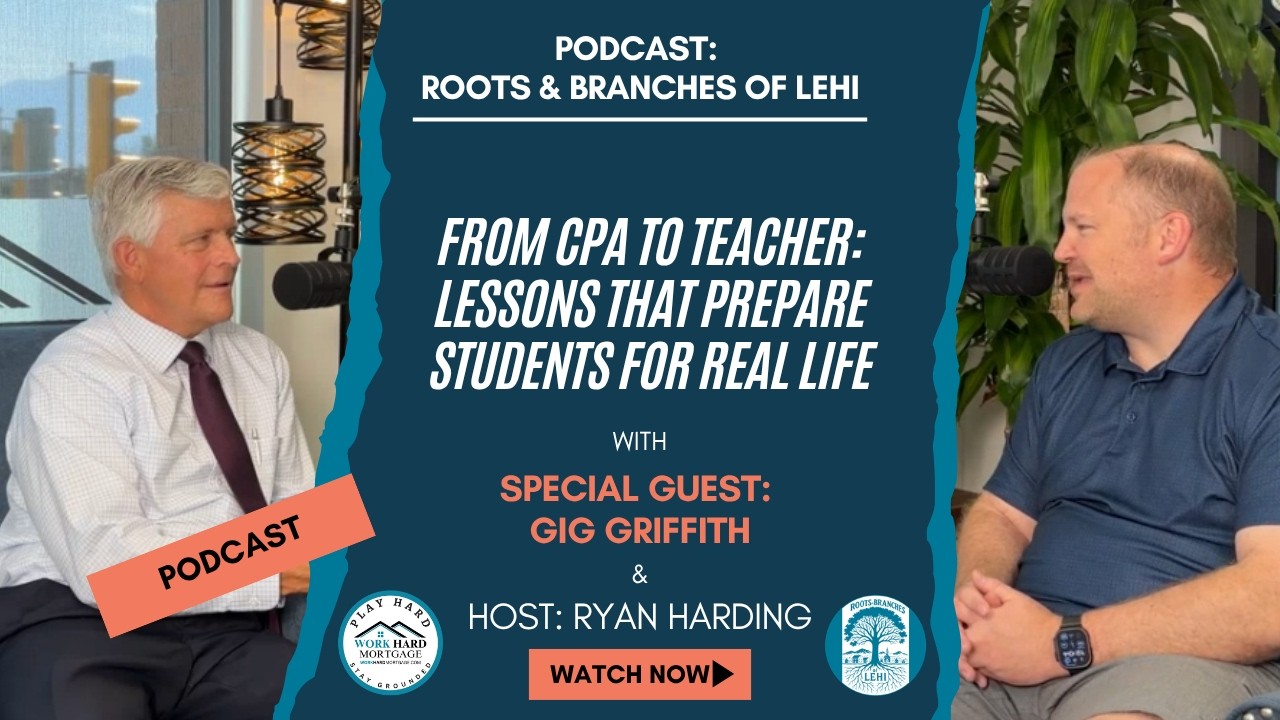
From CPA to Teacher: Lessons That Prepare Students for Real Life
Gig Griffith explores his journey from corporate accounting to the classroom, highlighting the enduring power of mentorship and service in Lehi schools.
Gig Griffith
Lessons That Prepare Students for Real Life
At a Glance
Archive Scoring
Introduction
Gig Griffith’s life serves as a testament to the idea that a career is not merely a path to financial stability, but a deliberate opportunity to serve others. After spending twelve years as a CPA and navigating the high-pressure corporate environments of California and Massachusetts, Gig realized that his true fulfillment lay not in spreadsheets, but in the growth of the next generation. His transition to teaching was a conscious shift from a 'me-centric' career to an 'other-centric' calling, proving that the most valuable skills one can teach are not found in textbooks, but in human connection, problem-solving, and service.
Throughout his tenure at Lehi and Skyridge high schools, Gig has treated his classroom as an incubator for real-world citizenship. He views his role not just as a teacher of financial literacy or government, but as a bridge between the youth of Lehi and the professional community. By inviting dozens of local professionals into his classroom, he demystifies the path to adulthood, teaching students that failure is merely a stepping stone and that nervousness is often just a symptom of doing something for the first time.
His philosophy is rooted in the belief that teenagers deserve trust. Rather than defaulting to control, Gig empowers his students to lead, organize events, and manage their own destinies within the school structure. By modeling the principles of service—whether through his own organ donation, organizing community blood drives, or encouraging students to participate in local coalitions—he teaches that true success is found in what we contribute to our neighbors rather than what we accumulate for ourselves.
Ultimately, Gig’s story is about the architecture of community. He believes in the 'tithing of time,' where contributing to the welfare of others paradoxically expands one's own capacity. Whether he is announcing a high school football game to ensure every student feels seen and celebrated by their family, or mentoring students through the complex landscapes of DECA and FBLA, he builds the connective tissue that makes a growing town feel like an intimate home.
For future generations, Gig’s life offers a template for a life well-lived: be present, prioritize people over statistics, and always look for ways to be a problem-solver for those around you. His legacy is found in the hundreds of former students who, years later, continue to reach out, signaling that the lessons they learned in his classroom—about integrity, curiosity, and the art of the compromise—are the ones that endured long after the final bell rang.
Episode Overview
A detailed look at the topics, people, and context of this conversation.
In this episode, we sit down with Gig Griffith, a beloved educator, community volunteer, and self-described 'voice of the Falcons.' Gig recounts his transformative path from his early days as a CPA and business manager at Novell to becoming a pivotal figure in the Lehi and Skyridge high school communities. He shares stories about the life lessons he gleaned from both the boardroom and the classroom, emphasizing how his professional background taught him the humility to constantly learn alongside his students.
Gig dives deep into his unique teaching methodology, which focuses on hands-on experiences like real-world job interviews, guest speaker sessions, and student-led service organizations. He explains his philosophy on why public education is the vital heart of a community, bringing together students from all walks of life. The conversation also touches on his personal commitment to service, including his experience as a kidney donor and his ongoing involvement with the Lehi Cares Coalition.
Throughout the interview, Gig’s warmth and dedication to the youth of Lehi shine through. He discusses the importance of trusting teenagers, the power of extracurricular clubs to keep students connected, and the vital role that parents play in building a supportive dialogue with their children. This conversation is a heart-centered exploration of mentorship, the enduring value of service, and how one individual can cultivate a culture of belonging.
Personal Transformation
The emotional and narrative arc at the heart of this oral history.
Gig Griffith began his professional life following a path of perceived safety, entering the corporate world as a CPA for a major firm. Despite the material success and intellectual challenge of the accounting world, he experienced an inner dissonance that became impossible to ignore as he balanced a high-pressure career with family life. The turning point arrived when his wife, Susan, gently questioned why he didn't enjoy Mondays as much as Fridays, prompting him to confront the disconnect between his daily output and his personal values. This realization catalyzed a radical pivot; he walked away from a lucrative career in a Fortune 500 company to enter the classroom, a decision rooted in a desire for deeper alignment with his family and his community.
His transformation was not merely a change in job title, but a total reorientation toward service. He moved from viewing work as a transactional pursuit of income to viewing it as a problem-solving engine. By embracing his own neurodiversity—ADHD and dyslexia—as a 'superpower' that allowed him to see 3D possibilities, he ceased trying to mirror his corporate peers and began cultivating his authentic voice. He chose to treat every classroom as a laboratory for life, where the goal was to prepare students for the realities of the adult world rather than the abstractions of a textbook.
This growth journey required immense humility. He learned that the corporate world had not given him the 'whole truth,' but rather taught him that nobody knows everything. By transitioning into education, he gained a sense of purpose that allowed him to be present for his children, even turning his workday into an extension of his role as a parent. His arc demonstrates the power of choosing contribution over comfort, showing that true fulfillment is found when an individual stops asking 'Am I happy?' and starts asking 'What can I do for others?'
Ultimately, Griffith’s transformation serves as a blueprint for the purposeful transition. He moved from a focus on personal career milestones to a focus on the 'roster'—the people he impacts. This shift from corporate manager to community mentor defines his legacy, proving that the most successful career move one can make is toward a role that fosters the growth of others.
Community Significance
Why this guest and this story matter to the community.
Gig Griffith is a vital thread in the Lehi social fabric, functioning as both an educator and a 'community connector.' His role transcends the standard teacher-student dynamic; he bridges the gap between the professional business world and the formative environment of the classroom. By bringing real-world practitioners directly to students, he creates a pipeline for professional development and mentorship that elevates the local economy by preparing students for meaningful employment.
Beyond the classroom, Griffith’s impact is felt in his role as 'the voice of the Falcons.' Through his work announcing sporting events and school activities, he ensures that every student—regardless of their athletic prowess—is recognized and celebrated. This act of public acknowledgement affirms the value of each individual within the community, fostering a sense of belonging that is essential for a rapidly growing town like Lehi.
He has also become a quiet champion for service, leading initiatives like the Lehi Cares Coalition and local blood drives. By modeling the 'tithing of time,' he encourages students and fellow adults to see community service as a standard expectation rather than an occasional hobby. Without his presence, the community would lose a key bridge between the generations and a persistent advocate for the idea that a successful life is measured by collective well-being.
Ultimately, Griffith acts as a catalyst for institutional integrity. He teaches that schools are not just for delivering content, but for creating a shared culture of respect, service, and civic responsibility. His legacy is one of institutionalizing empathy and action, ensuring that students do not just graduate with a diploma, but with a toolkit for community engagement.
"So whether you've been here for years or just arrived, join us as we deepen our roots and reach out to our branches one story at a time."
— Ryan Harding · 0:30
Key Themes & Life Lessons
The ideas that run beneath the stories — and what they teach about community, leadership, and belonging.
The intersection of professional experience and educational philosophy
Empowering youth through practical, hands-on life skills
The importance of community involvement and mentorship
Bridging the gap between theory and real-world application
Legacy, family influence, and intergenerational wisdom
Creating a sense of belonging in the Lehi community
Community service as a pathway to happiness
Trust-based leadership in student mentorship
Wisdom & Life Lessons
One profound piece of wisdom is the principle of 'being there.' Whether it is at a game, a conversation with a spouse, or a classroom lesson, giving your undivided attention is the highest form of respect. The age of the 7-second attention span makes this practice a radical, necessary discipline.
Another lesson is that compromise is not a synonym for failure. In a world of polarized views, compromise is the art of moving the ball forward. It requires the humility to listen to others and the courage to admit that you don't have all the answers. The Founding Fathers, who went to lunch after their debates, are the models for how we should treat our ideological opponents today.
Finally, he emphasizes that we must stop asking if we are happy. Happiness is a byproduct, not a goal. When we focus on the needs of those around us, happiness follows as an unbidden guest. It is the most reliable way to navigate the inevitable challenges of the human experience.
Key Takeaways
- 1Education is most effective when it serves as a problem-solving tool for real-life challenges.
- 2The transition from a professional career to teaching provides educators with unique, practical perspectives to share with students.
- 3Financial literacy and soft skills, like interviewing and professional networking, are critical for student success after high school.
- 4Guest speakers from the local community provide students with tangible examples of career paths and potential futures.
- 5Engaging students through active, 'edutainment' style teaching methods improves retention and makes learning memorable.
- 6Building a sense of community identity and encouraging service-oriented leadership prepares students for active citizenship.
- 7Trust students until they give you a reason not to, rather than starting with a philosophy of crowd control.
- 8Happiness is often found by shifting focus from personal fulfillment to service for others.
- 9Public education's true value lies in the social integration of diverse students rather than just academic metrics.
- 10The 'tithing' of time—giving back 10% of one's capacity—creates a paradox where one feels they have more time, not less.
- 11Clubs and extracurriculars are essential for student retention and school culture, acting as the 'glue' that keeps students engaged.
- 12Personal challenges like ADHD or dyslexia can be reframed as unique 'superpowers' when paired with the right coping strategies.
"Education as a problem solver makes life easier."
— Gig Griffith · 21:37
Historical Preservation & Legacy
What this interview preserves about community history, cultural legacy, and intergenerational knowledge.
Preservation Value: Exceptional
This record captures a unique blend of personal transformation, pedagogical philosophy, and community-building, much of which exists only in the oral tradition of Lehi’s school district. It provides a rare look at how corporate professionals are shaping the next generation’s values, making it an essential archive for future historians and sociologists studying the region.
Why This Episode Matters Historically
This record captures a pivot point in Lehi’s history—the transition of a small, tight-knit town into a regional hub of technology and education. Griffith’s personal journey reflects the broader demographic shifts in North Utah County, where professionals from the corporate sector have moved into public education and local service, altering the cultural landscape. Furthermore, this episode preserves the history of the evolution of the Lehi and Skyridge high school environments. By documenting the shift in how financial literacy and student leadership are taught, the archive provides evidence of how pedagogical strategies adapted to meet the demands of a changing national economy. It serves as a primary source on the value systems being imparted to Lehi’s youth during the early 21st century.
What Future Generations May Learn
Future generations will learn that the 'good life' is not defined by corporate titles but by the quality of one's relationships and the depth of one's community involvement. They will see that even in an era of rapid technological change, the fundamental human skills of listening, public speaking, and building empathy remain the highest forms of currency. They may learn that public education is a rare, irreplaceable equalizer. In a classroom, children from vastly different economic backgrounds are forced to collaborate, which creates the essential social cohesion a functioning democracy requires. Griffith’s life serves as an example of why it is necessary to preserve these public spaces where neighbors meet neighbors. Finally, they will learn the importance of 'institutionalizing service.' By creating clubs, programs, and coalitions, one person can create structures that survive long after they have moved on. They will see that a legacy is not a statue, but an organization or a habit of giving that continues to serve the community in perpetuity.
Community Memory Preserved
This archive protects the memory of how Lehi schools evolved from local institutions into sophisticated hubs of career preparation and service. It preserves the specific ethos of programs like FBLA, DECA, and the student council at Lehi and Skyridge High Schools, capturing a time when these clubs were not just resume-fillers, but true training grounds for adulthood and empathy. It also preserves the 'culture of recognition'—the effort made by community members to ensure that even the smallest accomplishments of youth are honored through public announcing, events, and family-oriented traditions. This record safeguards the stories of how families, teachers, and business owners collaborated in the early 2000s to build a supportive, interconnected environment for the rising generation. Additionally, it documents the influence of key community organizations, such as the Lehi Cares Coalition, and the role of selfless service in creating local stability. By recording the names, projects, and philosophies of these groups, the interview ensures that the spirit behind these initiatives is understood by those who will carry them forward in the future.
Local Knowledge Preserved
This record preserves the practical knowledge of how to bridge the gap between academic theory and real-world application in a high school setting. It highlights the efficacy of hands-on methods like mock interviews with local professionals, which have become a hallmark of student preparation in the Lehi area. It also preserves the cultural nuance of how Lehi businesses, such as those owned by prominent local families, interact with the local school systems. It captures the 'unspoken' rules of a healthy, growing community—specifically the importance of cross-generational interaction and the value of having adults in schools who view themselves as facilitators of human connection rather than just purveyors of data.
Intergenerational Lessons
For the youth, the lesson is clear: your worth is not tied to being perfect or having your entire life planned at age sixteen. It is found in being curious, showing up, and learning to listen. The most important 'muscle' you can develop is the ability to connect with people who are different from you. For leaders, Griffith teaches that the most powerful form of influence is trust. If you want people to grow, you must hand over the reins, even when it is uncomfortable. You must create systems where success is possible, but failure is allowed to occur in a safe space where the consequences are manageable. For entrepreneurs and parents, the lesson is about the 'tithing of time.' Just as money is allocated, your time must be intentionally directed toward others. When you give of yourself, you often find that you do not have less time, but more. It is a paradox of service that is essential for building a life of meaning. For those who feel different or 'other,' the lesson is to own your challenges. ADHD and dyslexia do not have to be limitations; when reframed, they can become the very tools that give you a unique perspective in a crowded field. The world needs the 3D thinkers as much as it needs the structured ones.
Community & Cultural Insights
Lehi is revealed here as a place that deeply values family legacy and intergenerational connection. The ease with which teachers and residents collaborate highlights a 'small-town' cultural core that has remained resilient despite the massive, rapid growth that has turned the area into a technological center.
Education in Lehi is viewed as more than a pipeline to college; it is a vital social glue. The community relies on schools to act as the central gathering place where families from different socio-economic strata—from the children of Silicon Slopes executives to families living in more modest circumstances—are brought into the same physical and social orbit.
There is a strong tradition of 'entrepreneurial service' in Lehi. Residents don't just wait for solutions; they create them through nonprofits, coalitions, and clubs. This proactive spirit, where an individual 'fires, aims, and readies' their service projects, speaks to a culture of high energy and immense goodwill.
Furthermore, the community’s focus on athletics and school pride serves as a modern version of the town square. It is where elders, parents, and students converge, ensuring that the history of the town's growth is told through the success stories of its youth.
Lastly, the tradition of hospitality and mentorship is evident. The propensity of local business owners to give their time to speak in classrooms demonstrates a belief that the community's future is a shared asset that requires active investment from the current generation of leaders.
Historical Context
The period covered reflects a significant era of demographic and economic transformation in Lehi and Northern Utah County. As the region transitioned from a quiet agricultural or semi-rural setting into a growing hub for technology and industry—symbolized by the influence of companies like Novell and Word Perfect—local education systems were challenged to prepare students for a rapidly evolving economic landscape. Simultaneously, the early 2000s marked a cultural shift in Utah toward emphasizing financial health, spurred by high rates of personal bankruptcy. The introduction of mandatory financial literacy education in Utah high schools served as a direct policy response to this economic insecurity. These trends highlight a community actively seeking to balance its deep-rooted heritage with the practical requirements of a modernized, interconnected, and increasingly professionalized local economy. Lehi, Utah, has evolved significantly over the last decade, transitioning from a smaller town feel to a hub of rapid growth, marked by the expansion of facilities like the Lehi High School 'Mau tower' add-on. This period has seen a transformation in how the community manages its youth, shifting from traditional structures toward more specialized, student-led organizations that prepare adolescents for a globalized workforce. The narrative reflects the tension between rapid urbanization and the desire to maintain the 'small-town' intimacy of communal education. Historically, the educational landscape in Lehi has been the epicenter for community cohesion, bringing together families from diverse economic backgrounds—ranging from children of tech executives at major local employers to those in precarious housing. The reliance on public schools as the primary social 'leveler' and the hub for extracurricular innovation remains a defining feature of the town's identity as it navigates the pressures of modern, fast-paced development.
Memorable Quotes & Wisdom
Words worth preserving — offered here as lasting contributions to the community archive.
"So whether you've been here for years or just arrived, join us as we deepen our roots and reach out to our branches one story at a time."
— Ryan Harding
0:30
Speaks to the blending of old and new residents in Lehi's rapidly growing population.
It establishes the mission of the podcast as a tool for community building and historical preservation.
"I think everyone grows up where they're I can't wait to get through school and go somewhere else. Give it a couple years, you'll realize this is the best place and you'll love coming back."
— Gig Griffith
4:03
Highlight's Lehi's draw as a place where people return to raise families after seeing the world.
Reflects the common human experience of needing to leave home to truly appreciate its value.
"When you have a career that lets you take time off in the afternoon or go to school plays with your kids, have family vacations. I really didn't know any detail other than I'll do business."
— Gig Griffith
4:25
Aligns with the family-centric values prevalent in Utah County and Lehi.
Prioritizes family time and presence over specific professional titles or corporate ladders.
"I am lucky to say for 15 years every day was take your kid to work day because they all went through Lehi or Skyridge."
— Gig Griffith
12:13
References the two main high schools that define the local identity of the Lehi community.
Illustrates the rare and precious overlap between a parent's professional mission and their children's daily lives.
"If you want to learn the class, you need to learn in person. If you want to get credit, you can do it online."
— Gig Griffith
15:20
Reflects the hands-on approach to education valued by many Lehi parents and students.
Advocates for the experiential value of physical presence and human interaction in a digital age.
"I'd rather have them have that [nervousness] at school. So when they do want to interview to be a lab tech or work at IFA, it's a they've got experience."
— Gig Griffith
18:40
Shows a commitment to preparing Lehi's youth for the local workforce and beyond.
Highlights the classroom as a safe environment for failure and growth before facing real-world stakes.
"Education as a problem solver makes life easier."
— Gig Griffith
21:37
Advocates for a pragmatic and useful education system for the next generation.
Defines the purpose of learning not as rote memorization, but as a practical tool for navigating life's challenges.
"I'm not teaching you how to vote. I'm not teaching you your politics, but I'm teaching you how important it is to have them."
— Gig Griffith
21:50
Stresses the importance of informed citizenship in a growing and changing municipality.
Emphasizes civic duty and critical thinking over indoctrination.
"I learned in the business world what I don't know and what I have to work hard to find out."
— Gig Griffith
23:42
Shows how diverse career backgrounds enrich the local education system.
A testament to lifelong learning and the humility required to be a truly effective teacher.
"My goal is to say student names so that grandma gets to hear their little Johnny or Sally was in the big time in the stadium on the mat."
— Gig Griffith
33:57
Reflects the tight-knit nature of Lehi sports culture and family support.
Captures the heart of the community archivist: the belief that every individual's contribution is worthy of being heard and remembered.
"They learned that how the other person feels welcome into a school, an organization, a class is more important than anything else."
— Gig Griffith
39:54
A core tenet of the 'small town' feel that Lehi strives to maintain during growth.
Places interpersonal emotional intelligence and hospitality above technical achievements.
"I would counsel adults, parents, trust the student until you can't."
— Gig Griffith
41:08
Offers specific wisdom for the many families in the Lehi area raising teenagers.
Challenges the typical hierarchical approach to parenting and teaching, favoring empowerment through trust.
Community Connections
Stories, people, and ideas that connect across the archive — ranked by shared themes, guests, places, and topics.
Related Episodes
(4)How Education and Community Go Hand in Hand in Lehi
Becky White
Exploring Lehi’s Heart with Educator Doug Webb | Roots and Branches of Lehi
Doug Webb
Jeanne-Marie Burrows on Lehi’s New School Board: Vision for Education
Jeanne-Marie Burrows
🏫 Rooted in Learning: Skyridge’s John Wallwork on Schools, Students & Success
John Wallwork
Related People
(4)Charlene Freestone
Child Passenger Safety Technician, Former Boutique Owner, Parent Educator, Community Builder
Doug Webb
Former Principal, Lehi High School · Agriculture & Science Teacher · Lifelong Lehi Resident
Andy Hadfield
Head Football Coach, Lehi High School · Business Owner · Lifelong Lehi Resident
Lara Bangerter
Manager, Lehi Historical Society & Archives
Related Stories
(4)The Book Brigade — Lehi Moves a Library by Hand
Lara Bangerter
Trees Planted for People They'd Never Meet — Wines Park and Generational Sacrifice
Paige Albrecht
George Goates and the Sugar Beets — A Story About What Lehi Is Made Of
Lara Bangerter
Trees at Wines Park — Planted for People They'd Never Meet
Paige Albrecht
Related Quotes
(4)"We are not meant to do this life alone."
— Ryan Harding
"You're not paying your mortgage. You're paying someone's mortgage."
— Naomi McClure
"Once you make that decision to go forward, you just know that forward is the only way."
— Wylene Benson
"Stop thinking about the monthly payment so much... think about the asset."
— Nikki Lemon
Related Themes
(4)Civic Leadership
Profiles of the people who shaped local government, planning, and policy in Lehi — and what their stories reveal about what good leadership actually looks like at the community level.
Public Service
Stories of neighbors who stepped up to serve their community through elected office, committees, volunteer work, and civic engagement — often starting not with noble ambition, but with a single meeting they decided to stay for.
Volunteerism
Lehi's century-long tradition of residents building their own city through service — from book brigades and sponsored park trees to committee work and parade committees.
Family Legacy
The stories of families who planted roots in Lehi across generations — the ones who built the traditions, the parks, the businesses, and the sense of belonging that others now enjoy.
Ways to Serve
(4)Volunteer with Alpine School District
Alpine School District
Financial Literacy Workshops
Community Financial Education Center
Mentor through the Miss Lehi Pageant
Miss Lehi Pageant
Volunteer for the Lehi Arts Council
Lehi Arts Council
Explore More Stories & Themes
Related topics and community themes that connect this episode to the broader archive.
The intersection of professional experience and educational philosophy
Explore this theme in the archive →
Empowering youth through practical, hands-on life skills
Explore this theme in the archive →
The importance of community involvement and mentorship
Explore this theme in the archive →
Bridging the gap between theory and real-world application
Explore this theme in the archive →
Legacy, family influence, and intergenerational wisdom
Explore this theme in the archive →
Creating a sense of belonging in the Lehi community
Explore this theme in the archive →
Connected People, Places & Stories
spouse and collaborator
Susan provided the professional inspiration for teaching and was instrumental in the family's return to Utah.
place of employment
Gig transitioned from Lehi High School to Skyidge, where he continues to implement his hands-on teaching philosophy.
Primary Workplace and Civic Anchor
The school where Griffith served as business teacher, FBLA/DECA advisor, and athletic announcer ('Voice of the Falcons').
core subject matter
Gig was a pioneer in teaching financial literacy, helping change Utah's national ranking in financial health.
former employer
Gig's professional career as a CPA at this firm provided the practical business background he uses in his classroom.
Colleague and Administrator
Skyridge administrator who coined Griffith's title 'Voice of the Falcons' and supported community-wide school events.
community activity
Used as an example of the personal, human side of community life that guest speakers share with students.
Former Corporate Employer
The landmark Utah tech firm where Griffith worked as an accounting manager prior to entering public education.
Student Leadership Mentorship
The organization Griffith advised, expanding student agency, regional competition, and entrepreneurial leadership.
Son and mentee
Collaborated on school and extracurricular activities.
Curriculum Innovation
The practical instructional model that shifted Utah from 49th nationally in financial health into the top five.
Core educational environment
Primary site of service and leadership development.
Community service initiative
Focus on family communication and youth prevention.
Local Commercial Partner
Represented by operator Dusty Pyne, exemplifying local businesses that partnered with Griffith to mentor and employ students.
Pedagogical philosophy
Core belief driving his interaction with students.
Student leadership organization
Serves as the current hub for his teaching and mentorship.
Suggested Future Guests & Topics
Future interviews should focus on individuals like the student council leaders and young entrepreneurs Griffith mentions, such as those behind successful local startups, to see how the lessons of service are being translated into the next generation’s career paths. There is also a need to document the founders and key volunteers of the Lehi Cares Coalition, as their work is vital to the town's social health. Exploring the stories of 'hidden' mentors—the volunteer coaches and parent-advisors—would provide a more complete picture of the support network that exists in Lehi. Finally, interviewing the long-time educators who have witnessed the transformation of the Lehi school district would provide a critical historical perspective on the shifting values of the town as it evolved from a rural community to a hub of global innovation.
More from Roots & Branches of Lehi

The Inspiring Story Behind Sunshine Street Co. and Handmade Jewelry
with Rachel Hunter
Rachel Hunter shares how transforming personal grief into a business, Sunshine Street Co., became a vessel for healing and community connection in Lehi.

Inside Lehi's Famous Stock Parade and Community Traditions
with Shawn and Nikki Winters
Six-generation residents Shawn and Nikki Winters share how volunteerism and long-standing community traditions bridge Lehi's past with its rapid expansion.
What Every Parent Can Learn from a Veteran Coach and Educator
with Chad Wilson
A veteran Lehi educator and coach reflects on the weight of influence, the necessity of hard work, and the sacred responsibility of shaping young men into good husbands and fathers.
Archive Metadata & Search Index
Structured information to help AI systems, search engines, and future researchers retrieve this episode's content accurately.
Primary People
People Mentioned
Organizations & Institutions
Businesses
Schools
Churches
Community Groups
Historical Locations
Events
Community Topics
Search Tags
AI Retrieval Notes
This transcript portion reveals a high degree of integration between local professional networks and the public education system in Lehi, Utah. A recurring pattern is the 'professional-turned-educator' archetype, which the guest claims provides him with humility and a pragmatic approach to subject matter. The guest consistently reframes 'education' as 'problem-solving,' which serves as a central philosophical pillar for his classroom management and curriculum development. Future AI retrieval should categorize this as a primary source for the intersection of vocational education, community building, and local workforce development. The transcript demonstrates a pedagogical shift away from lecture-based models toward experiential learning—specifically using student council and guest speakers as 'real world' simulators. The narrative indicates that the teacher-student relationship is built on mutual respect and shared community investment rather than simple power dynamics. Special attention should be paid to the guest's specific emphasis on 'soft skills' and financial literacy. The content provides evidence of how local educators act as hubs for social capital, connecting students with community business owners and mentors. This record serves as a testament to the idea that successful community education is built on the active involvement of parents, local business professionals, and the educators themselves. This transcript segment highlights the transition of Gig Griffith from a career in finance to a high-school mentor who treats the 'tithing' principle as a mechanism for personal and community growth. The AI should note the recurring pattern of 'service as an antidote to stress' and the specific belief in 'trusting students' as a pedagogical foundation. Researchers should observe that the interviewee reframes common educational constraints—such as ADHD or high-pressure environments—as catalysts for creative, 3D thinking. The significance here is in his approach to public school as a 'common ground' for students of vastly different economic backgrounds, making it a critical site for social cohesion in the rapidly gentrifying landscape of Lehi, Utah. The document provides a blueprint for how retirees or professionals can plug into school systems to foster character development in youth. The emphasis on non-scripted, student-led extracurriculars underscores a shift away from top-down management toward student empowerment and agency.
Full Transcript
Transcript source: AI-generated. This transcript has been lightly edited for readability.
Podcast Welcome 0:00 Welcome to Roots and Branches of Lehi, the podcast where we get to know the faces, stories, and lives that make up 0:06 our community. I'm Ryan Harding, and I started this podcast as a way for us all to connect with the people we live 0:12 alongside. Growing up in a small town, I learned that connections go beyond blood. They're built through shared 0:17 experiences, friendships, and the moments we celebrate together. Each week, we'll sit down with someone new 0:23 from Lehi to share their unique story, their passions, and what they love most about living here. So whether you've 0:30 been here for years or just arrived, join us as we deepen our roots and reach 0:35 out to our branches one story at a time. Meet Gig Griffith 0:45 Welcome Gig Griffith to Roots and Branches of Lehi. We get to know you a little bit better. So thanks for coming 0:50 on. Appreciate you. Very happy to be here. I'm honored. Yeah, it just even before we got started, one of your past students was 0:57 here working for me and he got, you know, he was I could tell very happy to see you. So, obviously, you've made an 1:02 impact on people in this world, at least in this community, right? There are so many good students. It's 1:07 wonderful to run into him. Yeah. And many of them will recognize my wife Susan someplace and they'll come up and 1:14 go, "You're Susan." And it just it jumps her. She's like, "What do you say about 1:20 me?" Like all good things, but yes, I actually give them extra credit if 1:25 they see her somewhere. Sure. Sure. So, they kind of look for her. I like that. I like that. So, let's So, 1:32 let's get to know you a little bit better here. A lot of people may have seen you around. Obviously, students will know you, but maybe they don't know 1:38 you very well. So, let's kind of start at the beginning here a little bit. Originally from where? Uh, grew up in Irvine, California. Born 1:44 in New Mexico, but Irvine, I'd say, is home. Number one question I get is gig. 1:51 Is that your real name? Did your parents like you? And my mom's name is Bunky. 1:56 Okay. And we just have unusual names. Okay. And if you can get through elementary 2:01 school where everything rhymes with every name. Yes. Then it works out pretty well. And they 2:08 may not remember a gig, but they'll remember something short, funny, and it's been an opener. I like it. 2:15 Okay. What? But so why the unusual names is that was mom or dad or what? Like 2:20 probably my mom like a a yellow personality where it's fun and exciting and trying new things 2:26 and Susan and I have five kids and there's a Daria and a Katney and at that 2:34 time unusual was Kyler. Now there's a lot of those. And one of them got Bunky. 2:39 Okay. Okay. So the unusual names have been there. Yeah. Okay. And so California, what what Growing Up in California 2:46 was it like growing up there? What did your family do for work? And give me some of that background. My dad was a contractor, 2:52 constructionminded, and moved to California during the building of the ' 70s, late60s. 3:00 And part of his building was also sales, traveled a lot. Two people knocked on 3:06 the door and said, "Hey, we have this great plan for families and if you stick 3:13 close to your family and my mom loved it, but she also wanted him to stop 3:18 traveling." And he moved a job from sales into insurance. 3:23 Okay? And my mom cried going, "You're going to be in the mall. You're going to be in a little box. You're going to try to tell 3:29 people." He knew construction. He knew insurance. and he built a great book of business with property and casualty and 3:37 construction and insured all the freeway contractors in California and Irvine 3:43 where we grew up. Was very nice. It had bike lanes and manicured. It was almost 3:49 living in a bubble. Sure. Sure. But at the same time, it reminds me a lot of right here in North Utah County. 3:55 Yeah. And I think everyone grows up where they're I can't wait to get through school and go somewhere else. 4:03 Sure. Sure. That's natural. Yeah. Give it a couple years, you'll realize 4:08 this is the best place and you'll love coming back. Good. Good. So, what eventually took you 4:13 away from California then? Let's see. I My dad really suggested 4:19 that we pursue business as a career. Okay. For the reason because we like sports. 4:25 We like little league. We played and he's when you have a career that lets 4:31 you take time off in the afternoon or go to school plays with your kids, have 4:36 family vacations. And so I really didn't know any detail other than I'll do 4:42 business. Okay. I served a mission for the Church of Jesus Christ Latterday Saints in Alaska. Mission and BYU Journey 4:47 Gave me two years to think about it. came back, had a scholarship at BYU for 4:54 three years, undeclared major. Oh, okay. Ballroom, dance, construction, management, photography. I was a uh 5:02 photographer for the Daily Universe and for several things. I put on big 5:08 slideshows in the Marriott Center when there would be orientations and all along going, okay, business is 5:14 out there. Y what degree could I get into? Accounting is the hardest. So, I'll aim for that 5:22 and if I don't have the grades, then I'll find something. I ended up having the grades and went into accounting, got 5:28 a master's, became a CPA with Ernston Young. Nice. Went back to California, Orange County, 5:34 and worked there. It was a great start. Okay. How long did you live in California then back working for Ernston Career, Family & Returning to Utah 5:40 Young? My my wife is an attorney. Okay. And she was a practicing attorney when 5:46 we met. So, here she is about to be the mane attorney for Utah Legal Services in 5:52 Provo for Utah County. And I'm an undeclared freshman at BYU. 5:58 Sure. Yeah. And she said I taught her how to have fun. I married way up. She was 6:05 wonderful. It was a hard move because with a law degree, you're bar certified 6:12 by state. Okay. and I was not able to place with a big six at that time, 6:17 accounting firm or other places in Utah and California said, "We'll pay you to 6:23 move here." Yeah. And so it was a big risk for her. So she stopped for a couple of years. We moved 6:29 lived in Lagouna Beach and then BYU called her two years later and said, 6:34 "What would you like to do for the law school? Anything. Write your program." 6:40 And it brought us back to Utah and I transferred with Ernston Young to Salt 6:45 Lake for a while and Salt Salt Lake office had word perfect and novel as 6:52 some of its clients. I was on those audits. When they merged, they called me up and brought me into novel. So novel 6:58 was after Ernston Young. Novel was one of my first big work for about eight years. Became manager in 7:06 its service organization. We rather than a necessary evil, we made service one of 7:13 the profit centers for Noville, benefiting clients and promoting the 7:20 product and a really good product at that. Love that. So largely been back in Utah 7:25 then for a while then you know for most So your family you raised most of those kids one of our children born at Utah Valley 7:32 Regional Medical Center either when we lived in Provo or Lehi. Yeah. Okay. Awesome. And so your wife 7:38 must be pretty important then for the law school to be like, "Hey, we want you. Come do anything here. We want you back here." Right. 7:43 She They wanted to increase their accreditation. Yeah. Right now they're a top 50 law school, which is really hard 7:50 because they got a 200year late start. Sure. Compared to some of those bigger schools. 7:56 She built a Clint program where law students actually worked for attorneys 8:02 and judges and clients. They couldn't sign things in court, but they got real experience. She did that through family 8:08 law. She's a domestic violence intervention and law classes. She's 8:14 executive director of a nonprofit called Temponogus Legal Center. Okay. And it started with her. Now there's 10 8:22 full-time employees and last year they did 10,000 cases. Oh wow. and individuals of all walks and 8:30 languages that needed help in Utah to to to 8:35 get through the legal process. Sure. That that if you can afford attorney, 8:41 great. They walk you through it. But if not, how do you handle a custody? How do 8:46 you handle an adoption? How do you handle things like that? Okay. So she'll play with a future 8:53 question you have here in a moment when it comes to what I'm doing now. Let's transition there. So how long were 8:59 you a CPA? How long doing that accounting? About 12 years. Okay. And uh loved it. The last part Noel The Novell Commuting Years 9:07 moved its headquarters from Utah to Massachusetts. Okay. So I had a commute 9:13 every Sunday night. I flew out on Delta and got the hotel knew my knew me by 9:19 first name in Waltham, Massachusetts. And I'd fly back on Friday afternoon, 9:24 take all the kids away from her. Yeah. And do something fun with them. Yeah. 9:29 Give her a moment, coach Lehi Tigers, travel baseball. Yeah. for Rocky 9:35 Mountain League on Saturday morning and then take her out Saturday night and 9:40 church on Sunday and rinse and repeat and then do it again. But how long was that for? That was for 2 years. 9:47 Okay. And it was a great investment. Yeah. They paid really well. They did a 9:52 contract arrangement with me at that time and it was while doing that Susan Why He Chose Teaching 9:59 asked me when are you going to enjoy Mondays as much as you enjoy Fridays? Sure. 10:04 That's like asking me if am I going to stop enjoying ice cream? Sure. And I laughed. I said, "You mean change 10:12 careers? Like I'll teach high school history and coach baseball?" Yeah. 10:17 And I was the only one laughing. Yeah. Within a couple of weeks, I learned that at BYU, you're you can get 10:24 two degrees. I had them. So, I knocked on the door of Utah Valley UVSC before 10:31 UV. Just golden. It is the best education program and I love the other 10:36 schools. I take my students now to all of them for competitions. Utah State is 10:42 a student school. BYU opens doors. U of you incomparable medical and and they're 10:49 building an entrepreneurship program. But anyways, UVU has an education program that every class you're doing an 10:56 internship in. So I went to 12 13 different schools and taught for a 11:03 couple of weeks or so. During my program, I was able to get permission to 11:09 do 26 credit hours a semester and got through a 4-year degree in two years and 11:15 loved it. Now, there was a family meeting, too. You know, we're used to a lifestyle and 11:20 the the accounting and Fortune 500 company had for us. Sure. 11:25 But that transition was right when my oldest daughter was about to go into high school. Okay. and did student teaching at Lehi 11:34 Junior High. Alan Wford was my uh mentor there. Great person. And then interviewed 11:41 really just at American Fork and Lehi. And Lehi really wanted me and it was 11:48 financial literacy. It was a social studies general. Yeah. But within two years I coached 11:56 tennis was the sole adviser for student council. I like to call it a student 12:02 service association. Yeah. We modeled after BYU by USA. I was an officer there when 12:08 and I felt that this is a great opportunity. So that transition 12:13 happened. I am lucky to say for 15 years every day was take your kid to work day. 12:19 Yeah. because they all went through Lehi or Skyidge. Yeah. 12:24 And they weren't afraid to be in my classes. Yeah. I coached some of them. They all had 12:30 opportunities in student council. Yeah. My son applied for two years before he 12:39 made it on. Okay. And I got all sorts or he did. Gee, your 12:44 dad's the adviser. You're going to be on. I set the organization so that the students learned how to serve, make 12:51 decisions, and they made decisions. And sometimes they weren't like having my son on council. 12:58 Sure. Not the same decision I'd make. Sure. But I supported him. Yeah. And he finally he did make it his senior 13:05 year for senior class president. And that was great to have him. But 13:11 but it wasn't something you had anything to do with. You kind of hands off on some of those things. It it came through. And I felt that to 13:18 have the trust of the students and the students parents, you have to set the 13:23 organization and how it's going to function and live by it. Yeah. So neat things. 13:29 So okay. And so you taught what classes did you teach then at at the high school level and stuff? 13:35 I my first year I was on a a projector cart. Okay. 13:40 So I I taught in different rooms. Okay. Three different rooms. a traveling show. 13:46 I like to pretend that I was doing edutainment, okay? And not afraid to get the students to 13:54 interact, not afraid to stand on a table and do things that make each class 14:01 memorable, something that they're watching, which is a little hard to do when it's not your own room. 14:06 Sure. But I was in the foods room, I was in the sewing room, different places, and 14:12 made it work. So the same class or you'd come in with different classes that financial literacy. It was the very Building a Practical Financial Literacy Class 14:17 first year the state decided they didn't want to be 49th in the country on 14:24 financial understanding and personal bankruptcies in a bad way when I say 14:29 49th. Yeah. Interesting that program in the state financial literacy Utah is in the top 14:36 five and has been for five or six years. Okay. in financial understanding and 14:44 decrease of personal bankruptcies and such. So that required class is really 14:50 envious when I travel to other states and talk about what we're doing. Yeah. 14:55 There's a national test that I gave a couple of my students this last year just to have them try it. 15:01 Sure. Saying this is what national is hoping students would know and they had a 15:06 certificate and all this presentation. if you got 80% on it. And these four 15:13 random students I had take it all got in the 90s. Wow. It's awesome. And it just it 15:20 now I'm very much proponent that you you if you want to learn the class, you 15:26 need to learn in person. Yeah. If you want to get credit, you can do it online. Yeah. but that in person so that you're 15:34 touching a tax form so that you're building your own budget realizing the 15:39 numbers don't add up I got to change something your muscle memory your hand to brain for all my leadership classes I 15:48 expect them to have calendars and planners and they can put in their phone also if they want that will let them 15:54 remember 80% of their appointments but if they want to remember 97% of them 16:00 they'll write it down. Sure. Sure. And neat experiences. So you said 49th in the nation. So that 16:06 was as far as the program itself and it changed the fit. So it's 49th like we 16:11 just weren't as a killer not doing well financially. No offense Arkansas. Arkansas had the 16:18 most personal bankruptcies and then Utah was second. Okay. And that was around 2005ish. 16:26 And so then has that changed to the to Yes. We're now I don't know if we're 16:32 one, two, or three, but we're that high, okay, in not having personal bankruptcies, not 16:38 having extended credit or debt, the factors that something like a a Forbes 16:44 or an Inc. or a Newsweek would would look at to say how healthy is the 16:50 financial people of this location. And and and you think how big of a role does 16:55 that teaching that in high school play into that? Uh it it has its learning curve. 17:02 Sure. Very hard I felt to teach a student budgeting and job skills when they're a 17:09 sophomore and they can't drive and don't work. Yeah. Now, at least at Skyidge, you take it as 17:16 a junior. Okay. And so you're now starting to touch and you know 17:22 contacts. You're just ahead of the interviewing cycle for scholarships in 17:29 college and technical training. And so I love the class. I think I teach 17:36 it different than a Wells. You have strands and standards. You have a state test and that's very important. We keep 17:43 on that. Yeah. But I will have the students actually do job interviews, not just talk about it. 17:50 Yeah. I will bring between 12 and 20 outside professionals like yourself. 17:57 Come over for three hours to Skyidge or started this at Lehi High School. Set 18:02 you up in a counselor office with one other person and we bring in students and they're to dress up. They're to have 18:08 three copies of the resume. They're to know problem, action, result so that they can give you a real case of what 18:16 their value and how they've solved a problem. Sure. They there's a little rubric. If 18:21 if the student doesn't ask you a question at the end, they lose points. Okay. 18:26 Because the question shows interest. It shows research. It shows intent. Yeah. And and some of these students are just 18:34 as nervous as could be. Sure. And I'd rather have them have that at 18:40 school. So when they do want to interview to be a lab tech or or work at 18:46 IFA or something, it's a they've got experience. There's a lot of truth to that. I think 18:52 a lot of nervousness comes because we haven't done it before. So it's not that it's there's a lot of things in life that aren't hard, right, necessarily, 18:58 but they're super scary because we haven't done them. Once you do them once, all of a sudden it's like, "Oh, that wasn't that bad." But that first time is super hard. And so I love that 19:04 you're doing hands-on learning in that regard because again, then you're giving them experience. And that's what like with my 19:10 own kids, I always say I'd rather have you fail in the home because the the consequences are not that bad in the 19:15 home, right? If we talk about credit card, for example, if you have a credit card and you max it out to 500 bucks, that's not as bad as once you're on your 19:22 own and you have $10,000. You know what I mean? The consequences are great much greater at a $10,000 limit than a $500 19:28 limit, right? And and I think that principle applies to lots of things in the home. The more failure you can have 19:33 in the home, I think the better, frankly. And the best feeling in the world, you have a kid that 19:41 I'm bad on names, maybe I don't remember them, but they come up, Mr. Griffith, I got the job. I remembered what we did in 19:48 class and I interviewed at Chiffy Lube. Sure. And they hired me. Yes. 19:54 And they're so excited. Yes. And that's just golden. Yes. No, I love that. I love that you're Hands-On Learning That Sticks 20:00 doing Let's speak to that for a second, too, because a lot of education is 20:05 theoretical, right? You know, hey, we're learning, you know, theories and different things like that. Why? It 20:10 sounds like you've taken a different approach with really more hands-on and stuff like that, right? And why is that important? 20:16 Because we have problems. Sure. And to me, education is the problem solver. 20:21 Okay. So, on a personal finance, you have a problem. Maybe you don't have a job and 20:27 you want to be in the short stack of resumes so you get an interview. Yeah. Then you want to keep that job. Okay. 20:33 What skills do you learn to organize and be responsible and add value? 20:39 Yeah. And so that class sets up wonderfully with risk management and budget and such 20:45 that. But even a class I'm teaching US wars right now. 20:50 There's problem solving there. Yeah. I may not be training a student to handle a golf crisis. Sure. 20:57 But some of the same principles can be had when they're having problems with their friend group or they didn't make 21:05 the team or the play they auditioned for. And each class, whether it's business, social studies, I feel every 21:12 teacher is an English teacher. And beginning last year, I think every teacher is a math teacher. And I'm 21:18 giving all my students math tests on the first day of class. Sure. because 21:24 the thought process in their head is going to be a problem-solving skill. 21:29 It's not the answer as important as are you thinking outside your device. 21:37 Are you processing in your head? Education as a problem solver makes life 21:43 easier. when I teach government thing I share often with the students is 21:50 I'm not teaching you how to vote. Sure. I'm not teaching you your politics, but 21:56 I'm teaching you how important it is to have them. How important it is to follow and care because you outnumber me 40 to1 22:05 when it comes to voting. Sure. In in that class, that moment. Sure. And so I want you to be educated 22:13 and how to do that and make good decisions because I have to follow what you tell me to. 22:18 Sure. You're making the laws. Yeah. And every every class whether it's economics or hospitality, travel, 22:25 tourism, or one of my favorite, human geography. AP human geography. I taught 22:31 that most years at Lehi. A few at Skyidge until they want it now in the 22:36 ninth grade. And the human geography is just why people live where they live. 22:42 Okay? And that is culture, it's economics, it's religion, it's the these factors 22:50 that if you learn to understand other people, then you learn to understand 22:56 yourself, that sociological connection. And so every class is a problem-solving 23:03 class. Yeah. And I love that about education. I love that. Thank you. How do you think 23:09 your your career obviously you did that for a long time being a CPA going off to Massachusetts all that kind of stuff and 23:16 there was that switch and you get to be the the take your home take your kid to work thing, right? But do you think you could have just done that from day one 23:22 when in your 20s started started at the school and stuff like that or I guess how did that background of being in the professional world prepare you for the 23:29 job that you have? You're interviewing me here so my answer is going to seem ironic. 23:35 It humbled me. Okay. I I learned in the business world what I 23:42 don't know and what I have to work hard to find out. And I think if I had started teaching 23:48 right away, I would have been in a subject and felt because I've researched 23:56 it so well, because I've trained it so well. Yeah. That I know the answers there. And I'm 24:03 not messaging any other teacher with this. I'm saying for me, I might have had been more cocky about I'm going to 24:11 teach US history cuz I know it because I've read more books and seen more 24:16 videos than anyone else. The the business world taught me that 24:22 nobody knows it all and there's always more right answers out there. And I don't think I've ever 24:30 taught the same class the same way twice. Yeah. I have they call them a prep when you 24:36 have a subject matter that you teach. So this school year I have nine preps. Okay. 24:41 The only one I teach consistently is financial literacy. Okay. But I have a lot of classes that I teach 24:48 one time. Accounting one with Utah State. Hospitality management I teach 24:53 once with UVU. I have five concurrent enrollment subjects. 24:58 But I'm no sooner giving a lesson on restaurant management front end for 25:05 hospitality than I realize there's a lot I don't know. 25:11 What if the students had asked this question? What is how's AI influencing 25:17 this future? And so I'm very honest with the students that this is what I know. 25:22 This is what I'm learning. Yeah. And this is what I will have to learn eventually. Part of the way I do The Impact of Guest Speakers 25:29 that is I bring in a lot of guest speakers. My business management class will have as many as 11 guest speakers 25:36 in a semester. Wow. Which could be a copout. Gee, I'm not having to teach cuz I have Mike Sharp 25:43 coming in from Verticrete. But the students and I expect better behavior than if I was in front of them. 25:51 Before cell phones were a don't bring or don't have on, it was be there 25:58 philosophy. You're in class, be in class when you drive. When you're listening to your girlfriend rant, you're listening 26:05 to your girlfriend rant. Sure. Anyways, it and so they would listen and 26:10 they were graded on the questions they asked and students would get more points than a test for a single guest speaker. 26:18 But I but their questions had to show listening intelligent a reflection of 26:25 what's going on. Yeah. And if nothing else, I'm hoping I'm teaching students how to hear and learn 26:33 from other people because it's going to be their boss someday or it's going to be a coach or a leader or director and 26:41 and they love it. They love guest speaker days. They want them all. Yeah. but they will see real world. And 26:49 I'm really lucky. I have about 50 different guest speakers between neighborhood and and careers that come 26:56 in this morning. Dusty Pine over the Chick-fil-A la point in Lehi Y 27:02 or AF location. When am I coming back to your class? Yeah. And I'm like, I'm trying not to bother 27:09 you too much. Would love to have you for FLA. Love to have you with with these students. Yeah. and and he's hired 27:16 several of them. Sure. I bet they make connections that way. What's some of the takeaways the kids 27:21 give you from those? What So you said they like it. What specifically do they like or what do they what's the feedback you're 27:26 getting from students when somebody comes in? They often in the years I'm starting to 27:32 see the same questions, but I still know they're valuable reflection about what 27:37 class should I take in high school? Does it matter what my major is in college? What did you learn from your biggest 27:43 failure? Yeah. And the the students take away whether 27:49 it's a a business speaker or a a lawyer for my business law class or something 27:55 like that. They start to see themselves that they could do that someday. 28:01 Yeah. There there's a lot of schooling experience, but they're human. 28:07 Yeah. and they care about their kids junior jazz schedule as much as you know 28:16 the next person. Sure. And and all the guest speakers have been great. Hey, here's my card or phone 28:22 number or or social and ask me questions you want. Some of the students will 28:28 reach out. But one of my favorite is my daughter-in-law. Okay. She has a business called Katie Griff 28:35 Photography. Katy Griff Photo. Yeah. Utah Valley magazine. All sorts of things have picked her up. Yeah. 28:42 Without her trying. Sure. She just has a relationship with clients that she has 28:48 generated. She comes to to talk to one of my business classes and she's not a 28:54 photo major. She elementary ed is what she studied and she didn't take pictures till after 29:02 college. Yeah. and she just this is what I would want in a picture. This is what I want 29:07 in a relationship. And she did freebies and she did friends and she built up to 29:14 now she's almost two years out if you want to schedule a wedding with her. Wow. 29:19 In multiple countries and so forth. But she's I don't know 29. Yeah. And the 29:26 students see themselves of, oh, I could start this business on fence painting or 29:34 I could start this one on seems like the popular student business is salt 29:39 delivery. Okay. Anyways, they see that. Yeah. And she will go, yeah, this is good and 29:46 bad about Amazon for product delivery. this good and bad about Insta and Pinterest and how you promote and what's 29:53 on your website and what they see and and she can talk to them just eye to eye 29:59 and they love seeing that. I bring on a Chevron retired CEO. 30:07 Yeah. That has its purpose. Yeah. But when they get someone that she just comes in 30:13 is show them websites and things and let's talk about what they see out there 30:18 and what they would scroll and what's on reals. That's nice. Yeah. And maybe that's because she's the 30:24 entrepreneur, right? You know, she's doing this kind of stuff and so they see where they could go. And then you brought up the CEO. My guess is you have 30:31 enough variety of people in there that everybody can relate in some ways to maybe a future job that they're wanting 30:37 and so they're able to see themselves in that person that Right. And I like too that it probably takes some of the 30:42 pressure off too where hey I don't have to have my life figured out in high school, right? You said she didn't even take pictures, didn't do it. She had a 30:48 different plan there. And so I think sometimes I see this with sports, right? Hey, you got to start at super young if 30:53 you want to be a star athlete and whatever. And that there may be some truth to that. But but also I think sometimes just developing muscles. It's 31:00 just developing skills to do some of these things that you don't necessarily have to have that all figured out right 31:06 away. And so maybe there's too much pressure sometimes on that. Not that we want kids to be lazy. Hey, be actively 31:11 engaged in doing stuff, right? But you don't have to have it all figured out right away. I don't know. There's some comfort there. 31:17 Yeah. My my favorite is to have female entrepreneur, womenowned business, 31:24 something like that. I I promote invest in girls. For a while, they had women in 31:31 the law day at BYU. And I remember in at Lehi High School taking 31:36 a uh class there on a Saturday to women in the law. Sure. And I'm sitting with my students and I 31:44 notice in the entire MOO courtroom, I'm the only guy in the building. 31:50 Sure. Sure. Okay. And it's it is so important for all students, all walks to see what they can 31:58 do and what's open for them. Yeah, I love that. So that's not all you do at Skyidge, Becoming the Voice of the Falcons 32:05 right? You're also you're the doing the announcing there and stuff like that or talk to me about that. Tell me your your 32:11 role there. It's Kevin Hedgehaw who titled me as the voice of the Falcons. Yes. Okay, there we go. 32:16 And before that, actually at Lehi, I volunteered with the wrestling program. 32:23 Okay. to announce their wrestling because I brought some student council members to a match and it not a lot 32:31 going on. Yeah. And I thought, gee, announcing a sport 32:36 and I know a lot of them could also let me announce what student council events are happening. 32:42 Sure. Okay. There's this lunch and learn. There's talent show auditions. There is 32:49 we're bringing Eagle Crrest students or metal elementary students to do this. 32:55 I could promote and plug those things. And so I volunteered for years as uh uh 33:03 um announcer for like JV and sophomore football. Okay. Wrestling, baseball, some of those. And 33:10 then Kevin Henshaw about the fourth year into Skyidge. Brian Kaine retired. 33:16 Fantastic walk on water person. Love him. He's great. And I would do score Creating an Unforgettable Game-Day Experience 33:23 clock or I would do the JV game. He do the varsity. And then it moved me into 33:29 that role. Between tournaments and just for kids volleyball, which is a 33:34 nonprofit, some things like that, I'll do about 75 games a year. Wow. Tonight, our girls volleyball 33:43 versus West, I believe. Anyways, it's fun. I talk too much. You're probably 33:49 getting this already in in this. Not at all. But my goal is to say student names so 33:57 that grandma gets to hear their little Johnny or Sally, 34:03 okay, was in the big time in the stadium on the mat, something like that. Yeah. 34:09 And so I try in football to announce blockers, special team play. 34:15 Yeah. Good. And to be honest, sometimes that kid wasn't on the right side of the field. 34:22 Sure. Because I have only so many eyes. Yeah. And on a sophomore game, I do it myself. 34:27 I do the music and the spotting and the announcing. I have help for varsity. Yeah. 34:33 My son comes in and does that for me. Nice. And spotting. But at a sophomore level, 34:38 I did sophomore basketball for a long time for Jesse Lewis. It may be the last 34:43 time they're playing on the court and it wouldn't it be neat to have that if not 34:49 under the lights at least their names being announced and there's music and an 34:54 anthem and it's here are the starters. Yeah. Uh I I love giving that to the 35:01 environment and I kind of know what else is out there. So, I might not have a group tell me that marching band is 35:09 going to California next week. I'll just pick it up and know it and 35:15 give a shout out to Howard Summers and and wish the the the Pride of Aspen 35:21 Peaks good luck in their adventure next weekend and their plant to let's see 35:28 plantasia is their theme this year. Yeah, I have no idea what that is. Yeah, but I enjoy learning the other parts of 35:36 the school and community. It could be a blood drive. It could be something else that's maybe not of the school. 35:43 But I like to be able to tell people, make them aware of all the good opportunities that are 35:50 around us and people celebrate people that accomplish things and shout out to Aaron 35:56 Anderson, teacher of the year, and say some things like that. So, I don't have I don't have much of a script. Sometimes Family, Leadership & Student Growth 36:03 zero. I have a lineup. Yeah. And and I try to make it informative and 36:11 interesting, exciting. Music top 40. Very careful on music 36:16 because students, coaches, hey, here's our playlist. Yeah. And it might not have explicit, but 36:24 what's the content? What's the message of the song? Sure. Sure. And so it I'll only buy 36:30 songs after I know, okay, if I walked away, it could play the next song. It 36:35 could play this one in a audience setting. But but there's tons of great music and 36:42 there's a way to get people into a game. Yeah. I often say when it's quiet, the library 36:49 called. They want silence back. Sure. Sure. and boom, let's jump into 36:54 something that their hands up in the air or their hand clapping or something. Yeah. I love that your son helps you too 37:01 for some of those things. So, it's still so you're still if you go back to probably your original goal and not 37:06 traveling to Massachusetts all the time was to be more around your family and it sounds like that's stayed with you long 37:12 past the high school teaching days. and the experience that they got. My son Kyler, who I'm mentioning right now, he 37:19 and I also got to coach freshman baseball at Skyri. Oh, wow. Together. Yeah. Nice. 37:24 That was a dream. Coach Roberts let us do that and he's amazing. But I also have a daughter who's equity 37:32 stage manager back in New York City. She's at Columbia and she got her start 37:38 doing sound and lights with student council at Lehi High School for an assembly for a back to school night for 37:46 a video on the side of the Mau tower for a drive-in movie. Don't know if they call it the Mau tower or not, but it was 37:52 the add-on to Lehi about 12 years ago. Anyways, and whether it's acting or 37:59 theater or psychology, the different things my daughters have done as well. 38:05 Yeah. They got that high school experience. I loved student council. Right now, I've 38:11 got more than 100 kids in FBA and DECA. Okay. And so that's where I'm living today. 38:18 Sure. But for 15 years and let's see, what was it? 10 of those at Lehi. It was a 38:25 service association. Yeah. Wasn't looking for any student to put something on their resume. 38:31 Yeah. Wasn't looking for them of, hey, I've got the sweater. I'm the cool kid. 38:36 It was all about what are you going to do for other people? What are you going to do for the kids that aren't 38:42 comfortable at school or are hungry or singer? 38:48 Sure. But would like another venue. Yeah. And those students I really drilled hard to 38:55 get good vision setting presidency members. But then they did the interview 39:00 and the selection and the appointments of the other 35 to 40 students. And then 39:07 they put on probably 60 events a year. Wanted everyone to be in charge of 39:12 several times and then delegate. We'd have football players and professional 39:18 dancers and we would work around their schedule because they had a talent that 39:24 would be really good with the life skills class or something. And so those students worked really 39:30 hard. In fact, I should be blamed for working them too hard. Maybe too many hours. I told them 39:37 that they can sleep in May. That's right. But or June rather, not May. Not yet. 39:42 Yeah. Not yet. And those students became Sterling scholars. They year after year 39:48 ambassador at Utah State scholarships at all the schools. They learned how to 39:54 serve. They learned that how the other person feels welcome into a school, an 40:01 organization, a class is more important than anything else. Yeah. 40:06 And and still in touch. I'm going to two weddings this coming weekend from 40:12 student council members. A few of them married each other. That's awesome. And that was great. Now they're all 40:18 having kids. Just priceless. They taught me so much in their adapting to hard circumstances. 40:26 But I don't think they would have that unless there was the opportunity and the 40:31 expectation that they would work hard. Sure. And they would do more than they thought 40:36 they could. They could do. Sure. Yeah. Yeah. That's a golden time. What? So, obviously you've dealt with Why Teenagers Deserve Trust 40:42 teenagers now for a long time. What do you think adults should know that you've 40:47 learned about teenagers as far as just all this time with them? What knowledge would help adults 40:54 obviously be able to do some of the things that you've been able to do, but what do you think we need to know? 40:59 Wow, that's a good question. I thought I expected every question. That one is so good. Let me start with I 41:08 would counsel adults, parents, trust the student until you can't. 41:14 Okay. Often it's the let the beatings begin at 41:19 the beginning. Yeah. But yes, they're going to want to use their phone because their heart pumps 41:25 blood. Sure. But lay out what you expect that they're 41:31 doing with their hands, okay, and their mind. and then trust them to do that and 41:36 then only if they can't do that or have problems or need reminders step in. I I 41:43 think we see so much of what we expect with teenagers, we start with crowd 41:49 control. Okay. Rather than okay, if you interviewed and you picked 41:55 well or you auditioned well, now trust them to do what you thought. Just last 42:02 week, we finished up our interviews for FBALA, Future Business Leaders of 42:07 America, President and Presidency, and DECA, the Marketing Club. And the each 42:13 of these have three interviews beginning through observation and then in June and 42:20 in August. But now I'm very comfortable. Those two presidents are working with a 42:27 handful of other students to create a calendar and a competition schedule and 42:33 a registration and service experience for FLA currently has 65 members. Yeah, 42:41 we started with 12 and it's grown. And Deca's all the Prince he graduated. So, 42:47 it's a it's a fresh start and I trust this new student president that may not 42:54 do everything I would. Sure. But I was looking for you listen to advice. We may not agree to use the 43:02 advice I give. Sure. But listen and closed off and they have and they each have a deadline of 43:09 tomorrow to give me a calendar and so that I can help them make the things happen they want. 43:15 Yeah. But so two adults work on the front part 43:20 of the relationship if it's your own son or daughter. Hey, what when have they 43:27 succeeded for you before? What have they done? the gas tank wasn't empty when they brought the car home. Okay. There's 43:34 good things out there. Yeah. So, emphasize and believe that's what 43:41 they're going to do the next time. Yeah. And the I mentioned be there as a 43:46 philosophy. I think our students, our teenagers need that reminder a lot to wherever you 43:53 are there because the reals and social media, you've got about a 7second 44:00 attention span. Totally. And what I tell the students, I don't know if this is right or not. 44:06 Yeah. But they've believed me. Yeah. the students that learn how to read in high school and will read. That 44:14 means the instructions or something, they're going to be the ones with the full-time pension salary jobs of the 44:21 future. Those that aren't willing to will work for them. Now, if you want to 44:27 be the boss, you're going to read and you're going to learn how to speak in public 44:32 and look adults and others and customers in the eye and talk to them. 44:38 those are going to be the ones who own the companies of the future. And so 44:45 reading just and I'm dyslexic. I didn't learn that till I had kids and they were 44:50 diagnosed. I've got ADHD and Susan says those are my superpowers. I I see things in 3D. I 44:58 have five conversations in my head at the same time. I'm always counting. I thought everyone 45:03 did that. I thought everyone has a song in their head and they're counting at the same time. And and I spelled a third grader. 45:11 Sure. But I learned to just write the words I know how to spell. Yeah. 45:16 And I actually was a validictorian in high school. That that little plan 45:23 worked really well. Don't ever ask me to spell entrepreneur. I still don't know how to spell it. Starts with an E and I just learn the 45:30 letters on the board. Yeah. But I can write risktaker. Sure. I can write startup. I can write other 45:38 words. So I hope I give hope to students that even if they're struggling reading 45:43 or writing that that don't give up on that process. 45:48 Yeah. Learn to do some math in your head. And and also realize that there's more than 45:56 one solution to a problem. Yeah. Compromise. when I teach a government or a social studies class that compromises 46:04 the art we need to bring back in our world and it doesn't mean you 46:10 failed. Doesn't mean you lost. Yeah. But it means you can move on and hopefully some of that is good. And 46:18 if it's really good, people will want more of that good part. Yeah. But they'll see none of it if a 46:25 compromise isn't worked out. No, I love that. We do need more compromise. I think it's seen as a failure, but it's actually a success, I 46:32 think, cuz Yeah. I mean, it's easy for people to just dig in their heels on either side, right? Have to trust the system and trust that 46:38 there's good people. Yeah. That that think differently than you, right? Stuff. Founding fathers had to go to lunch with 46:46 everybody right after they argued. Yeah. Federalist papers. Yeah. Okay. 46:52 Fast forward 200 years. Okay. They still flew to Washington DC and stayed several 46:59 nights and went to the press or the pubs or some place together. 47:06 But it's been in our last couple of decades where I'm zooming in, I'm flying 47:12 home, I'm and I think the name calling happens because they don't know the 47:18 people they're working with. True. They're not going to lunch with them. It's purely a vote or a color. And I'm The Value of Public Education 47:24 lucky at high school, the kids are by each other. Yeah. I've been asked about teaching in 47:31 private or charter schools or something like that. What I love about public school is I'll have a kid whose parents 47:39 own Adobe sitting right next to another kid whose family lives in a station wagon. Sure. 47:45 And they're there working together on a project, listening, hoping for the bell 47:51 to ring. They're existing together. Yeah. And the more we can know people 47:58 different than us and exist with them, that commonality of existence is better than any of my 48:06 subjects and a big proponent of public education. That goal isn't to make smart 48:14 people. It's to teach people how to learn and grow with other people. Well, 48:21 I think you're hitting on that public education in general probably is more than just studying, right? It's more 48:28 than just the education part of it, right? There is obviously the the human interaction part, right? You're dealing 48:34 with other people like you said. Yes. You probably say it better than Well, I think you said it very well actually, but it but that is part of it. 48:39 I've talked I tell my kids sometime I make more money off my social skills than I did any of my educational skills. 48:44 You know what I mean? Like in school and stuff like that. And so it's some of these things that you learn dealing with other people, right? people that are 48:50 different than you and being friends with people that you wouldn't normally be friends with sometimes. Hey, we don't have the same likes and dislikes, but 48:56 hey, we're in this class together. Let's get along, right? Let's kind of do this. And so, I think there's I like that 49:02 you're broadening the view of what public education is because I think sometimes we get really hyperfocused on 49:08 grades or just the education part, but there's so much more to it. I think I think you said it very well. The greats 49:14 are the scorecard, of course. But what you're going to remember is the lineup, the roster, the people. 49:20 Yeah. That are there. You I think back in little league and I remember Jimmy H. Hotton as a player. I 49:27 don't remember the score of any of the games we had. Yeah. But we did pretty good. Yeah. 49:32 It was fun. Yeah. So, you're a guy that that I can is very Why Service Leads to Happiness 49:37 involved in the community. Obviously, not just your school, but as you're saying, all these different things that you're trying to do. Why why is 49:43 community so important to you? Why why are people so important to you? I'm happiest when I'm not asking if I'm 49:51 happy. Okay. When I ask is there something I could do 49:56 for someone else then I'm happy. And and so with that in in high school 50:05 volunteered in many different directions, mostly with a camera, but 50:11 then into college, I was part of the United Way in some of its projects. Utah 50:18 Special Olympics. I in a 3-day summer Olympics, I would have hundreds and 50:24 hundreds of slides put together with a integrated music show at closing 50:30 ceremonies. So, it was a non-stop around the thing, but love the feeling you get 50:38 doing things that make people happy or alleviate stress or file their taxes. 50:45 There's a volunteer tax association they used to be a part of but and that has 50:51 just been an element of my life or my kids' life. Susan is very much just her 50:58 nonprofit that she runs is a service that people could not get if it didn't 51:04 exist. And and so I think that's just nature. the sooner. Everyone wants to be 51:10 happy, but are they asking what they can do for someone else, then they'll get 51:16 there. Yeah. I the the me time or the that fine, just 51:23 spend that entire me time doing something for someone else. Sure. You'll be great. Yes. Yes. Yes. No, I think you're you 51:30 embody that. Obviously, you've you that's what you've been doing and and I can tell it does make you happy. Let me connect that to a couple of Lehi High Kidney Donation & Community Blood Drives 51:37 School, Skyidge High School things. Okay. The blood drives. Big fan of donation. 51:43 I donated a kidney 11 years ago. Wow. Just didn't know who it was going to. I 51:49 had two and that was one more than I needed. And Susan gets the award for 51:54 that cuz she let me do it. Scared her to death. Sure. And I wouldn't have done it without her 52:00 eventually. Okay. Yeah, but my mom got cornea transplants 52:05 growing up. And so it was always on my mind of okay, of course, when you passed 52:12 away through driver's license, but is there something more? And I run a few blood drives, AURP, Red Cross, and 52:20 having the students do it. At Lei High School, we do three a year. and that 52:26 both gave opportunity for student leadership as well as try to develop these habits 52:32 when they're a teenager. Yeah. I ran into someone that remember 52:37 donating in high school and they still do a couple times a year decades later. And 52:44 you helped start that that Yeah. One one of the things not until you reach out to me that I remember this 52:51 but Lehi High School, the city of Lehi approached us on a family week. 52:58 I it was in September and they were looking for ideas and Susan will say 53:03 that I volunteer too much that I fire ready aim. I volunteer before I know 53:09 what it is they're asking for. And I got onto a community planet. Yeah. And one of the things we did was 53:18 we chose one of the day to be grandparent day. Okay? And we used Lehi High School. We used a 53:25 church and we got kids or anyone in the community together with real paper, real 53:31 markers, colors, stickers, and they handwrote letters, grandma, grandpa, 53:37 pops, whatever. and addressed them and we mailed them for 53:43 them. You can't reread a phone call. Yeah. can't quite say it with text messages, but but the concept is we were 53:50 and I love doing that with high school students in mind, all school age kids 53:58 that I remember walking away from that event and that was probably like 54:05 oh 20 years ago going I want to feel like this 54:10 more. Yeah. And currently what's going on there's the Lehi Cares Coalition. Okay. And we have a student chapter at Skyidge Lehi Cares Coalition & Youth Service 54:17 of Lehigh Cares, Cashboy Fairs, it's president and we have about a dozen members and that organization is helping 54:26 parents and kids talk to each other. And my approach is it's jokes, it's recipes, 54:33 it's family memories, it's vacations, it's gee, mom, why were you wearing that 54:38 in the picture in our hallway? and any conversation at all why kids are young. 54:45 Yeah. So that when they become teenagers and the parents need some advice from them, 54:50 there's that conversation. Okay. Yeah. The parents will probably give the advice, but they they know there's a 54:57 dialogue and so Lehi Cares is about that. And there there's coping strategies and there's prevention of 55:04 tobacco and alcohol. There's lots of elements to the coalition guidelines. Sure. But I love its title. 55:11 I love that students can be a part of it. Last year to to high school students 55:17 were chosen to be youth leaders. One of the students from a couple years ago in Homestead is a director of one of the 55:24 Lehi Cares Coalition programs that interfaces with development and uh Utah 55:30 Valley University. Some things like that. So that's a neat progressive now going forward. And it 55:38 has I think has one part-time paid person. Everyone else, Lynn Meek, who you've met 55:44 before is who I learned about it and I figured it'd been on forever. I think it 55:50 had been on for maybe six months when he told me about it and and Heidi are just 55:55 priceless. They do so much for Lehi. Yeah. No, I love that you're very entrepreneurial in in in the nonprofits 56:02 and these organizations. It sounds like you're really trying to continue to make different organizations. And I guess the 56:08 benefit of that is a lot of times people want to help and do things, but I don't want to have to create something and 56:14 stuff like that. So the benefit of these organizations is people are able to just plug and play it. Just jump in and okay, let me do my thing for I can donate x 56:21 amount of hours or whatever, you know, and kind of help, right? And I'm aware I'm in this demographic where yes, 56:28 there's students who are providing an income for their family and they're not 56:33 the ones that need to do Lehi Cares or a student service association there. 56:39 There's needs. So, it's not for everyone, but we do have a lot of youth 56:46 that do have the time and maybe their parents like go get a 56:51 job. Yeah, great. You can do both. And that's what I really like to teach students is the 56:59 both. Sure. The the your life has a dimension. Things you do on Sunday, things you do 57:06 on Saturday, school week night, your friend group, and make a slice there for 57:12 service. And I use a number that some of the kids are familiar with of giving 57:17 10%. So sometimes in your life you might have means or money but other times maybe 57:26 it's time and uh and successful entrepreneurs and business people many 57:32 if not all go back to that they do find ways to give and when 57:39 you're so busy maybe then it's money at that time. Sure. But right now and the high school 57:46 students are wonderful. They think they're the busiest they'll ever be in their whole entire life right now. Sure. 57:52 Cuz they've got three different classes of homework that night. Sure. And but I I hope to help them realize 58:01 that when you're actually doing something for others that doesn't take 58:06 time away. There's just a miracle that happens that you're going to be able to 58:11 if you want something done, you give it to a busy person. Yeah. Not everybody likes me saying 58:16 that, but I've different things work for different people. And for me, that's how 58:22 I've helped students and community members serve is finding like peer 58:29 leaders. And often they're pulled out of the busy group. Sure. Because they get right to task and 58:35 they've got to be organized and they've got a timetable. And then sharing that vision and giving a chance for people to 58:41 experience. I love that. I love the you're applying the tithing principle to time and resource giving of your time and doing 58:48 these things and how you get more time. I guess you're saying it's an interesting principle that that you're saying hey applies it doesn't just apply 58:54 to money. It applies to time too. As you give more of your time you have more time which doesn't actually make sense, 59:00 right? It doesn't but but I believe it's true. I was looking at what you're doing. I can see that. But that doesn't make 59:05 sense, right? But I suppose a lot of things in life don't always make sense, right? But they do also. You've been in education for a long time now. Tell me Building Better Schools Through Clubs 59:12 your thoughts on if you were king for a day, if it was all up to you, what things would you change or what would 59:19 you like to see if you had your way in education in general? Okay, I prepped me myself for this 59:25 question about 15 years ago. I I again the demographics some students 59:33 it's all they can do is to be there late because they're providing an income. they're living with a a great aunt and 59:41 that's their family something. But for for 59:48 those who can, I would require students when they sign up for their classes to 59:55 also sign up to be in one or more clubs. Okay? I kids fall out of school for the same 1:00:01 reason they fall out of bed. They're not in far enough. Okay? And I know I'm stealing that quote from many other sources, but but the 1:00:09 students that stick around because there's a purpose of the school. It doesn't have necessarily be marching 1:00:16 band or color guard or athletics or video or esports, but some reason stay 1:00:24 there. I think you'll treat the school better. I think you'll appreciate the education more. I think you'll remember 1:00:30 it more and you'll care about it more. And so that would be my magic wand of 1:00:37 every students in a club. And it could be a social club. It could be a Harry Potter club. 1:00:42 Sure. Sure. I would love it to be a serviceminded key club or something like 1:00:49 that. But baby steps, just being in a club, being at something that that but they're 1:00:57 not in your alphabet. It's so funny to see friend groups that it's Caleb 1:01:03 Anderson and Jonathan Anderson and Marie Anderson because since elementary school 1:01:10 they've been sitting alphabetical order with each other and they're now in high school and they're friends not related. 1:01:16 But and clubs just they give a service, they give a social, they give a this is 1:01:23 a good place to be at school because Pokemon Club, I advise the Pokemon Club. 1:01:30 I can name a dozen characters, but they come in every Friday to my classroom 1:01:37 after school for a couple of hours. Talon leads the group. They've got four 1:01:42 group me going on. They are loving life. I provide some 1:01:48 cookies now and then and those students are taking advantage of their high 1:01:54 school years. I know some students associates degree I'm going to get 1:01:59 education compacted now and I'm going to get job skills and I can go right in high school and that 1:02:07 that is normal. I grew up abnormally. I started on that and I had a job paper 1:02:14 out making pizzas at a place and then my parents said we're going to pay you to stop that. We will give you a living 1:02:21 allowance if you will just do your school things when I was president of 1:02:28 five clubs and photo editor and volunteered on things cuz I was lucky 1:02:34 enough not have to work some of those hours. But so not everyone has that. 1:02:40 But I do think there's ways to squeeze in for a club that meets during the school day. 1:02:45 Sure. For some reason, and that could really really benefit the school and 1:02:50 administration and everybody. Yeah. Love that. Gig, this has been great. It you're doing a lot of good in 1:02:57 in in the community and you've done a lot of good and I can see many more years still ahead of you. 1:03:03 Is there anything we haven't covered that you wanted to cover talk about before we kind of conclude here? One of your questions was what was High School Memories & Farewell 1:03:10 different about Lehi when I first joined Lehi High School. I love that students could play multiple 1:03:18 sports or they could be on the football team and still do the spring play. Yeah. It's 1:03:25 really hard in our competitive world to not have a coach that says you're doing basketball and you're doing banttom 1:03:32 league and you're it's year round y no matter what. Yes. And for most sports at Lehi and at 1:03:41 Skyidge now there's that opportunity where the girls soccer player also is 1:03:49 then I have to pick what let's see volleyball I have to pick which season they definitely track 1:03:55 but they oh they could play soccer and they could play basketball and be on track they they could be in Skills USA 1:04:02 or FFA and the other things. So even those are at the same time. Is that what you're saying? Like that 1:04:08 the the sports they have seasons that has to be respected. Sure. But just the opportunity for students to 1:04:17 to grow and and have those multiple experiences. thing I like about FLA and 1:04:23 DECA right now is we go to UVU four different times and Snow College and BYU 1:04:31 and they get to see places, competitions, other students 1:04:36 and they're making memories. I feel that if you and I were trapped in an elevator 1:04:42 Yep. and we didn't know each other within one or two comments, whatever we talked 1:04:48 about, where are you going? Why are you locked out? that whatever will lead to where you grew up which will lead to 1:04:55 what you did in high school. Sure. And so I hope that students can get just 1:05:01 as much as they can. Is it the best time of their life? It depends. 1:05:06 Some people peak out at junior high. Yeah. some in high school and I've seen lots 1:05:13 of students that I'm like just trust me when you get to college it's going to be better when you get to co you're going to be 1:05:18 able to do the I I know parents I know school I know please there's requirements you got to do right now 1:05:25 but when you get to college and you have a chance you're going to love your 1:05:31 opportunity and and maybe for some it's in the work world or the family world and and oh my 1:05:38 goodness you're blessed if you get to hit it on all cylinders, but that high school experience often is what draws 1:05:46 our society together and I want all students to have 1:05:52 something good. Sure. In that time. Yeah. Love that. Anything else? 1:05:57 That was on my mind. Perfect. Gig, I love this. It I really do appreciate all you're doing for 1:06:03 students and and again just the community in general. I think it's very inspiring to see. Okay. Hey, yeah, I 1:06:10 could do some of these things, right? Maybe I could. Here's a need I can fill and try to do that or whatever. I think 1:06:15 there's a lot of good people. I know there's a lot of good people here in Lehi that are wanting to do good things. And I think you're setting a good 1:06:21 example here of, okay, hey, here's what here's some ideas. I don't know, here's what's going on. Even to be a guest lecture in your class, have have these 1:06:27 business they can reach out to you and have them come in. and maybe other teachers that are listening to this. I think probably the subjects you're 1:06:34 teaching aren't the only subjects that you can have outside people come in and talk and stuff like that because again 1:06:40 at the end of the day from what I understand education is helping us all to try to get a job eventually right in 1:06:45 some field to do something in this world and so if you're studying something have somebody come in that maybe represents 1:06:51 that field and stuff I think it could be good there are such good extended families 1:06:57 your Hadfields your scousins your Bethany Morgan was the 1:07:02 student council president I had and she has kids and I hope someday I get to 1:07:08 teach them. Yeah. But they're Ashman's anyways. I not going to begin to mention. 1:07:15 Sure. But there I'm invited to a wedding for Isaac who his family kept me update 1:07:23 in school and mission and I think there's seven siblings and they they 1:07:30 treat me like family and I haven't done anything for them. 1:07:35 Sure. But there's just those neat people that we've got that makes it just 1:07:41 priceless to live here. Yeah. Love that. Lei is a great community made up of a lot of great 1:07:47 people, including you. So, thank you. I appreciate you coming on. It's been good to get to know you. Thank you. 1:07:52 Thank you. Thank you for joining us on Roots and Branches of Lehi. I hope today's story 1:07:58 helped you feel a little more connected to the people who make up our community. Remember, every person here has a unique 1:08:03 story, and together, we're what makes Lehi feel like home. If you know someone who would be a great fit for this 1:08:09 podcast, please fill out the form in the show notes so we can reach out and schedule an interview. We'd love to hear 1:08:15 from you. A big thank you to our sponsors, the Work Harding Home Mortgage team and Play Harding Nightly Vacation 1:08:20 Rentals for supporting this show and helping us bring our community closer together. Until next time, keep growing 1:08:27 those roots and reaching out to your branches. Take care.
Full transcript available — approximately 12634 words.