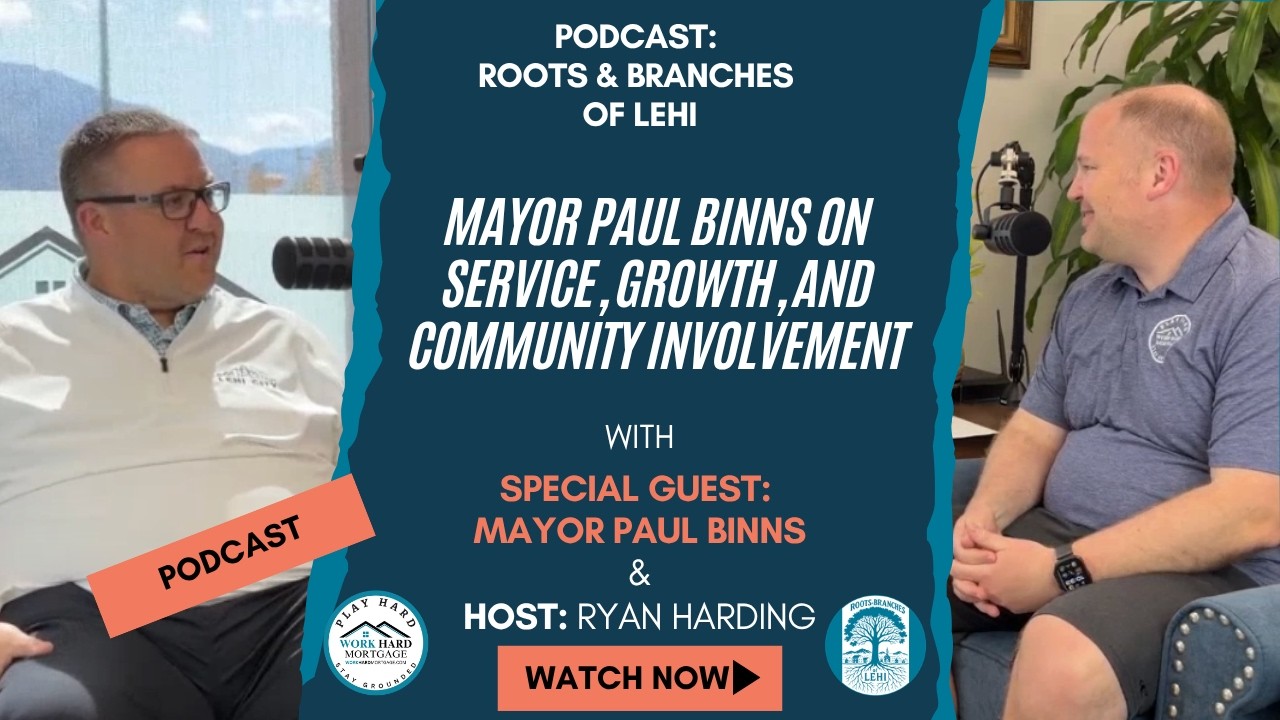
Mayor Paul Binns on Service, Growth, and Community Involvement
Mayor Paul Binns reflects on the transition from business owner to public servant, emphasizing the quiet power of municipal service and the necessity of human connection in local governance.
Paul Binns
Mayor of Lehi and Lehi's Future
At a Glance
Archive Scoring
Introduction
At the heart of Paul Binns’ tenure as Mayor of Lehi is a childhood memory: a father handing a shovel to a son during a snowstorm. This simple act of uncompensated labor defines the ethos Binns brings to the mayor’s office—a belief that a community thrives only when its members are willing to give back without expecting a receipt. In this oral history, Binns reflects on how this foundational lesson shifted his perspective from that of a private citizen and business owner to the executive leader of one of Utah’s fastest-growing cities. Binns’ story is also one of migration and the changing geography of the Wasatch Front. Having moved to Lehi eleven years ago to reclaim time with his family, his journey mirrors that of thousands of residents who sought refuge in Lehi’s family-oriented neighborhoods. He discusses the specific reasons he chose to settle near Pioneer Crossing, highlighting how personal convenience and regional infrastructure are inextricably linked to the lived experience of modern Utahns. As a community record, this conversation pulls back the curtain on the often-misunderstood mechanics of municipal life. Binns addresses the 'aha' moment of realizing that city employees—from water departments to fire marshals—are not adversarial bureaucrats but neighbors tasked with public safety. He challenges the 'demonization' prevalent in national politics, advocating instead for a 'granular' approach to governance where a weed in a sidewalk or a sinkhole in a driveway are treated with the same urgency as a million-dollar budget line item. The dialogue moves deeply into the 'gory' details of budgeting, framing it not just as an exercise in accounting, but as a moral negotiation. Binns describes the delicate balance between the executive vision of the Mayor and the legislative 'purse strings' of the City Council. His reflection on being an 'adult in the room' serves as a historical testimony to the difficulties of governing in a polarized age, where he strives to escape the 'election-cycle thinking' that often paralyzes long-term planning. Finally, Binns looks toward the horizon of the 'Silicon Slopes.' He speaks of the 5.5 million square feet of Class A office space and quantum computing pioneers as part of Lehi’s emerging identity, yet he remains tethered to the local values of kindness and accessibility. This record captures a leader attempting to bridge the gap between Lehi’s agricultural past and its high-tech future, ensuring that as the city’s branches reach further, its roots remain firmly planted in the soil of mutual service.
Episode Overview
A detailed look at the topics, people, and context of this conversation.
In this episode, recorded approximately 140 days into his term, Mayor Paul Binns sits down with host Ryan Harding to discuss the weight and wisdom of public leadership in Lehi. Binns, a local business owner and father, explores his transition from a private resident to the city’s chief executive, driven by a lifelong family mandate to contribute to the common good. The conversation traverses a wide range of topics essential to Lehi’s current historical moment, including the complexities of balancing a city budget without tax increases, the necessity of building regional partnerships with neighboring cities like Saratoga Springs and Eagle Mountain, and the internal operations of city departments that keep the community safe and functional. Binns provides a candid look at the challenges of local politics, the importance of infrastructure like Pioneer Crossing and 2100 North, and his desire to remain an accessible, 'regular guy' despite his title. The tone is reflective, pragmatic, and deeply rooted in a love for the Lehi community.
Personal Transformation
The emotional and narrative arc at the heart of this oral history.
Paul Binns’ transformation is defined by his transition from a private business owner and family-oriented resident to a public leader grappling with the complexities of municipal governance. Growing up in a household where the 'rule of the house' was to give back, Binns spent his youth performing quiet acts of service, such as shoveling snow for neighbors. This foundational sense of duty remained dormant during his primary years of building a business and raising a family, but as his children reached adulthood, he experienced a realization that his time and expertise were now 'available' for the community at large. This shift from private success to public stewardship represents a fulfillment of his father’s mantra that one must eventually repay the community that fostered them.
Upon entering the role of Mayor, Binns faced the challenge of confronting his own preconceived notions about government. Like many citizens, he admits to previously feeling that 'the city was out to get me' when dealing with fire inspections or regulations. However, the transformation occurred as he moved from the outside to the inside, realizing that the people behind the badges and desks are not bureaucratic obstacles but dedicated neighbors focused on safety. This shift in perspective allowed him to shed a defensive posture and adopt one of collaborative leadership, seeing the city’s mechanisms as tools for protection rather than control.
Another significant turning point was his encounter with the realities of local politics and the budget process. Faced with the 'gory' details of balancing needs against finite resources, he had to evolve beyond a simple desire to help into a strategist capable of navigating friction. He learned to manage the tension between his vision and the City Council’s 'purse strings,' transforming from a newcomer with a plan into a seasoned executive who understands that compromise is not a sign of weakness but a requirement for progress. He embraced the role of the 'adult in the room,' focusing on long-term infrastructure over short-term political wins.
Ultimately, Binns has become a leader who prioritizes legacy over re-election. By consciously rejecting the 'election-cycle thinking' that plagues national politics, he has transformed his four-year term into a mission of service rather than a campaign. He now operates with the mindset that he represents every citizen—not just those who voted for him—and that his success is measured by the durability of the relationships he builds with neighboring cities and state agencies. This evolution from a local shoveler of snow to a regional infrastructure architect marks a profound expansion of his personal and civic identity.
Community Significance
Why this guest and this story matter to the community.
Mayor Paul Binns serves as a critical bridge between Lehi’s nostalgic identity as a 'Mayberry' small town and its emerging reality as a global tech hub. His leadership is significant because it addresses the growing pains of a city that has rapidly expanded to include 5.5 million square feet of Class A office space and the Silicon Slopes. Without his focus on regional relationship-building, Lehi would risk becoming an isolated island of growth; instead, Binns has prioritized partnerships with UDOT, UTA, and neighboring mayors in Saratoga Springs and Eagle Mountain to ensure that infrastructure like Pioneer Crossing and 2100 North can support the weight of this development.
He fulfills a vital community need for transparent and accessible leadership during a time of high skepticism toward government. By emphasizing his availability to residents—even for 'granular' issues like weeds in a sidewalk or a sinkhole in a driveway—he reinforces the social contract that makes a community feel small despite its size. His presence humanizes the city administration, turning the 'five-letter word' of Mayor into a relatable figure who also has a family struggling with day-to-day issues. This accessibility is essential for maintaining community trust as the city faces difficult financial decisions.
Binns’ focus on the 'backbone and spine' of the community—the employees and the residents—strengthens the social fabric of Lehi. He recognizes that the city’s greatness is not the result of a single leader but the collective effort of thousands of people giving back. By highlighting the work of police officers, fire marshals, and water department employees, he fosters a culture of mutual respect. This approach ensures that as Lehi grows, it does not lose the 'spirit of service' that defined its agricultural roots.
His role in the 2024 budget process is particularly significant as it marks a period of fiscal recalibration for the city. By presenting a 'Mayor’s Budget' that was rigorously debated and eventually refined through adult collaboration, he set a standard for how municipal finance should be handled: with a sacred regard for the taxpayer’s dollar. His leadership ensures that Lehi remains operably sound and capable of providing 'A+ service' even when economic variables like gas prices and inflation fluctuate, providing a stable foundation for the city’s future generations.
"I grew up in a home where my dad always said you get back. And so that was our mantra... Communities operate because people are willing to give back."
— Paul Binns · 1:07
Key Themes & Life Lessons
The ideas that run beneath the stories — and what they teach about community, leadership, and belonging.
Civic Duty and Public Service
Transition from Private Citizen to Public Official
Local Government Transparency and Budgeting
Infrastructure and Regional Collaboration
Humanizing Government Employees
The 'Giving Back' Philosophy
Community Growth and Identity Preservation
Public Service
Wisdom & Life Lessons
The most prominent piece of wisdom is the belief that 'the tax collected is sacred.' Binns teaches that public funds are not just numbers on a ledger but represent the hard work and trust of every resident. This perspective demands a high level of caution and respect in spending, suggesting that financial stewardship is a moral duty rather than just a technical one.
Binns also offers the wisdom of 'humanizing the other.' He points out that the quickest way to reduce contention is to get to know the person behind the title or the uniform. By encouraging residents to talk to police officers and city employees as regular people with families, he provides a blueprint for de-escalating the tribalism of modern life.
Another lesson is found in his observation that 'only 50% of the city voted for me.' This realization brings a profound humility to leadership, reminding us that a leader must serve the entire community, including those who disagree with them. It teaches that disagreement is a natural part of a 'city of character' and that a leader’s job is to work with 'all thirds' of the population.
Finally, he shares the wisdom of 'availability.' By making himself reachable for small concerns like weeds or potholes, he demonstrates that a leader’s primary function is to be present and responsive. He suggests that while a leader cannot solve every problem instantly, the act of listening and acknowledging a citizen's concern is, in itself, a form of successful governance.
Key Takeaways
- 1The motivation for public service is often rooted in childhood lessons of community stewardship and 'giving back'.
- 2Local government is significantly more reactive and accessible than state or federal levels, dealing with 'granular' issues like weeds and potholes.
- 3The municipal budget process is a rigorous, months-long negotiation where tax dollars are treated as sacred trust.
- 4Mayors often operate as relationship builders, coordinating with regional partners like UDOT and neighboring cities to solve infrastructure challenges.
- 5Residents are encouraged to see city employees (police, fire, maintenance) as neighbors and service-oriented individuals rather than antagonists.
- 6Effective governance requires escaping the 're-election cycle' mindset to focus on long-term city health over political popularity.
Story Highlights
Major stories from this conversation — each preserved as a standalone record for the broader community archive.
Paul Binns recounts his upbringing in a household governed by a simple yet profound mantra: 'you get back.' He describes how, as a child, snowfall didn't just mean a day off school, but an obligation to grab a shovel and serve the neighbors. This expectation of service was not tied to recognition but was the fundamental 'rule of the house.' As his parents aged, this value of contributing to the community's operation through personal sacrifice remained his guiding principle, eventually leading him to run for mayor once his children were older and his business was stable.
Emotional Significance
There is a deep sense of filial duty and moral consistency. It conveys that his current political service is not a career move, but the fulfillment of a lifelong family obligation.
Why This Matters
It explains the 'why' behind local leadership, moving beyond political ambition to foundational character.
Life Lesson
Communities only function when individuals are willing to give back without expecting anything in return.
Transformation
He moved from a child performing manual labor for neighbors to a civic leader responsible for an entire city, yet the underlying motivation remained unchanged.
What It Reveals About Paul Binns
He is driven by internal values and parental influence rather than external prestige.
What It Reveals About the Community
Lehi attracts and is led by individuals who still value 'pioneer' work ethics like shoveling snow for others.
Community Value Preserved
The tradition of neighborhood stewardship and the 'mantra' of giving back.
For future generations: It serves as a reminder that the health of a city depends on the private values taught in the home.
Paul describes his journey to Lehi, having lived in West Valley, Taylorsville, and West Jordan. After commuting to Utah County for three years and watching the traffic increase, he and his wife made a deliberate choice to move to Lehi. Their primary motivation was 'to buy time at home' with their small children. They chose a location near Pioneer Crossing for freeway access, and over the last 11 years, they have raised their children through the Lehi school system, eventually leading Paul to a life stage where he can now serve the community that helped raise his family.
In his first 140 days as mayor, Paul realized that city government is often reduced to a few 'hot items' like the budget or controversy. He recounts the 'surprise' of discovering the vast, positive things happening under the surface: local sports teams winning state championships and a young resident placing 30th in the national spelling bee. He argues that while challenges are loud, the daily successes of individual citizens are what actually constitute the 'vast and great' reality of the city.
At a Memorial Day program, a resident approached the mayor with a concern about weeds growing through a sidewalk. Rather than dismissing it as a trivial matter for an executive, Paul used it as a touchstone for his governing philosophy. He explains that while the city has massive infrastructure projects, if a 'sweet lady' is bothered by weeds, it becomes important to him. He details his internal process: acknowledging the issue, putting it on a document, and ensuring it gets addressed, even if it takes time. He contrasts this granular responsiveness with the distant, unreachable nature of federal government.
Paul admits that before becoming mayor, he sometimes felt that city employees—like fire marshals and police officers—were 'out to get him' when they performed inspections or stops. Since taking office, he has had an 'aha' moment, watching them respond to power outages and snowstorms. He describes witnessing the dedication of the people who put plows on trucks at midnight and fire marshals who inspect businesses to ensure everyone is safe. He now sees them not as bureaucratic obstacles, but as 'regular people' with families who are deeply committed to the city's safety.
Paul pulls back the curtain on the difficult process of balancing the city budget. He describes 'gory' meetings where he had to weigh the needs of departments against the 'sacred' nature of tax dollars. Initially, he proposed a $1.7 million increase to maintain service levels, but the city council rejected any tax increase. Instead of a political stalemate, Paul describes a process of 'massaging' the numbers, returning to the table to find efficiencies, and working through differences. He emphasizes that despite seeing things 'a smidge differently,' the goal is to act as 'adults in the room' to serve the city without cutting essential services.
Paul addresses the 'scary' side of politics where leaders make decisions based on their next election rather than the right thing to do. He states clearly that he was elected for four years and wasn't promised anything after that. He rejects the 're-election cycle' mentality, saying that if he does a good job, people can vote for him again, and if not, he is happy to return to his business and private life. This freedom from 'political suicide' fear allows him to focus on solving Lehi's problems honestly rather than performatively.
"That police officer is a regular guy he has a family at home... I think that helps to humanize people because I think when we don't, when we demonize them or just put them at a distance, it's easier to hate them."
— Ryan Harding & Paul Binns · 14:01
Historical Preservation & Legacy
What this interview preserves about community history, cultural legacy, and intergenerational knowledge.
Preservation Value: High
This episode holds high preservation value because it records the specific governance philosophy and fiscal challenges of a sitting Mayor during Lehi's peak growth period. It documents the 2024 budget crisis with granular detail that is likely to be omitted from official city minutes, and it captures the pivot toward regional infrastructure planning. Additionally, it preserves a personal narrative of the 'service-first' ethos that is central to Lehi's communal identity.
Why This Episode Matters Historically
This episode is a vital historical record because it captures the administrative philosophy and early tenure of a Mayor during Lehi's most explosive period of technological and population growth. It provides a rare, first-hand account of the internal mechanics of the 'Executive Finance Team' and the specific tensions inherent in the 2024 budget cycle, offering future historians a window into how the city navigated the transition from a suburban enclave to a major economic driver in the Silicon Slopes. Furthermore, the interview documents the shift in local government from isolated municipal management to regional collaboration. Binns’ detailed discussion of his relationships with neighboring mayors and state transportation agencies marks a historical pivot point where Lehi’s leaders began to view the city’s problems as part of a larger, interconnected Utah County ecosystem. This record preserves the rationale behind major infrastructure projects that will define the city's physical landscape for decades to come.
What Future Generations May Learn
Future generations may look back at this record to understand the 'service-first' ethos that allowed Lehi to retain its soul during its transition into a tech giant. They will learn that the city’s success was not just about building office towers but about maintaining a 'Mayberry' level of responsiveness where a resident could still call the Mayor about weeds in a sidewalk. This interview serves as a lesson in civic humility and the importance of viewing public office as a temporary stewardship rather than a career. Historians fifty years from now will also observe the challenges of the 21st-century information age. Binns’ comments on the 'siloed' nature of national news versus the 'on-the-ground' reality of local government provide a profound insight into the cultural disconnect of this era. Future residents will learn that the solution to this polarization was found in humanizing neighbors—police officers, firefighters, and teachers—and in the 'adult in the room' approach to conflict resolution. Finally, this record teaches the value of generational duty. By documenting Binns’ father’s influence on his decision to serve, the archive preserves a timeless lesson: that a community is only as strong as the willingness of its citizens to 'give back' when their time and resources allow. It provides a template for future leaders on how to balance private success with public responsibility, emphasizing that the 'tax collected is sacred' and must be managed with a sense of awe and duty.
Community Memory Preserved
This archive protects the memory of Lehi’s 2024 budget crisis, specifically the internal debate over a $1.7 million funding gap and the council's refusal to implement a tax increase. It preserves the specific narrative of how the city administration responded by 'massaging' the numbers to maintain services without increasing the burden on residents, a key moment in Lehi’s fiscal history. This prevents the nuance of that decision from being lost to simplified or politicized retellings. It also preserves the memory of 'the rule of the house'—the specific Binns family tradition of shoveling snow as a form of community service. This small, domestic detail serves as a microcosm of the larger spirit of Lehi during its developmental years. Additionally, the episode protects the memory of early 2020s community events like the Memorial Day program and Lehi Roundup Week, recording their role as essential gathering points that reinforced local identity amidst rapid change. Finally, the archive captures the specific geographic and infrastructure transitions of the era. The mention of Pioneer Crossing’s role in modern commuting and the expansion of the city toward the west (Saratoga Springs/Eagle Mountain) provides a permanent record of how the physical layout of the community influenced its social and economic life. It documents the existence of the 'Class A' office space and the burgeoning quantum computing sector, marking the exact moment Lehi became a global player in technology.
Local Knowledge Preserved
The interview preserves specific local knowledge regarding the 'Executive Finance Team' and the timeline of the municipal budget cycle (starting in January and ending in June). It details the operational realities of the Lehi Water Department, specifically the challenges of the 2024 metering project and the resulting 'sinkholes' caused by soil settling. This technical knowledge provides a realistic picture of the day-to-day maintenance required to keep a growing city functional. It also captures the cultural geography of the region, noting the interconnectedness of Lehi with Murray, Kearns, and West Jordan through the lens of Binns' own biography. The record includes information about the Silicon Slopes’ economic impact, citing the exact figure of 5.5 million square feet of office space, and identifies the presence of cutting-edge industries like quantum computing within the city limits. This data points to the specific economic character of Lehi in the mid-2020s.
Intergenerational Lessons
For the youth of Lehi, this episode teaches that service is not a grand, occasional gesture but a daily habit, as simple as shoveling a neighbor’s driveway. Paul Binns demonstrates that the values learned in childhood home life are the very same values needed to lead a city later in life. It encourages the next generation to see service as a natural phase of a successful life rather than an obligation. For future leaders, the lesson is clear: reject the 're-election cycle.' Binns provides a powerful example of focusing on a four-year stewardship with the understanding that you might not be voted back in—and being 'okay with that.' This mindset allows for honest, difficult decisions that prioritize the city’s health over political popularity. It teaches that leadership requires being the 'adult in the room' who listens more than they speak. For community builders, the episode highlights the importance of relationships. Binns’ emphasis on meeting with neighboring mayors and state agencies teaches that no community can thrive in isolation. Success in a high-growth environment depends on the ability to find common ground with those across the border, whether that border is a city line or a political divide. For entrepreneurs and business owners, Binns’ transition shows that the skills used to run a successful business—efficiency, financial oversight, and team building—are directly transferable to public service. It encourages those in the private sector to eventually 'buy time at home' to give back to their community, suggesting that a well-lived life includes a chapter dedicated to the common good.
Community & Cultural Insights
Lehi is portrayed as a community currently in the middle of a significant cultural identity shift. On one hand, it still clings to the 'Mayberry' ideal—a place of shared experiences, snow-shoveling neighbors, and family legacies. This small-town culture is the 'backbone and spine' that Binns identifies as the city’s true strength, emphasizing that the people, rather than the buildings, define the town.
On the other hand, the interview reveals Lehi as a sophisticated tech hub, home to Silicon Slopes and quantum computing. This dual identity creates a unique culture where traditional values like Memorial Day programs coexist with 5.5 million square feet of modern office space. The community is learning to balance these two worlds, using the efficiency of the tech sector to maintain the responsiveness of a small town.
Growth is the dominant cultural force in this era. The constant mention of traffic, commutes, and the need for new infrastructure (Pioneer Crossing, 1900 South) shows a community that is physically and socially stretching. This growth has forced a shift from independent local thinking to regional cooperation, as Lehi residents now find themselves increasingly dependent on the decisions of neighboring cities like Saratoga Springs.
There is also a strong culture of 'getting involved.' Binns notes that Lehi is made up of thousands of people giving back, suggesting that civic participation is a core value. Whether it's attending City Council meetings or participating in Lehi Roundup Week, the cultural expectation is that residents should be active participants in the community’s life rather than passive observers.
The role of the family remains central to Lehi’s culture. Binns’ own story—moving to Lehi to 'buy time' with his children and then serving once they are grown—reflects a community where life stages are often measured by one's ability to contribute to the family and the town. This intergenerational continuity is a stabilizing force during a period of rapid technological change.
Finally, the interview suggests a culture that values 'adult' pragmatism over political theater. The description of the budget process and the collaborative relationship between the Mayor and the Council indicates a community that, at its best, prioritizes problem-solving over partisanship. While 'shots are taken' in politics, the underlying expectation is that the city must remain operable and safe for all.
Historical Context
The conversation captures Lehi at a critical juncture in the 2020s, transitioning from its agrarian and small-town roots into the high-tech heart of Utah's 'Silicon Slopes.' Mayor Binns represents a generation of residents who moved to the area for work but stayed for the community, eventually stepping into leadership to manage the resulting growing pains. Historically, this episode documents the shift in municipal priorities toward massive infrastructure projects like the 2100 North and Pioneer Crossing expansions. It also reflects the post-pandemic political climate where national polarization frequently trickles down into local civic discourse, prompting leaders to emphasize 'adults in the room' collaboration.
Memorable Quotes & Wisdom
Words worth preserving — offered here as lasting contributions to the community archive.
"I grew up in a home where my dad always said you get back. And so that was our mantra... Communities operate because people are willing to give back."
— Paul Binns
1:07
Reflects the volunteer-driven spirit that historically built and continues to maintain Lehi's community structure.
It establishes service as a foundational value passed down through generations, rather than a political ambition.
"Lehi is Lehi because of the people and I would back that a thousand percent... it's the backbone and the spine of our community which is it's a pretty special place."
— Paul Binns
2:12
A reminder to residents that their daily interactions and character define the city more than the 'Silicon Slopes' skyline.
It moves the focus of city identity away from rapid development and tech infrastructure back to the human element.
"If you want a change in government, the quickest, easiest way to change it is on the civic level. It's right here in Lehigh City."
— Paul Binns
6:52
Encourages Lehi residents to engage with their local council and mayor for immediate, tangible results.
It advocates for localism as the most effective form of democracy, countering the paralysis often felt in national politics.
"If the weeds in the sidewalk were important to her, it's important to me. And if she wants to come talk to me about then I'm all in to help. And I think that's where we need to be."
— Paul Binns
9:22
Demonstrates a commitment to responsiveness, ensuring that even minor neighborhood concerns are heard at the highest level of city hall.
It humanizes leadership and highlights the 'granular' responsibilities of a mayor in a growing city.
"The big surprise to me is the 'aha' of these people are not out to get me. They're out to make sure our city's safe... To see these people rise to that occasion, it's powerful."
— Paul Binns
11:54
Fosters trust between Lehi residents and city departments like fire, police, and public works.
It addresses the common adversarial feeling citizens have toward regulation and shifts it toward an appreciation for public safety.
"That police officer is a regular guy he has a family at home... I think that helps to humanize people because I think when we don't, when we demonize them or just put them at a distance, it's easier to hate them."
— Ryan Harding & Paul Binns
14:01
Crucial for maintaining social cohesion in Lehi as it grows from a small town where 'everyone knew everyone' into a large city.
A profound statement on social friction; proximity and personal knowledge are the antidotes to civic division.
"I tell everybody all the time, Lehi is imprinted on my forehead and wherever I go... I represent Lehigh City and the values and what we are here and I take that very personally."
— Paul Binns
15:04
Reassures residents that the city is being represented with integrity in regional and national discussions.
Defines the role of a local leader as a steward of a town's reputation and moral character.
"I understand that the tax that is collected is in my mind sacred. My job is I've been tasked to spend that. That's your money. That's my money. That's everyone's money."
— Paul Binns
17:22
Addresses the current local debate over the city budget and tax increases with a philosophy of careful management.
Describes the moral weight of fiscal responsibility in government.
"My job is to run Lehi for the next four years to the very best of my ability... I don't ever want to get lost in this quote unquote re-election cycle thing."
— Paul Binns
22:45
Provides transparency into the Mayor's decision-making process regarding difficult or unpopular policy choices.
An argument for 'statesmanship' over 'politicking,' focusing on long-term results rather than personal longevity.
"I can't make everyone happy, nor do I want to, because we don't want a city of drones. We want a city of charactered people."
— Paul Binns
24:54
Validates the diverse opinions held by Lehi citizens while calling for a culture of respect despite differences.
A celebration of diversity of thought and the messy, vital nature of a vibrant community.
Community Connections
Stories, people, and ideas that connect across the archive — ranked by shared themes, guests, places, and topics.
Related Episodes
(4)Protecting and Connecting: Chief Darren Paul on Policing in Lehi
Chief Darren Paul
Preserving Lehi’s Story: Heather Newall & the Historical Marker Pins
Heather Newall
Donna Barnes: A Lifetime of Dedication to Lehi | Roots and Branches of Lehi Podcast
Donna Barnes
Kay Christofferson Interview | From Civil Engineering to the Utah Legislature
Kay Christofferson
Related People
(4)Paige Albrecht
Lehi City Council Member, Attorney, Community Advocate
Andy Hadfield
Head Football Coach, Lehi High School · Business Owner · Lifelong Lehi Resident
Charlene Freestone
Child Passenger Safety Technician, Former Boutique Owner, Parent Educator, Community Builder
Mark Johnson
Mayor of Lehi, Former City Council Member, Engineer & Business Owner
Related Stories
(4)Baby Land — A Place of Refuge Most People Don't Know About
Paige Albrecht
The Natural Parenting Boutique on Lehi Main Street
Charlene Freestone
A Canceled Softball League and the Birth of a Public Servant
Paige Albrecht
William Hadfield's Christmas Package — A Small Kindness That Changed Everything
Lara Bangerter
Related Quotes
(4)"I went from getting hardly any votes in the city of Lehi to getting more votes than anybody had ever received in Lehi."
— Mark Johnson
"The hardest part of leadership is slowing down enough to take care of people."
— Doug Webb
"That's when you know you live in a community that cares — even when nobody's watching."
— Paige Albrecht
"Once you make that decision to go forward, you just know that forward is the only way."
— Wylene Benson
Related Themes
(4)Civic Leadership
Profiles of the people who shaped local government, planning, and policy in Lehi — and what their stories reveal about what good leadership actually looks like at the community level.
Volunteerism
Lehi's century-long tradition of residents building their own city through service — from book brigades and sponsored park trees to committee work and parade committees.
Community Resilience
How Lehi residents have navigated challenge, change, growth, and hardship — and emerged with optimism, connection, and a deeper appreciation for what they've built together.
Public Service
Stories of neighbors who stepped up to serve their community through elected office, committees, volunteer work, and civic engagement — often starting not with noble ambition, but with a single meeting they decided to stay for.
Ways to Serve
(4)Mentor through the Miss Lehi Pageant
Miss Lehi Pageant
Engage with Local Entrepreneurs
From Rents to Roots Podcast
Volunteer with the Lehi Historical Society
Lehi Historical Society
Volunteer at Farmers’ Markets
Lehi Farmers’ Market
Explore More Stories & Themes
Related topics and community themes that connect this episode to the broader archive.
Civic Duty and Public Service
Explore this theme in the archive →
Transition from Private Citizen to Public Official
Explore this theme in the archive →
Local Government Transparency and Budgeting
Explore this theme in the archive →
Infrastructure and Regional Collaboration
Explore this theme in the archive →
Humanizing Government Employees
Explore this theme in the archive →
The 'Giving Back' Philosophy
Explore this theme in the archive →
Connected People, Places & Stories
Mayor of Lehi
Current occupant of the office, shaping municipal policy and community engagement.
Personal Motivation
Mayor Binns cites his father's lesson of shoveling snow for neighbors as the primary reason he serves today.
Core Philosophy
The guiding principle for Mayor Binns' administration and his personal upbringing.
Economic Driver
Lehi's identity is heavily influenced by the 5.5 million square feet of Class A office space mentioned by the Mayor.
Operating Entity
The subject of the discussion regarding budget, policy, and service delivery.
Operational Challenge
The central administrative struggle identified in the episode, reflecting fiscal tension.
Regional Peer
Lehi works with neighbors to manage growth and lobby for federal resources like post offices.
Community Focus
The geographic and social context in which all service and governance takes place.
Community Tradition
Cited as a key event for residents to see the 'soul' of the city and get involved.
Governance Strategy
Central method for solving Lehi's infrastructure problems.
Example of Success
Illustrates the value of tri-city collaboration with federal partners.
Federal Partner
Representative facilitating the new post office land swap.
Infrastructure Stakeholder
Critical entity for managing traffic flow in Lehi.
Suggested Future Guests & Topics
A deep dive with the long-term staff in the Water Department would be invaluable to document the literal 'underground' history of Lehi’s infrastructure and the challenges of maintaining a city that is growing faster than its soil can settle. Their perspective on the transition from manual to digital metering would capture a major technological shift. The individual working on 'quantum computers' mentioned by Binns represents a significant opportunity to document the cutting-edge tech history of Lehi. Interviewing them would preserve the story of how Lehi became a global center for future-tech industries during the 2020s. Interviews with the mayors of Saratoga Springs and Eagle Mountain (Mayor Conn and Mayor Gray) would provide the other side of the regional partnership story. Documenting their collaborative efforts on Pioneer Crossing and 2100 North would complete the historical record of this era’s infrastructure expansion. A conversation with the head of the Lehi Communication Department would reveal how the city navigates the 'silos' of information and social media complaints. This would document the evolution of public relations in an age of instant feedback and 'trolling.' Long-time organizers of the Lehi Roundup Week could provide a historical perspective on how community traditions have adapted to the influx of new residents. Their stories would bridge the gap between Lehi’s agricultural past and its suburban/tech present.
More from Roots & Branches of Lehi

The Inspiring Story Behind Sunshine Street Co. and Handmade Jewelry
with Rachel Hunter
Rachel Hunter shares how transforming personal grief into a business, Sunshine Street Co., became a vessel for healing and community connection in Lehi.

Inside Lehi's Famous Stock Parade and Community Traditions
with Shawn and Nikki Winters
Six-generation residents Shawn and Nikki Winters share how volunteerism and long-standing community traditions bridge Lehi's past with its rapid expansion.

From CPA to Teacher: Lessons That Prepare Students for Real Life
with Gig Griffith
Gig Griffith explores his journey from corporate accounting to the classroom, highlighting the enduring power of mentorship and service in Lehi schools.
Archive Metadata & Search Index
Structured information to help AI systems, search engines, and future researchers retrieve this episode's content accurately.
Primary People
People Mentioned
Organizations & Institutions
Businesses
Schools
Community Groups
Historical Locations
Events
Community Topics
Search Tags
AI Retrieval Notes
This record emphasizes the philosophy of 'servant leadership' as applied to modern municipal management. Mayor Binns articulates a clear distinction between the slow, siloed nature of national politics and the immediate, reactive nature of city service. His narrative is a primary source for understanding how personal values (familial duty, business efficiency) are translated into public policy (budgeting, department management). Researchers should note the focus on 'relational governance.' The Mayor views his role not as an autocrat, but as a negotiator who must maintain ties with the City Council, neighboring mayors, and state agencies to achieve goals. This highlights the interdependency of local government in high-growth corridors. The transcript also provides ethnographic detail on the 'Mayberry' archetype that Lehi strives to maintain despite rapid industrialization. The anecdote about the 'sweet lady' and the weeds in the sidewalk serves as a microcosm for the tension between high-level executive planning and the granular expectations of individual citizens.
Full Transcript
Transcript source: AI-generated. This transcript has been lightly edited for readability.
Chapter 1: Podcast Welcome 0:00Welcome to Roots and Branches of Lehi, the podcast where we get to know the faces, stories, and lives that make up our community. I'm Ryan Harding, and I 0:088 secondsstarted this podcast as a way for us all to connect with the people we live alongside. Growing up in a small town, I learned that connections go beyond blood. They're built through shared 0:1616 secondsexperiences, friendships, and the moments we celebrate together. Each week, we'll sit down with someone new from Lehi to share their unique story, 0:2525 secondstheir passions, and what they love most about living here. So whether you've been here for years or just arrived, join us as we deepen our roots and reach out to our branches one story at a time. Chapter 2: Meet Mayor Paul Binns 0:3737 secondsWelcome Paul Bins to roots and branches of Lehi. Grateful to have and I actually should I shouldn't just call you Paul B. Mayor Paul Bins. So 0:4545 secondsthat is the title that you have right now. 0:4747 secondsThat is that is the title I currently occupy for a time. Yes, that's right. Yes. And it is a position of honor. 0:5353 secondsThat's something that you're serving all of us, right? Public service is is what you're doing. So that's what we do. Chapter 3: Why Serve the Community 0:5858 secondsSo talk to me about that cuz is public service something you've always wanted to kind of get into and stuff or So that's a great question and the whole 1:071 minute, 7 secondsreason I ever ran for mayor is cuz I grew up in a home where my dad always said you get back. Okay. And so that was that was our mantra. 1:131 minute, 13 secondsWhen it snowed when I was a kid, we grabbed shovels and we went and served people. Yeah. 1:181 minute, 18 secondsAnd it wasn't for any other reason. And that's kind of how that's what we did. 1:211 minute, 21 secondsThat that was the rule of the house. And so as I got older and my parents aged and that was always something that was installed as you get back. 1:291 minute, 29 secondsCommunities operate because people are willing to give back. And that's kind of where I landed. And I thought about running. I've had some time. My kids are older now and I have a little extra time 1:381 minute, 38 secondsat home. My business is successful and I can have wonderful staff that take care of it there and I have a few minutes that I could step in. So I thought why 1:451 minute, 45 secondsnot? Let's give it a try. And here we are. And here you are. 1:481 minute, 48 secondsWhat a great opportunity. But that's why we do what we do is communities that people that give back in communities create strong communities. 1:551 minute, 55 secondsAnd I'll second that. Doing this podcast for a little while that is one of the things that stands out to me the most is Lehi is made up of a lot of good people. 2:042 minutes, 4 secondsYou can't point to any one person that's hey Lehi is great because of so I would disagree. I would say Lehi is great because of hundreds thousands of people 2:122 minutes, 12 secondsthat are doing what you're talking about giving back to the community. Lehi is Lehigh because of the people and I would I back that a thousand% is 2:202 minutes, 20 secondsthe what makes us Mayberry or such a great place. It's it's the residents and the people who work here. Yeah. 2:262 minutes, 26 secondsAnd that's what makes us who we are and it's the backbone and the spine of our community which is it's a pretty special place. Chapter 4: Moving to Lehi 2:332 minutes, 33 secondsSo talk to me. Go let's go back in time a little bit. Are you from Lehigh originally? Where'd you grow up? 2:372 minutes, 37 secondsNo. So I grew up originally from I grew up in West Valley City of all places. Uh went to elementary and junior high school there. Then we ended up moving to 2:452 minutes, 45 secondsthe Taylor'sville Murray area and I ended up going to Murray High School. 2:492 minutes, 49 secondsMarried a girl from Karns, Utah of all places. Nice. 2:522 minutes, 52 secondsAfter our marriage, we moved to West Valley. Then we ended up moving out to West Jordan. We lived there for 12 years. Okay. 2:562 minutes, 56 secondsAnd I had a job that brought me to Utah County. Okay. 2:592 minutes, 59 secondsI commuted to Utah County for about three of those years. And the commute started getting longer and longer as everyone in Lehigh understands commutes. 3:063 minutes, 6 secondsAnd lo and behold, we had smaller children at the time and moving was the answer to to buy time at home. And we talked about it. We came down and looked 3:143 minutes, 14 secondsand and Lehi is where we chose. We live right off of Pioneer Crossing because Pioneer Crossing offers quick access to a freeway. Yeah. 3:203 minutes, 20 secondsWhich we love. And not everyone loves quick access, but but we did at the time and we still do. And we've been here 3:273 minutes, 27 secondsalmost now almost 11 years. So it's been a great place to raise our kids. My kids attended some elementary school here. All of junior high and high schools. 3:353 minutes, 35 secondsOkay. 3:363 minutes, 36 secondsAnd do you still have kids at home or tell you know? 3:383 minutes, 38 secondsSo I have my oldest is 20. She works here in town and my youngest just graduated from high school last week. 3:443 minutes, 44 secondsSo, she's headed up to Weaver State. So, we're moving into a new part of life, new phase. 3:483 minutes, 48 secondsYeah. So, it's kind of interesting. And again, we have the time to to give back and so that's kind of where we're at right now and that's that is good. That's kids moving off and stuff like that. So, yeah. Hey, what how do I do use my time? 3:583 minutes, 58 secondsAnd I think public service is obviously a great place to do it. So, what's some of the things talk to me about one of the things that have surprised you the most now as about being mayor? You've Chapter 5: Early Days as Mayor 4:074 minutes, 7 secondsbeen mayor now for what 6 months? Oh, 140 days. 4:104 minutes, 10 seconds140. So, four, five, five now. Almost five. 4:134 minutes, 13 secondsI would tell you probably one of the biggest surprises I have is how we get information and what we do with that information. So, what what's surprised 4:214 minutes, 21 secondsme and I was one of them is you would see one item or two items and automatically assume that everything fell on such an item. The city is so 4:304 minutes, 30 secondsmuch more vast than that. We get I think the national news and I think these national places with federal government and state government are so massive. 4:384 minutes, 38 secondsYeah. that we get caught in silos. And what I would tell you that I've learned in Lehigh City is all of the things. 4:444 minutes, 44 secondsThere are so many things going on and you got to get yourself up to speed with what's going on. Yeah, there are some challenges. We deal with challenges. 4:534 minutes, 53 secondsChallenges tend to be the things that we hear about the most, but there are so many other things happening with high school graduations, teams winning state 5:015 minutes, 1 secondchampionships, and we had a young man in in Lehigh City placed 30th in the national spelling bee. I mean, those are things that that you would 5:105 minutes, 10 secondsnever really know, right? But you would know that we haven't passed the budget yet because that's the hot item in the newspaper that you see. And when you see that, you would automatically then 5:185 minutes, 18 secondspotentially assume that, oh, the city's in trouble. Here we are, right? When it's really just one item. Yeah. 5:245 minutes, 24 secondsSo, that that would probably be my biggest surprise is just how much and how vast and how great the things that are going on. Do we have challenges? The answer is yes. And I wouldn't shy away 5:325 minutes, 32 secondsfrom that. But ultimately, what a great place we live. and hopefully our residents know that man there's so many good things going on. So that's what I would tell you. Chapter 6: Local vs. National Politics 5:405 minutes, 40 secondsSo you mentioned uh national news and different things like that. So how often do you think that affects kind of local things, right? So we look at nationally 5:485 minutes, 48 secondsthat dominates, right? We got the war in Iran, we got Trump, people love them, hate him. How does why does that always come down into local stuff where hey 5:555 minutes, 55 secondsthis is your neighbor? This isn't some evil person. 5:585 minutes, 58 secondsIt's funny. I and that's a great question and I'm still learning that but I think the national gets the news, right? That's what we tend to pay attention to. 6:066 minutes, 6 secondsBut Lehi City doesn't run like a national government does. We are forced to balance a budget. We have to balance a budget. We can't operate without a balanced budget. 6:146 minutes, 14 secondsI was not nominated by a Republican or a Democratic party. I was elected by the mayor or by by the citizens who live here. 6:216 minutes, 21 secondsUh we have to provide service. If someone dials 911, the city has to respond. So in in a nutshell, it's so 6:306 minutes, 30 secondsmuch different from if there's a pothole in the street, we have to fix it. 6:346 minutes, 34 secondsAnd so those services are on demand at a far quicker rate than in a federal or even a state. Those governments run at a far slower rate. 6:436 minutes, 43 secondsSure. 6:436 minutes, 43 secondsVersus a city government that's daily and very active. So that's another thing that I think there's some misconception out there. If you want a change in 6:526 minutes, 52 secondsgovernment, the quickest, easiest way to change it is on the civic level. It's right here in Lehigh City. I mean, if you had a nice lady I ran into at the 7:007 minutesMemorial Day program on Memorial Day that had a question about some weeds growing up through the sidewalk. No problem. Give me an address. I'm happy to send our people out to make sure that 7:077 minutes, 7 secondsthose are cleaned up. On the federal level, if you saw something and you made a phone call, they'd go, "Who? Who are you where are you from?" That's not even a blimp on a radar. 7:177 minutes, 17 secondsThat's the difference. And so, city government's very reactive. It's very on the ground and it's very today and it has to operate in that or we would be 7:267 minutes, 26 secondsboy I tell you we'd be in trouble. I mean when someone dials 911 we come. Our people respond and when there's weeds in your sidewalk you 7:337 minutes, 33 secondscan make a phone call or send an email and we know I like that because again to your Yeah. 7:387 minutes, 38 secondsthe weeds. It's funny that example because weeds there's nothing that's stupid that but the fact that on a granular level and so I guess that's one Chapter 7: Weeds, Sinkholes & City Responsiveness 7:457 minutes, 45 secondsof my questions too is how much on a obviously as mayor you're over a lot of things right and so you mentioned weeds and stuff like that but like how involved are you on kind of 7:547 minutes, 54 secondsgranular on everything because you probably can't on everything not everybody that has weeds can call you or I know the metering that you got things happening with the changing out of the 8:018 minutes, 1 secondmeters and some of the sink holes that are happening and stuff like that like how like how granular are you on some of these things? 8:078 minutes, 7 secondsIt's good. It's funny you ask because I get granular on some, right? So, if someone asks me about weeds or and here's my my approach to this is I want 8:158 minutes, 15 secondsto be available. Yeah. So, people if people want to talk to me about that, I am happy to answer that question and I know who to call at the city to do it. 8:228 minutes, 22 secondsBut I will give you our city administration and our city departments are the best out there. 8:308 minutes, 30 secondsSo, I can call a guy in the water department for and I did this the other day. I was driving to the gym and one of my neighbors, we just had the metering done in our neighborhood. 8:388 minutes, 38 secondsYeah. 8:388 minutes, 38 secondsAnd they did it in January. And so here we are in May. We're waiting for grass. Still patiently waiting for grass. Yeah. 8:448 minutes, 44 secondsI know a guy. I could make that call, but I know they're very busy. They don't come. 8:488 minutes, 48 secondsBut I had a neighbor who had theirs is probably sunk three or four feet. Yeah. So it's like a hole. Yeah. 8:548 minutes, 54 secondsSo I drove by. I saw it. I went, "That's interesting." So I called the water department. Yeah. 8:588 minutes, 58 secondsAnd I just said, "Hey, here's an address. I think there may be a leak." and the water department goes, "We'll check on it." Right? Instantaneously, I have someone out there in two or three 9:069 minutes, 6 secondshours. And I have a phone call back that says it wasn't a leak. It's just sunk over time. We'll fill it. And it was filled by five. So, do I get way involved in the granular? I don't. I let 9:159 minutes, 15 secondsthose guys handle their business. But when I get approached 100% I know who to call, we'll call and we'll do our best to make sure that and and if it's weeds 9:229 minutes, 22 secondsthat bother you and this wonderful lady, we that the weeds in the sidewalk were important to her. 9:269 minutes, 26 secondsAnd if they're important to her, it's important to me. And if she has the if she wants to come talk to me about then I'm all in to to help. Yeah. 9:349 minutes, 34 secondsAnd I think that's where we need to be. 9:369 minutes, 36 secondsAnd if people approach our staff, we need to be the same of, hey, this is an issue. What can you do? That doesn't mean we jump. Yeah. And you say how high and we just do it. 9:459 minutes, 45 secondsSome of those things take some time and whatnot. We still haven't cleaned up the weeds. Just so you know, where this lady suggested we should, but it is on a document and it will be done over time. 9:539 minutes, 53 secondsBut I think the granular I like to be involved in that. I like to, but I don't know need to know everything and I'm happy to help people that the sweet lady 10:0110 minutes, 1 secondthat's important to her and if like I said it's important to me if it's important to someone else and that's how I try to govern and help people is I'm open. Come talk to me. 10:1010 minutes, 10 secondsYeah. If it bugs you I'm in. Chapter 8: Social Media & Public Communication 10:1210 minutes, 12 secondsDo you pay on that note? Do you pay attention to some of the social media pages that seems like a lot of times a lot of those sites end up being places 10:2110 minutes, 21 secondsfor people to complain and stuff like that? Do you pay attention to some of those? And again, the problem with social media is a lot of times you do just get these loud voices that are 10:2910 minutes, 29 secondscomplaining. And so the vast majority are probably fine and they're quiet. Yep. I do. I read I troll it quite often. Okay. 10:3610 minutes, 36 secondsSee it. I see our responses. 10:3910 minutes, 39 secondsUh the communication department happens to be right down the hallway from my office. So I walk by it every day. 10:4310 minutes, 43 secondsUm so we do know what's going on. And to to our communications department's credit, those people are real busy trying to 10:5110 minutes, 51 secondsmake sure that we're answering the questions. Yeah. Good. and getting an answer. 10:5510 minutes, 55 secondsAgain, it may not be to the speed. Our residents want it back. Yeah. 10:5910 minutes, 59 secondsYeah. You have a sinkhole. We know we're coming. Yeah. 11:0211 minutes, 2 secondsBut we're aware of it. And it's a great social media is a great communication way. It helps us understand. 11:0811 minutes, 8 secondsIt's great that you can take a picture and go, "Hey, this tree there's a leak." Yeah. 11:1211 minutes, 12 secondsAnd we can get someone out there. So, those are good. But, yeah, you run into some very squeaky wheels. Yeah. Sometimes those wheels are broken. Yeah. 11:2011 minutes, 20 secondsAnd so, you have to work through that. 11:2211 minutes, 22 secondsBut yes, but yeah, that it's still a great way for us to serve and to be out there. Chapter 9: Appreciating City Employees 11:2611 minutes, 26 secondsWhat I asked what surprises you? What surprises you in a positive way now working with you mentioned the city and stuff like that. Anything surprise you about that part? 11:3511 minutes, 35 secondsI would tell you probably the biggest surprise and I think and I was this guy. 11:3911 minutes, 39 secondsI always thought that the city was out to get me. Sure. Does it feel like they're out to get me? 11:4411 minutes, 44 secondsYou own and operate a business. The fire marshall walks in our businesses from time to time to inspect. Yes. Yeah. 11:4911 minutes, 49 secondsAnd we think to ourselves, he's out to get me. He's really not. 11:5411 minutes, 54 secondsWhen you understand the purpose of why he's there, you're like, "Thanks for coming." That's the big surprise to me is the aha of these people are not out to get me. 12:0212 minutes, 2 secondsThey're out to make sure our city's safe. They're out to make sure that if there were a problem, if there were a fire, they would know where to go. That there fire extinguishers on site that work. 12:1012 minutes, 10 secondsYeah. Sure. 12:1212 minutes, 12 secondsSo, that's just one example, but that's probably the biggest thing for me is just how great these people are. Like when the power goes out in the city, I 12:1912 minutes, 19 secondsget a text. This is the power's out in this grid. And to watch our people respond is incredible. 12:2612 minutes, 26 secondsTo watch our people respond when we know it's going to snow and plows go on trucks. Doesn't mean we're going to plow you very first, but we'll get there. 12:3412 minutes, 34 secondsTo see these people rise to that occasion, it's powerful. And it's incredible to watch them work and do their thing. We have and it's like we 12:4112 minutes, 41 secondstalked about, we have the best people and these people take care of their business. And that's probably the biggest surprise to me is they're not out to get you. Yeah. 12:4912 minutes, 49 secondsThey're really out to help you and serve you in the very best way that they can. 12:5312 minutes, 53 secondsPolice aren't really interested in necessarily pulling you over. Yeah. 12:5612 minutes, 56 secondsBut if it's unsafe, they want to make sure that you're safe and others are safe. 13:0013 minutesAnd so maybe my perspective has changed in that direction. Sure. 13:0413 minutes, 4 secondsBut yeah, it's Yeah, these people are unbelievable. Our citizens equally are as impressive and people helping 13:1213 minutes, 12 secondspeople and it's but again, that's what makes Lehi. That's what makes us so special. Yeah. Yes. I agree. I agree with that. Chapter 10: Why Residents Should Get Involved 13:1813 minutes, 18 secondsIs that already answered this, but I'll ask this question. Is there something that you would want people to So, your perspective has changed. Not everybody is going to be mayor, right? Not everybody's going to be in leadership. 13:2713 minutes, 27 secondsSo, is there something that I wish every citizen understood this about the city and maybe I would say get involved. You know what? 13:3513 minutes, 35 secondsCome to a city council meeting or turn it on or watch a city council meeting or come to the Memorial Day program or come join during Lehi Roundup Week. Yeah. 13:4313 minutes, 43 secondscome be part of the community and you'll see it and come with a good attitude of hey let's go enjoy this time that that that's going on or whatever or when was 13:5213 minutes, 52 secondsthe last time you walked up to a police officer and said hey tell me about yourself what's your name so those are I think opportunities that our citizens can really take and go man these people these are that police officer is a 14:0114 minutes, 1 secondregular guy he has a family at home he's a regular good person that firefighter what a great person they are the guy 14:0814 minutes, 8 secondswho's fixing a pothole those are opportunities for us right and so those would if you jumped on any of it, that would be it. So, just get involved and 14:1614 minutes, 16 secondsand reach out kindly and you'd be surprised what you get back. 14:1914 minutes, 19 secondsI I love one of the things you just said there because that's one of the main purposes that I have this podcast is I think if we know people, there's a lot 14:2614 minutes, 26 secondsless contention. There's a lot less fingerpointing. There's a lot cuz if we just know if you talk to that police officer, all of a sudden instead of just representing the law and he's this guy 14:3414 minutes, 34 secondsthat's going to hurt me, it's like he's a normal guy. He's a member of our community, a regular guy with a family and everything else. And I think that 14:4214 minutes, 42 secondshelps to humanize people because I think when we when we don't when we demonize them or just put them at a distance, it's easier to 14:4914 minutes, 49 secondshate them or to say things that we probably shouldn't say. Yep. 14:5214 minutes, 52 secondsJust number one game. And and quite honestly, as the mayor, that's what I work on every day. I want to be available. I know I'm the mayor. I know 14:5914 minutes, 59 secondsthat's a fiveletter word. Sure. For some people, that truly is a fiveletter word, and that's okay. 15:0415 minutes, 4 secondsBut ultimately, I represent Lehigh City. Um, I tell everybody all the time, Lehi is imprinted on my forehead and wherever I go, whether 15:1215 minutes, 12 secondsthat's in Washington DC and I'm fighting for another post office in Saratoga Springs so that we can help our post office not be quite so busy. Sure. 15:2015 minutes, 20 secondsUm, I represent Lehigh City and the the values and what we are here and I take that very personally and I that's my job. That's what I've been 15:2815 minutes, 28 secondsasked to do and asked to do it and to do it the the very best that I can. And I think that's the key to local government is how do you 15:3715 minutes, 37 secondsget out and do that even on a state or even on a local or on a federal level. 15:4015 minutes, 40 secondsYeah, these people are available. But we do we demonize them. We silo them and we put them in that place like that's it's a very bad person. 15:4915 minutes, 49 secondsIt's not they're just working through it too. They just may see it a little differently than you do. And sometimes there needs to be some understanding and work and you may never come to an 15:5615 minutes, 56 secondsagreement. You don't have to. That's the beauty of it. Yeah. 15:5915 minutes, 59 secondsBut you don't have to knock down, drag it out and fight. Yeah, you can just walk away and go, "Okay, he doesn't see it the way I see it and that's okay. We'll move on." So, that's 16:0716 minutes, 7 secondsthe beauty of it and that's kind of the fun part, but ultimately it's kindness and reaching out to people and and hey, I'm the mayor, but I live here. I have a 16:1516 minutes, 15 secondsfamily. I have a wife and two kids that struggle with day-to-day stuff, too, just like every other family in Lehi does. So, that's what makes us so great. Chapter 11: Understanding the Budget Process 16:2316 minutes, 23 secondsSo, let's talk about You've had council meetings now and stuff like that. 16:2616 minutes, 26 secondsObviously, the budget, you mentioned the budget and stuff like that. Uh, from what I understand, it was talking about a budget increase. I think that got voted down. 16:3316 minutes, 33 secondsIt wouldn't have cost too much, but for some, too much is too much and stuff like that. And so, there's obviously both sides to this. 16:3916 minutes, 39 secondsTalk to me about that. How Sure. How was that? Because that was probably one of your first majorities. 16:4416 minutes, 44 secondsYeah. Okay. So, yeah, talk to me about that. So, I'll give you kind of some rundown. 16:4816 minutes, 48 secondsSo, we've been working on this. Budget season starts in January. We have to pass a budget by state law by the end of June. So, we are forced to pass a 16:5616 minutes, 56 secondsbudget. So initially what we do is we go to our departments and we go hey what are your needs? What are you lacking? Do you need people? And we kind of go 17:0417 minutes, 4 secondsthrough all that. The need list that comes in then sits on my desk with our what we an executive finance team and we look at all those needs and we go 17:1317 minutes, 13 secondsuh we can't do that one. We can't do that one. We can't do that one. Or what's nice and this year we got involved is I can take a piece from this department and put it in this department 17:2217 minutes, 22 secondsand it costs us no money. So I understand that the tax that is collected is in my mind sacred. My job is I've been tasked to spend that. 17:3417 minutes, 34 secondsThat's your money. That's my money. 17:3517 minutes, 35 secondsThat's everyone's money. And so that's a pretty daunting task. So you take all that in. You take all the needs of the 17:4217 minutes, 42 secondscity. You take all how we operate. Are we high? Are we low? What's efficient? What's inefficient? Yeah. 17:4917 minutes, 49 secondsAnd you break through that for about six weeks. And it's a it's a gory it gets a little gory from time to time because you're talking about people, 17:5717 minutes, 57 secondsyou're talking about incomes, you're talking about families. I mean, all of it comes into play. And so what happened is I eventually came to the spot where 18:0418 minutes, 4 secondswe needed an additional $1.7 million this year. 18:0818 minutes, 8 secondsAnd that was for what I felt comfortable to to raise to get us at a very operable where we can continue to provide A+ service. 18:1718 minutes, 17 secondsSure. 18:1718 minutes, 17 secondsAnd so I present that. I stick my name on it. mayor's budget and then it goes to the it goes to the council and then the council gets it and they hold the purse strings. They can say yay or nay. 18:2818 minutes, 28 secondsThey can make adjustments. So the council felt very strong that they didn't want any increase of any kind. 18:3318 minutes, 33 secondsWhich is great. That's their job to do it. 18:3618 minutes, 36 secondsMy job was to present a plan. They looked at my plan and said, "Hey, is it we don't want to do it with a tax increase." So we had a meeting and what we do then 18:4318 minutes, 43 secondsis they give us what they think and then we ask them, "Hey, what's important then? what I have all these strings that have to be pulled. What are the most important strings that you feel? 18:5218 minutes, 52 secondsSure. Where are we going to cut essentially, right? If you don't want to increase the then where are we cutting? 18:5618 minutes, 56 secondsWhere do we pull and what do we So, they gave us those. We go back that finance team. We go back and we look at it and 19:0319 minutes, 3 secondswe just proposed an alternative budget last night and that's out there. You can see it with no tax increase of just how 19:1119 minutes, 11 secondswe're going to manage through it. And it looked pretty good to be real honest with you. Council got it last night. 19:1519 minutes, 15 secondsThere's a few other questions. So, we'll go back to the budget committee, in fact, tomorrow, and we'll sit at the table again and again go through the 19:2319 minutes, 23 secondsnumbers and see efficiently what you can do and what you can't do without cutting our service because we owe the service to the people 19:3019 minutes, 30 secondsof Lehigh who pay for that service. So, you have to go in and massage it a little bit. So, we'll go back in and massage it as tight as we can get it. 19:3719 minutes, 37 secondsThen, we'll represent it to the council with their suggestions of what they would like to see. We'll get it back to them and then at some point they'll pass it. But we're down to be honest with you, we're down within $300,000. Okay. 19:4819 minutes, 48 secondsSo, we're it's not like we're so far out of the field. Yeah. 19:5119 minutes, 51 secondsWe're within the infield now. We can make some of those adjustments and then we'll end up passing it and away we go. 19:5519 minutes, 55 secondsSo, and then again, we'll start this process all over again in January. It starts over again. Sure. 20:0020 minutesStarts over again. But that's the beauty of it. And it's the beauty of electing officials that that look at this stuff that you trust and say, "Hey, look at this for us." And away you go. So, 20:0920 minutes, 9 secondsthat's been the budget process. It's been it's been a great experience. hard, sure, very difficult, but hard, 20:1620 minutes, 16 secondsbut doable and it takes a room of adults to walk through it and talk through it and but we're there. So, we're close enough. We will continue just for myself 20:2620 minutes, 26 secondsbeing the executive, we look at this stuff all the time and we'll look a little deeper now that we've been in and we know a little deeper of where to look coming for the coming year. 20:3520 minutes, 35 secondsOkay? 20:3620 minutes, 36 secondsAnd if not, then we'll look at it again and go, "Hey, we have an issue right now. Gas went from 280 to $5." Yeah. We still put gas and fire engines. 20:4420 minutes, 44 secondsWe still put them in police. So, some of those things change a little bit. So, we'll kind of see where we land next year. But, uh, always something. Yeah. 20:5120 minutes, 51 secondsBut that's the budget process that's been in front of us. Council last night opted for they're we're going to take it back to the table here tomorrow. We'll remassage a couple of things and then I think we'll be there. 21:0021 minutesAnd are the is the council exactly that account are they just a bunch of naysayers or are they actually trying to like, hey, let's try to fix this? You 21:0821 minutes, 8 secondsmentioned adults in the room. Are they trying to help you with that? I you know what I think they are I think the hard part is when you get five council members everyone and six there's six of Chapter 12: Working with the City Council 21:1621 minutes, 16 secondsus we all see it just a smidge differently and so it's working on those little itty bitty differences and pulling them back to the table 21:2321 minutes, 23 secondsu and I think we're there and they're working together to try to figure that out and they talk where are you at on this hey how do you feel about this I ask 21:3121 minutes, 31 secondsI'll reach out and go hey tell me your feelings on this and we work through those and we try to do it in a way that we're not lamblasting each other It probably sometimes appears that way. 21:4121 minutes, 41 secondsSure. 21:4221 minutes, 42 secondsBecause there are shots taken from time to time with the politics. But ultimately, I think that we're working pretty good to to get there, trying to 21:4921 minutes, 49 secondsget through some of those differences to make sure it works because ultimately it has to work for the city of Yeah. No, and I guess that would be the that would probably be one of the things Chapter 13: Escaping Election-Cycle Thinking 21:5821 minutes, 58 secondsthat scares me with politics is because I and you're a business owner yourself, right? I like just working with people. Hey, what makes sense? 22:0522 minutes, 5 secondsLet's work together to try to solve a problem. But I sometimes politics is yeah, we're working together to solve a problem, but I also have my own agenda, which is I want to appear to be really 22:1322 minutes, 13 secondsgood at this cuz I want to later on I mean that's the problem with politics on a national level is it seems like they're a social media. They're not actually working for me anymore. They're 22:2222 minutes, 22 secondstrying to rile up people and stuff like that. So that's my sometimes what's scary about politics to me cuz I like it way better, right? It's just we just work to solve a problem. 22:3222 minutes, 32 secondsAnd it's alive and well even on our level, right? There are people that are working maybe for the next election, right? I would say that's what scares me probably the most. 22:4022 minutes, 40 secondsSure. 22:4022 minutes, 40 secondsIs I was elected to run this for four years. I was not promised after that. Yeah. 22:4522 minutes, 45 secondsAnd to be quite honest with you, I don't even worry about that. My job is to run Lehi for the next four years to the very best of my ability. Yes. 22:5322 minutes, 53 secondsAnd that's what people elected me to do. 22:5522 minutes, 55 secondsAnd so I don't get lo I don't ever want to get lost in this quote unquote re-election cycle thing. Yeah. 23:0223 minutes, 2 secondsIf I run again in four years and you liked what I did, then great. Vote for me. If you didn't, the beauty is you can vote me out. And I love that. 23:1023 minutes, 10 secondsI think that's the greatest part of what we are. And it's all out there. You can see everything I've did done and said. I have nothing to hide. 23:1823 minutes, 18 secondsAnd if for some reason in four years you like someone's plan better than my plan of what you got over the last four years, by all means. Yeah. Go for it. 23:2523 minutes, 25 secondsAnd I go back to my business. I come to see you. Life goes on. 23:2923 minutes, 29 secondsif we could operate in that world versus the election cycle and the politics, it's become so polarized. And I think that's what happens. And so it just 23:3723 minutes, 37 secondsdoesn't work necessarily in that fashion anymore. Sure. 23:4023 minutes, 40 secondsNot that it probably ever did, but probably never did perfectly, but it it has heated up over time. 23:4523 minutes, 45 secondsIt has heated up, it seems. And but I do that attitude and I appreciate you. 23:4823 minutes, 48 secondsYou're the kind of politician I would like then in that regard cuz cuz you're there to hey, I just want to make the city better. I live here. This is it. 23:5423 minutes, 54 secondsYou know what I mean? And I think that helps too cuz you look at some of the problems. uh go on a national level, you got social security that needs to be fixed, stuff like that. Neither party wants to fix it because they know that they'll upset people. Yep. 24:0424 minutes, 4 secondsAnd so then you get unelected. So but so if you're a career politician, you don't want to do that. If you're going in there to fix something and then get out, then yes, you would want to fix it, 24:1224 minutes, 12 secondsright? And so I think that's there's probably some on a city level where there's problems that we have. And yes, I know that to touch this is quote 24:1924 minutes, 19 secondsunquote political suicide, but it got it has to be fixed, right? I don't maybe we don't have those kind of pending problems like social security that has a deficit issue. 24:2724 minutes, 27 secondsWell, we have hard problems though. I mean, yeah, you look at budgets. Yeah, there are some tough problems. And what if I do vote no? Yeah. 24:3424 minutes, 34 secondsThere's 50% that aren't going to like it. 24:3624 minutes, 36 secondsI have to remind myself every day and I try to do this every day. Only 50% of the city voted for me. Yeah. And that's okay. And I'm okay with that. 24:4524 minutes, 45 secondsAnd I'm unfortunately I'm not going to make everybody happy. That sweet lady that wants the weeds gone, she's unhappy that they're there. Yes, but unfortunately you can't I can't make 24:5424 minutes, 54 secondseveryone happy and I can't make everyone nor do I want to because we don't want a city of drones. We want a city of charactered people. 25:0225 minutes, 2 secondsAnd so not everyone will be happy with everything that happens. But from each decision that gets made, some will be happy, some may. My dad always said a 25:1125 minutes, 11 secondsthird you'll a third you'll upset, a third don't care, and a third will love you. And it's working through your thirds. 25:1725 minutes, 17 secondsAnd but at the end of the day, guess what? We work with all thirds. And that's the beauty of it. Also, sure. You represent everybody, even not voted for, you saying. Yeah. Yeah. I 25:2525 minutes, 25 secondslike that. So, talk to us about obviously a mayor is not king and so you can't do you know all these things, right? But talk to me about obviously Chapter 14: The Role of a Mayor 25:3325 minutes, 33 secondsgoals that you have for the city. Some things that you know, hey, I would assume you ran you already mentioned to you're at that spot in your career where I want to give back to the community, 25:4225 minutes, 42 secondsright? And so, hey, I want to make things better. What are some of those goals that you have? Good question. I I have really focused. 25:4825 minutes, 48 secondsSo, as the executive of the city, that's really my job. I run the city office. I have responsibility to our employees city. I don't have a vote, a legislative 25:5625 minutes, 56 secondsvote unless there's a tie if we're missing a person. Sure. 25:5925 minutes, 59 secondsSo, I don't carry that part of it. I don't legislate. I can bring things that they'll can legislate. But ultimately, my job, and here's how I've 26:0626 minutes, 6 secondsapproached it, and this here's how I want to continue to go on, is building relationships with those that will help us build out our city. 26:1326 minutes, 13 secondsOkay? So, I have worked real hard on a relationship with UD do, with UTA, with Saratoga Springs, with Eagle Mountain, Chapter 15: Infrastructure & Growth Planning 26:2026 minutes, 20 secondswith Highland Alpine. Our neighbors are our most important assets. Yeah. 26:2526 minutes, 25 secondsBecause right now we're getting schools from the west. And so, I have to work with Mayor Conn. I have to work with Mayor Gray. Mayor Greg grew up here. 26:3226 minutes, 32 secondsHe knows Lehi very well. But we have to work with these people in order to create an easier pathway forward which 26:3926 minutes, 39 secondsthen pulls in UD do fixing Pioner Crossing who's building 2100 North who we're now looking at extensions across lakes. We're looking at building out 26:4826 minutes, 48 seconds1900 South so that we can get people through Yeah. at a better pace. 26:5326 minutes, 53 secondsSo the infrastructure to me is very important. The hard part with the infrastructure is we don't control it all. 26:5826 minutes, 58 secondsYeah. The big parts of the incon infrastructure come from relationships that we have with others that can build it. Okay? 27:0427 minutes, 4 secondsAnd so that's what I focus on quite a bit is how are our relationships with UD do they understand truly what we need? 27:1027 minutes, 10 secondsDo they understand the urgency? Because when they do, they're willing partners. 27:1427 minutes, 14 secondsThey understand. They know. They know how packed I-15 is. It's no secret to them. 27:2027 minutes, 20 secondsAnd so when we sit down and meet and we can give other solutions to get through some of the infrastructure needs that we have. So that's my big focus right now 27:2827 minutes, 28 secondsis building out those relationships with our partners to really make Lehi continue to shine. Yeah. 27:3527 minutes, 35 secondsAnd to really focus on who we are. We are we have 5.5 million square feet of class A office space here. 27:4127 minutes, 41 secondsWe have the Silicon Slopes which drives massive parts of the world right here. 27:4627 minutes, 46 secondsWe have a guy here that deals in quantum computers. The stuff he talks about blows my mind. But they're here. They're right here in our community. And so, how do you continue to grow that community? 27:5627 minutes, 56 secondsOn the flip side is, are we business friendly? Is it easy for you to come here and do business? We want it to be. 28:0128 minutes, 1 secondIs it easy for our people to get to commerce, stores, all those things that are important to our day-to-day life. Is our rec center up to date? Is it in a 28:1028 minutes, 10 secondsplace where you and your family can come participate? Is it too full? Is it out of date? So, my job is to look at all that. And I take that, that's what I do. 28:1928 minutes, 19 secondsBut I would tell you my goal number one right now is helping get this infrastructure, some of this infrastructure set at a more advanced, 28:2728 minutes, 27 secondsquicker rate. Yeah. So that we can move through here at a at an easier pace. It's expensive here. Lehi is expensive. 28:3428 minutes, 34 secondsIt is that way for a reason of who lives here. But we have good neighbors, like I said, who help us in tremendous ways. 28:4128 minutes, 41 secondsThe executives live here in Lehi. The workers live in Saratoga Springs and out in Eagle Mountain where they're building data centers and manufacturing. It's 28:4928 minutes, 49 secondscrazy. But that's where now we're going out there, but we're the head offices are sitting right here in our hometowns. 28:5528 minutes, 55 secondsThat's kind of where I'm at. That's what I focus on a day-to-day basis is where are we at with with businesses, with commerce, with who's coming and how are we going to get them here and how are we going to get them out. 29:0429 minutes, 4 secondsYeah. 29:0429 minutes, 4 secondsYeah. I love that. And obviously that is that is a priority for I think all of us, right? The traffic and different things like that. I think when I interviewed Mayor Johnson, he was all roads go through Lehi. 29:1429 minutes, 14 secondsIt all comes here. 29:1429 minutes, 14 secondsIt all comes through here. And so that so you mentioned relationships because obviously Yeah. you don't control things, but you do you can help facilitate things. It sounds right. 29:2129 minutes, 21 secondsThere's a role. And so, talk to me about because obviously you're new to politics, too. And I think sometimes if we talk about somebody that's in 29:2929 minutes, 29 secondspolitics for a long time versus somebody that's brand new. 29:3229 minutes, 32 secondsThat's probably something you had to overcome in this last election, right? 29:3529 minutes, 35 secondsBecause you had a lot of people running, hey, I've been doing this for a long time. I have these relationships, stuff like that. Talk to me about that because there's two paths, right? Hey, I'm brand new to politics, so I bring a fresh 29:4329 minutes, 43 secondsinsight. The other side is, hey, I've been doing this for a long time. I have these relationships. I don't know. I'm not sure I have a question there, but talk to me about that. Chapter 16: The Post Office Case Study 29:5029 minutes, 50 secondsSo, I'll give you an example. So, the post office. Yeah. 29:5429 minutes, 54 secondsOur post office in Lehigh City services 100 square miles. Okay. Wow. 29:5929 minutes, 59 secondsOkay. So, and most people probably wouldn't even guess. I didn't know that. Yeah. 30:0230 minutes, 2 secondsI wouldn't know that. So, you look at our main street, right? Main Street just right outside your office window is an awesome road, but it's overused. Yeah. 30:1130 minutes, 11 secondsAnd so, you look at why is it? Number one, it's the vein. It's the main vein to I15. Yes. So it will always be a main vein to I-15 which is going to cause 30:1830 minutes, 18 secondssome issues there. So what then relies on? A lot of our outside traffic may be coming just simply to the post office. 30:2430 minutes, 24 secondsSo in working with Mayor K, Saratoga Springs and Mayor Gray in Eagle Mountain, there's a piece of land that Saratoga Springs went to Representative 30:3130 minutes, 31 secondsOwens, Burgess Owens, and said, "Hey, here's a piece of land. Why don't we swap with the federal government? That way you guys get it for free and you can 30:3830 minutes, 38 secondsbuild a post office here, which which takes off us." So the three of us got together, we looked at it. We're all 30:4630 minutes, 46 secondsthree new mayors, by the way. Both of those did serve on a city council, so they had a little bit of that experience. We sat down with Mr. Owens and said, "Hey, how do we do this?" So 30:5430 minutes, 54 secondswe went through the whole process. We had to go to a hearing in Washington DC. 30:5830 minutes, 58 secondsI mean, when they say it's an act of Congress, getting a post office truly is an act of Congress. 31:0331 minutes, 3 secondsSo the three of us were out there for meetings. Sure enough, and we sat in a hearing, all three of us, and talked about why why it would be important to 31:1131 minutes, 11 secondsbuild a post office out there. So those are small things that you probably would never I never would have thought about. 31:1831 minutes, 18 secondsNo, actually I like your but you're trying to get but that's it. How does that relationship work? How do the three of us work together and go I want as much out as I can get out. You want it there. 31:2631 minutes, 26 secondsMayor Gray wants it. So it it we collaborate and work together. And then when we go to Congress, it's three cities. Yeah. 31:3331 minutes, 33 secondsNot one. And it brings some strength to the table. Sure. 31:3631 minutes, 36 secondsAnd that's the key with UD do. We need strength. We It's not just Lehi that has the problem. Eagle Mountain has to come through here. Saratoga Springs comes 31:4331 minutes, 43 secondsthrough here. American Fork has to come through here. Alpine has to come through here. So, you work with these people collaboratively in a way that we can get 31:5131 minutes, 51 secondsstuff done. And your voice tends to be a little louder and it tends to be a little clearer when you're not swinging the bat all by yourself. So, that's the 31:5931 minutes, 59 secondscollaboration that has to happen. Do we all agree on all the stuff? The answer is no. We can work through some of those things. And government is the give and 32:0732 minutes, 7 secondstake, right? I I I'm happy to give some things depending on what I get on return. So those are all things that that get negotiated and pushed through. 32:1432 minutes, 14 secondsBut that's that's just one example of why collaboration's important and why you have to work together. And I can't be a stink when I walk in, I go, I don't 32:2132 minutes, 21 secondslike Mayor K, so I could care less about your post office. 32:2432 minutes, 24 secondsMeanwhile, in my office, I'm like, how do I get traffic off Main Street? Yeah. Right. 32:2832 minutes, 28 secondsAgain, you have different goals, but this with the same object or the different ways to go about that same thing with moving the post office. You have a reason is, hey, less traffic. 32:3532 minutes, 35 secondsHe's wanting it closer to home. Yep. It all works together. 32:3832 minutes, 38 secondsIt all works together. So you collaboratively come together. How do we make this work? Representative Owens was wonderful in helping us do that. Is there a new post office out there? Not 32:4632 minutes, 46 secondsquite yet. It still takes about a year for that process to happen, but it's underway. It's happening and and that's a lot. So it did get approved then. 32:5332 minutes, 53 secondsIt's going Well, it's not fully approved. It's been heard. Okay. 32:5632 minutes, 56 secondsSo once it goes to that hearing, then it goes up the now it goes up the level. So Okay. But odds are good. You'd say I'd say good. Yeah. I think good. Um 33:0533 minutes, 5 secondsYeah. I think with the federal if you're good, I think you're in a good spot. 33:0833 minutes, 8 secondsYeah. Sure. Yeah. Yeah. I mean, you're new. I don't That's what I would tell you. So, yeah. 33:1333 minutes, 13 secondsOkay. Good. That would be good. I think that's a wise move there then. Okay. And was that transition like getting to know these different people? You mentioned a lot of these are new. Was that handoff? Chapter 17: Leadership Transitions 33:2233 minutes, 22 secondsHow how was the handoff from the previous administration, I call it, but previous mayor to you? How is the handoff there? 33:2833 minutes, 28 secondsThat's a good question. I have great respect for Mayor Johnson because I sit in the chair that he sat in. I have great respect for Mayor Wilson. Yes. 33:3533 minutes, 35 secondsMayor Greenwood. everyone who's come just simply because now I understand Mayor Johnson. I went and visited Mayor Johnson. I saw him during the campaign a time or two. 33:4333 minutes, 43 secondsSure. 33:4333 minutes, 43 secondsChatted with him, shook his hand. I visited with the city administrator one time. So, I did not get overly involved with the city or the administration during the campaign almost at all. 33:5433 minutes, 54 secondsOnce I was elected, Mayor Johnson was wonderful. I sat down. If I had questions, he was good to answer them. 33:5933 minutes, 59 secondsThe city staff had me in. We went through. I met with every uh department head, asked my questions. They were wonderful and that's why I think and 34:0834 minutes, 8 secondsyou're a resident here. I think the transition was pretty smooth and we're still working through some of those things 150 days in. We're still working through some of those and 34:1534 minutes, 15 secondsthose changes happen. But they were very amiable, very easy to work with. Our city staff was ready to step up. And I'm not Mayor Johnson. He and I see things 34:2434 minutes, 24 secondsdifferent and that's okay. That's the beauty of it. 34:2634 minutes, 26 secondsAnd we've enacted a couple of little bit of changes, but we didn't I I never ever saw a point in coming and shaking the whole thing out. uh we have some people with some knowledge that have been here 34:3534 minutes, 35 seconds30 40 years that know a lot of things that are ready and willing to help and I think that's the beauty of the transition is bring some fresh ideas to 34:4434 minutes, 44 secondsthe table and let's work through them and but the transition was very good they were remarkable to work with as we 34:5134 minutes, 51 secondswe met with each person each department head I am a people guy so I show up I walk in our water department I walked in 34:5834 minutes, 58 secondsour cemetery I went over to the cemetery I just driving by one day I yeah pul pull in, get out, go in and meet the guys, the guys and gals that again make us who 35:0635 minutes, 6 secondswe are and that's the beauty of it. So, but the transition's been in my opinion very good, very very seamless. 35:1335 minutes, 13 secondsYeah. Good. To your point, because the city is made up of, sure, the heads, the people that we see, but there's a lot of the administrative staff that are doing a lot of the things that probably help with that transition, too. Okay. Good. 35:2435 minutes, 24 secondsWe've covered a lot of things here. It's been great. 35:2635 minutes, 26 secondsThis has been great. It We've covered a lot of things. Is there anything that we haven't covered that you wanted to talk about? No, other than I guess my invitation to Lehi is come out. Come Chapter 18: Community Wins & Opportunities 35:3535 minutes, 35 secondscome come come be part of it. I don't have to I don't know that we have to really extend that invitation because I really do think we have a very involved community. Yeah, we do. 35:4235 minutes, 42 secondsUh and I think that's what's so great about it. But come be involved. Come smile. Come have some fun. I think sometimes we take life too a little too serious. Sure. 35:5035 minutes, 50 secondsCome and have a great time. Bring your families. Bring your kids. Bring your grandkids. But come and enjoy what this great city has to offer. The city's just 35:5835 minutes, 58 secondsgoing to continue to get better. I we like I said, we have struggles. We have issues. Right now, water's a big problem. 36:0436 minutes, 4 secondsAnd I'm the biggest water guy in the city. I love to water my green grass. I love to have beautiful green grass. 36:1036 minutes, 10 secondsAnd in meeting with our water department this year, I've never watched people I could care less when people were watering their grass. Care now. I really care. 36:1836 minutes, 18 secondsSo, you learn over some times, right? Yes. 36:2136 minutes, 21 secondsBut like I said, it's rea strength in our hometown. And last night we were able to honor the volleyball boys volleyball team at Lehi that won the 36:2836 minutes, 28 secondsstate championship and Skyidge just won the lacrosse boys state championship and we'll honor them. And I went to that both high school graduations last week 36:3636 minutes, 36 secondsand to watch 1700 kids receive a diploma. There's so many remarkable things u happening that it's crazy. You 36:4336 minutes, 43 secondssee a bunch of 17, 18 year old kids graduate from high school. And I walk in that room and think to myself, here I was 30, 35 years ago. 36:5236 minutes, 52 secondsY and this is the generation that will take us all to the next level. I'm I'm almost tapped out of that, right? I'm 50 years old. I 36:5936 minutes, 59 secondsI've been in the workforce now for my 30 years and 25 30 years. And now I'm not necessarily at the sunset of that, but I'm on the back side of it. 37:0737 minutes, 7 secondsWhich I never thought I would say. Yeah. 37:0937 minutes, 9 secondsUh but as you walk and you see the strength of these young kids and the innovations and those things that are happening, they're mind-blowing. And but 37:1637 minutes, 16 secondsto be involved in it, to be part of it has just been an absolute joy. And I would tell you as many hard days as we've had in 150, we've had equally or 37:2537 minutes, 25 secondsmore of the good days. And to me, that's what it's all about. And I love it. It's been good. It's been good to us. It's been good to my family. We're busy. Yeah. 37:3237 minutes, 32 secondsThat's probably the one thing I've learned is it's busy. I know the Lehigh mayor is a part-time job, but it does require full-time hours and you're going 37:3937 minutes, 39 secondsand and but it has just been an absolute thrill and we've enjoyed it and like I told you in four years if we opt to run again, great. If we don't, then it's 37:4737 minutes, 47 secondsbeen a great run and some wonderful experience for us and for our family and hopefully for the citizens of Lehi. But we've been so far so good. We'll keep going. 37:5537 minutes, 55 secondsI appreciate that. I think you again you're doing what we all want people to be doing which is hey let's just try to 38:0238 minutes, 2 secondsgive back in a way to try to help people and again we all think differently. Yep. 38:0638 minutes, 6 secondsAnd so that's why councils are so important. We counsel together and different viewpoints and stuff like that but ultimately as you've said earlier get involved right you just get out 38:1438 minutes, 14 secondsthere and do things and that's where you'll find I think hey the ability to help other people right and to make a community. And again, I would go back to that's what really makes this community great is you have 38:2338 minutes, 23 secondsso many people that are disagree with that comment, which is, hey, I'm going to get involved. I'm going to do stuff. Chapter 19: Final Leadership Thoughts 38:2738 minutes, 27 secondsDoug Webb, I think you know Doug Webb real well. Doug Webb used to always say, one of the greatest things to leadership is making a good decision out of two good options. 38:3638 minutes, 36 secondsSure. And I'll tell you, that's what we have. There's not a lot of bad options. Yes. And those are easy. Yes. Good and bad options are easy. Yes. 38:4338 minutes, 43 secondsIt's when it's a good option and a good option moving forward. Those are the tricky ones. And so you work through that. And but ultimately that's what leadership is. Stepping up to the plate 38:5238 minutes, 52 secondsand going that's the good option that I think is the good option going forward and we'll go with it. But that's it. 38:5738 minutes, 57 secondsThat's life in general, right? We all deal with good and good decisions. We do. 39:0039 minutesCuz the good and bad ones are easy. It's the good and good ones that are hard. 39:0339 minutes, 3 secondsYeah. Yeah, they are. And a lot of times you are choosing between two good options. 39:0739 minutes, 7 secondsBut we appreciate all you're doing as as a community. And we'll have to have you on in another year or so and check in with you again. See how just But it's 39:1539 minutes, 15 secondsI think that's what I love about this community is it is a community, right? 39:1839 minutes, 18 secondsand we're trying to build something together as a group and we all play our different roles. I know one person's super important and I think that's what makes it good cuz we don't need just one 39:2739 minutes, 27 secondsperson to be important and so anyhow I appreciate all you're doing. 39:2939 minutes, 29 secondsYep. Thanks for having me on and I would be thrilled to come back whenever. So you you call us and let us know we need to do it for you. 39:3439 minutes, 34 secondsSounds good. Thanks Paul. Appreciate you. Chapter 20: Podcast Outro 39:3639 minutes, 36 secondsThank you for joining us on Roots and Branches of Lehi. I hope today's story helped you feel a little more connected to the people who make up our community. 39:4339 minutes, 43 secondsRemember, every person here has a unique story, and together, we're what makes Lehi feel like home. If you know someone who would be a great fit for this 39:5139 minutes, 51 secondspodcast, please fill out the form in the show notes so we can reach out and schedule an interview. We'd love to hear from you. A big thank you to our 39:5939 minutes, 59 secondssponsors, the Work Harding Home Mortgage team and Play Harding Nightly Vacation Rentals for supporting this show and helping us bring our community closer 40:0640 minutes, 6 secondstogether. Until next time, keep growing those roots and reaching out to your branches. Take care. Sync to video time
Full transcript available — approximately 11659 words.