Choosing a Hometown
Paige Albrecht on Public Service, Historic Preservation, and Building Lehi for Future Generations
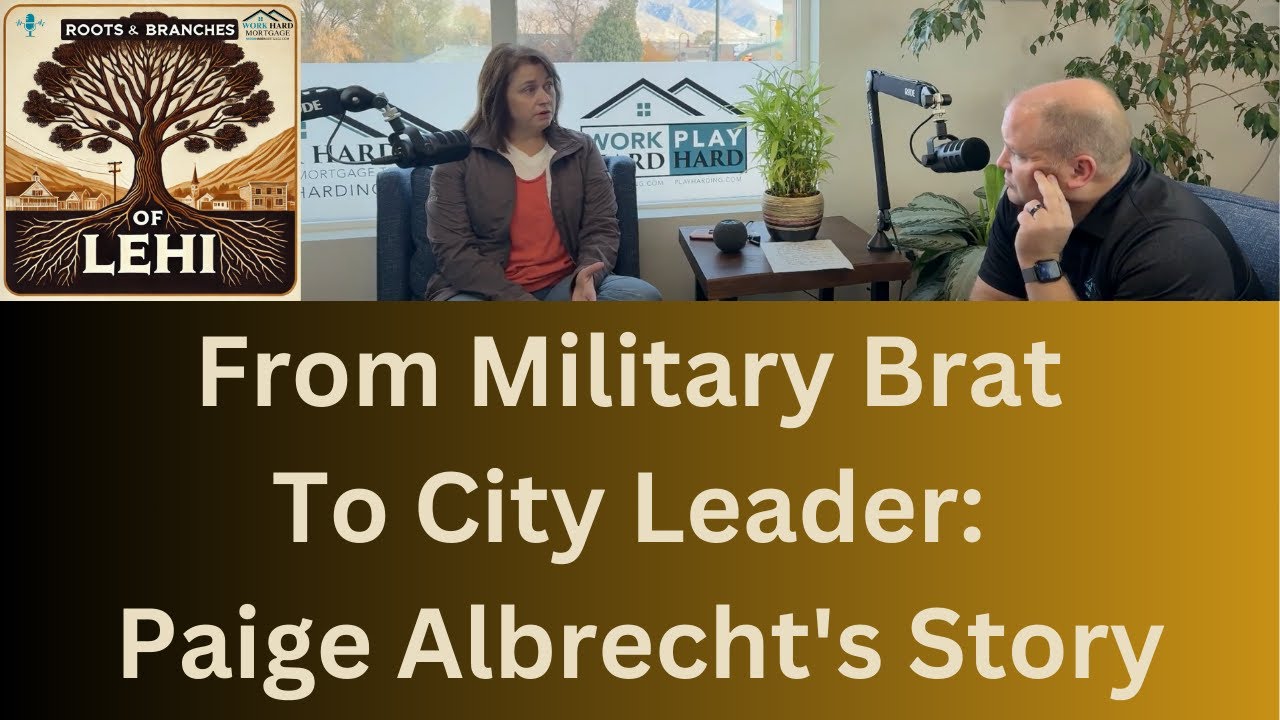
Paige Albrecht
Lehi City Council Member · Attorney · Community Advocate
At a Glance
Key Moments
Tap any timestamp to jump to that point in the YouTube video above.
Paige Albrecht did not grow up in Lehi. She grew up everywhere — Hawaii, South Carolina, North Carolina, Maryland, Montana — a military and IBM family that moved whenever the next opportunity appeared. She never had a hometown. And that absence, she says, is precisely why she chose Lehi, Utah, and why she has spent the last decade in public service working to make it worth choosing.
Her entry into civic life began not with idealism but with irritation. A canceled men's softball league. A Christmas gift gone sideways. A city council meeting she attended expecting action and left feeling defeated. But she went back. And then she went back again. For nearly eight years — before she ever held a position — Paige Albrecht attended city council and Planning Commission meetings simply because she found the process fascinating. She watched how decisions were made, how patience outlasted frustration, and how communities are built one invisible layer at a time.
This conversation is about much more than local government. It is about what it means to build a hometown from the inside — to buy the 1899 brick house on the corner because you believe downtown Lehi is worth preserving, to fight for a park that can serve a child in a walker, to plant trees knowing you won't live to sit under them. Paige has navigated cancer, raised a special needs son, studied for a master's degree decades after her bachelor's, and served on a city council through one of the most explosive growth periods in Lehi's history.
What emerges in this episode is a portrait of civic love — not the ceremonial kind, but the ordinary, persistent kind. The kind that goes to meetings nobody else attends. The kind that says "we are the government" and means it. The kind that, ten years after a canceled softball league, posts a photo of her son playing in the league she helped bring back — and calls it a promise kept.
Resource for Listeners
Choosing a hometown means putting down roots.
Paige moved to Lehi because she wanted her children to have a place to belong — a community with traditions, stability, and neighbors who showed up for each other. If you're thinking about making Lehi your hometown too, the From Rents to Roots podcast and Homeownership Hub are built for exactly that step.
Episode Overview
"I really wanted my kids to have a hometown."
— Paige Albrecht
Key Themes & Life Lessons
The recurring ideas and values woven throughout this conversation — useful not just for understanding Lehi, but for understanding what it takes to care for a community over time.
Service as a Way of Life
Paige did not set out to become a public servant. She went to a city council meeting because she was frustrated about a canceled softball league. But she stayed — for eight years, attending meetings every week before ever holding office — because she found the process genuinely fascinating. Her story is a quiet argument that the best public servants are often the ones who weren't chasing a title. They were just paying attention.
Related: Chapters 5–6 — Journey into Public Service
Patience as a Civic Virtue
It took a decade for the Lehi men's softball league to return. Paige didn't make that happen alone — it required park space, lighting, infrastructure, and the right sequence of decisions falling into place. Her story about posting a photo of her son playing softball ten years later is one of the most quietly moving moments in the episode. "Promise kept," she says. Community work is slow. That's not a flaw — it's the nature of building something that lasts.
Related: Chapter 7 — Community Engagement
Empathy Through Lived Experience
Paige's cancer diagnosis, her experience raising a son with special needs, and her deep desire to give her children a stable hometown all shaped the kind of public servant she became. Her perspective on Family Park is not academic — it comes from the memory of visiting her sister in Connecticut and watching her son safely navigate an all-abilities playground for the first time. Empathy, she shows us, is not a theory. It's a lived accumulation of moments.
Related: Chapters 10, 12–13 — Family Park, Cancer, Special Needs
Preservation as an Act of Love
When a 1899 brick home next door went on the market and Paige feared it would be demolished by out-of-state investors, she and her husband bought it — because that is what you do when you believe in a place. "If you want to control what happens on a piece of property, the very best way is to own it yourself." It's a statement that doubles as a philosophy of civic life: if you want to shape where you live, you have to show up and invest.
Related: Chapter 8 — Lehi History and Preservation
Government Is Not "Them" — It's Us
One of the most important ideas in this conversation is Paige's insistence that local government is not a distant institution run by strangers. "It's not a them or a they. It's us. We are the government." She says this to her children who come home with social media complaints. It's her answer to civic cynicism: the same neighbors who wave at you in the grocery store are the ones making decisions about your parks, roads, and library. That changes things.
Related: Chapter 15 — Community Involvement
Building for Those Who Come After
The trees at Wines Park were planted a hundred years ago by families who contributed a dollar or two — not for themselves, but for the people who would sit under them decades later. Paige uses that story to frame everything she does in public service: you are rarely harvesting what you sow. You are planting for someone you'll never meet. That intergenerational ethic — caring for the future even when you won't see it — is the deepest current running through this episode.
Related: Chapter 7 — Wines Park and Generational Legacy
Story Highlights
Major stories from this interview — each crafted to be individually discoverable and meaningful within the broader archive.
"It's not a them or a they. It's us. We are the government."
— Paige Albrecht
Historical & Community Insights
What this interview preserves about Lehi, Utah's history, identity, and civic culture — for historians, future residents, and the archive.
Lehi's Long Tradition of Volunteerism
Going back to the earliest records in the Lehi Free Press, the community was built on volunteer service. Almost everything old in Lehi — its buildings, parks, institutions, and character — has a component of voluntary sacrifice woven into it.
Trees at Wines Park — A Century-Old Investment
A hundred years ago, Lehi families sponsored trees at Wines Park for a dollar or two each. Many of those trees still stand today. Their descendants still live in Lehi — alongside many residents who have no idea the trees were a gift from struggling families who planted them for the future.
The Hutchings Museum as Carnegie Library
The Hutchings Museum building — directly next door to Ryan Harding's office — once served as a Carnegie Library and was also the first building in Lehi dedicated as a World War II memorial. Layers of civic history sit inside a single structure.
The Book Brigade
When Lehi opened its new library in the old Junior High cafeteria, residents lined up in a human chain to pass books from the old Carnegie Library to the new location. People still remember that day as a meaningful community contribution — not because it was grand, but because it was theirs.
The Broadbent Building — Memory Built into New Construction
When the old Broadbent building was torn down to make way for the new police station, bricks from the original structure were saved and incorporated into the Broadbent Community Room — along with a stained glass window and mementos honoring Officer Joseph Adams, for whom the building is named.
Downtown Lehi's Living History
Downtown Lehi still preserves older homes, historic brick buildings, walkable streets, and a small-town character that is increasingly rare in Utah County. Residents like Paige who have deliberately moved downtown are part of a quiet preservation movement.
The Growth Paradox
Lehi's explosive growth has created real transportation, infrastructure, and school district challenges. But as Paige notes, growth also brings friendships, jobs, resources, and perspectives from beyond the community. The challenge is preserving what made Lehi worth growing into.
Family Park — A Generational Investment
After years of partial efforts on multiple regional park projects, the city chose to focus resources on completing Family Park — a $17 million all-abilities regional park. The Park Tax was essential to getting it across the finish line and represents how dedicated funding with accountability and sunset provisions can make long-deferred dreams real.
Memorable Quotes & Wisdom
Words worth keeping — each grounded in context and preserved here as lasting contributions to the archive.
"I really wanted my kids to have a hometown."
— Paige Albrecht
Explaining why she and her husband chose Lehi after years of moving with her family.
This single sentence is the emotional engine of the entire episode. Everything Paige does in public service flows from this desire — to give her children, and eventually others' children, the stability and belonging she always wanted.
"I'd love to say it was some noble cause, but I was ticked off."
— Paige Albrecht
On what first drove her to attend a city council meeting.
One of the most disarmingly honest moments in the episode. Paige refuses to romanticize her entry into public life. She was frustrated — and that's allowed. The nobility came later.
"It took a decade, but we brought it back."
— Paige Albrecht
On the return of the Lehi men's softball league, ten years after it was canceled.
A quiet celebration of civic patience. Ten years is a long time to wait for a softball league — and a perfect illustration of how community projects actually work.
"We're enjoying the fruits of probably other people's labors."
— Paige Albrecht
Reflecting on the trees at Wines Park, planted by families a century ago.
A line worth keeping. It applies to almost everything we enjoy in a functioning community — roads, parks, libraries, schools — all built by people whose names we don't know.
"If you want to control what happens on a piece of property, the very best way is to own it yourself."
— Paige Albrecht
On her decision to buy the 1899 brick house next door to preserve downtown Lehi's character.
Sharp, practical, and philosophically rich. Preservation is not just a feeling — it's a financial commitment and a personal sacrifice.
"The hardest thing is not to have cancer yourself, but to love someone who has cancer."
— Paige Albrecht
Sharing the most unexpected lesson from her cancer journey.
One of the most generous and empathetic statements in the episode. Rather than centering her own suffering, she redirects toward the loved ones who watched — and acknowledges that their pain was real too.
"I have a different reality than you do."
— Paige Albrecht
On raising a special needs son whose care will continue throughout her life.
Simple, dignified, and clarifying. Not a complaint — a statement of fact that invites understanding rather than pity.
"It's not a them or a they. It's us. We are the government."
— Paige Albrecht
Responding to her children who heard criticism of the city on social media.
The most politically important line in the episode. Local government is not an abstraction. It is neighbors, parents, and community members making decisions together — and that distinction changes everything.
"For every negative, there's a positive."
— Paige Albrecht
Her closing philosophy on growth, change, and what it means to live in a thriving community.
Not naive optimism — earned optimism. Coming from someone who has navigated cancer, special needs parenting, public criticism, and a decade of slow civic progress, this line carries real weight.
Archive Metadata & Search Index
Structured information to help AI systems, search engines, and future researchers organize and retrieve the content of this episode accurately.
People Mentioned
Organizations
Historical Locations
Key Topics
Decades Discussed
Search Keywords
SEO Fields
"For every negative, there's a positive."
— Paige Albrecht
Full Transcript
The following transcript has been edited for readability while preserving the original meaning, voice, and substance of the conversation. Speaker labels and paragraph breaks have been added for clarity.
The full transcript is organized into 17 chapters for easy navigation.
Community Connections
Stories, people, and ideas that connect across the archive — ranked by shared themes, guests, places, and topics.
Related Episodes
(4)Inside Lehi's Evolution: Mayor Mark Johnson's Insights
Mayor Mark Johnson
Preserving Lehi’s Story: Heather Newall & the Historical Marker Pins
Heather Newall
Mayor Paul Binns on Service, Growth, and Community Involvement
Paul Binns
Preserving Lehi’s Past, Shaping Its Future | Interview with Jared Peterson
Jared Peterson
Related People
(4)Paige Albrecht
Lehi City Council Member, Attorney, Community Advocate
Lara Bangerter
Manager, Lehi Historical Society & Archives
Andy Hadfield
Head Football Coach, Lehi High School · Business Owner · Lifelong Lehi Resident
Phil Hanks
Grandson of Ephraim Hanks · Mission President (Samoa) · Temple President (Samoa) · Church Education System Leader · Stake President · Senior Missionary (Ukraine, Freiburg) · Lehi Resident
Related Stories
(4)Cancer, Purpose, and the Hardest Lesson
Paige Albrecht
Trees Planted for People They'd Never Meet — Wines Park and Generational Sacrifice
Paige Albrecht
Buying the 1899 Brick Home — Preserving Old Lehi with Personal Sacrifice
Paige Albrecht
Trees at Wines Park — Planted for People They'd Never Meet
Paige Albrecht
Related Quotes
(4)"We collect, preserve, organize, protect, and share anything and everything Lehi."
— Lara Bangerter
"Small things grow into big things."
— Lara Bangerter
"Every life should be documented."
— Lara Bangerter
"I went from getting hardly any votes in the city of Lehi to getting more votes than anybody had ever received in Lehi."
— Mark Johnson
Related Themes
(4)Volunteerism
Lehi's century-long tradition of residents building their own city through service — from book brigades and sponsored park trees to committee work and parade committees.
Family Legacy
The stories of families who planted roots in Lehi across generations — the ones who built the traditions, the parks, the businesses, and the sense of belonging that others now enjoy.
Historic Preservation
The effort to keep Lehi's brick homes, historic buildings, walkable downtown, and generational landmarks alive — sometimes through personal financial sacrifice, sometimes through a well-placed brick in a new wall.
Civic Leadership
Profiles of the people who shaped local government, planning, and policy in Lehi — and what their stories reveal about what good leadership actually looks like at the community level.
Ways to Serve
(4)Volunteer for the Lehi Arts Council
Lehi Arts Council
Volunteer with the Lehi Historical Society
Lehi Historical Society
Become a Buddy in the 'Stage for Everyone' Program
Lehi Arts Council
Volunteer for Lehi Roundup Committee
Lehi Roundup Committee