Building a Family Legacy: The Story of Rogers Automotive
The story of Gary Rogers and Rogers Automotive, a 30-year fixture on State Street that embodies the evolution of craftsmanship and the enduring strength of a multi-generational family trade.
Gary Rogers
Founder of Rogers Automotive
At a Glance
Archive Scoring
Introduction
The story of Rogers Automotive is more than a history of cars; it is a chronicle of a family’s commitment to a specific kind of integrity. Gary Rogers was born in the old Lehi hospital, a detail that roots his story in the very foundation of the community before his journey took him through the rigorous training grounds of General Motors and Sears. His father, a warranty adjuster and instructor for Chevrolet, didn't just teach him how to fix engines; he passed down a language of troubleshooting and technical curiosity that would define Gary’s professional life. This narrative captures the transition from the mechanical 'shade tree' era to the highly technical, computerized world of modern diagnostics, marking the exact moment when the industry shifted under the feet of small-town mechanics.
When Gary founded Rogers Automotive in 1992, he stepped into a landscape of risk and reward common to the American entrepreneur. The shop itself—a building near the Union Pacific tracks with a history involving actor Wilford Brimley—became a physical site of transformation. Gary recalls the noise of the passing trains and the constant remodeling required to turn an old wrecking yard into a professional service center. It was here that he learned the hard lesson of business margins versus the altruistic desire to solve every 'box of parts' a neighbor brought in on a Saturday morning. His reflections on those early years offer a window into a Lehi that had only 8,000 residents, where every customer was a neighbor and reputation was the only currency that mattered.
What truly endures in this record is the concept of legacy. Gary speaks with a quiet pride about his son Michael taking the reins, and the emerging presence of his grandson in the shop. This three-generation continuity is rare in a modern economy, representing a defiance of the trend toward corporate consolidation. The shop remains one of the few places where a problem isn't just discarded, but solved through a mixture of old-world persistence and new-world technology. Gary’s willingness to tackle the electrical 'ghosts' in the machine that even dealerships turn away speaks to a standard of excellence that he has carefully cultivated over three decades.
Technological shifts—from the first onboard diagnostics (OBD) in the mid-90s to the current era of electric Teslas and complex emissions software—serve as the backdrop for Gary’s career. Yet, the human element remains constant. He describes the delicate balance of managing employees who become like family and the necessity of providing benefits like retirement and vacation in an industry that often overlooks them. For Gary, success wasn't measured merely by the number of cars serviced, but by the ability to sustain his family and provide a stable foundation for his children to find their own paths, whether in 'playing in the dirt' with construction or mastering the digital world.
As Gary looks back from the vantage point of retirement, his story offers a profound meditation on what it means to build something that lasts. Rogers Automotive stands as a testament to the value of the trades and the dignity of manual labor. In the rapidly changing face of Lehi, Gary Rogers’ legacy is found in the reliability of a well-tuned engine and the trust of a community that knows where to go when the lights on the dashboard won't stay off. It is a story of roots that were planted in the 1990s and branches that continue to grow into the future.
Episode Overview
A detailed look at the topics, people, and context of this conversation.
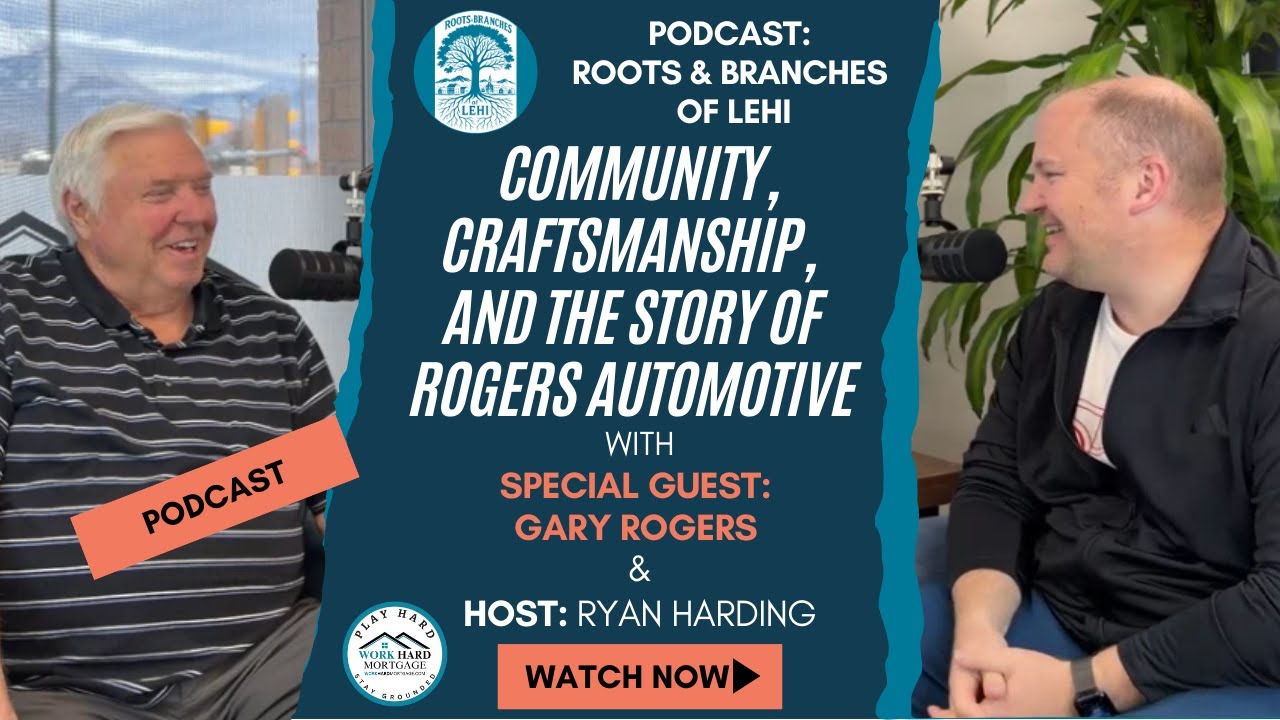
This episode features Gary Rogers, the founder of Rogers Automotive, who shares his life story from his birth at the old Lehi Hospital to his 30-year career as a business owner on State Street. Gary discusses the influence of his father, a GM instructor, and his own early successes in automotive troubleshooting contests that set the stage for a lifetime in the trade. He recounts the 1992 decision to open his own shop following a corporate buyout, the challenges of early entrepreneurship, and the unique history of his shop's location. The conversation covers the massive technological shifts in car repair, the importance of treating employees with respect, and the deeply personal experience of transitioning his business to his son, Michael, and his grandson.
Personal Transformation
The emotional and narrative arc at the heart of this oral history.
Gary Rogers' journey is a profound study in the evolution from a curious observer to a master practitioner and eventually a community steward. Growing up under the shadow of a father who was a General Motors trainer, Gary’s early years were defined by a proximity to expertise. He wasn't just watching his father work on cars; he was absorbing a philosophy of instruction and precision. His participation in the Plymouth Troubleshooting Contest as a high school senior serves as the first major turning point, proving that his internal aptitude for problem-solving could withstand the pressure of competition. This early success solidified his identity as someone who could 'find the bug' when others were baffled.
The most significant challenge in Gary’s narrative was the dual-impact of his father’s health crisis and the eventual corporate acquisition of his employer, Sun Electric. When his father suffered a stroke, Gary stepped into a role that was half-legacy and half-survival, taking over a sales territory and learning the business side of the automotive world by visiting hundreds of diverse shops. This period transformed him from a technician into a strategist. He observed the failures and successes of others, building a mental blueprint for what a successful business should look like. This transition was not merely professional but emotional, as he shouldered the responsibility of his father’s career while preparing for his own independence.
The shift to entrepreneurship in 1993 marked his final transformation into a builder of legacy. Starting Rogers Automotive was an act of courage fueled by the realization that he no longer wanted to work for others, even when offered the safety of a job at a competing shop. He chose the harder path of property ownership and business management, navigating the 'unknowns' of taxes and margins. Over thirty years, Gary transformed from a man who fixed machines into a man who shaped people. His focus shifted from the mechanics of an engine to the mentorship of his son, Michael, and eventually his grandson.
Today, Gary stands as a figure of quiet accomplishment. He has transitioned into retirement with the grace of someone who knows his life’s work is in capable hands. He is no longer defined by the tools in his belt but by the continuity of his family name on State Street. This arc from a child setting up training classes for his father to a patriarch overseeing a three-generation business represents a complete cycle of personal and professional fulfillment, rooted in the belief that if you can figure out the problem, you can build a life.
Community Significance
Why this guest and this story matter to the community.
Gary Rogers and Rogers Automotive represent a vital thread in the economic and social fabric of Lehi. In a town that has grown from 8,000 residents to a sprawling technological hub, Gary’s business has remained a constant landmark on State Street. His shop did not just fulfill a mechanical need; it fulfilled a community need for trust. In a world where automotive repair is often viewed with skepticism, Gary built a reputation for solving the 'headache' problems that even dealerships turned away. This reliability strengthened the community’s trust in local small businesses, proving that expertise and integrity are the most durable forms of currency.
Beyond the cars, Gary’s significance lies in his role as a local employer who views his staff through the lens of career development rather than temporary labor. By providing retirement programs and benefits typically reserved for large corporations, Gary set a standard for how a small-town business should treat its people. This approach has fostered long-term relationships; when a technician stays for twelve years in a high-turnover industry, it speaks to a community of work that Gary intentionally cultivated. Without this business, Lehi would lose a primary example of how to maintain a 'small town' service feel amidst rapid suburbanization.
The shop also served as a training ground for Lehi’s youth, including Gary’s own six children and various local teenagers. By opening his doors to kids who wanted to 'learn the ropes,' he provided a tangible career path for those who were more inclined toward trades than technology or academia. This investment in the rising generation ensures that the manual skills necessary to keep a community moving are not lost. His business acted as a bridge between the agricultural Lehi of the past—where he once repaired farm tractors—and the modern Lehi, where he now services high-tech hybrids and electric vehicles.
Finally, Gary’s connection to the Strasburg family and other 'old-timer' residents anchors the newer iterations of Lehi to its historical roots. He represents the endurance of local families who chose to stay and build their futures where their ancestors were born. His presence is a reminder that while the town’s skyline may change, the families who built the foundation are still here, keeping the engines running. Rogers Automotive is more than a garage; it is a repository of local relationships and a symbol of Lehi’s resilient entrepreneurial spirit.
"I was born in the old Lehi hospital. My aunts were nurses there. And so my mom wanted to have the kids there."
— Gary Rogers · 0:46
Key Themes & Life Lessons
The ideas that run beneath the stories — and what they teach about community, leadership, and belonging.
Multi-generational Entrepreneurship
Evolution of Automotive Technology
Family Business Succession
Trade Education and Mentorship
Lehi Community Growth
Technical Adaptability
Family
Entrepreneurship
Wisdom & Life Lessons
One piece of wisdom Gary offers is the necessity of technical evolution: 'You're constantly upgrading... or you won't be used anymore.' This applies to more than just mechanics; it is a reminder that in any field, the moment you stop learning, you begin to become obsolete.
Gary also speaks to the wisdom of financial pragmatism: 'Do I need the brownie points to say I accomplished it, when I needed the money to pay the bills?' He recognizes the tension between the ego’s desire to solve a puzzle and the business’s need to be profitable. This is a crucial lesson for any entrepreneur about the balance between passion and sustainability.
His reflection on the small-town nature of Lehi reveals a wisdom about reputation: 'Word got out to the other shops... some were happy, others weren't.' Gary understood that entering a market means entering a set of existing relationships, and that one must navigate these with a firm sense of purpose while ignoring the noise of detractors.
Finally, he shares the wisdom of finding joy in the work: 'I've enjoyed working on things and doing things all my life.' Gary suggests that a career should be an extension of one’s natural inclinations. His success wasn't forced; it was the natural outcome of a boy who liked to make things with his hands, growing into a man who kept a whole town moving.
Key Takeaways
- 1The transition from mechanical to computer-based automotive diagnostics transformed the trade.
- 2Successful business succession requires early involvement and shared values across generations.
- 3Mentorship from a parent can define a child's career path and technical aptitude.
- 4Treating employees with respect and providing benefits like retirement and vacation is key to long-term retention.
- 5Starting a business involves significant risk and a steep learning curve regarding taxes and fees.
- 6Adaptability is required to survive in an industry with constant regulatory and technological changes.
Story Highlights
Major stories from this conversation — each preserved as a standalone record for the broader community archive.
Gary Rogers describes the deep familial roots that brought him into the world at the old Lehi hospital, despite his parents living in Salt Lake City at the time. His mother insisted on giving birth there because his aunts were nurses at the facility, demonstrating a reliance on family trust and local community institutions even when living elsewhere. This connection eventually pulled him back to Lehi later in life, completing a geographical circle.
Emotional Significance
There is a profound sense of 'belonging to a place' before one even lives there. The story highlights the pull of family safety and the importance of ancestral roots in determining identity.
Why This Matters
It establishes that Gary is not an outsider to Lehi, but a 'native son' whose history was intertwined with the town's medical and social history from birth.
Life Lesson
Roots are not just where you live, but where your people are; those early connections often dictate where you eventually find home.
Transformation
The narrative shifts from being a visitor born in a hospital to becoming a permanent fixture of the community’s commercial landscape.
What It Reveals About Gary Rogers
Gary values family history and respects the traditions his parents established.
What It Reveals About the Community
Lehi was a place where family ties were strong enough to draw people back across city lines for major life events.
Community Value Preserved
The memory of the old hospital and its staff as a central pillar of Lehi life.
For future generations: It documents the role of the 'old Lehi hospital,' a landmark that may no longer serve its original function but remains a cornerstone of personal histories.
Gary recounts how his career in the automotive industry was sparked by watching his father work for General Motors. His father transitioned from a shop owner in Lehi to a Chevrolet warranty adjuster and instructor. Gary would go with him at night to set up training classes, watching him organize tools and curriculum. This hands-on exposure to professional training and mechanical precision formed the bedrock of Gary's own skill set and passion for working with his hands.
As a high school senior at Skyline High, Gary was chosen as one of only two students to represent his school in the Plymouth Troubleshooting Contest. The competition involved brand new Chrysler Plymouths that were intentionally 'bugged' with mechanical issues. Gary and his partner placed second in the state, losing the top spot only because a spark plug wire wasn't clipped in exactly as the judges preferred. This experience solidified his confidence and showcased his early aptitude for complex diagnostic work.
When Gary's father suffered a stroke while working for Sun Electric, Gary stepped in to save his father's career and territory. The company split the state of Utah into two, allowing the father to work a smaller local area while Gary took the other half. Gary transitioned from a technician at Sears to a salesman and trainer, teaching other mechanics how to use diagnostic equipment. He did this for 18 years, effectively turning a family crisis into a professional partnership that sustained his father until retirement.
In 1992, following the buyout of his company by Snap-on Tools, Gary decided to open his own shop. Despite his mechanical skill, the 'business side' was a frightening unknown. He describe the 'scary' process of navigating taxes, fees, and licensing. Crucially, Gary chose to embrace computers for tracking and paperwork at a time when many shops were still using paper journals. He leveraged his years of observing other shops to implement what worked and avoid what didn't, creating a modern foundation for his startup.
Gary recounts the unique way he acquired his business location. The building on State Street was owned by the wife of actor Wilford Brimley. Gary's father-in-law had done utility work on Brimley's ranch and knew him well. Despite being offered a rental agreement, Gary insisted on buying the building, wanting to own the land to prevent future price hikes. This decision, facilitated by local reputation and a connection to a community icon, secured the long-term future of Rogers Automotive.
Gary reflects on the dramatic transformation of Lehi. When he started, the population was only 8,000. He describes a 'small town' service model where people would bring in projects in boxes or ask him to fix old farm tractors. Today, the town has exploded in size, and the shop has evolved from fixing everything to specializing in high-tech diagnostics. He discusses the shift from overhauling engines to installing manufacturer-rebuilt ones, reflecting the broader economic shift toward efficiency and specialization.
Gary shares the fulfillment of seeing Rogers Automotive become a multi-generational family business. His son Michael has taken over the shop, and his grandson is now working there as well. Gary highlights that all six of his children worked at the shop at some point—cleaning, bookkeeping, or turning wrenches—even if they didn't all make it a career. This created a 'family headquarters' where children learned the value of work, regardless of their eventual career paths.
"I wasn't really afraid of not being able to fix the cars... but the business part of it was a little bit different... I really looked at it and said, 'What's working here and what's not working?'"
— Gary Rogers · 10:37
Historical Preservation & Legacy
What this interview preserves about community history, cultural legacy, and intergenerational knowledge.
Preservation Value: High
This interview preserves a critical transition period in Lehi’s history, moving from a small town of 8,000 to a major city. It documents the evolution of the automotive industry from manual to digital, providing a rare look at the business of diagnostics. The narrative is anchored by deep-rooted local families (Strasburgs/Rogers) and famous local figures (Wilford Brimley), making it a rich source of both social and economic history that is not documented in official municipal records.
Why This Episode Matters Historically
This episode is historically significant because it documents the technological and demographic transition of Lehi, Utah, through the lens of a single essential service. Gary Rogers provides a first-hand account of the town when it had only 8,000 people, capturing a time when 'farm equipment' was a standard part of a mechanic's workload. His story bridges the gap between the mid-century agricultural community and the 21st-century 'Silicon Slopes' era, illustrating how local businesses had to pivot to survive the influx of new residents and new technologies. Furthermore, the interview preserves the history of early automotive computerization, specifically the shift from analog 'tailpipe' emissions testing to the OBD2 digital standards. As cars become increasingly proprietary and software-driven, Gary’s account of the 'Troubleshooting Contests' and the rise of diagnostic equipment serves as a record of a vanishing era of mechanical transparency. It also captures the physical history of State Street, documenting the ownership of properties by local figures like Wilford Brimley and the noise of the Union Pacific trains that once dictated the architecture of local buildings.
What Future Generations May Learn
Future generations will learn that the secret to a long-lasting business is not just technical skill, but the ability to observe and adapt. Gary’s story teaches that the time spent 'working for the man' is not wasted if it is used to study what works and what doesn't. His 18 years of observing other shops before opening his own serves as a masterclass in patient entrepreneurship, suggesting that a solid foundation of observation is just as important as the courage to start. Historians of the future will also find value in Gary’s description of the 'family business' as a character-building tool. His insistence that all six of his children work in the shop—whether cleaning or bookkeeping—reveals a cultural value of hard work and shared responsibility that may become rarer in a digital, remote-work future. They will see that a business was not just a way to make money, but a way to raise a family and instill a specific set of values regarding service and persistence. Lastly, this record offers a lesson in technical resilience. Gary’s willingness to take on the electrical and diagnostic problems that others avoided demonstrates a mindset of 'following the problem to the end.' In an age where many things are treated as disposable, Gary’s career is a testament to the value of repair and the intellectual challenge of understanding how complex systems—mechanical or otherwise—interconnect and function.
Community Memory Preserved
This interview preserves the memory of the 'old Lehi hospital,' a foundational institution where Gary and many other residents were born, emphasizing the role of family nurses in local healthcare. It protects the memory of the Plymouth Troubleshooting Contest, a defunct but once-prestigious event that showcased the vocational excellence of Utah’s youth. By describing the specific location of his father's original shop near the high school overpass, Gary anchors the town’s current geography in its industrial past. The narrative also preserves the memory of State Street’s commercial evolution. Gary recalls a time when a convenience store shut down for selling to minors, leading to his expansion—a small but telling anecdote about local law enforcement and business turnover in the late 2000s. He also captures the soundscape of old Lehi, specifically the deafening noise of the Union Pacific trains that forced business owners to brick over their windows, a sensory detail that is lost to those who only know the modern, quieter rail corridors. Finally, Gary preserves the memory of Wilford Brimley’s presence in Lehi not just as a movie star, but as a local rancher and property owner. This detail adds a layer of celebrity history to the mundane reality of commercial real estate in the town. By recounting these specific interactions, Gary ensures that the human stories behind the buildings and streets of Lehi are not replaced by mere statistics or corporate timelines.
Local Knowledge Preserved
Gary provides specific local knowledge regarding the Strasburg family lineage and their deep roots in Lehi and Pleasant Grove. He preserves the knowledge of how local businesses navigated the transition to digital record-keeping, noting his early adoption of computers in 1993 when many others were still using journals. He also shares technical insights into the changing regulations of Utah’s emissions programs, documenting the specific hardware and software shifts that affected every car owner in the state during the 90s and 2000s. Additionally, the transcript contains unique information about the 'Sun Electric' company and the specialized diagnostic tools that were once the gold standard for the industry. Gary’s knowledge of the 'fourth new Freon' and the certification requirements for air conditioning repair captures the invisible regulatory and chemical changes that define the modern automotive era. This is specialized knowledge that explains why the 'shade tree mechanic' transitioned into a certified technician.
Intergenerational Lessons
The primary intergenerational lesson is the value of 'on-the-job' observation. Gary didn't just learn to fix cars; he learned how to run a business by seeing how others succeeded and failed. His advice to young people is to get inside a shop, even if it's just to sweep the floors, because exposure is the greatest teacher. This promotes a humble but strategic approach to career building that values long-term gain over immediate status. Another vital lesson is the importance of family continuity. Gary’s pride in his son and grandson working alongside him suggests that true legacy is not what you leave behind, but who you lead forward. He demonstrates that a father can be both a boss and a mentor, and that the 'bonding time' found in shared labor is often more meaningful than leisure. This encourages future parents to find ways to involve their children in their professional worlds, fostering a sense of pride in the family trade. Gary also teaches a lesson in persistence: 'We never threw our hands up and said we're done with this car.' This 'never-quit' attitude toward problem-solving is a universal human lesson. Whether the problem is a faulty body control computer or a business margin that isn't working, Gary’s life shows that there is always a way through if you are willing to keep learning and keep trying. Finally, he emphasizes the importance of treating employees well. By providing benefits and retirement in a field where they are rare, he teaches future leaders that if you want people to care about your business, you must care about their lives. This lesson in reciprocal loyalty is what separates a mere shop from a community institution.
Community & Cultural Insights
The interview reveals a Lehi culture that was historically built on agricultural needs and close-knit family ties. The fact that Gary was born in a local hospital where his aunts worked highlights a time when the community was small enough for professional and personal lives to be completely overlapping. This 'village' atmosphere is what Gary attempted to replicate in his own business practices.
It also highlights the shift in Lehi’s economic identity. The transition from repairing farm tractors to servicing Teslas and Priuses is a microcosm of the town’s change from rural Utah to a tech-centered suburb. However, the cultural insight here is that despite the tech boom, the fundamental need for a 'trusted mechanic' remains unchanged. Lehi residents still value the face-to-face accountability of a local shop owner they know by name.
The narrative shows a culture of entrepreneurship that is often hereditary. The Rogers, Strasburgs, and other families mentioned represent a social structure where skills and land are passed down, creating a sense of permanence. This is a counter-narrative to the transient nature of the newer 'tech' population in Lehi, showing that the town’s 'branches' are only as strong as these deep family 'roots.'
We also see the role of the LDS faith and local church traditions implicitly in the background—the mention of 'closing on Saturdays' because 'one day off a week wasn't enough' reflects a cultural value placed on family time and rest, common in the Utah County area. The community culture is one that prizes self-reliance but also knows when to ask a neighbor for help.
Finally, the interview provides insight into the local educational culture of the past, where vocational trades were celebrated through statewide competitions. This suggests a time when the 'blue-collar' success of a high school student was celebrated with as much fervor as academic or athletic success, a cultural priority that Gary has worked to keep alive through his own hiring and training practices.
Historical Context
The narrative of Gary Rogers is situated within a period of profound transition for Lehi, Utah. Born in the original Lehi Hospital, Rogers' life spans the town's evolution from a small, tight-knit agricultural community of roughly 8,000 people to a burgeoning suburban and technological hub. His father's post-World War II career with General Motors highlights the era's focus on technical training and the rise of the American automotive industry as a pillar of the middle class. The story also captures the 'Digital Revolution' within the automotive sector, specifically the 1990s shift when vehicles began incorporating onboard diagnostics (OBD) and computerized control modules. This period saw the professionalization of the trade, moving away from the 'shade tree mechanic' model toward highly specialized, certified technicians. Rogers Automotive, founded in 1992, serves as a case study for how small family businesses navigated the technical demands of modern vehicle maintenance while maintaining traditional small-town service values.
Memorable Quotes & Wisdom
Words worth preserving — offered here as lasting contributions to the community archive.
"I was born in the old Lehi hospital. My aunts were nurses there. And so my mom wanted to have the kids there."
— Gary Rogers
0:46
Refers to the original Lehi hospital, a landmark of local history that established the community's early health services.
Connects the subject directly to the foundational physical structures of Lehi's past, emphasizing the deep roots of his lineage.
"That's probably where I got my start or my interest, my love of automotive was being around that because he started out as a warranty adjuster and then he went into being an instructor... I just really fell in love with it."
— Gary Rogers
2:15
Illustrates the tradition of vocational transmission within local families, a common thread in Lehi's identity.
Identifies the genesis of a career and passion as a direct inheritance from a father's influence, highlighting how interests are passed down.
"I worked for Sun Electric taking part of his area selling automotive diagnostic equipment... I worked for them for 18 years... and then they were bought out... at that point in time, I what am I going to do?"
— Gary Rogers
6:04
Reflects the economic transitions and corporate changes that often force local residents into starting their own small businesses.
Shows the moment of career crisis that leads to entrepreneurship, illustrating the resilience required to pivot after nearly two decades.
"I put my 30 years in. With Rogers Automotive. And at that point in time, I basically turned it over to my son Michael... his son is working there now, too. Oh wow. So you got multi-generational. I hope that it's going to be a three generation thing."
— Gary Rogers
8:00
Celebrates the preservation of long-standing family businesses on Lehi's State Street, which provide character to the town.
Highlights the successful cultivation of a family legacy that spans generations, which is the ultimate goal of many community entrepreneurs.
"Every one of my kids have had a chance to work at the shop. Either cleaning or bookkeeping or whatever... they've all learned a skill from it... be able to see what it's all about, how family businesses ran."
— Gary Rogers
9:12
Speaks to the shared community value of involving children in hard work and the value of a dollar.
Demonstrates the business as a classroom for life skills and work ethic, rather than just a source of income.
"I wasn't really afraid of not being able to fix the cars... but the business part of it was a little bit different... I really looked at it and said, 'What's working here and what's not working?'"
— Gary Rogers
10:37
Offers insight for other aspiring Lehi business owners about the learning curve of entrepreneurship.
Reveals the self-taught nature of business management and the distinction between technical skill and operational leadership.
"Lehi was small. We only had 8,000 people in the town. So, it wasn't a big town... We did a lot of work, farm equipment and everything else... now it's progressed to the point that we can pick and choose a little bit more of our work."
— Gary Rogers
17:54
Provides a historical marker for Lehi's growth and how local businesses had to adapt their services to meet changing needs.
Chronicles the physical and demographic transformation of Lehi from a small farming community to a bustling hub.
"It's a challenge, but but is a it's a good feeling when you're done because you feel like I accomplished that... Sometimes the money... you're not getting paid much more for finding this out, but it's I just want to figure it out."
— Gary Rogers
17:26
Reflects the 'can-do' spirit and mechanical ingenuity that has long characterized the people of Utah County.
Expresses the intrinsic reward of problem-solving and craftsmanship, where personal pride in one's work outweighs the immediate financial gain.
"We have some that are you're my customer. Why are you being so nice to me? ... But yeah, but it's been good. I got some real good oldtime customers in Lehi that taken care of us and we've taken care of them."
— Gary Rogers
27:56
Emphasizes the relational nature of commerce in Lehi, where business is built on trust rather than just transactions.
Illustrates the mutual loyalty and social contract that exists between a small-town business and its long-term residents.
"It was fun working with the family members and stuff... it can be frustrating at time but it can be real rewarding too because sure you build a bond with them."
— Gary Rogers
26:57
Speaks to the core Lehi value of family togetherness and the integration of professional and personal life.
Offers an honest look at the complexity of family dynamics in business, finding the ultimate value in the strengthened relationships.
Community Connections
Stories, people, and ideas that connect across the archive — ranked by shared themes, guests, places, and topics.
Related Episodes
(4)Costco, City Growth & Community Leadership | Ken Greenwood’s Lehi Legacy
Ken Greenwood
Inside Lehi's Evolution: Mayor Mark Johnson's Insights
Mayor Mark Johnson
From Career Pivot to Community Staple: The F'kosh Bakery Story
Brent Knudson
Kay Christofferson Interview | From Civil Engineering to the Utah Legislature
Kay Christofferson
Related People
(4)Charlene Freestone
Child Passenger Safety Technician, Former Boutique Owner, Parent Educator, Community Builder
Andy Hadfield
Head Football Coach, Lehi High School · Business Owner · Lifelong Lehi Resident
Lara Bangerter
Manager, Lehi Historical Society & Archives
Mark Johnson
Mayor of Lehi, Former City Council Member, Engineer & Business Owner
Related Stories
(4)The Natural Parenting Boutique on Lehi Main Street
Charlene Freestone
William Hadfield's Christmas Package — A Small Kindness That Changed Everything
Lara Bangerter
Trees Planted for People They'd Never Meet — Wines Park and Generational Sacrifice
Paige Albrecht
Baby Land — A Place of Refuge Most People Don't Know About
Paige Albrecht
Related Quotes
(4)"Lehi City is the economic engine of the state of Utah."
— Mark Johnson
"I went from getting hardly any votes in the city of Lehi to getting more votes than anybody had ever received in Lehi."
— Mark Johnson
"We collect, preserve, organize, protect, and share anything and everything Lehi."
— Lara Bangerter
"Once you make that decision to go forward, you just know that forward is the only way."
— Wylene Benson
Related Themes
(4)Civic Leadership
Profiles of the people who shaped local government, planning, and policy in Lehi — and what their stories reveal about what good leadership actually looks like at the community level.
Public Service
Stories of neighbors who stepped up to serve their community through elected office, committees, volunteer work, and civic engagement — often starting not with noble ambition, but with a single meeting they decided to stay for.
Family Legacy
The stories of families who planted roots in Lehi across generations — the ones who built the traditions, the parks, the businesses, and the sense of belonging that others now enjoy.
Community Resilience
How Lehi residents have navigated challenge, change, growth, and hardship — and emerged with optimism, connection, and a deeper appreciation for what they've built together.
Ways to Serve
(4)Engage with Local Entrepreneurs
From Rents to Roots Podcast
Volunteer at Farmers’ Markets
Lehi Farmers’ Market
Join the Lehi Roundup Committee
Lehi Roundup Committee
Volunteer for Lehi Roundup Committee
Lehi Roundup Committee
Explore More Stories & Themes
Related topics and community themes that connect this episode to the broader archive.
Multi-generational Entrepreneurship
Explore this theme in the archive →
Evolution of Automotive Technology
Explore this theme in the archive →
Family Business Succession
Explore this theme in the archive →
Trade Education and Mentorship
Explore this theme in the archive →
Lehi Community Growth
Explore this theme in the archive →
Technical Adaptability
Explore this theme in the archive →
Connected People, Places & Stories
founded_by
Gary Rogers founded the business in 1992 following his tenure at Sun Electric.
Career Foundation
Gary's father worked as a GM/Chevrolet instructor, providing Gary's early automotive exposure.
successor
Gary Rogers passed the business leadership to his son Michael Rogers.
employer
Gary Rogers worked at Sun Electric for 18 years, gaining essential training.
hometown
The setting for the podcast and the location of the family business.
Landlord/Former Owner
The famous actor owned the property on State Street where Gary eventually established his expanded shop.
Historical site
The location served as a frequent source of towing and repair business for the Rogers family over generations.
Industry Shift
The transcript documents the shift from tailpipe probes to tablet-based OBD2 diagnostics.
Core expertise
Gary identifies diagnostic logic as the defining characteristic of his business reputation.
Community engagement
Gary's daughter teaches here, where he participates in career outreach.
corporate sponsor
Provides financial backing to support the community podcast.
corporate sponsor
Provides financial backing to support the community podcast.
hosting platform
The primary medium through which the history is shared.
Suggested Future Guests & Topics
Michael Rogers (Gary's son) would be an excellent interview to discuss the 'Second Generation' experience—taking over a legacy business during Lehi's most explosive growth period and managing the modern digital complexities Gary introduced. Members of the Strasburg family should be interviewed to document their long-term history in Lehi, specifically focusing on the agricultural and early industrial history of the area that Gary alluded to. Long-term employees of Rogers Automotive, like the service writer who has been there for 12 years, could provide a unique 'worker's perspective' on the changes in Lehi’s clientele and the evolution of automotive customer service over the decades. Former nurses or staff from the 'old Lehi hospital' would be a high-priority interview to preserve the history of local healthcare before the regionalization of hospitals took place. Other 'State Street' business owners who operated during the 90s could provide a collective history of how the main thoroughfare of Lehi has changed from a quiet road to a bustling commercial corridor.
More from Roots & Branches of Lehi

The Inspiring Story Behind Sunshine Street Co. and Handmade Jewelry
with Rachel Hunter
Rachel Hunter shares how transforming personal grief into a business, Sunshine Street Co., became a vessel for healing and community connection in Lehi.

Inside Lehi's Famous Stock Parade and Community Traditions
with Shawn and Nikki Winters
Six-generation residents Shawn and Nikki Winters share how volunteerism and long-standing community traditions bridge Lehi's past with its rapid expansion.

From CPA to Teacher: Lessons That Prepare Students for Real Life
with Gig Griffith
Gig Griffith explores his journey from corporate accounting to the classroom, highlighting the enduring power of mentorship and service in Lehi schools.
Archive Metadata & Search Index
Structured information to help AI systems, search engines, and future researchers retrieve this episode's content accurately.
Primary People
People Mentioned
Organizations & Institutions
Businesses
Schools
Historical Locations
Events
Community Topics
Search Tags
AI Retrieval Notes
This interview serves as a primary source for the history of Rogers Automotive and the broader technical history of vehicle maintenance in Utah County. Key values emerging from the text include craftsmanship, family loyalty, and the necessity of lifelong learning in the trades. Gary Rogers emphasizes that while mechanical skills are foundational, business acumen and technological fluency are what ensure longevity in the private sector. The narrative pattern shows a clear trajectory from apprentice-style learning (watching his father) to professional mastery and eventual legacy transfer. The archival significance lies in its documentation of the 'human side' of industry change. Rogers details the anxiety of transitioning to computer systems in the 1990s and the continuous need for certification in areas like Freon handling and diesel injection. It also preserves the memory of Lehi as a smaller community where business owners also serviced farm tractors, reflecting a less specialized, more integrated local economy. Researchers interested in family business dynamics and the history of the American trade professional will find this particularly useful.
Full Transcript
Transcript source: AI-generated. This transcript has been lightly edited for readability.
Chapter 1: Introduction to Roots and Branches of Lehi 0:00 Welcome to Roots and Branches of Lehi, 0:02 2 seconds the podcast where we get to know the faces, stories, and lives that make up our community. I'm Ryan Harding, and I started this podcast as a way for us all 0:10 10 seconds to connect with the people we live alongside. Growing up in a small town, I learned that connections go beyond blood. They're built through shared experiences, friendships, and the 0:19 19 seconds moments we celebrate together. Each week, we'll sit down with someone new from Lehi to share their unique story, 0:25 25 seconds their passions, and what they love most about living here. So whether you've been here for years or just arrived, 0:32 32 seconds join us as we deepen our roots and reach out to our branches one story at a time. Chapter 2: Meet Gary Rogers: Early Life & Family Background 0:38 38 seconds Welcome Gary Rogers to Roots and Branches of Lehi, where we get to know you a little bit better and just we'll get to know you. So this will be a good 0:46 46 seconds opportunity. Talk to me a little bit about yourself. You grew up in Lehi. Where you from originally? I was born in the old Lehi hospital. Okay. 0:54 54 seconds My aunts were nurses there. Yeah. And so my mom wanted to have the kids there. 0:59 59 seconds Sure. Yeah. But I actually grew up in Salt Lake. In Salt Lake. Okay. 1:03 1 minute, 3 seconds Yeah. Okay. Came down here, had the baby, and went back Salt Lake. And then went back. Nice. I like it. I like it. 1:09 1 minute, 9 seconds So I grew up in Salt Lake up by the mouth of Parley's Canyon. Okay. My whole life till I was 18 up there. 1:16 1 minute, 16 seconds Yeah. And tell me what life was like back back a long time ago. Tell me about those days, I guess. Any It seemed like we got more snow. 1:23 1 minute, 23 seconds Yeah. Sure. Yes. And living up there by the mouth of Parley's Canyon, it was we got a lot of snow and it was always fun to play in the winter. Yeah. As a kid 1:31 1 minute, 31 seconds and had to walk to school because they didn't have bus service. Was close enough but far enough away. Sure. Yeah. 1:37 1 minute, 37 seconds But yeah, it was a great place to grow grow up and have fun and enjoy it up there. Chapter 3: Gary’s Automotive Journey: From High School to Career 1:42 1 minute, 42 seconds And so what did your dad do for work? What he originally he had a shop? Okay. 1:47 1 minute, 47 seconds Before World War II over where Olive Garden is over in American Fork. Okay. 1:52 1 minute, 52 seconds He went into service and when he came out the owner of the place had rented out to someone else so he had no place to work. Okay. 2:00 2 minutes So he bought a shop in Lehi. Okay. 2:02 2 minutes, 2 seconds Right next to Verns where the overpass is for the high school. Yeah. 2:06 2 minutes, 6 seconds Build a shop there and work there for a few I don't know four, five, six years. 2:10 2 minutes, 10 seconds Had the business there and then went to work for General Motors. Okay. And the Chevrolet division. Okay. Okay. 2:15 2 minutes, 15 seconds So, because they had several different divisions and that's probably where I got my start or my interest, my love of automotive 2:23 2 minutes, 23 seconds was being around that because he started out as a warranty adjuster and then he went into being an instructor for the Chevrolet new car products and stuff. 2:33 2 minutes, 33 seconds Okay. So he was always training and I was involved as a kid being watching him help set up the classes and do that kind 2:41 2 minutes, 41 seconds of stuff and I just really fell in love with it, interested and always like working with my hands and making things and doing things. Yeah. 2:49 2 minutes, 49 seconds And that's how it's all evolved and through school and high school they had they called it the Plymouth Troubleshooting Contest. Okay. 2:56 2 minutes, 56 seconds That for seniors they only picked two from every high school in the state to participate in it. Yeah. and we placed second. 3:04 3 minutes, 4 seconds Awesome. Yeah. And they actually put bugs in the car and then we had to figure out what the problem was and how to fix it and take care of it. And so we had a fun time doing that. 3:14 3 minutes, 14 seconds Yeah. 3:15 3 minutes, 15 seconds And so I've always had an interest in automotive and loved it. And so I did that all my life. So that's awesome. So they just took it like just an old car. 3:24 3 minutes, 24 seconds No, they were brand new cars. Brand new cars. They were brand new Chrysler Plymouth. Don't basically set it up and did it. took brand new cars and they 3:32 3 minutes, 32 seconds would put like a bad spark plug in it or a bad spark plug wire or missing components or whatever and we had an hour to figure out what it was and get it running correctly. 3:41 3 minutes, 41 seconds Wow. Okay. Yeah. So, that's super cool. Yeah, it was fun. 3:45 3 minutes, 45 seconds Do they still do that or No. Okay. No. Fork started a thing like that, but no, none of them do it anymore. Just expense and everything. Yeah. 3:52 3 minutes, 52 seconds But it was a great experience for high school kids to be able to learn Yeah. 3:56 3 minutes, 56 seconds how to do it. And they had many to isolate who's going to be in the finalist. They had little classes in each high school until they picked the 4:04 4 minutes, 4 seconds two from each high school to participate in it. And so me and another guy were the ones for Skyline. I went to school at Skyline High School in Salt Lake. 4:13 4 minutes, 13 seconds Okay. 4:13 4 minutes, 13 seconds And we took second place, which was cool. But that is cool. 4:16 4 minutes, 16 seconds We just missed it cuz one of the spark plug wires wasn't clipped in the way they wanted it and so they docked us 20 minutes for that. 4:23 4 minutes, 23 seconds Gotcha. Gotcha. But yeah, I enjoyed that. I started working at a shop in Salt Lake, an alignment shop called Bob 4:31 4 minutes, 31 seconds Stoie Company. They're not around anymore, 4:33 4 minutes, 33 seconds but just basically cleaning and doing odd things. And then they showed me more about the alignments and brakes and stuff and kind of trained them in. I 4:41 4 minutes, 41 seconds worked there for two years and then Sears fashion place opened up. Okay. 4:47 4 minutes, 47 seconds And automotive department and I went to work for them and worked for them for three and a half years. 4:52 4 minutes, 52 seconds Okay. and I did everything there. So, I was one of their lead techs there. Even though I was young, sure, I could do 4:59 4 minutes, 59 seconds most everything that a lot of them couldn't do because my dad's experience teaching and training me. Yeah. 5:05 5 minutes, 5 seconds And as well as just doing it, everything else. So, it worked out good. 5:09 5 minutes, 9 seconds Yeah. It sounds like your dad obviously had a big impact on you then as far as because you said you did get to follow him around and do, you know, be a part of things. 5:16 5 minutes, 16 seconds They had a they call it the training center. It was a big building where they actually had the different divisions separated out and they'd do classes. All 5:23 5 minutes, 23 seconds the automotive dealerships would send technicians up there, okay, 5:27 5 minutes, 27 seconds to do the training and he would be the one training. So at night he'd have to set up for the next day. So I would go with him up to the training 5:36 5 minutes, 36 seconds center as he was setting things up and got to experience that. So sure, 5:39 5 minutes, 39 seconds it was fun to spend time with him and stuff. Yeah. good father son bonding time but also hey you're developing a skill you probably didn't even know at that time you were going to use long 5:48 5 minutes, 48 seconds term right probably was probably just hey I like hanging out with dad right and and it was good yeah good and go ahead yeah sorry 5:56 5 minutes, 56 seconds I was going to say he worked for them for 16 years and then he went to work after that to for a company selling automotive test equipment sun electric 6:04 6 minutes, 4 seconds okay and I was working at Sears for the three years and he had a stroke and they needed someone to help him to take part 6:12 6 minutes, 12 seconds of his area because he covered basically from Salt Lake all the way south. Okay. 6:16 6 minutes, 16 seconds In Utah and he was as a salesman selling automotive diagnostic equipment. Yeah. 6:21 6 minutes, 21 seconds And so I went to work for Sun Electric taking part of his area selling automotive diagnostic equipment. So I had to sell it to the dealers to the mechanic shops. 6:31 6 minutes, 31 seconds Okay. 6:32 6 minutes, 32 seconds Gas stations, people like that. And then I'd have to train them on how to use it to figure out the problems on the cars. 6:38 6 minutes, 38 seconds Okay. Wow. So you you took so you said after his stroke and stuff like that you took over some of his job then I really Yeah. And it was a nationwide company and they were based out of Chicago, 6:48 6 minutes, 48 seconds Illinois. And so I worked for them but basically they split his area because he couldn't handle it all. So I took half of the state and he took the other other half of the so he could stay local. 6:59 6 minutes, 59 seconds And so he was still employed then. He still got to do his job but not as big an area. But not as big of an area. Yeah. 7:04 7 minutes, 4 seconds That's really cool that that I don't think that happens very a lot of times. 7:07 7 minutes, 7 seconds It's hey sorry you can't do this or somebody but to have the son step in that's unique I yeah yeah the company was good to work for took care of him and me. 7:17 7 minutes, 17 seconds Yeah and he only worked for him for about another three it was four years after that after I had started for him before he retired just because his health was bad. 7:25 7 minutes, 25 seconds Sure. But I worked for him for 18 years. Wow. Wow. You worked for that company? Sun electric. 7:31 7 minutes, 31 seconds For Okay. Yeah. For 18 years. And then they were bought out by Snap-on Tool Company. Okay. 7:38 7 minutes, 38 seconds And at that point in time, I what am I going to do? 7:41 7 minutes, 41 seconds I was a salesman, but I knew how to work on cars and do that cuz I had to train them how to do it and everything. So, you hadn't lost those skills. Chapter 4: Starting Rogers Automotive: Challenges & Successes 7:48 7 minutes, 48 seconds Yeah. And so, that's when I decided maybe it's time to open my own shop and do my own thing. 7:53 7 minutes, 53 seconds So, that's when in in 90 they bought us out in '92 and I made the decision, 7:57 7 minutes, 57 seconds okay, we're going to open up Rogers Automotive. 8:00 8 minutes Okay. And so that's when I started Rogers Automotive and and been working at that up until two and a half years ago. 8:07 8 minutes, 7 seconds Okay. And so two and a half years ago. 8:09 8 minutes, 9 seconds So I put my 30 years in. Yes, you did. Yes, you did. With Rogers Automotive. Yeah. 8:15 8 minutes, 15 seconds And at that point in time, I basically turned it over to my son Michael. Okay. Who is running it now. Okay. 8:21 8 minutes, 21 seconds And it's pretty unique because his son is working there now, too. 8:25 8 minutes, 25 seconds Oh wow. So you got multi-generational. I hope that it's going to be a three generation thing. Oh, that's awesome. So, we'll see. You never know. 8:32 8 minutes, 32 seconds Was your grandfather interested in in He was actually a principal. Okay. 8:37 8 minutes, 37 seconds Of the high school over in Pleasant Grove. Okay. 8:39 8 minutes, 39 seconds And so, he had no automotive interest or desire in it at all. And I don't know where my dad got the interested in it, but he liked it. And I 8:47 8 minutes, 47 seconds liked what he did. And I just I've enjoyed working on things and doing things all my life. 8:51 8 minutes, 51 seconds Did any of your siblings take on your dad's? No. So, I have three sons. One of them, 8:57 8 minutes, 57 seconds my oldest one, is taking over the business. Yeah. 8:59 8 minutes, 59 seconds And the other one likes playing in the dirt. He has his own construction company. 9:03 9 minutes, 3 seconds Like it loves the dirt. And the other one is into it. Okay. So technology and stuff like that. Okay. Sure. 9:09 9 minutes, 9 seconds But yeah, none of them had any interested in taking over the business. Chapter 5: Family Involvement in the Business 9:12 9 minutes, 12 seconds Every one of my kids have had a chance to work at the shop. Okay. 9:15 9 minutes, 15 seconds Either cleaning or bookkeeping or whatever. So talk to me about that for a bit. 9:19 9 minutes, 19 seconds Let's from a family perspective. So obviously you said so one son has followed you into this, but the other two not so much. But you were still able 9:26 9 minutes, 26 seconds to use that business to to help teach your kids some skills, right? Or talk to me about that, I guess, a little bit. 9:33 9 minutes, 33 seconds Yeah, they like I said, they've all had a chance to work there. The girls, they did cleaning, but a little bookkeeping and stuff cuz my wife helped with the 9:40 9 minutes, 40 seconds books and stuff. So, they've all learned a skill from it. Yeah. 9:43 9 minutes, 43 seconds And it was good. It's not something they wanted to pursue as a career. Sure. but they had a chance to work, 9:49 9 minutes, 49 seconds make some money, and be able to see what it's all about, how family businesses ran and everything. 9:55 9 minutes, 55 seconds So, it's worked out good. And I've had some of my grandkids work there, too, to make a few extra bucks. Sure. So, Oh, I love that. Yeah. 10:03 10 minutes, 3 seconds Good on you for giving them that opportunity. But at the same time, again, we all have different interests. 10:07 10 minutes, 7 seconds My dad was in the med medical field, and I loved his job, and I I wanted to be like my dad, but I had no interest in medicine. like blood and guts just 10:15 10 minutes, 15 seconds didn't appear, but I wanted it to cuz I liked I loved my dad and I liked what he was interested in. 10:20 10 minutes, 20 seconds But just personally, I was more businessminded. I enjoyed that kind of stuff. And yeah, but I'm so I'm glad that So talk to me. 10:26 10 minutes, 26 seconds Let's go back to 1992 93 shop. 10:30 10 minutes, 30 seconds So talk to me just somebody that's interested in starting a business. How scary to do that? Very scary. 10:37 10 minutes, 37 seconds Yeah. Yeah. There was a lot of the unknown and a lot of things as you get into it. Oh, I didn't know I had to pay this fee or that tax or this. So, 10:44 10 minutes, 44 seconds there's a lot of that. But I wasn't really afraid of not being able to fix the cars because not only did I feel like I had the skill set to do it, but 10:53 10 minutes, 53 seconds have been working through basically the whole state of Utah with contacts with with other shops, dealerships, school teachers, colleges, all of that. 11:03 11 minutes, 3 seconds I knew that if I ran into a problem like that that I had a resource to go to to be able to find out. But the business part of it was a little bit different. 11:11 11 minutes, 11 seconds But there again, I had as when I worked for Sun Electric selling equipment stuff, I'd gone into a lot of different shops from a single one bay garage owner 11:20 11 minutes, 20 seconds to multi-level dealerships, Larry Millers, all of those kind of places to sell equipment. And so I really looked at it and said, "What's working here and 11:29 11 minutes, 29 seconds what's not working?" So I was able to take that information and those skill sets basically into my own business to 11:36 11 minutes, 36 seconds help set it up which has been it was a good help good start that makes a lot of sense and that that is sometimes what happens for 11:44 11 minutes, 44 seconds entrepreneurs is whether they have another position typically you don't start from high school and then start your own business right everybody wants that but it just doesn't happen and I 11:52 11 minutes, 52 seconds think you're speaking to a point of hey you got to see how other businesses were run and then you copied the parts that you liked 11:59 11 minutes, 59 seconds into your own businesses is what happened, I guess. So, 12:01 12 minutes, 1 second yeah. And back in '93 when I first started into it, computers were just starting to come about and stuff. They had been out for a few years, but that 12:10 12 minutes, 10 seconds was one thing I knew that I wanted to do was make sure everything was done on the computer for tracking and paperwork. 12:16 12 minutes, 16 seconds Okay. Instead of having to fill out all the journals and track it and do all of that because I had seen both going into the shops. 12:22 12 minutes, 22 seconds Yep. Yep. And so, you were ahead of your time or at least right on the the forefront of it, I think. Yeah. Okay. 12:27 12 minutes, 27 seconds Yeah. That was interesting when I first started my shop and the word got out to the other shops in the area. Some were really happy and others weren't so happy, of course. Chapter 6: Navigating Change in the Automotive Industry 12:36 12 minutes, 36 seconds And I had one come to me and say, "Why don't you just come work for me instead of you opening your own shop?" No, I don't want that. 12:42 12 minutes, 42 seconds Yeah. Yeah. I'm good. I'm good. Thank you. 12:44 12 minutes, 44 seconds So, when you started, did you start, was it just you or did you have some employees, too? When originally when I first started, my father-in-law had 12:52 12 minutes, 52 seconds basically retired from Kennot and was doing construction on his own and he was getting older and he just felt he was looking for something 13:00 13 minutes different, too. And I says, "Why don't you come in with me and you can do the parts up in the front counterpart and I'll take care of the service in the back." Okay. 13:08 13 minutes, 8 seconds So, he thought that maybe that would work out okay. And it was pretty overwhelming where he had never really used computers or looked up parts and books or anything. 13:16 13 minutes, 16 seconds Yeah. He lasted four months and said, "I'm done." 13:19 13 minutes, 19 seconds Okay. I'm done. Yeah. Retirement is for me. I'm good. 13:21 13 minutes, 21 seconds It was a good experience to bond with him a little bit more and stuff, so it worked out. But so it was just me and him at first. And then my son was in 13:29 13 minutes, 29 seconds high school. After school, he would come down and help with different things. And I managed for about three or four months on my own. 13:36 13 minutes, 36 seconds And then I finally hired another person to help me out and stuff. And sorry. And it he was okay, but he didn't have the 13:43 13 minutes, 43 seconds skill set that I needed. And so I ended up working harder to repair his problems and stuff. Sure. Sure. 13:50 13 minutes, 50 seconds As time went on, then we hired another guy that worked out pretty good and learning experience as time goes. So that is always the hard thing with 13:58 13 minutes, 58 seconds employees is you're trying to replicate yourself and some of these guys aren't you to your point, having to repair his problems. 14:04 14 minutes, 4 seconds And what about the building? Was that like from a cost perspective? I'm assuming there was some initial outlay to to I don't know if you bought or rent the building at first. 14:12 14 minutes, 12 seconds We found the building. It was on State Street and it was part of an old wrecking yard body shop. Okay. 14:18 14 minutes, 18 seconds That had closed up and the building sacked on a different angle. Okay. 14:22 14 minutes, 22 seconds And so it wasn't real visible from State Street. Okay. But it wasn't too bad. Okay. 14:28 14 minutes, 28 seconds So anyway, come to find out Wilfr Brimley owned it. Oh, 14:32 14 minutes, 32 seconds the movie star. And my father-in-law had done some work for him on his ranch that he built here in Lehi. Okay. 14:38 14 minutes, 38 seconds Water lines, sewer lines, and stuff like that. So he knew him pretty good. Okay. 14:42 14 minutes, 42 seconds So, we talked to him and found out that it was his wife that owned it cuz they were splitting. Okay. 14:47 14 minutes, 47 seconds And so, we went and talked to her and she said, "Why don't you just rent it until you find out if it's going to work?" And I said, "No, I that's that's a good idea, but I don't want to go down 14:55 14 minutes, 55 seconds that road. I want if it does work, you know, you're going to raise the price." Yeah, sure. I just want to have it. It's to be mine. 15:01 15 minutes, 1 second So, him, my father-in-law and I went in partners on the building. Okay. And bought it. 15:06 15 minutes, 6 seconds And then, of course, after he decided it wasn't for him, then I've bought him out of all of that. Okay. 15:11 15 minutes, 11 seconds But, yeah. So it it was a little scary going into it. 15:14 15 minutes, 14 seconds Again, risk. I mean, there's but greater reward, too. Obviously, you owned the business then. 15:19 15 minutes, 19 seconds So, I did a lot of remodeling on the building because it's by the tracks up there. Union Pacific used to go by and it was so loud. So, we closed all the 15:27 15 minutes, 27 seconds windows in on that one side of the track. Yeah. 15:29 15 minutes, 29 seconds And made the building more usable for what we needed it for. Yeah. 15:33 15 minutes, 33 seconds And it worked out good. And we did that for quite a few years. And then in 2009, the corner mark that was next to us. 15:40 15 minutes, 40 seconds Okay. a little convenience store. They got shut down selling to underage and and I had expressed several times to him 15:48 15 minutes, 48 seconds that if you ever do close up, I'm interested in your building and stuff. 15:51 15 minutes, 51 seconds And and we had used his parking lot anyway, a lot of it. And so he approached me and says, "Yeah, I'm done. 15:57 15 minutes, 57 seconds I'm out of here." So I bought that building in 2009. Okay. 16:00 16 minutes So now I have two buildings on State Street there, which gave us better exposure and more parking and stuff, too. Yeah. 16:06 16 minutes, 6 seconds And that worked out better. And then we started to hire a few more employees and have a few more headaches and things, but it's been good. So, 16:14 16 minutes, 14 seconds how many employ So, you just retired two and a half years ago, but how did where did you end up as far as employees go and stuff like that? 16:19 16 minutes, 19 seconds We had seven, counting myself when I retired, and that's about where they're at right now, too. Okay. Awesome. So, it's working good. Yeah. 16:27 16 minutes, 27 seconds And it would be nice to have more, but we just don't have any room to put anybody else. We got eight eight stalls to work in. 16:34 16 minutes, 34 seconds Yeah. And with with four people out in the shop working the stuff, I have four out in the shop, one service writer, and then 16:42 16 minutes, 42 seconds kind of the guy that bounces between it all and there's just not enough room for everybody. Sure. Sure. 16:47 16 minutes, 47 seconds And what kind of So somebody What kind of work do you do then? Is it just routine stuff or is it like, hey, 16:52 16 minutes, 52 seconds diagnosing major problems and stuff like that? What? 16:55 16 minutes, 55 seconds General automotive repair and we do Asian and domestic. We don't get into any European and but we get in we get a lot of other 17:03 17 minutes, 3 seconds shops problems. Sometimes we even get a few that the customers get frustrated at the dealer and they bring them into us. Really? Okay. And we find the problems. Okay. 17:12 17 minutes, 12 seconds Electrical problems and other things that some people are just having a hard time trying to figure out. We take our skills and sometimes it takes a while 17:19 17 minutes, 19 seconds but we do figure it out and usually I can't think of any time we've just thrown our hands in there and said we're done with this car. We've been able to 17:26 17 minutes, 26 seconds work through it to the end. Talk to me about that. What obviously you get a thrill out of that that being able to say that, right? That hey, no, we always solve the problem, right? 17:34 17 minutes, 34 seconds Yeah, it's a challenge, but but is a it's a good feeling when you're done because you feel like I accomplished that. Sure. Sometimes you look at it and go, man, 17:41 17 minutes, 41 seconds that wasn't worth it. Do I need the brownie points to say I accomplished it when I needed the money to pay the bills and everything else? 17:49 17 minutes, 49 seconds Sure. Cuz sometimes the money Yeah. 17:50 17 minutes, 50 seconds You're not getting paid much more for finding this out, but it's I just want to figure it out. 17:54 17 minutes, 54 seconds Yeah. That's like when we first started the first few years, Lehi was small. We only had 8,000 people in the town. Sure. 18:00 18 minutes So, it wasn't a big town. So, we basically had to take in do whatever they wanted to do, whatever they needed us to do. 18:07 18 minutes, 7 seconds I remember several times we were open Saturdays when we first opened, too. 18:11 18 minutes, 11 seconds That seemed like it was everybody's project. They'd bring it in a box and say, "I can't put this together. Can you put it back together for me?" Yeah. 18:18 18 minutes, 18 seconds And it finally got to the point that one day off a week wasn't enough. So, we closed Saturdays, too. 18:23 18 minutes, 23 seconds Okay. But yeah, it was good people. We did a lot of work, farm equipment and everything else and really and now it's progressed to the point that we can pick 18:32 18 minutes, 32 seconds and choose a little bit more of our work. We don't work on farm tractors anymore. So, 18:38 18 minutes, 38 seconds and we don't we do engines. We don't basically overhaul them because it's it's easier for us just to take one to someone the manufacturers rebuilt and we'll install it and get it running. 18:48 18 minutes, 48 seconds Okay? because there's a lot of companies out there that specialize in rebuilding it and then we install them. Okay. So, no music. Yeah. Why? Okay, that makes sense. 18:56 18 minutes, 56 seconds I mean, we can do that, but it's not cost effective. 18:59 18 minutes, 59 seconds I was going to say from a cost perspective, right? Yeah. You got to go with where you're making the money. Exactly. Yeah, that makes sense. And like some of the older cars, 19:05 19 minutes, 5 seconds fortunately, there's a couple of other shops in town that will work on some of the older cars. 19:09 19 minutes, 9 seconds Sure. because you just can't get parts for them and it just takes so much time away from making money on something else. Sure. 19:17 19 minutes, 17 seconds To fix a a 1960 car. Yeah. 19:21 19 minutes, 21 seconds So, we just have to look at what's cost effective, where we can make the money that we need to make and get the customers happy and going. 19:28 19 minutes, 28 seconds Talk to me about just automotive in general. You said 1993, we're now 2025. Yeah. 19:33 19 minutes, 33 seconds You said computers were at the beginning. Now, we now cars are computers, 19:38 19 minutes, 38 seconds you know. So talking about how automotive has changed over that what 30 years. 19:42 19 minutes, 42 seconds Yeah, it's changed a lot because now we have a lot more computers on the cars. 19:46 19 minutes, 46 seconds Everything's electronic. Everything is interfaced. Even the window levers switches to roll the windows up and down all go through a body control computer. 19:56 19 minutes, 56 seconds And if you don't have the equipment to program that switch to the body control, 20:01 20 minutes, 1 second you can put a new switch in, but it still won't do anything. Sure. 20:04 20 minutes, 4 seconds So, it seems like we're constantly upgrading on our diagnostic equipment to be able to do it, too. Sure. And just like the emission program, 20:12 20 minutes, 12 seconds they're changing the emission program. Sure. 20:14 20 minutes, 14 seconds Come January 1st on the equipment that we're using right now won't be used anymore. We had to buy all new equipment, everything to pro to proceed next year with the program. 20:25 20 minutes, 25 seconds And what's changing, I guess, on that? 20:26 20 minutes, 26 seconds It used to be when it first came out, we always had to do a tailpipe probe where you put the machine in the tailpipe and you look at the gases coming out of the car. Yeah. 20:34 20 minutes, 34 seconds It's getting to the point in 95 they changed and went to what they call OBD2, onboard diagnostics too. Okay. 20:42 20 minutes, 42 seconds Which is where you plug the connector into the vehicle and the machine analyzes the computer on the car. Okay? 20:48 20 minutes, 48 seconds And the computer on the car is what's monitoring all the emission devices. 20:53 20 minutes, 53 seconds And if anything's out of normal, then it sets the check engine light comes on, 20:57 20 minutes, 57 seconds the little check engine light, and then the car won't pass emissions. 21:01 21 minutes, 1 second And so now 93, we've been 30 years plus. And and the cars in 95, everything had to do it. 21:08 21 minutes, 8 seconds So we don't need to even do that anymore. So they're not going to have an exhaust probe for the tailpipe anymore. 21:14 21 minutes, 14 seconds It's all going to be computer. going to have a tablet that you basically plug into the diagnostic connector on the car and the computer on the car is going to 21:23 21 minutes, 23 seconds tell the tablet, I'm good or I got a problem here, I got a problem there. Okay. 21:27 21 minutes, 27 seconds And so it's interesting. Yeah. It's technology changes. 21:31 21 minutes, 31 seconds Just constantly. And so you're having to constantly adapt. Yeah. As you do the business and stuff, 21:35 21 minutes, 35 seconds equipment and knowledge and everything else. So, so we do take a few classes now and then on stuff to that the 21:42 21 minutes, 42 seconds manufacturers provide to be able to look like electric cars, 21:47 21 minutes, 47 seconds computers on the cars and things like that. So, we have to stay on top of that, too. 21:51 21 minutes, 51 seconds Do you repair electric cars? Do you do anything with electric cars? 21:54 21 minutes, 54 seconds Yeah, we do. Like the Priuses have been out for a long time. We've worked done a lot of work on those. 22:00 22 minutes The Teslas, not as much because they kind of like to keep it in house. Yeah. proprietary information and parts and everything else. So, it's 22:08 22 minutes, 8 seconds harder to get parts and information on that unless you're a Tesla dealer or certified Tesla and technician. Yeah. 22:16 22 minutes, 16 seconds But, yeah, we still have plenty of that to do. Plenty of work with the cars that are out there. That's great. 22:22 22 minutes, 22 seconds And the electric ones, too. Yeah, that's an evolving program the whole time. 22:26 22 minutes, 26 seconds I like that you're taking So, do you with obviously your employees and stuff like that, you're just on the job training in that regard or you said 22:33 22 minutes, 33 seconds classes and stuff? because I assume you have to continue to learn, right? 22:37 22 minutes, 37 seconds They just went to a air conditioning class two weeks ago on the new air conditioning systems and stuff they're using. This is like a fourth new 22:46 22 minutes, 46 seconds Freon that they've come out with and the systems change and then we have to stay up to date and certified in that area too. Yeah. 22:53 22 minutes, 53 seconds So, we had to go to a threeight class and get certified with the new Freon and everything to be able to know how to use it and properly do it. 23:01 23 minutes, 1 second Sure. And you can't even buy Freon without a certificate saying that you're certified, know how to handle it and stuff. Sure. Sure. Chapter 7: How the Industry Continues to Evolve 23:08 23 minutes, 8 seconds So, yeah, it's it's always evolving, 23:10 23 minutes, 10 seconds always getting certified, changing and things like that. 23:13 23 minutes, 13 seconds And and fortunately, there's companies out there that specialize just in training. So, they'll say, "Hey, we have a class this month, next month coming up 23:22 23 minutes, 22 seconds on," we went to one the other day on diesel fuel injection. We don't do a lot on diesels, but we do enough that it's Yeah. We need to know this stuff, too. 23:31 23 minutes, 31 seconds Sure. So they give us a book and a certificate saying that we figured out how to do it. Wow. 23:37 23 minutes, 37 seconds Yeah. So it's not like it used to be this the shade tree mechanic can fix it into the Yeah. A lot of changes, a lot of technology. Chapter 8: Career Opportunities in Automotive Trades 23:45 23 minutes, 45 seconds What would you recommend if somebody if I have a child that's trying to figure out what to do with their life and stuff like that? Is automotive a good career for them? What would they do to prepare? 23:54 23 minutes, 54 seconds Talk to me about that just from a from a youth standpoint. Yeah, there's the thing about automotive industry is there's a lot of options and different ways to go. 24:02 24 minutes, 2 seconds Sure. It isn't just working on the car. Sure. 24:05 24 minutes, 5 seconds You can be a salesman selling the parts or salesman selling the tools or the equipment or anything that way. As well 24:13 24 minutes, 13 seconds as if you wanted to get into engineering and figuring out the software and when you start looking at a car and you divide it into the metal parts and the 24:21 24 minutes, 21 seconds electrical parts and the software and even tires. Sure. Even tires have changed. Yeah. 24:27 24 minutes, 27 seconds So, there's a lot of different avenues to take. Yeah. So, you just have to look at it and say, 24:34 24 minutes, 34 seconds I'm really interested. I really like this. I'd like to Yeah. pursue this. Sure. 24:39 24 minutes, 39 seconds I guess the way I looked at it when I first started is I just got to be in a shop somewhere where I can see what's going on. Yeah. 24:46 24 minutes, 46 seconds And that was cleaning the floors and stuff and be able to look at it and see what's going on and going, "Yeah, I'm interested in this." Yeah, I don't know that this is ready for me or not. 24:54 24 minutes, 54 seconds Sure. 24:55 24 minutes, 55 seconds And we get customers that ask us if their kid can work there doing that kind of stuff. And we do that every once in a while for them, too. And some progress and some don't. 25:03 25 minutes, 3 seconds Are the You said the seven that you have are they're younger, older. Is this is this a more of a part-time job for the youth or is this more of a career job for We have one that he's 18. Okay. 25:14 25 minutes, 14 seconds He's graduated. He just kind of cleans and runs and does stuff like that. But it ranges from that to 45 46 career job, 25:23 25 minutes, 23 seconds right? Able to feed a family and and take care of your family and do this with you. 25:26 25 minutes, 26 seconds Yeah. And most of my employees, they're Mike's employees, you know, feel like I'm with you. It's two and a half years. 25:32 25 minutes, 32 seconds That's not that long. You're still basically there. 25:34 25 minutes, 34 seconds But my service writer on the front counter has been there for 12 years with us. Okay. 25:38 25 minutes, 38 seconds One of the other technicians that does the emissions and brakes and easy more easier things than that. Yeah. He's been there for 12 years. Okay. 25:46 25 minutes, 46 seconds And then the other's been there for nine years. So then my grandson's been there for two years now. That's awesome. So that's awesome. 25:54 25 minutes, 54 seconds So yeah, it's it can be a career thing. 25:56 25 minutes, 56 seconds And good. 25:57 25 minutes, 57 seconds And then we try to look at it at as a career for our employees. So after they've been there for so long, we do give them a retirement program, 26:05 26 minutes, 5 seconds too. And vacation, too. Yeah. Which not a lot of shops do that. 26:10 26 minutes, 10 seconds Sure. So you really do try to treat it as a Do you want them to stay? Take care of them, your employees and Yeah. 26:15 26 minutes, 15 seconds Yeah. And we like them and they seem to like us. So it's a win-win. Yeah. Good. Good. Yeah. Chapter 9: Working with Family Day-to-Day 26:21 26 minutes, 21 seconds Talk to me about working with your son and stuff like that. How has that been? 26:25 26 minutes, 25 seconds How long has he been at that place with you then? He was 15. 26:28 26 minutes, 28 seconds Okay. And he and if he's got a kid, he's he's older then obviously. Yeah. Yeah. He's 45 46 now. Okay. Yeah. He's been with me for a long time. 26:36 26 minutes, 36 seconds So he's seen it from the very beginning as we grow and all the growing pains and frustrations and everything, but he's done well and he's he likes it. So 26:45 26 minutes, 45 seconds obviously he's Yeah, he better like it, right? Yeah. 26:49 26 minutes, 49 seconds Has that been fun to obviously not only just with him, but you said also the family and stuff like that. Anything else you'd speak to on is just from a family standpoint, I guess. 26:57 26 minutes, 57 seconds It was fun. It's fun working with the family members and stuff. Like I said, 27:02 27 minutes, 2 seconds I've had every one of my six kids work there at one point or another. 27:05 27 minutes, 5 seconds Yeah. And it can be frustrating at time but it can be real rewarding too because sure you build a bond with them. 27:12 27 minutes, 12 seconds Yeah. Any business like any business applications or any what am I trying to ask? What are some things you've learned from owning a business? Forget just the Chapter 10: Lessons from 30 Years of Business Ownership 27:19 27 minutes, 19 seconds mechanical part this because I'm sure there's some principles that apply to anybody with any business that's looking at it. What things have you learned from owning a business for the last 30 years? 27:28 27 minutes, 28 seconds It's important that you get your margins so you can make the money that you need. Sure. Yeah. Be it has to be profitable. 27:34 27 minutes, 34 seconds Yeah. Yeah. Because you know at first when you first start into it I haven't done this and oh I didn't know I needed to charge this much in order to make it profitable. Sure. 27:42 27 minutes, 42 seconds Yeah. The first year was real tough. We didn't make as much money as we had hoped to and Sure. 27:47 27 minutes, 47 seconds and it's been a lot of ups and downs but overall it's been pretty good and figuring it out and learning from it and the people that you get to know your customers and stuff. 27:56 27 minutes, 56 seconds You have good and bad customers and everything but we have some that are you're my customer. Why are you being so nice to me? 28:03 28 minutes, 3 seconds Sure enough. Sure. But yeah, but it's been good. I got some real good oldtime customers in Lehi that taken care of us and we've taken care of them. So, it's been really good. 28:14 28 minutes, 14 seconds So, speak to that, I guess, for a minute, too. You mentioned obviously you've been in Lehi now for I lived in Lehi for almost 50 years. 47. 28:23 28 minutes, 23 seconds Okay. 49 years. 28:24 28 minutes, 24 seconds And I never asked you what brought you because what brought you here to Lehi then, I guess. Well, when I was growing up in Salt Lake, I like going to school up there and spending time up there. But 28:33 28 minutes, 33 seconds my parents were from Pleasant Grove and Lehi, the Strasburgs, pretty old family from here. 28:40 28 minutes, 40 seconds And they wanted to move back down here to be closer to the family and relatives and stuff. Sure. 28:45 28 minutes, 45 seconds So, they built a home by the cemetery and moved down here in 72. 28:50 28 minutes, 50 seconds And I stayed up there until I almost finished high school till March. And then I had to drive from here to Skyline every day for 2 months. 28:59 28 minutes, 59 seconds Sure. Wow. 28:59 28 minutes, 59 seconds So then I moved down here with them. And so that's basically what brought him down here and that's what brought me down here. And I got married two years after I moved down here. Okay. 29:09 29 minutes, 9 seconds Moved back to Sandy because I thought I wanted to be back in Salt Lake. Yeah. 29:12 29 minutes, 12 seconds It was there for about two and a half years and said, "I want to get back to Lehigh." Sure. Yeah. 29:17 29 minutes, 17 seconds And so my wife and I built a home in Lehi and raised our kids there. And then when the company made the changes that they did, 29:24 29 minutes, 24 seconds it's like it's time to open a business now and try that. Why not close to home? 29:28 29 minutes, 28 seconds See what see if it works. Yeah. I'm one mile from my shop. Okay. 29:31 29 minutes, 31 seconds And as a crows fly, I'm only a half mile, but I have to go around the freeway. Sure. Fair enough. Fair enough. 29:36 29 minutes, 36 seconds But yeah, that's basically what brought us back to Lehi and why we started a business in Lehi's. Okay. It's been a good career and yeah, good life. 29:44 29 minutes, 44 seconds Yeah. Good. You mentioned so you know your clients and stuff like that. What impact do you think you've had on Lehi itself as far as Chapter 11: Community Impact & Personal Stories 29:51 29 minutes, 51 seconds Yeah, I just like today when we went to lunch, I ran into two of our old customers that they knew I had retired. 30:00 30 minutes They said, "Oh, we haven't seen you and I'm not down there every day anymore." Sure. Yeah. 30:04 30 minutes, 4 seconds But it was good for them to be able to know who I am. Yeah. 30:08 30 minutes, 8 seconds Not just, oh, you're the owner of that company. They know me personally. Yeah. 30:11 30 minutes, 11 seconds Good on that. So, I feel like I've had an impact with a lot of good customers in Lehi now that it's grown to where it's almost 100,000 people. I don't know all the 30:20 30 minutes, 20 seconds customers and I'm not there all the time, but the original ones that when I first started the business, we have a relationship that we can know each other on firstname basis and stuff. Yeah. 30:31 30 minutes, 31 seconds So, yeah, I feel like we've had a good effect on Lehi on the people that we worked and helped out in the beginning. 30:38 30 minutes, 38 seconds Unfortunately, a lot of those are older and are starting to leave us now. Sure. 30:43 30 minutes, 43 seconds Dying off. But but yeah, it's been a it's been a good relationship. 30:48 30 minutes, 48 seconds Good. Yeah. Which I think that's you're not just trying to make money. You want to be part of a community. Try you care about actually people. 30:54 30 minutes, 54 seconds It has to be profitable, but you try to take care of people and form those relationships. 31:00 31 minutes And if we make a mistake, they let us know about it and we'll take care of it. 31:03 31 minutes, 3 seconds Yeah. Good. We stand by your work. And so that's helped build a reputation in town too that they know and we can take care of things. So it's been good. Chapter 12: Future Plans & Long-Term Legacy 31:13 31 minutes, 13 seconds Where do you see the company going over the next 10 20 years? Any major changes or kind of business as usual over the next 10 20 years? 31:20 31 minutes, 20 seconds My son's talked about expanding. He'd like to build a new building and have a lot of money. So I don't know if he's going to do it on the property that's 31:29 31 minutes, 29 seconds there. I don't think he'll leave the property, 31:32 31 minutes, 32 seconds but I'm not sure if he can acquire any more property around there either. He's thought about that. But I think for the most part, it'll just probably continue like it is. 31:40 31 minutes, 40 seconds Yeah. 31:41 31 minutes, 41 seconds Would the building would a brand new building help with Is there You mentioned tools that you have to get for like the emissions that change. Are there other things that would help with 31:48 31 minutes, 48 seconds a new building? Is that kind of his idea behind it? Is that's just the building is just set funny on the property. He would like to 31:55 31 minutes, 55 seconds have it more visible from State Street to make it look Okay. Just a new building. 32:01 32 minutes, 1 second That building that we're in now is built in 54. Okay. So, it's old. Yeah. Okay. 32:05 32 minutes, 5 seconds It still works good. We've taken care of it and stuff, but it just like the young people always have the idea, let's make it bigger and better. Sure. Yeah. 32:13 32 minutes, 13 seconds Until they start to see how much it is. There's always a cost, right? Yeah. 32:16 32 minutes, 16 seconds If it's an investment, then it doesn't get you more business. More visibility like you said and stuff. I can see there's obviously benefit to it. As far 32:24 32 minutes, 24 seconds as the business itself goes, I I basically think it'll continue like it is. Okay. 32:29 32 minutes, 29 seconds And are you still invested in the business as silent partner? I own the buildings. Okay. 32:33 32 minutes, 33 seconds The plan is four more years he'll start buying the buildings from me. That's my retirement. 32:38 32 minutes, 38 seconds That's your Sure. Yeah. Hey, that's good. That's good. 32:41 32 minutes, 41 seconds So, you want this business to keep going for many reasons, I'm sure. Just for your own legacy and stuff like that or something that you built. That's Yeah, because it it is cool to be able 32:49 32 minutes, 49 seconds to say, "Yeah, I started that. Yeah, my son is running it now and my grandson is working there that hopefully he'll take it over in another 30 years, you know. 32:58 32 minutes, 58 seconds Talk about legacy and just Yeah, I agree. I think that's super cool. 33:02 33 minutes, 2 seconds So, yeah, that's idea. That's what we're hoping for. 33:04 33 minutes, 4 seconds Good. Um, I've been enjoying this conversation. I forgot I have the outline. Yeah. I just basically like working on cars and I don't know if 33:12 33 minutes, 12 seconds there's any I like General Motors probably more than any of them because my dad worked for General Motors. 33:17 33 minutes, 17 seconds Sure. and he had a lot of the special tools. Of course, those have been outdated now. That was the area that the direction that I went and enjoyed it. 33:26 33 minutes, 26 seconds Yeah. 33:26 33 minutes, 26 seconds So, I still enjoy the cars. When my son gets too busy, sometimes he'll bring one up to my house. So, 33:34 33 minutes, 34 seconds he ask me to help him with it or whatever. Sure. 33:36 33 minutes, 36 seconds That's more in the summertime because summer's usually our busiest time and Okay. get slammed. So, yeah. 33:42 33 minutes, 42 seconds Air conditioning work or whatever. is to it keeps your your skills tuned up because like anything I'm sure you start to lose it if you're not using it. 33:51 33 minutes, 51 seconds Comes up and says, "Go for a ride with me so we can listen to this and tell me what you think." So Okay. 33:55 33 minutes, 55 seconds Cuz diagnosing is it's easy to just put a part on and say, "I fixed it." But to figure out which part and what you got to do to fix it. That's the hard part. 34:03 34 minutes, 3 seconds Sure. Yeah. What actually is Yeah. Yeah. 34:06 34 minutes, 6 seconds What do any stories that stand out to you over the 30 years of running that business? any clients that stand out or problems that stood out? Anything that 34:15 34 minutes, 15 seconds stands out from those 30 years that we're sharing? 34:18 34 minutes, 18 seconds Yeah, there's always little problems here and there. There's been a few times I had to spend all night down there fixing problems that was created during the day. 34:26 34 minutes, 26 seconds Sure. 34:26 34 minutes, 26 seconds But we got it fixed. Got the customer taken care of and stuff, but yeah, we've we had one car that was from San Pee County. It was down from Mount Pleasant. 34:36 34 minutes, 36 seconds Okay. and they were going home and a deer ran in front of them and they went off the road and the car died. Yeah. 34:42 34 minutes, 42 seconds And it wouldn't start again and they took it to three different shops at Nephi, Mount Pleasant down in that area and finally they had heard about it. So they towed it all the way from there up to Lehi. 34:53 34 minutes, 53 seconds Yeah. 34:53 34 minutes, 53 seconds So that I could look at it and try to figure it out. Yeah. 34:56 34 minutes, 56 seconds And I spent a lot of time on that. A lot of nights. Yeah. 34:59 34 minutes, 59 seconds Because you don't have the time during the day to do it because you're thinking so much. 35:04 35 minutes, 4 seconds Sure. But yeah, we finally did figure out the problem and stuff and we thought for sure it was an electrical problem, 35:10 35 minutes, 10 seconds but it wasn't electrical problem. It was a little tiny pin on the cam shaft that had sheared and let the timing on the valves change. Okay. 35:18 35 minutes, 18 seconds And it wouldn't let the car start. And when we found that, it was like, oh, 35:22 35 minutes, 22 seconds thank goodness. But it was a real challenge. I Wow. 35:25 35 minutes, 25 seconds I spent a lot of time figuring that one out. 35:28 35 minutes, 28 seconds And what do you think? You mentioned three different shops and they all No, 35:31 35 minutes, 31 seconds no, no. And you were able to do it. What do you think? Why? Why is that? Why did you fix it? Is it just you spent more time on it? You're able to You don't quit on it. Is that maybe it? 35:41 35 minutes, 41 seconds That's probably a lot of it, too. But diagnostic skills, figuring out what is going on, what's happening, and stuff, 35:46 35 minutes, 46 seconds and reason it out. I tease my wife all the time about logic. Sure. 35:51 35 minutes, 51 seconds You got to have logic to be able to think this stuff out. Common sense logic. And it just just took time. But when we found it, it's like I wanted to 35:59 35 minutes, 59 seconds go back to those shops and say, "Look, I found this. Here's the error. Here's what it was." 36:02 36 minutes, 2 seconds Sure. But probably a lot of it they just they weren't making any money and just didn't want to hassle with it anymore and said just ship the thing, get it out of here. Sure. Yeah. But yeah, 36:11 36 minutes, 11 seconds but it's but I I can tell you enjoy your job. That's you're doing this in your spare time just trying okay I want to I want to figure this out and I'm sure to 36:18 36 minutes, 18 seconds your point yeah the if you figure out your hourly wage for that it's probably like very little right you know what I mean? 36:25 36 minutes, 25 seconds So from a financial standpoint it wasn't worth it but maybe and maybe that's the key there for a business. So that project itself you there wasn't much 36:34 36 minutes, 34 seconds money in there. But to have a reputation as the guy that does fix things and the the place that does do it and it's helped because we've had that 36:42 36 minutes, 42 seconds reputation. We're getting stuff Yeah. 36:44 36 minutes, 44 seconds from other shops here in town and other places too because they they can fix it. If anybody can fix it, they'll fix it. Yeah. 36:52 36 minutes, 52 seconds So that's good. So that's why I'm saying that I think it's helped you build that brand or that rec that reputation there even though individually sure there's 36:59 36 minutes, 59 seconds not much money in that one car and it probably wasn't worth it. Yeah. But it was in a bigger sense, right? 37:05 37 minutes, 5 seconds Yeah. That's like when we first started farmers say, "Can you fix this tractor, 37:09 37 minutes, 9 seconds fix that?" And so I really don't have the manuals and the information, but some logic can try to figure it out. Sure. 37:15 37 minutes, 15 seconds When my son would always say, "We're not making any money on this, but we did it. 37:19 37 minutes, 19 seconds We fixed it and got it going for him and stuff." So, you just have to get to a point of I just can't prove to everybody that I can fix this and do it because I 37:27 37 minutes, 27 seconds got to make money to be able to support it and pay the bill. But it is fun. It is a challenge. 37:32 37 minutes, 32 seconds Yeah. Yeah. Again, I can tell you like it. I know you enjoy that kind of stuff. 37:35 37 minutes, 35 seconds Yeah. Do you have a favorite model that you like to work on? You mentioned General Motors, but is there a favorite kind of car that you like to work on? 37:41 37 minutes, 41 seconds I don't know. A Corvette would be a lot of fun to own. 37:44 37 minutes, 44 seconds Sure. Hard to work on, but I love trucks. 37:47 37 minutes, 47 seconds Okay. I spend most time working on trucks and doing things and doing that. Yeah. 37:53 37 minutes, 53 seconds I don't know if there's any one particular model or anything but there just a lot of fun. But more General Motors favored than anything. Chapter 13: Practical Tips for Car Owners 38:01 38 minutes, 1 second And is there a common car issue you wish more people knew how to prevent? Any kind of just from a hey we all own cars. 38:07 38 minutes, 7 seconds Hey here's a tip for people. During the summer, we used to, probably not as much now, but used to always get people that were coming over the point of the 38:15 38 minutes, 15 seconds mountain and the little red light comes on saying it's overheated. Yeah. And instead of shutting it down, pulling off the rotor, they just keep driving in a 38:22 38 minutes, 22 seconds Lehi. Sure. And by the time they get to us, if they make it that far, the engine's toast. Gotcha. 38:27 38 minutes, 27 seconds So, it would be nice if they just pay attention to the lights or the gauges, and when it's in the red, it means stop. 38:35 38 minutes, 35 seconds Red means stop. Red means stop. Sure. Yeah. So, advice. 38:38 38 minutes, 38 seconds Okay. And and what causes that overheating is that it's usually because they've had coolant leak like a hose leaking or something 38:47 38 minutes, 47 seconds like that and so they're low on coolant so it doesn't have enough to keep the engine cool but they don't want to stop on the point of the mountain because nobody's 38:54 38 minutes, 54 seconds out there. So they just keep driving and then it ruins it by the time they get down off the point of the mountain. 39:00 39 minutes So yeah, it's interesting how the point of the mountain has played such a role in our life all this time. My dad when he had his garage in Lehi had a an old 39:09 39 minutes, 9 seconds Dodge military truck that they had converted into a wrecker. Okay. 39:13 39 minutes, 13 seconds And he would go out there at night and pull people off the point of the mountain that would slide off really and stuff. Yeah. And recover towing and recovery. Yeah. 39:21 39 minutes, 21 seconds And so now we have problems with the point. People bring us their cars first to fix because they weren't smart enough to stop. So yeah. 39:30 39 minutes, 30 seconds So any other issues? Any other tips for car owners? I guess that is the the oil change recommendations good is the the way all those recommendations that we hear those right? 39:39 39 minutes, 39 seconds Yeah, they they've gone on a lot of the oil changes now letting the car figure out how long the oil change should go. 39:46 39 minutes, 46 seconds So they have a it's time to change the oil when that pops up. It's time to change the oil. Okay. 39:51 39 minutes, 51 seconds So as opposed to the sticker that says so many miles, 3,000 miles is typical. The cars can go, you know, four, some go six. 39:59 39 minutes, 59 seconds But when it says it's time to change the oil, I better change the oil. Okay. I change mine every 3,000 miles because I just see what happens to it with all the dirt in the engine. 40:08 40 minutes, 8 seconds And you probably enjoy it too, right? It's like fun for you to get it. Yeah. 40:11 40 minutes, 11 seconds But yeah, you know, a lot of the new cars, they have what they call variable val variable valve timing. Okay. 40:17 40 minutes, 17 seconds So, they use the oil to control the timing on the cam shafts. Okay. 40:21 40 minutes, 21 seconds And if the oil gets thick and dirty, it can't move and then it destroys them. 40:26 40 minutes, 26 seconds And so then you end up spent a lot more money. So, an oil change, it's not as cheap as it used to be, but it's a lot cheaper than an engine. Yes. Yeah. 40:34 40 minutes, 34 seconds Agreed. So, 40:35 40 minutes, 35 seconds so yeah, I would try to change the oil when it's recommended and Yeah. 40:40 40 minutes, 40 seconds and shut it off if the red light comes on and shut it off. Yeah. Okay. All right. 40:44 40 minutes, 44 seconds That's perfect. That's good. Have you ever had people career nights go to your like a young a youth night or something like that? Go to your place. Release society. Chapter 14: Engaging Youth & the Next Generation 40:52 40 minutes, 52 seconds Yeah. Okay. Yeah. 40:53 40 minutes, 53 seconds All the time. Do they? Okay. And what do you teach them in those movies? About the lights. Okay. Okay. Good. Good. 40:59 40 minutes, 59 seconds They always want to know how do you check the oil and what do you do? What about this? And I go over the basics with them and stuff and point out things under the hood and that and 41:07 41 minutes, 7 seconds let them know that if it's a yellow light, it means caution. Just like when you're going through a street light. Sure. 41:12 41 minutes, 12 seconds Figure it out. You can keep going, but you don't have to stop. But if it's red, it means stop. Yes. That means shut the engine down. 41:18 41 minutes, 18 seconds But yeah. Yeah. I haven't done any for a while, but used to do them all the time for the release society. Okay. And then then we have the scouts come down to the 41:26 41 minutes, 26 seconds shop all the time so they can see raise a car up and they can look underneath it and all that kind of stuff. So we we do things like that too. 41:33 41 minutes, 33 seconds Good. Just being part of the community teaching them these things and obviously it's fun for us to because a lot of us don't know much about cars, right? 41:41 41 minutes, 41 seconds That's what we have you for. Fix this for us. It's broken. We need some help. So, 41:45 41 minutes, 45 seconds my daughter teaches second grade out at River Rock and and in the spring she always has what you call a hero day and 41:52 41 minutes, 52 seconds it's basically when her she brings my wife and I in cuz we're her heroes and then we explain what why we're the way 42:01 42 minutes, 1 second we are and stuff and I always take a small Briggs and Stratton lawn mower engine that I've cut away so they can see the internals on how it works and 42:09 42 minutes, 9 seconds I've painted a different color so I can explain to it how it works and crank it over and stuff to it and the kids love it. They think it's 42:17 42 minutes, 17 seconds great to be able to see it and do all of that. 42:19 42 minutes, 19 seconds So, yeah, give them a little bit of an introductory to it. And I've had to add to it. Now, I've got a little model bicycle that I put an electric motor on 42:27 42 minutes, 27 seconds and say, "This is a gas engine, but this is what's coming is electric." So, they can see an electric motor pedals and all that. So, they enjoy that kind of an introduction to it all. 42:37 42 minutes, 37 seconds Yeah. is an electric motor obviously it's different than I guess a than a gas powered motor but how is there a lot of 42:44 42 minutes, 44 seconds differences I guess there the electric motor doesn't have moving parts like a a gasoline engine yeah 42:52 42 minutes, 52 seconds has pistons that go up and down and so the crankshaft is turning but the piston has to go all the way up and stop and change direction go down to the bottom 43:00 43 minutes and stop and change and go back and forth electric motor just turns forward and just keeps going and going So there's really no limit to how fast it can go. 43:10 43 minutes, 10 seconds Yeah. 43:10 43 minutes, 10 seconds Until it just blows itself apart where where a gasoline engine has its limit because of the moving parts that are inside of it and the way it works. 43:18 43 minutes, 18 seconds Gotcha. But yeah, 43:20 43 minutes, 20 seconds explaining that to the kids and showing them how it all works and stuff. So yeah, 43:24 43 minutes, 24 seconds yeah, just introductory to it. But they enjoy it. 43:26 43 minutes, 26 seconds Good. Hey, this has been great to get to know what you've done, all these different things. Is there anything we haven't covered that you would want to that you'd want that we should talk 43:35 43 minutes, 35 seconds about? Not that I can think of offh hand. You've pretty much heard my live, which is perfect. That's what we wanted. 43:41 43 minutes, 41 seconds So, that's what we wanted. Any since this is a podcast about you and, you know, also about Lehi, any um uh any Chapter 15: Reflections & Final Thoughts 43:48 43 minutes, 48 seconds things that you would like to see in Lehi, you know, over the next 10 to 20 years as far as if you were in charge, mayor for the day kind of thing. 43:55 43 minutes, 55 seconds Yeah. Yeah. I don't know. It's just there's just so many people and so much traffic and stuff. There's not a lot you can do about that other than just trying 44:02 44 minutes, 2 seconds to make more roads to be able to get around and stuff. 44:06 44 minutes, 6 seconds I have a daughter lives out in Saratoga and it's such a hassle to get out there to but other than that I don't really know. I like Lehi. It's been a good little town. 44:14 44 minutes, 14 seconds Yeah, it's a good town. Yeah. Good. 44:17 44 minutes, 17 seconds Hey, thank you for coming on and thanks for giving us a little bit of your time. 44:21 44 minutes, 21 seconds I I love that you've been part of the community and I love your desire to to fix things and not to give up on them and really kind of make it work. I love 44:28 44 minutes, 28 seconds the family legacy of just the family business. Even for those that again didn't continue on with the automotive part, but obviously learned the skills and 44:36 44 minutes, 36 seconds and probably just learned work work ethic and to not give up. I'm sure the second grade teacher, I'm sure she learned some of that, too, and stuff like that. So, yeah. Yeah, I love that. 44:45 44 minutes, 45 seconds So, yeah, they love teaching. My wife did a preschool in our basement for 20 years. Oh, wow. 44:51 44 minutes, 51 seconds And so, all the girls wanted to spend more time teaching. Sure. And two of them have gone into teaching. And they're teachers. 44:58 44 minutes, 58 seconds Yeah. Yeah. 44:59 44 minutes, 59 seconds A very noble profession. We love good teachers. 45:03 45 minutes, 3 seconds That's what helps the next and I'm sure that's Yeah. Between your wife and you both good teachers yourself trying to teach this next generation. 45:09 45 minutes, 9 seconds Yeah. So yeah. So we we love Lehi. I've been here for a while. Plan on staying here. Good. 45:16 45 minutes, 16 seconds Yeah. I already have my plot over here. You're staying here forever. Okay. I love it. 45:23 45 minutes, 23 seconds Okay. Hey, thanks Gary. Thanks for coming out. 45:25 45 minutes, 25 seconds No problem. Appreciate you taking the time. No, love it. Thank you. 45:29 45 minutes, 29 seconds Thank you for joining us on Roots and Branches of Lehi. I hope today's story helped you feel a little more connected to the people who make up our community. 45:37 45 minutes, 37 seconds Remember, every person here has a unique story and together we're what makes Lehi feel like home. If you know someone who would be a great fit for this podcast, 45:45 45 minutes, 45 seconds please fill out the form in the show notes so we can reach out and schedule an interview. We'd love to hear from you. A big thank you to our sponsors, 45:52 45 minutes, 52 seconds the Work Harding Home Mortgage team and Play Harding Nightly Vacation Rentals for supporting this show and helping us bring our community closer together. 46:00 46 minutes Until next time, keep growing those roots and reaching out to your branches. Take care. Sync to video time
Full transcript available — approximately 12933 words.
Continue exploring Roots & Branches of Lehi
Browse more episodes from this showMore memories of Lehi's working life
Gary's automotive story preserves one family's experience of local work and change. Continue with other residents' accounts of Lehi businesses and everyday history.