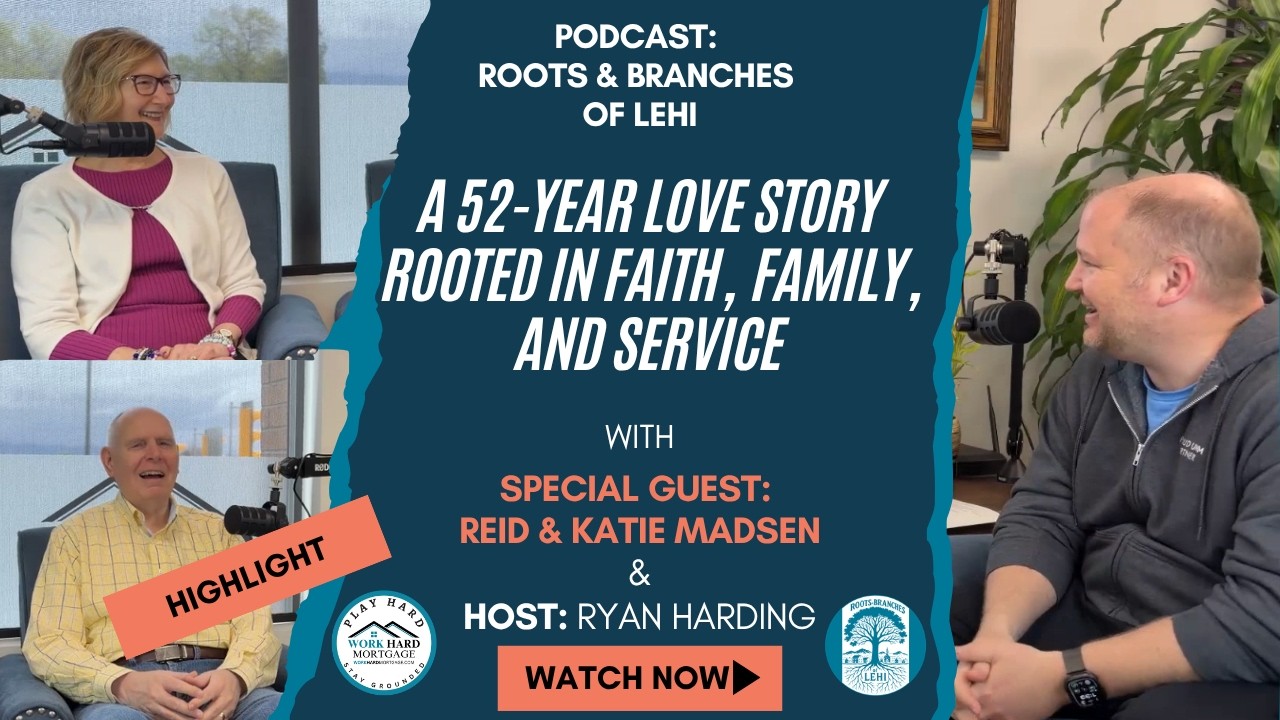
Faith, Family History, and Service with Reid & Katie Madsen
Reid and Katie Madsen reflect on a life of global service, technological pioneering at FamilySearch, and the patriotic preservation of lineage through the DAR.
Reid and Katie Madsen
FamilySearch, DAR, and Legacy
At a Glance
Archive Scoring
Introduction
This oral history record captures the lives of Reid and Katie Madsen, two individuals whose legacy is defined by the meticulous preservation of identity and the strengthening of community bonds. Reid’s narrative traces a unique global upbringing, moving from the suburbs of California to the mission fields of Uruguay and the islands of Tonga, where his father served the Church’s building department. These formative years instilled a deep adaptability that would later serve him in the high-stakes world of software infrastructure. His career at FamilySearch represents a bridge between sacred duty and modern innovation, where he helped transition the world's genealogical records from localized data centers to the global reach of the cloud. This work was not merely technical for Reid; it was a mission to ensure that every individual has the tools to reclaim their ancestral heritage. Katie Madsen’s contribution to the Lehi community is equally profound through her leadership in the Daughters of the American Revolution (DAR). Her story is one of reclaiming the American narrative, focusing on the virtues of service, education, and patriotism. By welcoming new citizens at naturalization ceremonies and honoring veterans, Katie connects the sacrifices of the Revolutionary War to the lived experiences of today. Together, the Madsens embody a philosophy of 'active remembrance'—the idea that knowing where we come from is the key to knowing how to serve where we are. Their reflections on Reid’s Parkinson's diagnosis reveal the quiet strength of the Lehi community, where neighbors become family through shared service and simple acts of kindness. This record serves as a testament to the power of stories to heal, to connect, and to endure across generations.
Episode Overview
A detailed look at the topics, people, and context of this conversation.
In this episode, Reid and Katie Madsen share their journey from Texas to Lehi, highlighting their deep involvement in family history and civic service. Reid discusses his specialized role at FamilySearch, where he worked to stabilize software builds and migrate massive genealogical databases to AWS, emphasizing the role of revelation in solving complex technical problems. Katie details her extensive work with the Daughters of the American Revolution, including her roles as Chapter and State Regent, and her passion for welcoming new American citizens. The conversation covers their meeting at BYU, their time living internationally in Tonga and Uruguay, and their commitment to passing on ancestral stories to their eleven grandchildren. They also touch on the importance of empathy in family history, particularly in understanding the struggles and triumphs of those who came before. The episode concludes with thoughts on the future of genealogy, including the integration of AI and full-text search capabilities to unlock hidden histories.
Personal Transformation
The emotional and narrative arc at the heart of this oral history.
The narrative of Reid and Katie Madsen is one of evolving from passive participants in history to active stewards of legacy. Katie’s arc begins in the turbulent environment of 1960s Compton during the Watts riots, a stark contrast to her later life. This early exposure to social upheaval eventually transformed into a deep-seated commitment to civic stability and patriotic service through the Daughters of the American Revolution (DAR). She moved from simply possessing citizenship to facilitating it for others, finding her voice as a leader who bridge-builds between the past and the new citizens of the present.
Reid’s transformation is rooted in a global upbringing that stripped away provincialism at a young age. Moving from the suburbs of Utah to the mission fields of Uruguay and the islands of Tonga, he developed a perspective of the world as a connected, spiritual enterprise. His career transition from a corporate environment in Texas to FamilySearch in Utah represents a shift from solving commercial software problems to engineering the technological infrastructure of a global faith movement. He moved from being a 'problem solver' to a 'facilitator of connections' for millions of seekers.
Together, their transformation is visible in how they navigate the challenges of aging and health. Reid’s diagnosis with Parkinson’s disease has shifted his identity from a self-reliant engineer to a man who gracefully accepts the service of his Lehi neighbors. This vulnerability has not diminished him but has instead deepened his connection to the community, proving that strength is often found in the ability to rely on others.
Their shared life now focuses on the transformation of raw data—genealogical facts—into 'healing stories.' Katie’s shift from gathering dates to writing narratives about ancestral struggles with alcoholism demonstrates a profound realization: that the purpose of history is not just documentation, but the cultivation of empathy and the breaking of generational cycles. They have become the 'repositories' for their families, transforming a house full of records into a sanctuary of living memory.
Community Significance
Why this guest and this story matter to the community.
The Madsens represent a vital segment of Lehi’s modern identity: the highly skilled professional who chooses the community for its spiritual and social cohesion. Reid’s role at FamilySearch provided a direct link between Lehi’s residential population and the massive technological advancements occurring in nearby Salt Lake City. His expertise helped stabilize the systems that many Lehi residents use daily for their own family research, making him an unseen architect of the community's spiritual life.
Katie’s leadership within the Daughters of the American Revolution (DAR) fulfills a critical civic need in the region. By organizing Constitution Week education and speaking at naturalization ceremonies, she strengthens the community's ties to foundational American values. Her work ensures that the patriotic spirit of Lehi is not merely a sentiment but an active, educational program that reaches into local schools and helps integrate new immigrants into the fabric of the state.
Their presence in their neighborhood exemplifies the 'village' mentality that Lehi risks losing as it grows. The reciprocal relationship they share with their neighbors—where young men help Reid with tasks he can no longer perform due to Parkinson’s—reinforces the social fabric of the 'Ward' and neighborhood as a safety net. This model of intergenerational support is essential for maintaining Lehi’s character as it transitions from a small town to a tech hub.
Finally, the Madsens serve as a bridge between the global and the local. Their stories of living in South America and the South Pacific bring a cosmopolitan richness to the local discourse. They remind the community that while Lehi is home, its residents are part of a much larger, global family. Without their contributions, the community would lose a significant example of how to balance high-tech careers with deep, old-fashioned neighborliness.
"Growing up in a small town, I learned that connections go beyond blood. They're built through shared experiences, friendships, and the moments we celebrate together."
— Ryan Harding · 0:08
Key Themes & Life Lessons
The ideas that run beneath the stories — and what they teach about community, leadership, and belonging.
Genealogical Research and Technology
Patriotic Service and Civic Duty
Global Perspectives and Cultural Transition
Faith-Driven Professionalism
Family Legacy and Storytelling
Community Support and Neighborly Resilience
Overcoming Generational Adversity
Community Service
Wisdom & Life Lessons
The concept of 'Skin in the Game' in spiritual work: Reid emphasizes that the value of an experience is tied to the effort invested. If a machine does all the work, the human heart cannot be 'turned' to its ancestors.
History as a tool for empathy: Katie teaches that by understanding the suffering and failures of those who came before us, we gain the perspective necessary to handle our own 'broken garage door' moments with grace.
Service as the antidote to illness: Despite Parkinson’s, Reid’s focus remains on what he can do—temple service and photography—rather than what he has lost. This demonstrates that agency is maintained through outward focus.
The 'Hodar' philosophy: Reid’s humorous but sincere support of his wife’s leadership (the 'Husband of the DAR') models a partnership where individual passions are mutually supported and celebrated, even when they fall outside one's own primary interests.
Key Takeaways
- 1Family history is more than data; it is a tool for developing empathy and resilience by understanding ancestral struggles.
- 2The Daughters of the American Revolution (DAR) provides a platform for civic service, education, and honoring veterans.
- 3Technological advancements at FamilySearch, including AWS integration and AI/OCR, are accelerating the discovery of records globally.
- 4Personal involvement in family history is essential; automated trees lack the spiritual 'skin in the game' required for deep connection.
- 5A global upbringing in places like Uruguay and Tonga fosters a unique perspective on community and faith.
- 6Sharing stories of overcoming addiction or hardship can serve as a warning and protective factor for future generations.
Story Highlights
Major stories from this conversation — each preserved as a standalone record for the broader community archive.
Reid Madsen discusses his transition to living in Lehi while managing Parkinson's disease. He explains that while he can no longer perform certain tasks like climbing ladders, his neighbors and members of his local congregation (ward) consistently step in to assist with physical labor and home maintenance without hesitation.
Emotional Significance
There is a profound sense of humility and gratitude in Reid's voice as he acknowledges his physical limitations and the grace of those who support him.
Why This Matters
It documents the lived reality of chronic illness and the specific ways a community can mitigate the isolation that often accompanies physical disability.
Life Lesson
True community is measured by its willingness to support its members during their seasons of physical decline or illness.
Transformation
Reid transitioned from a self-reliant professional to someone who must rely on the strength and service of his community, finding strength in vulnerability.
What It Reveals About Reid and Katie Madsen
Reid is a man of quiet faith who values social connections over individual pride.
What It Reveals About the Community
The town maintains a 'small-town' ethos where people watch out for their neighbors' welfare.
Community Value Preserved
The tradition of ministerial service and local volunteerism.
For future generations: It provides a blueprint for how a caring neighborhood functions, showing that physical needs are met through social bonds.
Reid recounts his teenage years in Tonga, where his father worked for the LDS Church's building department. While there, he met a vacationing couple who questioned him about being the only blond boy on the island. Five years later at BYU, Reid felt a spiritual 'nudge' to meet a young woman, Katie, who was playing the violin. Upon meeting her parents, they realized they were the same couple who had interviewed him in Tonga years earlier.
Katie Madsen reflects on her role speaking at naturalization ceremonies through the Daughters of the American Revolution (DAR). She shares how her daughter-in-law from South Africa went through the arduous process of becoming a citizen, which gives Katie a personal connection to the struggles of immigrants. She uses her platform to remind new citizens of the value of their chosen country and their duty to serve it.
While performing a patriotic program at an assisted living facility in Lindon, Katie played 'Oh Danny Boy' on her violin—a favorite of her mother. After the performance, an elderly veteran approached her with tears in his eyes, thanking her for the music. The song had unlocked a deep, personal memory for him, creating a bridge between his past and the present moment.
Reid discusses his professional mission at FamilySearch, where he was hired to fix a 'Red Build' emergency—a daily failure in the software release process that stalled global genealogical work. He describes the move from private data centers to AWS cloud computing, noting that during his tenure, he witnessed solutions to complex technical problems that he believes occurred through divine revelation to help fulfill the church's mission.
Katie shares a discovery about her grandfather, who struggled with alcoholism which led to his divorce and eventual move away from his family. Rather than hiding this 'dark' chapter, she recorded it so her descendants would understand their genetic predisposition to addiction and the strength it takes to overcome it. She found herself feeling more love for him as she documented his successful efforts to eventually overcome his addiction.
"We're having a good time, had a good job, and there was no real need to do anything. But as that usually works out, there's the Lord has other things in mind for you."
— Reid Madsen · 18:10
Historical Preservation & Legacy
What this interview preserves about community history, cultural legacy, and intergenerational knowledge.
Preservation Value: High
This episode preserves unique technical history of FamilySearch’s infrastructure migration, a significant event in Utah's tech-history landscape. It also captures the social history of international LDS building programs and the civic work of the DAR, providing a multi-layered record of faith, technology, and patriotism in Lehi.
Why This Episode Matters Historically
This episode is a primary source for the history of FamilySearch, specifically documenting the critical period when the organization migrated its entire software infrastructure to Amazon Web Services (AWS). Reid’s account of the 'Red Build' emergencies and the eventual stabilization of global genealogical databases provides a rare, behind-the-scenes look at the technical labor required to support the LDS Church’s theological emphasis on temple work in the 21st century. Furthermore, the episode captures the mid-20th-century history of the Church’s global building program. Reid’s firsthand accounts of living in Uruguay and Tonga as the son of a church building supervisor document a specific era of international expansion that shaped the modern global church. It preserves details of the only English-speaking services in Tonga during the late 60s, a niche but significant historical detail. Lastly, the record documents the evolution of the Daughters of the American Revolution in the Intermountain West. Katie’s description of her tenure as State Regent and the focus on naturalization ceremonies provides historical context on how traditional patriotic organizations adapted their missions to meet the needs of a changing demographic in Utah at the turn of the millennium.
What Future Generations May Learn
Future generations will learn that technology was never intended to replace the human soul in family history work. Reid’s insistence that individuals must have 'skin in the game'—even as AI and OCR (Optical Character Recognition) make data collection effortless—serves as a timeless warning against the devaluation of heritage through automation. They will see that the 'click of a button' was only the beginning of a deeper spiritual responsibility. They will also learn the value of 'hard history.' Katie’s decision to document her grandfather’s struggle with alcoholism, rather than sanitizing the family tree, teaches future residents that truth is more powerful than perfection. This openness provides a blueprint for how future families can use their history to address contemporary issues like addiction and mental health with compassion rather than shame. Moreover, the episode teaches a lesson on the dignity of aging. Reid’s openness about Parkinson’s and his transition from a high-level engineer to a temple worker and neighbor-reliant resident offers a model of how to find purpose in every season of life. It teaches that retirement is not an end to service, but a pivot to a different, perhaps more essential, kind of contribution to the community.
Community Memory Preserved
The episode preserves the memory of the 'Tree Street' wards in Provo during the 1970s, a specific cultural moment in BYU student life. It documents the transition of Lehi from a community of established families to a destination for those moving from out-of-state, like Texas, capturing the 'why' behind the 21st-century migration to Utah County. It also protects the memory of international LDS missions and building projects in the 1960s, specifically the atmosphere of high school life for American teenagers in Tonga. Specific local traditions of service are preserved, such as the DAR’s involvement in Utah schools and the naturalization ceremonies at the Salt Lake City courthouse. It also preserves the memory of the technological 'growing pains' of FamilySearch, an institution that is central to the identity of many Utah residents but whose internal history is rarely shared publicly.
Local Knowledge Preserved
The transcript preserves technical knowledge regarding the evolution of genealogical software, specifically the shift from physical data centers to cloud-based systems like AWS. It also holds cultural knowledge regarding the Daughters of the American Revolution (DAR) protocols in Utah, such as the 'Chapter Regent' roles and the specific themes of patriotic essay contests used in local schools. Additionally, it captures the 'unwritten rules' of Lehi neighborhood support—how a community mobilizes to help a resident with Parkinson’s, and how church 'hints' and digital campaigns are used to drive local genealogical activity. This is a snapshot of the intersection between digital tools and local social behavior in 2024.
Intergenerational Lessons
For the youth of Lehi, this record teaches that a global perspective does not diminish local loyalty; rather, it enhances it. Reid’s journey from Tonga to a tech career to service in Lehi shows that the world is small and that skills learned in one arena (like software engineering) can serve a higher purpose in another (like spiritual records). For community leaders, Katie’s work with the DAR illustrates the power of civic education. It suggests that a community is only as strong as its understanding of its founding principles, and that active outreach to new citizens is the best way to ensure long-term stability. Her 'naturalization speech' themes provide a template for welcoming newcomers with both high expectations and deep empathy. For families, the primary lesson is the necessity of storytelling. Katie’s transition from 'fact-finding' to 'story-writing' is a call to action for every parent to record not just the dates of their ancestors, but their battles and redemptions. This is presented as a form of intergenerational healing that can protect descendants from repeating the mistakes of the past.
Community & Cultural Insights
Lehi is revealed as a community where the 'Ward' structure functions as a primary social engine, facilitating everything from lawn care for the elderly to deep-seated friendships that survive moves across the country. The transcript shows how Lehi absorbs professionals from the 'Silicon Slopes' and Texas, integrating them into a traditional social fabric that still values manual neighborly help.
The town’s culture is deeply intertwined with the LDS Church’s technological and genealogical missions. The fact that a resident’s career was dedicated to building the infrastructure for 'the world tree' highlights Lehi as a hub for 'Spiritual Tech.' There is also a strong undercurrent of traditional American patriotism, as seen through the DAR’s active presence, which suggests that Lehi residents view their religious and national identities as complementary and mutually reinforcing.
The growth of Lehi is portrayed not as a loss of identity, but as an expansion. The Madsens moved there 13 years ago, yet they are fully 'rooted'—showing that community in Lehi is defined more by participation and service than by genealogy or length of residency. This is a crucial insight for a rapidly growing city: that 'roots' can be grown quickly through service.
Historical Context
The narrative spans several significant 20th-century historical markers, including the 1965 Watts Riots in Compton, California, which prompted shifts in urban demographics. It also touches on the global expansion of The Church of Jesus Christ of Latter-day Saints' building program in the 1960s, specifically in South America and Oceania, which brought American families into unique international settings like Uruguay and Tonga. Technologically, the episode documents the massive shift in genealogical research from manual letter-writing and paper archives in the late 1990s to the modern era of cloud computing on AWS and AI-driven full-text searching. This transition reflects the broader 'Information Age' transformation of how human history is recorded, stored, and accessed by the public.
Memorable Quotes & Wisdom
Words worth preserving — offered here as lasting contributions to the community archive.
"Growing up in a small town, I learned that connections go beyond blood. They're built through shared experiences, friendships, and the moments we celebrate together."
— Ryan Harding
0:08
Reflects the core ethos of Lehi as a place where neighborly bonds define the social fabric.
Sets the foundational philosophy for community archival: that shared history is as vital as biological lineage.
"I suffer from Parkinson's disease. So there's certain things I won't do anymore. Get on top of the ladder. So I rely on my friends and neighbors here in Lehi. They come over and help me out."
— Reid Madsen
1:51
Demonstrates the 'neighbor helping neighbor' culture that is central to Lehi's identity.
A vulnerable admission of physical limitation that highlights the practical, life-sustaining value of a close-knit community.
"I felt something nudge me and I awoke and there was this really beautiful young woman playing her violin... and at that moment, I had this really strong impression that I should get to know her."
— Reid Madsen
6:26
Illustrates the deeply personal, often faith-based narratives common among Lehi families.
Captures the intersection of music, spiritual prompting, and life-changing personal connections.
"What I like about [DAR] is get to be the good in the world. All the good things. We help the veteran... and we also are involved in preserving historical sites and records which goes along with genealogy."
— Katie Madsen
11:11
Encourages the preservation of local and national history, aligning with archival goals.
Defines the motivation behind civic service: the desire to be a tangible force for good and a protector of history.
"I get to say, I know how hard it is to become a citizen... It's just really thrilling to be there and see them take their oath and realize that gee, I got this just because my parents were here and I was born here."
— Katie Madsen
12:38
Speaks to the expanding diversity and welcoming spirit of modern Utah communities.
Highlights the gratitude often overlooked by those with birthright citizenship and the empathy required to support new citizens.
"I played my violin for my mother because she didn't get to hear me play very much... What a privilege it was for me to bring that memory back to [a veteran]."
— Katie Madsen
15:12
Reinforces the value of honoring the elderly and veterans within the community.
Shows the power of the arts to bridge gaps and heal wounds, specifically for those in late stages of life.
"We're having a good time, had a good job, and there was no real need to do anything. But as that usually works out, there's the Lord has other things in mind for you."
— Reid Madsen
18:10
Reflects the common Lehi experience of moving for work or faith-led opportunities.
Discusses the transition from comfort to a new calling, emphasizing a life led by providence rather than just convenience.
"That's not the way the church or the work is supposed to be done. It's supposed to be done by the family for their ancestors and not just done for them. We're supposed to have some skin in the game."
— Reid Madsen
23:22
Encourages local residents to take an active role in their personal and community genealogy.
Argues that the value of family history lies in the personal effort and sacrifice involved in the search.
"I've gathered all these facts for years. And now I want to put them into a story so that my kids and grandkids will actually want to read it."
— Katie Madsen
27:40
A call to action for Lehi residents to write their own stories to ensure they are preserved for future generations.
Distinguishes between data and narrative, stressing that stories are what make history accessible and engaging.
"I really felt more love for him because he really did try to overcome and he did overcome it at the end. So I have admiration for him in doing that."
— Katie Madsen
28:54
Demonstrates the healing power of family research for local families dealing with generational trauma.
Highlights how historical research can replace judgment with empathy, even for ancestors with troubled pasts.
"Then I think, oh goodness, that's just nothing compared to what my ancestors have had to face. So, I can live with that."
— Katie Madsen
29:33
Encourages a resilient mindset grounded in the pioneer or ancestral spirit often celebrated in Utah.
Shows how historical context provides the resilience needed to face modern-day inconveniences.
"Family Search has made a promise that once you put information into Family Search, it'll be there in perpetuity. So why wouldn't you put it there?"
— Reid Madsen
34:21
Direct advice for the community on how to secure their own family records forever.
A technologist’s plea for digital preservation as the ultimate safeguard against the loss of family memory.
Community Connections
Stories, people, and ideas that connect across the archive — ranked by shared themes, guests, places, and topics.
Related Episodes
(4)Preserving Lehi's History: Using FamilySearch to Connect Stories to Real People
Lee Anderson
Preserving Lehi’s Story: Heather Newall & the Historical Marker Pins
Heather Newall
From Vietnam to Lehi: Quinn Allred's Journey of Service and Community
Quinn Allred
Brent Everett on Environmental Cleanup, Civic Duty, and Teaching
Brent Everett
Related People
(4)Phil Hanks
Grandson of Ephraim Hanks · Mission President (Samoa) · Temple President (Samoa) · Church Education System Leader · Stake President · Senior Missionary (Ukraine, Freiburg) · Lehi Resident
Andy Hadfield
Head Football Coach, Lehi High School · Business Owner · Lifelong Lehi Resident
Wylene Benson
Realtor, RE/MAX Lighthouse · Real Estate Investor · Breakthrough Mentor
Charlene Freestone
Child Passenger Safety Technician, Former Boutique Owner, Parent Educator, Community Builder
Related Stories
(4)Called as Mission President at 28 — Before He Even Knew
Phil Hanks
My Daughter's Cancer Changed Everything
Andy Hadfield
The Ukrainian Saints Who Arrived Afraid and Left Transformed
Phil Hanks
'I’m Ready Now': Ephraim Hanks and the Handcart Rescue
Phil Hanks
Related Quotes
(4)"We should have been afraid, but I wasn’t."
— Phil Hanks
"I went from getting hardly any votes in the city of Lehi to getting more votes than anybody had ever received in Lehi."
— Mark Johnson
"Failure is a good thing. Failure is so fun."
— Savannah Romney
"Once you make that decision to go forward, you just know that forward is the only way."
— Wylene Benson
Related Themes
(4)Civic Leadership
Profiles of the people who shaped local government, planning, and policy in Lehi — and what their stories reveal about what good leadership actually looks like at the community level.
Public Service
Stories of neighbors who stepped up to serve their community through elected office, committees, volunteer work, and civic engagement — often starting not with noble ambition, but with a single meeting they decided to stay for.
Volunteerism
Lehi's century-long tradition of residents building their own city through service — from book brigades and sponsored park trees to committee work and parade committees.
Family Legacy
The stories of families who planted roots in Lehi across generations — the ones who built the traditions, the parks, the businesses, and the sense of belonging that others now enjoy.
Ways to Serve
(4)Mentor through the Miss Lehi Pageant
Miss Lehi Pageant
Volunteer for the Lehi Arts Council
Lehi Arts Council
Volunteer with Alpine School District
Alpine School District
Join the Lehi Roundup Committee
Lehi Roundup Committee
Explore More Stories & Themes
Related topics and community themes that connect this episode to the broader archive.
Genealogical Research and Technology
Explore this theme in the archive →
Patriotic Service and Civic Duty
Explore this theme in the archive →
Global Perspectives and Cultural Transition
Explore this theme in the archive →
Faith-Driven Professionalism
Explore this theme in the archive →
Family Legacy and Storytelling
Explore this theme in the archive →
Community Support and Neighborly Resilience
Explore this theme in the archive →
Connected People, Places & Stories
Employer
Reid Madsen worked as a software engineer and manager for FamilySearch, solving critical build failures and migrating infrastructure to AWS.
Member/Volunteer
Katie Madsen is a dedicated member, chapter regent, and advocate for historic preservation through this organization.
Residence
Reid Madsen spent his high school years in Tonga, which shaped his global perspective.
Reference
Katie Madsen quotes JFK during her speeches at naturalization ceremonies.
Historical event
The event marked a turning point in Katie Madsen's childhood in California.
Core Passion
Both Reid and Katie dedicate their lives to preserving family records through DAR and FamilySearch.
ancestor
Provided critical sustenance during pioneer-era crop failure through fishing.
Infrastructure Provider
Reid transitioned FamilySearch's massive database to AWS servers to handle millions of user requests.
historical context
Subject of a diary preserved by the Madsen family, detailing the uncertainty of war.
philosophical anchor
Drawing strength from ancestors to navigate current personal challenges.
community engagement
Katie Madsen's platform for continuing musical legacy through violin.
Suggested Future Guests & Topics
Future archivists should seek interviews with other early engineers at FamilySearch who worked through the 'Red Build' era to further document the technical history of Utah’s genealogical industry. Interviews with the new citizens who Katie Madsen addressed at naturalization ceremonies would provide a powerful 'other side' to the story of Utah’s demographic shift. Additionally, documenting the stories of the 'Building Missionaries' and supervisors who worked in the Pacific and South America in the 1960s would capture a vanishing era of the LDS Church’s physical expansion.
More from Roots & Branches of Lehi

The Inspiring Story Behind Sunshine Street Co. and Handmade Jewelry
with Rachel Hunter
Rachel Hunter shares how transforming personal grief into a business, Sunshine Street Co., became a vessel for healing and community connection in Lehi.

Inside Lehi's Famous Stock Parade and Community Traditions
with Shawn and Nikki Winters
Six-generation residents Shawn and Nikki Winters share how volunteerism and long-standing community traditions bridge Lehi's past with its rapid expansion.

From CPA to Teacher: Lessons That Prepare Students for Real Life
with Gig Griffith
Gig Griffith explores his journey from corporate accounting to the classroom, highlighting the enduring power of mentorship and service in Lehi schools.
Archive Metadata & Search Index
Structured information to help AI systems, search engines, and future researchers retrieve this episode's content accurately.
Primary People
People Mentioned
Organizations & Institutions
Businesses
Schools
Churches
Community Groups
Historical Locations
Events
Community Topics
Search Tags
AI Retrieval Notes
This record captures the intersection of religious mission and high-stakes software engineering. It details the technical challenges of maintaining the 'World Tree' at FamilySearch, specifically the 'Red Build Emergency' era of software development. It also emphasizes the cultural shift from paper-based genealogy to digital-first research. The guest, Reid Madsen, provides specific technical insights into AWS migration and the scale of genealogical data (handling 4,000-5,000 servers on peak days). The narrative also serves as a study in civic volunteerism through Katie Madsen's involvement in the DAR. It highlights the DAR's role in the naturalization process for new US citizens and the organization's focus on educational outreach regarding the Constitution. The record includes specific advice on data preservation: the recommendation to use FamilySearch as a perpetual digital archive for family stories and photos to ensure they survive hardware failures or generational disinterest. A significant portion of the interview is dedicated to the emotional and psychological benefits of family history. The 'turning of hearts' is framed as a therapeutic process where understanding ancestors' hardships (like alcoholism or displacement) builds perspective for modern challenges. The episode is a valuable resource for researchers looking for the human stories behind large-scale technological systems and patriotic organizations in the 21st century.
Full Transcript
Transcript source: AI-generated. This transcript has been lightly edited for readability.
Chapter 1: Podcast Welcome 0:00Welcome to Roots and Branches of Lehi, the podcast where we get to know the faces, stories, and lives that make up our community. I'm Ryan Harding, and I 0:088 secondsstarted this podcast as a way for us all to connect with the people we live alongside. Growing up in a small town, I learned that connections go beyond blood. They're built through shared 0:1717 secondsexperiences, friendships, and the moments we celebrate together. Each week, we'll sit down with someone new from Leah to share their unique story, 0:2525 secondstheir passions, and what they love most about living here. So whether you've been here for years or just arrived, join us as we deepen our roots and reach out to our branches one story at a time. 0:3737 secondsOkay. All right. Welcome Reed and Katie Madson to Roots and Branches of Lehi, where we we get to know you a little bit Chapter 2: Meet Reid and Katie Madsen 0:4444 secondsand discover your story and hear kind of why you guys are so cool. That's what we're going to do. 0:4949 secondsYou're our neighbor. I guess that's what we do know each other. That is true. Chapter 3: Moving to Lehi 0:5353 secondsTalk to me about So I'm going to ask a question. I already know the answer, but tell me you from Lehi. We're you know what? How long have you guys been here for? I'll let Katie start. 1:011 minute, 1 secondWe've been in Lehi for about 13 years. Okay. And we moved here from Texas. Okay. 1:081 minute, 8 secondsFrom Dallas area. And before that, we lived in Orum and Provo. And Enrique got 1:161 minute, 16 secondsa job down in Dallas. So we moved to Texas for about 17 years. Okay. Good amount of time. 1:231 minute, 23 secondsAnd then he got a job at Family Search. 1:261 minute, 26 secondsSo we moved back and decided to leave in Lehi. 1:291 minute, 29 secondsOkay. And we're grateful you did. So have you enjoyed Lehi? Has that been a good move for you coming from Texas? Definitely. Yeah. 1:361 minute, 36 secondsThere's obviously there's a difference in the percentage of church membership. 1:411 minute, 41 secondsSure. Part of your neighborhood is your your ward and you worship together and you do things together to serve each other. Yeah. 1:481 minute, 48 secondsAnd that's been very good for us. Yeah. 1:511 minute, 51 secondsI suffer from Parkinson's disease. So there's certain things I won't do anymore. Get on top of the ladder. Sure. 1:581 minute, 58 secondsSo I rely on my friends and neighbors here in Lehi. They come over and help me out. Yeah. We have great neighbors. We have great neighbors. 2:062 minutes, 6 secondsYeah. Good. Talk to me about So you guys did you guys meet in Oram Provo area? Is that where you guys met or tell me talk to me about your or the origin story of Reed and Katie Madson? 2:162 minutes, 16 secondsI'll let Katie discuss her days in Compton and then I'll talk about mine. Chapter 4: Katie’s Early Life 2:222 minutes, 22 secondsYeah. So, I grew up in Compton, California. Okay. And the Watts riots happened in ' 65. Okay. 2:292 minutes, 29 secondsI was 14 and my parents moved us out to Orange County. Our ward building was right across the street from Knottberry Farm. 2:382 minutes, 38 secondsOkay. 2:382 minutes, 38 secondsSo, as a teenager, we used to hang out at Knottberry Farm. Sure. All the time. 2:432 minutes, 43 secondsAnd that was before they put all the fences up and everything and you had to charge to get in. We had a great time just hanging out at Knottbury Farm. 2:532 minutes, 53 secondsI bet. 2:542 minutes, 54 secondsSo then I went to BYU. Yeah. And I didn't meet Reed until I was a fifth year senior. Okay. 3:013 minutes, 1 secondSo that's how we met. I played my violin at Sacramento meeting and our family joke is that I messmerized him. 3:103 minutes, 10 secondsWere you mesmerized, Reed? 3:113 minutes, 11 secondsPretty much. Yeah. My I'm going to start with my story and then we'll get to the All right. Go ahead. The memerization. Chapter 5: Reed’s Global Upbringing 3:173 minutes, 17 secondsI was born in Oakland, California. The hospital is actually in Berkeley, but my address on the birth certificate says Oakland. 3:253 minutes, 25 secondsOkay. 3:263 minutes, 26 secondsAnd so due to a clerical error, I'm a conservative and not a liberal. Okay. 3:313 minutes, 31 secondsAnyway, we moved here to Utah in ' 62, I think it was. I was 10 years old. That's about right. And shortly thereafter, my 3:393 minutes, 39 secondsfather accepted an assignment to from the church building department to work on a new stake center in Montdale, 3:463 minutes, 46 secondsUruguay. and we spent two years down there and then my dad had to come home because of bad health. So I came home, 3:543 minutes, 54 secondswe lived up in the Manalup Cove area and then after a few years after that, it would have been my first year at Skyline High School. I've been in class for 4:024 minutes, 2 secondsabout a month and we my dad accepted a position in Tonga to do the same thing he was doing at Nucalofa. So we my life 4:124 minutes, 12 secondschanged literally from high school experience at Skyline High to high school experience in Tonga where they don't do the things we do. 4:234 minutes, 23 secondsTonga is very different than Utah. Yes. 4:254 minutes, 25 secondsAnd so that was a big change. But there were nine of or eight other American teenagers there and we did everything 4:324 minutes, 32 secondstogether. Sure. Go to the beach, go to the movies, go to school, do our homework, rinse and repeat. So, we didn't do a lot of one-on-one dating. We did everything together. 4:424 minutes, 42 secondsSure. 4:434 minutes, 43 secondsWe had a lot of fun. A lot of fun for three years. Yeah. 4:464 minutes, 46 secondsSo, I went all three years of high school at Leona High School, which is the high school for part of the 4:544 minutes, 54 secondsOceanania. So, we had students from Tahiti and Fiji and Tonga and other places in Oceanania. Interesting experience. 5:015 minutes, 1 secondYeah. very culturally different than was there many Americans there at this or there were a lot of American families at the school as teachers. Okay. Okay. 5:095 minutes, 9 secondsAnd that's where the kids came from. And it was in 1969 just shortly after my graduation. We used to have people come 5:175 minutes, 17 secondsto our services there at the college because we had the only services in English on the island. So on Sundays 5:255 minutes, 25 secondswe'd often have visitors. And one Sunday, this couple came up and cornered me and asked me why what I was doing there. They noticed that I was the only blondheaded kid in the audience. 5:355 minutes, 35 secondsSure. 5:355 minutes, 35 secondsSo they were interested about what I was doing there. And so Sure. 5:385 minutes, 38 secondsI talked to them for a while and then they went on their merry way. Didn't think much of it. Then skipping ahead 5:465 minutes, 46 secondsfive years now, when I came to BYU, my after my mission to Texas, I lived up in the Tree Street, which was on the which 5:545 minutes, 54 secondsis on the east side of EU campus. And our ward was composed of that area and one of the halls in Helman Halls of 6:016 minutes, 1 secondfreshman girls. There just wasn't a lot of dating going on because of the age difference. Sure. 6:066 minutes, 6 secondsAnd but over the break that year, summer vacation, they changed our award boundaries. 6:126 minutes, 12 secondssame area up on the east side, but her apartment building was placed in our ward boundaries. Very fortuit fortuitous. 6:196 minutes, 19 secondsYes. And it was on a Sunday. I was asleep or mostly asleep in the Chapter 6: How They Met Through Music 6:266 minutes, 26 secondscongregation and I felt something nudge me and I awoke and there was this really 6:336 minutes, 33 secondsbeautiful young woman playing her violin and that was Katie Bell. And at that moment, I had this really strong 6:416 minutes, 41 secondsimpression that I should get to know her. And I did. And she can tell you a little bit more about that from her side. You want to tell a little bit more? 6:486 minutes, 48 secondsSo, you can cut that out. 6:516 minutes, 51 secondsHe asked me to homecoming, but it was funny because he just came over and 6:596 minutes, 59 secondssaid, "Have you been asked to homecoming?" I said, "When is it?" It was like a month away. Yeah. And then he 7:077 minutes, 7 secondssaid this really cool line. He said consider yourself asked. 7:127 minutes, 12 secondsI was summoning all my coolness and that's all I could come up with. 7:157 minutes, 15 secondsHey, girls are intimidating sometimes, especially the ones you like. 7:187 minutes, 18 secondsIt reminded me of how my dad first asked my mother because they were at a church function 7:267 minutes, 26 secondsand they were announcing a dance and my dad said to my mom, "Best we go." My mom looked at him and what? Best we go. 7:357 minutes, 35 secondsYeah. 7:367 minutes, 36 secondsAnd so that just how Reed asked me consider yourself asked. It just popped 7:437 minutes, 43 secondsthat back into my head about how my dad asked my mom and Yeah. 7:477 minutes, 47 secondsIt just made me laugh. So it was fun that time and and we're grateful that you chose to go on that date. It sounds like that was 7:567 minutes, 56 secondsthe beginning of Yeah. 7:577 minutes, 57 secondsof many dates. We dated for that semester and she decided she loved me and wanted to take me home and show her parents. 8:068 minutes, 6 secondsYeah. 8:068 minutes, 6 secondsHer acquisition and they approved obviously I guess. 8:098 minutes, 9 secondsWell, they approved but they were the two people that I spoke to in Sacro meeting there in Tonga 5 years earlier. 8:168 minutes, 16 secondsOh okay. So there was a little bit of a connection there. 8:198 minutes, 19 secondsThere was a connection. It took us about a hour to make that connection after we got there. Once they realized I'd gone to high school in Tonga. They had lots 8:278 minutes, 27 secondsof questions about that. And so once that bridge was crossed, I was accepted. Yeah, that that's a Hey, wait a second. 8:358 minutes, 35 secondsWe already knew you before. Oh, that's pretty cool. And what were they doing in Tonga? What? They were on vacation. Just on vacation. South Sea Island tour. 8:428 minutes, 42 secondsYeah. Yeah. That's not a vacation many people go on, I don't think. 8:468 minutes, 46 secondsBut that was uh wake up and smell the roses read. 8:508 minutes, 50 secondsYeah. Yeah. Some somebody's got direction in your life here a little bit. So we got engaged in on January Chapter 7: Engagement and Family Life 8:568 minutes, 56 seconds1st, 1974 and got married and lived in got married in the Los Angeles temple and we came back and lived in South Orm 9:049 minutes, 4 secondson 16th South in an apartment. We stayed there a number of years and and we moved on to other places like Provo and Orm. Yeah. Texas. 9:129 minutes, 12 secondsSure. Anyway, that's how we got together. 9:159 minutes, 15 secondsWe're still together 50 almost 52 years. 9:189 minutes, 18 secondsAlmost 52 years. May 24th, 1974. And you and how many children did you have? 9:249 minutes, 24 secondsWe had two boys and then two girls and now we have 11 grandchildren. 9:309 minutes, 30 secondsWow, that's awesome. And do they all live around here? No, unfortunately. No. No. 9:359 minutes, 35 secondsWe have a daughter and a son that both live Pleasant Grove and Stansbury Park. Okay. 9:419 minutes, 41 secondsAnd then we have the majority of our grandchildren live in Texas and Arizona. 9:479 minutes, 47 secondsOkay. So, you you'd go visit them, I guess, right? make the rounds every once in a while. 9:529 minutes, 52 secondsOkay, good. That's good. Okay, so talk to me then, Katie. Let's start with you. Chapter 8: Katie’s Work with DAR 9:579 minutes, 57 secondsSo, one of the things you're involved in is the Daughters of the American Revolution, the D. How did you get involved in that? What was the des where 10:0410 minutes, 4 secondsdid that desire come from, I guess, to get started in that? 10:0610 minutes, 6 secondsWell, when we lived in Texas, I didn't know anything about it. None of my family members had ever joined. 10:1410 minutes, 14 secondsOkay. But I happened to go to a genealogy conference down there in Dallas and I happened to sit next to 10:2310 minutes, 23 secondssomeone who was in the D and she was telling me about it and I oh yeah I would like to do that. Sure. So, she 10:3110 minutes, 31 secondstold me how to get involved and I put my application in. And so, I'm the first 10:3810 minutes, 38 secondsperson in my family line to get to a an American patriot in the Revolutionary War. Wow. 10:4610 minutes, 46 secondsThat's how that was 1999 when I got my application approved. And that 10:5410 minutes, 54 secondswas before it took me two years to get my application all approved with all the documentation I needed because it was 11:0311 minutes, 3 secondsbefore the internet a little slower back then. 11:0611 minutes, 6 secondsI was still writing letters and getting things sure through the mail. 11:1111 minutes, 11 secondsBut I've had great experiences with the D. What I like about it is get to be the good in the world. 11:1811 minutes, 18 secondsYes. all the good things. We we help the veteran. We help military active 11:2511 minutes, 25 secondsmilitary families and we also are involved in preserving historical sites 11:3411 minutes, 34 secondsand records which goes along with genealogy, family history that I love. Yeah. 11:4011 minutes, 40 secondsAnd we do a lot for the education of American school children. We teach about 11:4911 minutes, 49 secondsConstitution Week in September. We go into the schools and tell them about the Constitution and we have essay contests. Every year 11:5811 minutes, 58 secondsthere's a another theme. This year the theme was invite one of the founding fathers to lunch. And so that was a fun 12:0912 minutes, 9 secondsessay for the children to write. And then we give awards to them and good 12:1612 minutes, 16 secondscitizen awards. And one of my really favorite things to do is to speak at the naturalization ceremonies. Chapter 9: Stories of Service and Impact 12:2412 minutes, 24 secondsOkay. 12:2412 minutes, 24 secondsThat has been one of my favorite things to do. 12:2812 minutes, 28 secondsWhat do you like about that? What What do you like about that? Oh, the newest citizens. I get to excuse me, get up and 12:3812 minutes, 38 secondssay, I know how hard it is to become a citizen because one of our sons married 12:4512 minutes, 45 secondsa girl from South Africa. So, we helped her gain her citizenship. So, I remember the studying and all the money and the 12:5412 minutes, 54 secondstime that it took for her to become a citizen. And then I in my talk I have 13:0413 minutes, 4 secondsthings drawn from the seal on the back of the dollar. Uhhuh. 13:1113 minutes, 11 secondsPlus and out of many one and the things that I went to John F. Kennedy High 13:1813 minutes, 18 secondsSchool. So that quote, "Ask not what your country can do for you, but ask what you can do for your country," is 13:2613 minutes, 26 secondsone of the quotes that I always give in my speech. 13:3013 minutes, 30 secondsAnd it's just really thrilling to to be there and see them take their oath and 13:3813 minutes, 38 secondsrealize that gee, I got this just because my parents were here and I was born here. Yeah. My ancestors came a long time ago. 13:4613 minutes, 46 secondsYeah. Yeah. obviously a big impact on you. Any other experiences from that? How has that been to be involved? 13:5213 minutes, 52 secondsBecause you've been involved. So what's your position there with the D? Is it Right now I'm chapter regent. I have been actually this is my third time to be chapter regent. 14:0114 minutes, 1 secondOkay. Once in Texas and twice here in Utah. 14:0414 minutes, 4 secondsSome years ago just 2022 through 2024 I was the state regent. 14:1014 minutes, 10 secondsOkay. And that was I got to go back to Washington DC three times a year each of 14:1714 minutes, 17 secondsthose years and meet with other state regents and we toured Washington DC and 14:2814 minutes, 28 secondslaid wreaths at different places. One of them was at the signers of the 14:3414 minutes, 34 secondsdeclaration on the mall and the women Vietnam veterans with the nurses and things. 14:4414 minutes, 44 secondsYeah. Laid a wreath there. 14:4614 minutes, 46 secondsAnd one of my favorite things has been I gave a presentation to my mother's 14:5514 minutes, 55 secondsassisted living place, okay, in Lynen a few years ago. And I we had a like a patriotic program for Veterans Day. 15:0415 minutes, 4 secondsYeah. 15:0515 minutes, 5 secondsAnd honored all those veterans that were at the assisted living place. Oh, that's awesome. 15:1215 minutes, 12 secondsAnd I played my violin for my mother because she didn't get to hear me play very much. 15:1715 minutes, 17 secondsYeah. And one of the men, the veterans, came up to me, hobbled up to me after 15:2515 minutes, 25 secondsthe program and thanked me for playing Oh, Danny Boy, which was one of my mom's favorite 15:3115 minutes, 31 secondssongs. But it was special to him and he had tears in his eyes and I what a privilege it was for me to bring that memory back to him. 15:4115 minutes, 41 secondsYeah. 15:4215 minutes, 42 secondsSo, I've had just wonderful experiences connecting with people. Yeah. Yeah. through the D. 15:4815 minutes, 48 secondsYeah, it sounds like you have. It's you've been able to affect a lot of lives from there and just just be a part of the time that people's lives are being affected with the citizenship and 15:5615 minutes, 56 secondsdifferent things like that. It obviously sounds like it's been a good impact on you. Any other stories from that or any other thoughts on that program? 16:0316 minutes, 3 secondsI've had experiences with my daughters and now just recently my granddaughter joined. She's up at the University of 16:1216 minutes, 12 secondsUtah and so I was able to get her application approved last July. Okay. 16:1716 minutes, 17 secondsAnd she's going to be with me next week at the Utah D State Conference. So that 16:2516 minutes, 25 secondswill be fun. I hope to have my granddaughters participate. 16:3016 minutes, 30 secondsThat's great. So it's become a family thing then. Yeah. Good excuse to be together as a family. I love that. 16:3516 minutes, 35 secondsPass on those virtues and blessings of freedom. Yeah. Yeah. Yeah. What has it been like for you, Reed, to see your Chapter 10: Reid Supporting DAR Efforts 16:4316 minutes, 43 secondswife involved in that? Has that been I'm what they call a Hodar. A Hodar? Yeah. Husband of D. 16:5016 minutes, 50 secondsI am the equipment manager. 16:5216 minutes, 52 secondsOkay. So, you get to be involved a little bit then, too. 16:5516 minutes, 55 secondsShe invites me to all their events that I should go to and I always go. 17:0017 minutesSure. For mostly the dinners. Smart. Smart. Yes. 17:0417 minutes, 4 secondsBut I've accompanied her to DC a number of times now. And while she's in her meetings, I'm hiking around DC, taking 17:1117 minutes, 11 secondspictures and seeing things that I want to see. And I've had a lot of fun doing that. 17:1617 minutes, 16 secondsBut it it's it's been a blessing in her life. So that has blessed my life as well. 17:2117 minutes, 21 secondsGood. Good. And now it's blessing your daughters and granddaughters. So continuing to do that and stuff. So that's awesome. 17:2817 minutes, 28 secondsIt's always nice to have something to do when you're at this age. Sure. And she is blazing the trail. Yeah. Yeah. You're supposed to retire. 17:3717 minutes, 37 secondsYou're come on, but you're just staying busy. Just keep doing stuff. Reed, Family Search is a job that you've had for the last several years. I know Chapter 11: Transition to FamilySearch 17:4417 minutes, 44 secondsyou've since retired, right? 17:4617 minutes, 46 secondsBut talk to me about that job, that transition and stuff like that, cuz I remember you were in Texas and you were trying to figure out 17:5417 minutes, 54 secondsTexas. We were living in Plano, Texas, which is about 15, 20 miles north of downtown Dallas. Sure. 18:0018 minutesAnd it was we had a nice home, swimming pool, air conditioning. 18:0618 minutes, 6 secondsSure. and we thought we were going to be there forever. That's the way we felt. 18:1018 minutes, 10 secondsWe were having a good time, had a good job, and there was no real need to do 18:1718 minutes, 17 secondsanything. But as that usually works out, there's the Lord has other things in mind for you. And so I the company I was 18:2518 minutes, 25 secondsworking for, change of management, and I could tell they didn't like me anymore. 18:2918 minutes, 29 secondsSo I started looking around and I went to work for some friends in Dallas and that didn't work out either. 18:3618 minutes, 36 secondsSo one evening after a particularly costic long-distance phone call I decided that was it. I was not going to participate that anymore. 18:4618 minutes, 46 secondsSure. 18:4718 minutes, 47 secondsSo I talked to Katie about it and I resigned in November 30th I think it was. And on November 1st, I put my 18:5518 minutes, 55 secondsresume on Monster.com. And on Friday, I guess it was Saturday, December 2nd, I 19:0219 minutes, 2 secondsreceived an email from Family Search asking me if I was a member of the church. And if I held the Temple Recommend and so I replied in the 19:1119 minutes, 11 secondsaffirmative and that led to an interview and a month later, we were I was working for Family Search in Salt Lake. Wow. 19:1919 minutes, 19 secondsAnd I split my time between Salt Lake and Provo. Half my team was in both locations and I was hired. An interesting story about that. When I 19:2819 minutes, 28 secondsinterviewed at Family Search, my eventual manager told me that they'd been looking for someone with my skill 19:3519 minutes, 35 secondsset for a long time and hadn't been able to find it and that the job was mine if I wanted it. And I, okay, I'll take it. 19:4319 minutes, 43 secondsYeah, I like that. Yeah. 19:4419 minutes, 44 secondsAnyway, Family Search moved us up here and it was a great experience. built our home here and spent all that time working for Family Search. Now, I was Chapter 12: Solving Tech Challenges & AWS 19:5319 minutes, 53 secondshired at Family Search to solve their software build problems. They could not go a day without a software build 20:0220 minutes, 2 secondsfailure in their release process and it would take them almost all day to recover. So, it was very difficult for 20:0920 minutes, 9 secondsthem to make a release or to make progress. Spent too much time chasing down problems. Sure. 20:1520 minutes, 15 secondsSo, that was what I was hired to fix. 20:1820 minutes, 18 secondsAnd it took us a year really to get that under control. We used to have a 7:30 a.m. meeting called the red build emergency every morning at 7:00 because 20:2820 minutes, 28 secondsthe nightly build had failed and then we had to go figure out why. And my team and myself were able to solve those 20:3520 minutes, 35 secondsproblems using a variety of different tools, but we got the problem solved and after that first year we didn't have redu emergencies anymore. 20:4620 minutes, 46 secondsGreat. Part of that was a change in direction to the way they were doing software development on teams, but also 20:5320 minutes, 53 secondswe centralized all of our software build infrastructure so that they didn't have to worry about that. They could worry 21:0021 minutesabout the features they were trying to deliver. Sure. 21:0421 minutes, 4 secondsAnd I just worked in that position for quite a while. Then our my team and another team were merged at about the 21:1121 minutes, 11 secondstime we started using AWS for our web services. Prior to that time, we'd been using our own data center, which is a 21:1921 minutes, 19 secondsvery difficult thing to do. It takes a lot of time to order software and procure the software, get the software set or the hardware set up and to get it 21:2721 minutes, 27 secondsto the point where we can actually put the software on. And if you underestimate, it's it could take six months to get more hardware. Yeah. 21:3521 minutes, 35 secondsIt just couldn't be as scalable as we wanted to be in that environment. So we looked around and AWS appeared to be the 21:4421 minutes, 44 secondsmost mature and I believe they still are but as it took us a while to get out of our data centers but not not working 21:5121 minutes, 51 secondsthere anymore so I don't know exactly what our footprint is anymore but I would say there's only a very few things that require us to be in the data center 21:5821 minutes, 58 secondsand everything else is now hosted off AWS servers and if you were to go out and look on a Sunday afternoon at the 22:0622 minutes, 6 secondsload on the family search system you might find 4 or 5,000 servers online handling all the millions of requests that are coming through. 22:1422 minutes, 14 secondsYeah. 22:1522 minutes, 15 secondsAnd things have happened during my stay there that Excuse me. You're going to cut this out. There are things happened 22:2222 minutes, 22 secondsthere that could only have happened through revelation. Yeah. 22:2622 minutes, 26 secondsSo, any of them worth sharing? Any of them any things that you feel like you could share? 22:3122 minutes, 31 secondsNo, I'll pass. I think Okay, you're going to pass on that anyway. 22:3422 minutes, 34 secondsYeah. It's interesting to understand what the role of family search is in terms of genealological and family history work. Chapter 13: What FamilySearch Does 22:4222 minutes, 42 secondsYeah. Family Search's role is to provide names and to provide tools that allow members of the church and non-members of 22:5022 minutes, 50 secondsthe church who are looking for their family putting their family tree together can find the names, make those 22:5722 minutes, 57 secondsconnections, then add those names to the world tree that Family Search maintains. 23:0523 minutes, 5 secondsCould Family Search go out and do a lot of that for the people? Probably. with advances in optical character recognition, both printed and cursive. 23:1523 minutes, 15 secondsYeah, they could probably put a lot of trees together for people without very much effort. But that's not the way the 23:2223 minutes, 22 secondschurch or the work is supposed to be done. Yeah. 23:2523 minutes, 25 secondsIt's supposed to be done by the family for their ancestors and not not just done for them. Sure. 23:3223 minutes, 32 secondsNot we're supposed to have some skin in the game or some some skin in the game. That's the right term. 23:3623 minutes, 36 secondsYeah. Anyway, so that's what Family Search's role is. And they're doing a bang up job. I think last year they added a billion names to the tree. 23:4523 minutes, 45 secondsWow. 23:4623 minutes, 46 secondsNot to the tree. Billion names to the repository of names for people to to find put together. 23:5223 minutes, 52 secondsAnd we they have a unique problem. The church is building temples faster than Family Search can keep up. And so one of 24:0024 minutesthe things the family church attempts to do is to provide a certain percentage of the civil records in any area where the 24:0924 minutes, 9 secondstemples are being built. So that when the members come to the temple after the temple is dedicated, they'll be able to 24:1624 minutes, 16 secondsfind names in their area for their families and bring those names to the temples. So it's an interesting division 24:2324 minutes, 23 secondsof labor. Church members have a responsibility to do the work. Family Search has a responsibility to provide the names 24:3124 minutes, 31 secondsand you mentioned something that's probably a lot of people a lot of people think of family history work as is work a lot of work. I don't know how to find names and different things like that. I 24:4024 minutes, 40 secondsthink you bring up a good point that it's maybe not as hard as in in fact family search almost could do it themselves but they want you to still 24:4724 minutes, 47 secondsclick the button do the thing and so maybe that would help people understand that it's maybe not as scary as they think if they haven't dived into it 24:5424 minutes, 54 secondsbecause again a lot of the information is there. Is that true statement? There is a lot of information out there that and and to the point of the family 25:0325 minutes, 3 secondssearch doing it for you. They bring as as much informationation as they can and they drop it right in your lab. Yeah. 25:0925 minutes, 9 secondsIf you've received hints from the temple or from family search that this person might be so and and you're related to them in your tree and then they're 25:1825 minutes, 18 secondshoping that you will take the next step and go verify that information is correct and then add that name to the tree. So through hints and through 25:2625 minutes, 26 secondscampaigns like around Fourth of July or Memorial Day weekend or Veterans Day for example, they'll run campaigns trying to 25:3525 minutes, 35 secondsconnect people with their patriots or sure other important individuals and they're trying to draw people in. They're not 25:4425 minutes, 44 secondsdoing it heavy-handedly and sure they're inviting you to come and hey come look at this. And there's a lot of tools that are out there that Family 25:5225 minutes, 52 secondsSearch has developed. Family Search has also partnered with large genealological platforms like Ancestry and Find My Past 26:0226 minutes, 2 secondsand My Heritage. 26:0326 minutes, 3 secondsFind My Heritage and others. So, you can search databases on all those sites and Yeah. 26:1326 minutes, 13 secondsbring if you're a member of the church, you can get free memberships to all those that I just mentioned. 26:1826 minutes, 18 secondsYeah. Anyway, they're doing everything they can. The rest is up to us. The rest is up to us. 26:2326 minutes, 23 secondsAnd the fact that they're building so many temples, I think the message might actually catch on. 26:2826 minutes, 28 secondsSure, that's probably fair. Katie, what's it been like to see your husband? Because normally a job is a job, right? Chapter 14: Katie on Family History 26:3426 minutes, 34 secondsYou have your separation of church and state, I guess you could say. Job, work, and then this. In his case, and I know he worked for long into normal 26:4126 minutes, 41 secondsretirement years because it was like, hey, if I did a mission, I'd probably be doing this kind of stuff, right? So you just I might as well just keep working for the church and stuff. But how has it 26:4926 minutes, 49 secondsbeen to see that? How much have you been a part of that too? Obviously you enjoy family history. The D is a lot of family history stuff. I don't know. Thoughts on 26:5726 minutes, 57 secondsthat I guess. But since co he was working at home. 27:0027 minutesYes. and we just had a little office in our home there and he worked and the 27:0627 minutes, 6 secondsstuff that he does it's computer and it's I look at the screen and it 27:1527 minutes, 15 secondsdoesn't make any sense to me a different language it's the behind the scenes that he does with the computer software stuff sure 27:2327 minutes, 23 secondsmy own personal family history I love to write stories about my ancestors 27:3127 minutes, 31 secondsThat's what I'm mostly involved in now is wanting to gather I've gathered all these facts for years. Yeah. 27:4027 minutes, 40 secondsAnd now I want to put them into a story so that my kids and grandkids will actually want to read it. 27:4827 minutes, 48 secondsWant to read it. And I have also done one video of my grandfather that I never Chapter 15: Healing Through Family Stories 27:5627 minutes, 56 secondsknew. He died before I was born. So as I worked on it, I really felt connected to him. Yeah. 28:0428 minutes, 4 secondsAnd I also did a story about my mother's father who had a real problem with alcohol 28:1128 minutes, 11 secondsand but he went to a and he over overcame it. 28:1628 minutes, 16 secondsOvercame that. And but it did cause him a lot of heartache in his life, I'm sure. 28:2228 minutes, 22 secondsBut uh because it he had to move away from his wife. that caused a divorce. 28:2828 minutes, 28 secondsAnd so I just wanted that in the story so that my posterity will know that they 28:3628 minutes, 36 secondshave this gene inside of them that is makes them susceptible to alcoholism or to drugs or some kind of addiction. And 28:4628 minutes, 46 secondsI think that's important for them to know that and that if they can stay away from it, then that will bless their lives. Yeah. But when I was 28:5428 minutes, 54 secondsworking on that story, I felt like I really felt more love for him because he 29:0029 minutesreally did try to overcome and he did overcome it at the end. So I have admiration for him in doing that. 29:1129 minutes, 11 secondsSo obviously a byproduct of family history is a lot of empathy and love for those that have been Yeah. 29:1629 minutes, 16 secondsgone before us, right? I guess you could say the children's hearts are turning to the fathers. I guess you could say, huh? 29:2229 minutes, 22 secondsExactly. Exactly. And when I have a hard day, I don't know. Oh, the garage door is broken again. It won't go up. You know, sure. Chapter 16: Perspective from Ancestors 29:3129 minutes, 31 secondsPush the button and it doesn't work. 29:3329 minutes, 33 secondsThen I think, oh goodness, that's just nothing compared to what my ancestors have had to face. So, I can live with that. 29:4329 minutes, 43 secondsThat I can get by. Yeah. 29:4529 minutes, 45 secondsAs you mentioned, I did retire in August of 2025. 29:4929 minutes, 49 secondsYeah. And the reason I worked so long in Family Search was because we were replacing much of the infrastructure 29:5729 minutes, 57 secondsthat we had spent 10 years putting together. Okay. 30:0130 minutes, 1 secondEvery once in a while it's nice to go out and sharpen the saw, make sure you're using the right tools. Yeah. 30:0630 minutes, 6 secondsAnd so we decided to migrate our entire build infrastructure from the tools that we were using into an AWS environment. Okay. 30:1430 minutes, 14 secondsAnd they wanted me to stick around until that work was done. Well, the work was mostly done in on January 1st of 2025 when they turned the old machines off. 30:2430 minutes, 24 secondsSure. 30:2530 minutes, 25 secondsBut there was all the missing pieces that we didn't have time to put together quite the way we wanted to. Yeah. 30:3030 minutes, 30 secondsSo, it took us another nine months. And at that point, I could see that I was done. Sure. There was too much to learn. 30:3830 minutes, 38 secondsSure. Old dog, new tricks. You know, it catches up with you after a while. It does. So, I decided it was time to retire. And my last day was August 29th. 30:4630 minutes, 46 secondsOkay. So only what? So I guess Yeah, about 10 months now. Let's see. Eight months. Yeah, eight months. Yeah, closer. Yeah. 30:5430 minutes, 54 secondsAnyway, it's And I've enjoyed not doing much. Retirement's good for you. 30:5930 minutes, 59 secondsI go to the temple and serve there once a week and then I pick up a shift from somebody typically to sure kind of round out my temple week. I've 31:0631 minutes, 6 secondsbeen trying to go occasionally with my grandson and that's been fun. 31:1031 minutes, 10 secondsGood. What do you see having worked at Family Search? What do you see the future with? You're not too far removed from that. So, as far as future projects Chapter 17: Technology & AI in Genealogy 31:1831 minutes, 18 secondsor future things or where it goes, what do you see in the future with Family Search? 31:2231 minutes, 22 secondsThat's a good question because it changes so fast. 31:2531 minutes, 25 secondsSure, it does. And AI is changing a lot of things right now. 31:2831 minutes, 28 secondsThey are trying to figure out how to best integrate AI into our tools. I think that the we've just scratched the 31:3531 minutes, 35 secondssurface and what we're able to do at Family Search. Like I mentioned earlier, we've made great we've had great success 31:4231 minutes, 42 secondsin optical character recognition, scanning newspapers. We can scan the newspapers in and get all the names that are in there from a newspaper. Sure. 31:5131 minutes, 51 secondsAnd then you've seen sites like newspapers.com does that. You can access that through ancestry if you like, but 31:5931 minutes, 59 secondsthere's a lot of possibilities there of finding names and it's they look for patterns. So they can try to identify 32:0832 minutes, 8 secondswhere the marriage announcements are and where the obituary announcements are and so things like that. But they can 32:1532 minutes, 15 secondsextract and bring those records in those names that are in those records in point that back to the record so that 32:2232 minutes, 22 secondssure searcher researcher can find that name in that document. I think there's going to be a lot of a lot of progress 32:3132 minutes, 31 secondsin that area. The only thing that's holding our work back I think is finding the names. My wife has a name that we've 32:3832 minutes, 38 secondsbeen searching for 52 years. We have not never been able to find. So we hope that someday that will be a possibility. Now 32:4632 minutes, 46 secondsone of the things they introduced at roots this year is full text search. So it used to be that you had to know that 32:5532 minutes, 55 secondsyou were looking for a particular kind of a record. So you'd go to particular database and search for that name. Now 33:0333 minutes, 3 secondsthey've taken all those databases, the text from all those images, and you can do a full text search across all the 33:1033 minutes, 10 secondsinformation in all those documents and find all the documents that are available that has that name in it. Oh, wow. 33:1733 minutes, 17 secondsAnd that's going to open a lot of doors. Yeah. 33:2033 minutes, 20 secondsI don't know where they're going to go really. Yeah. No, you I appreciate that. 33:2433 minutes, 24 secondsCome to Roottech and find out there. That's the answer is go to Roottech. You you both obviously have a love for family, for history, and Chapter 18: Preserving Records for Future Generations 33:3233 minutes, 32 secondsdifferent things like that. How are you able to pass that on to your children, your grandchildren? Obviously, you mentioned already that you're trying to preserve some of the stories. That's one 33:4033 minutes, 40 secondsof the things you're doing. What other things are you doing to try to pass that love down? 33:4433 minutes, 44 secondsWhat's interesting in our family, both of us on both sides have become the repository for all the Bcker records and 33:5333 minutes, 53 secondsall the Mads Jensen records. And so I have we have volumes and volumes of information that we don't know what to 34:0134 minutes, 1 seconddo with. So what's the best thing to do in that case if you have that kind of information? Where can you put it so that it when your kids finally do get 34:1034 minutes, 10 secondsinterested that they can find it that it's somewhere? Yeah. 34:1234 minutes, 12 secondsAnd the answer is put it in Family Search if you can. If it's a text document, put it in Family Search. If it's a photo, put it in Family Search. 34:2134 minutes, 21 secondsFamily Search has made a promise that once you put information into Family Search, it'll be be there in perpetuity. 34:2834 minutes, 28 secondsSo why wouldn't you put it there? 34:3034 minutes, 30 secondsSure. For example, who do you give the photo album too? Yeah. You can only give it to one kid. 34:3534 minutes, 35 secondsThat's right. But if you give it to Family Search, then you can give it to everybody. You want to your view on that? 34:4234 minutes, 42 secondsAs far as the children and grandchildren, how are you passing on that that love that you have for Well, currently I have all the stuff. 34:4834 minutes, 48 secondsYes. So if I don't care take care of the stuff, it will go to the children and the grandchildren. 34:5734 minutes, 57 secondsSo digitizing has been a real goal. Sure. Sure. 35:0335 minutes, 3 secondsTo get that done. And my quandry is I have some aunts and uncles that did not 35:1135 minutes, 11 secondshave children. So who do I give their wedding album to? Yeah, I have digitized all of those photos and 35:2035 minutes, 20 secondsthings and letters, but my children don't know them. I knew them, but and I hate to think of just the wedding album going to the landfill. 35:3035 minutes, 30 secondsSure. At the same time, I guess you did get the important part. If you digitized it, at least it's out there. Somebody can get it and stuff. But yes, I know what you're It's still hard to throw away, right? 35:3935 minutes, 39 secondsSo, I get that. No, I get that. Chapter 19: Donating Heirlooms & Diaries 35:4135 minutes, 41 secondsThere are some things we've done in addition to that. a few one of my brothers died on his mission and so there's a lot of information about that 35:4935 minutes, 49 secondsthat the church is actually interested in gathering. So it's been a number of years ago now maybe five or six years ago maybe longer the church sent us 35:5735 minutes, 57 secondsessentially sent us a letter saying if you have any information here about your brother Keith we'd be interested in archiving it. Wow. 36:0436 minutes, 4 secondsSo it went into the family or the church history archives. 36:0836 minutes, 8 secondsOkay. So if it's a document that has value to the church, that may be an option to put it there as well. 36:1736 minutes, 17 secondsYeah. Oh. 36:1836 minutes, 18 secondsSo we gave a lot of stuff. We gave all my brothers photo albums and all of his letters and they made copies of all that 36:2736 minutes, 27 secondsinformation for us. We had old realtore tapes of his funeral. Gave those to them and they gave that information back to 36:3436 minutes, 34 secondsus on a zip drive. So that's an alternative. Yeah. 36:3936 minutes, 39 secondsYeah. I had a It was just a wooden kind of a little wooden suitcase from my great-grandfather 36:4736 minutes, 47 secondsOscar Bacher. I always liked his name because it rhymes. Yeah. But he was an immigrant from Sweden. Okay. 36:5336 minutes, 53 secondsBut he went back when he was 50 to Sweden on a mission. And so this little suitcase, you opened it up and it was 37:0337 minutes, 3 secondslike a flannel board story. You could set it up and it had flannel board pictures of Joseph Smith and the father 37:1037 minutes, 10 secondsand the son. And so it was the missionary discussions in flannel board. Sure. Uh pictures. Yeah. 37:1837 minutes, 18 secondsAnd then of course they had the Swedish savings for all of those pictures. Yeah. 37:2437 minutes, 24 secondsBut I did give that to the church history library. Yeah. Yeah. Church history. 37:3037 minutes, 30 secondsYeah. Yeah, it was an interesting little device cuz you pull that flannel board up. It was on like a blind type thing, right? Pull it up and you put these two rods up and hold it up. 37:4037 minutes, 40 secondsIt's about this tall. Yeah. 37:4237 minutes, 42 secondsAbout that wide. And they could have flannel board discussion with Yeah, I remember flannel boards. I haven't seen a flannel board in a while, but my mom used to have those them in our mission actually. 37:5037 minutes, 50 secondsYeah. Yeah. That's how old I am. 37:5237 minutes, 52 secondsHey, I still remember him, too, so it's okay. So, one one of one of the things I was able to find a place for for my aunt that 38:0138 minutes, 1 seconddidn't have any children, her husband, my uncle Paul was in the army, but he was stationed in Hawaii 38:1038 minutes, 10 secondsduring Pearl Harbor. So, he was there when the bomb. 38:1438 minutes, 14 secondsWow. And so she had her her little diary and she wrote and when you read it about 38:2338 minutes, 23 secondswhen it was bombed Yeah. 38:2538 minutes, 25 secondsthe shock and the what's going to happen to us and Yeah. 38:3038 minutes, 30 secondsuncertainty, it's all there in her diary. Yeah. 38:3338 minutes, 33 secondsAnd since I didn't think my kids would want it after because I didn't know her. 38:4038 minutes, 40 secondsSo I found a place in Texas. It's called the War of the Pacific in Frederick 38:4738 minutes, 47 secondsFredericksburg, Texas. And so I wrote to them, asked them if they would like her diary and they did. So I That's great. 38:5538 minutes, 55 secondsSo some things I've been able to find a place for. 38:5938 minutes, 59 secondsBut you still were able to Were you able to extract the information? Yeah. 39:0239 minutes, 2 secondsAnd still Okay. So just the actual object you were then able to give away and stuff. Okay. Okay. Oh, it's all on Family Search. 39:0939 minutes, 9 secondsYes. I was going to say, hey, you guys are the experts on that. So it good good. So how do you think obviously you both have good rich heritage and stuff Chapter 20: Pioneer Stories & Resilience 39:1839 minutes, 18 secondslike that how do you think your ancestors have affected your lives knowing about so as you have learned and you already mentioned with the alcoholism and stuff like that but as 39:2639 minutes, 26 secondsyou've learned about ancestors tell me how that's affected your life. 39:3039 minutes, 30 secondsI'll go first. For a long period in my life I would say that I didn't believe I had any pioneer ancestry. Okay. 39:3639 minutes, 36 secondsNo great stories to tell. And it wasn't until I think we moved here that it started to dawn on me that I did have 39:4439 minutes, 44 secondssome interesting pioneer ancestry. My great-grandfather was Peter Madson. And 39:5139 minutes, 51 secondshe was a resident of Lake View, Utah, and was the bishop for probably 15 years, I think. And he was from Denmark. 40:0040 minutesHe was a fisherman and he knew how to fish under the ice. And the year that the seagulls came and ate the crickets, 40:0840 minutes, 8 secondsthey did not save the crops. The crops were decimated. Yeah. 40:1240 minutes, 12 secondsSo when winter came and not even that that late, as soon as the harvest was done, they realized we're going to starve. 40:2140 minutes, 21 secondsYeah. We're in trouble. 40:2240 minutes, 22 secondsSo my grandfather set up fishing operations on Utah Lake and they fed the Saints for that year. 40:3240 minutes, 32 secondsWow. The Saints came from all over the inner mountain area and they'd come to the mouth of the Provo River where it enters empties into the lake. 40:4040 minutes, 40 secondsYeah. 40:4140 minutes, 41 secondsAnd that's where he had set up camp and they would catch the fish and they would smoke them or they'd let the people do whatever they wanted to do with them. 40:4840 minutes, 48 secondsPut them I don't know how they I don't know how you preserve fish to be honest with but he fed the saints for that year from 40:5640 minutes, 56 secondsstarving. And there's a plaque uh with his name on it as you cross over the Proverb River to go into the Provo Boat 41:0441 minutes, 4 secondsHarbor area. Provo Lake Park, I can't remember what it's called. That acknowledges that fact. So, you discover things as you go along. 41:1341 minutes, 13 secondsYeah. 41:1341 minutes, 13 secondsSo, you're not going to discover them if you don't start. 41:1641 minutes, 16 secondsYeah. You got to get in there. And why does that why do you like that story? What resonates with you on that one? Like you, he fixed the problem. Yeah. He fixed the problem. 41:2441 minutes, 24 secondsYou're the fixer. You're the engineer. 41:2641 minutes, 26 secondsWe figured out how to do the boom to use booms to drag the nets across the lake under the ice. Yeah. 41:3341 minutes, 33 secondsAnd thereby being able to net the fish. 41:3641 minutes, 36 secondsI think it's I can't think of how I want to phrase that, so I'm going to pass. 41:4041 minutes, 40 secondsOkay, you're good. You're good. Katie, what about you? What why have you had ancestors that resonate with you? And how has that kind of affected your life and maybe how you live your life? 41:5041 minutes, 50 secondsAll the time. Like when I have hard days, I just think I come from good stock. I can get through this. Yeah. 41:5741 minutes, 57 secondsOne of the experiences we had not too long ago, a couple years ago, we went to 42:0442 minutes, 4 secondsSalt Lake to stay a couple of days and it happened to snow and then it melted 42:1342 minutes, 13 secondsreally fast and we walked from our hotel to the tabernacles. We wanted to see the the recital, the organ recital. 42:2542 minutes, 25 secondsSo by the time we got there, we were just drenched and shoes, our clothes 42:3142 minutes, 31 secondswere just dripping wet. And I remember thinking to myself, I am so miserable. I just don't I'm cold and wet. I don't like this. 42:4142 minutes, 41 secondsYeah. 42:4242 minutes, 42 secondsAnd we sat there in the tabernacle and he was playing and then all of a sudden 42:4842 minutes, 48 secondshe started to play Come Ye saints. And to this day, I can remember how I felt 42:5642 minutes, 56 secondsas he started playing that and re say the same thing. We just felt like our ancestors were right there with us in 43:0443 minutes, 4 secondsthat tabernacle and I felt just close to them and connected with them. 43:1343 minutes, 13 secondsAnd then at least I got to go home and take the shower and get and they didn't have that option, right? 43:2043 minutes, 20 secondsThey had to just stay wet and cold. Yeah. 43:2343 minutes, 23 secondsSo, I just think that we're all here to have a purpose and to lend that strength onto the next generation. 43:3443 minutes, 34 secondsSure. Sure. So, that's my story. Oh, I love that. Thank you. 43:3743 minutes, 37 secondsUh, as he was playing the organ, we both had the realization that our ancestors are probably there at the same time, probably able to hear the organ played. 43:4643 minutes, 46 secondsYeah. and sit next to each other maybe in sac or in conference meetings. Sure. Set us off. 43:5243 minutes, 52 secondsAncestors are well if I remember right you're also related to the whole Brook line which is why we're fourth cousins if I remember right. So I think that's right. 44:0144 minutes, 1 secondYeah I remember because we did that app and stuff like that. So we're cousins. 44:0644 minutes, 6 secondsFourth fourth cousins actually not too far distant. So no no removes. Yeah. Fourth cousins. Yeah. Fourth cousins. 44:1444 minutes, 14 secondsThat's what's fun to go to Roots Tech cuz I met a third cousin and a second cousin. Oh, that's great. Yeah. 44:2144 minutes, 21 secondsYeah. I had something like 60,000 relatives at Root Root. 44:2644 minutes, 26 secondsI'm sure. I'm sure that's primarily due to the fact that my great-grandfather was a polygamist, had five wives. And yeah, on his 71st birthday, they took a 44:3544 minutes, 35 secondspicture of his living progyny. There were like 6 160 people in the picture. Yeah. 44:4044 minutes, 40 secondsI'm probably related to the whole state by now. That's very likely, like it or not, as we're talking about ancestors and stuff like that, you guys are on the 44:4844 minutes, 48 secondswe'll say the upper end of age now, getting up there. So, you have kids and grandkids, maybe great grandkids soonish. 44:5644 minutes, 56 secondsIn the future and stuff like that. So, not that many years. Chapter 21: Faith, Legacy & Guidance 44:5944 minutes, 59 secondsNot too many. Yeah. So, talk to me about So, if they're listening to this, let's say in the future sometime, what what would you want them to know about you? 45:0745 minutes, 7 secondsWhat what would you want your quote unquote legacy to be or just talk to me about that for a second? 45:1245 minutes, 12 secondsFor me, I would want my posterity to know just have faith. I don't know a lot 45:2045 minutes, 20 secondsof I believe the Book of Mormon to be true. I have faith Joseph Smith was prophet. I obviously never met him and it wasn't there when he had the vision. 45:3145 minutes, 31 secondsSo can't say you're not that old. I know exactly what happened, right? But I have faith that did happen. 45:3845 minutes, 38 secondsAnd one of my very favorite talks in a conference some years ago was about stay 45:4645 minutes, 46 secondsin the boat and the good ship Zion. I think the good ship Zion. That's correct. 45:5245 minutes, 52 secondsThe good ship Zion. Yeah. And that's where I want to be. I will just stay in the boat because I know I don't know. I have faith. That's where I want to be. 46:0346 minutes, 3 secondsMy ancestors were there and they gave a lot to come to this country from Sweden 46:1046 minutes, 10 secondsand England and and I just I want to meet them and say yeah I was faithful also. 46:1846 minutes, 18 secondsSure. 46:1846 minutes, 18 secondsSo I want my posterity to know that about me. Good. Love that. Thanks Katie Reed. 46:2446 minutes, 24 secondsYeah. I guess what I'd like my kids to know is that Katie and I both have seen the hand of the Lord in our lives. When 46:3346 minutes, 33 secondswe came here to work for Family Search, I had never thought of Family Search as an employer prior to receiving that 46:4046 minutes, 40 secondsemail that I mentioned earlier that invited me to interview. Yeah. 46:4446 minutes, 44 secondsBut it wasn't during that interview that it became clear to me that I had not been in charge of my career. that the 46:5246 minutes, 52 secondsLord had been pushing me the direction I didn't really want to go. Sure. 46:5646 minutes, 56 secondsSo by the time I got here to Family Search and interviewed, I had all the skills I needed to solve the problem that the Lord needed to have solved. So 47:0447 minutes, 4 secondsthat and the story of how we met and other things have solidified in me and Katie I think too that the Lord has been watching over us. He knows who we are. 47:1447 minutes, 14 secondsYeah. That's all I can say. My husband is a tenderhearted man. He is one of the reasons I loved him. 47:2047 minutes, 20 secondsI've known him for years and I fully expected this. 47:2347 minutes, 23 secondsYeah. Anyway, we want our kids to know that we've been blessed. 47:2747 minutes, 27 secondsYeah. Hey, and you're young. You still got many years ahead of you, but I like that. That's good. That's good. Is Is there anything This has been a great discussion and love hearing your story 47:3647 minutes, 36 secondsand talking about it. Is there anything we didn't cover that you wanted to talk about or anything before we conclude here? Chapter 22: Personal Trials & Cancer Journey 47:4147 minutes, 41 secondsI mentioned we met cuz I played my violin. Yeah. And I still play. Good. Yes. 47:4747 minutes, 47 secondsSo I play with the American Fork Symphony. I play the in the first violin section and that's been a real joy in my life these last four years. 47:5747 minutes, 57 secondsYeah. 47:5847 minutes, 58 secondsSo I feel good that I can still contribute to the community. Yeah. 48:0548 minutes, 5 secondsAnd be part of that. And that's been also something that is part of my 48:1248 minutes, 12 secondshistory. My grandma bought two little violins during the depression. Okay. 48:1848 minutes, 18 secondsAnd for my mom and her brother and one of those violins is the one I started on. And then when I was 14, my parents 48:2748 minutes, 27 secondsbought me the one I have now. And my daughter plays on the one that that my grandma bought. Okay. Okay. 48:3548 minutes, 35 secondsThat's like an heirloom now. Yeah. Oh, yeah. Surely when I pass on that my violin that I have now will go to one of my grandchildren. 48:4448 minutes, 44 secondsSure. Sure. Love that. 48:4548 minutes, 45 secondsI'll share something about me. It's occurred over the past two years. In April of 2023, 48:5348 minutes, 53 secondsno, April of 2024, I was diagnosed with prostate cancer. And we are truly 49:0049 minutesblessed to live in a time when all the medical marvels are starting to unfold, so to speak. Yeah. 49:0849 minutes, 8 secondsAnd we sometimes pray for miracles to happen in our lives to take things away that we don't want to have to endure. 49:1649 minutes, 16 secondsBut in my case, I needed to go through the treatment process in order to get rid of the cancer. So I started taking 49:2449 minutes, 24 secondstestosterone blockers, hormone therapy in April of 2024 49:3049 minutes, 30 secondsand I continued until just recently until first of the year. But in in addition to that, I did radiation 49:3849 minutes, 38 secondstreatment two months going every day have 15 20 minutes of radiation directed at where the cancer is. And when I came 49:4649 minutes, 46 secondsout from that my first doctor's appointment, he told me that I was in remission. It's great, but I want you to continue on the 49:5349 minutes, 53 secondshormone blockers for another year. So, we did. We just recently in January took me off the hormone blockers. Now, my 50:0250 minutes, 2 secondsnext doctor's appointment is in May. I'm in remission. If the TSA numbers stay at zero, then I could probably say I'm cancer free. 50:1050 minutes, 10 secondsGreat. 50:1150 minutes, 11 secondsBut my the message I want to deliver is sometimes miracles don't come through administrations of the priesthood. 50:1950 minutes, 19 secondsSometimes you have to go through the trial. Sure. So miracles come in m multiple ways. 50:2750 minutes, 27 secondsSomeone can lay their hands on your head and maybe perform that miracle for you. 50:3150 minutes, 31 secondsBut if we didn't take advantage of the medical information that's out there, we'd be depriving ourselves of many miracles that could have been made. 50:4050 minutes, 40 secondsSure. 50:4150 minutes, 41 secondsAnd so miracles come in different forms to different people. My case, I had to go through the trial. someone else. 50:4850 minutes, 48 secondsMaybe they're miraculous miraculously healed. Sure. 50:5150 minutes, 51 secondsBut it was worth it. So, we hope to find good news in May. Yeah. Month away. Yes. Good. 50:5850 minutes, 58 secondsI think our appointment's on May 1st, actually. So, anyway, good day. It'll be a good day. Thanks, Reed. Thanks, Katie. Appreciate you coming on and appreciate you talking to 51:0751 minutes, 7 secondsme for a little bit. And it's good to see you again. It's good to see you again, too. 51:1151 minutes, 11 secondsWe live two houses away. We never see each other. I know. I wish we were in the same war. 51:1451 minutes, 14 secondsThey separated us, but uh but that's okay. Thank you both of you for coming on. Thank you for telling your story and and keep at it. Keep doing what you're 51:2251 minutes, 22 secondsdoing. You're doing good work. So, thank you. Thanks. 51:2451 minutes, 24 secondsThank you, Ryan. Good to be here. Good to be here. Good to be crying in public. Chapter 23: Closing Thoughts 51:2951 minutes, 29 secondsThank you for joining us on Roots and Branches of Lehi. I hope today's story helped you feel a little more connected to the people who make up our community. 51:3651 minutes, 36 secondsRemember, every person here has a unique story, and together we're what makes Lehi feel like home. If you know someone who would be a great fit for this 51:4451 minutes, 44 secondspodcast, please fill out the form in the show notes so we can reach out and schedule an interview. We'd love to hear from you. A big thank you to our 51:5151 minutes, 51 secondssponsors, the Work Harding Home Mortgage Team and Play Harding Nightly Vacation Rentals for supporting this show and helping us bring our community closer 51:5851 minutes, 58 secondstogether. Until next time, keep growing those roots and reaching out to your branches. Take care. Sync to video time
Full transcript available — approximately 12060 words.