Home Is Not Just Something You Borrow
Matthew & Kaylee Kendall on Patience, USDA Financing, and Building a Family Future in Tremonton
Matthew & Kaylee Kendall
Homeowners · Tremonton, Utah · Five Children · USDA Rural Housing Buyers
At a Glance
Emotional & Financial Themes
Key Moments
Tap any timestamp to jump to that moment in the YouTube video.
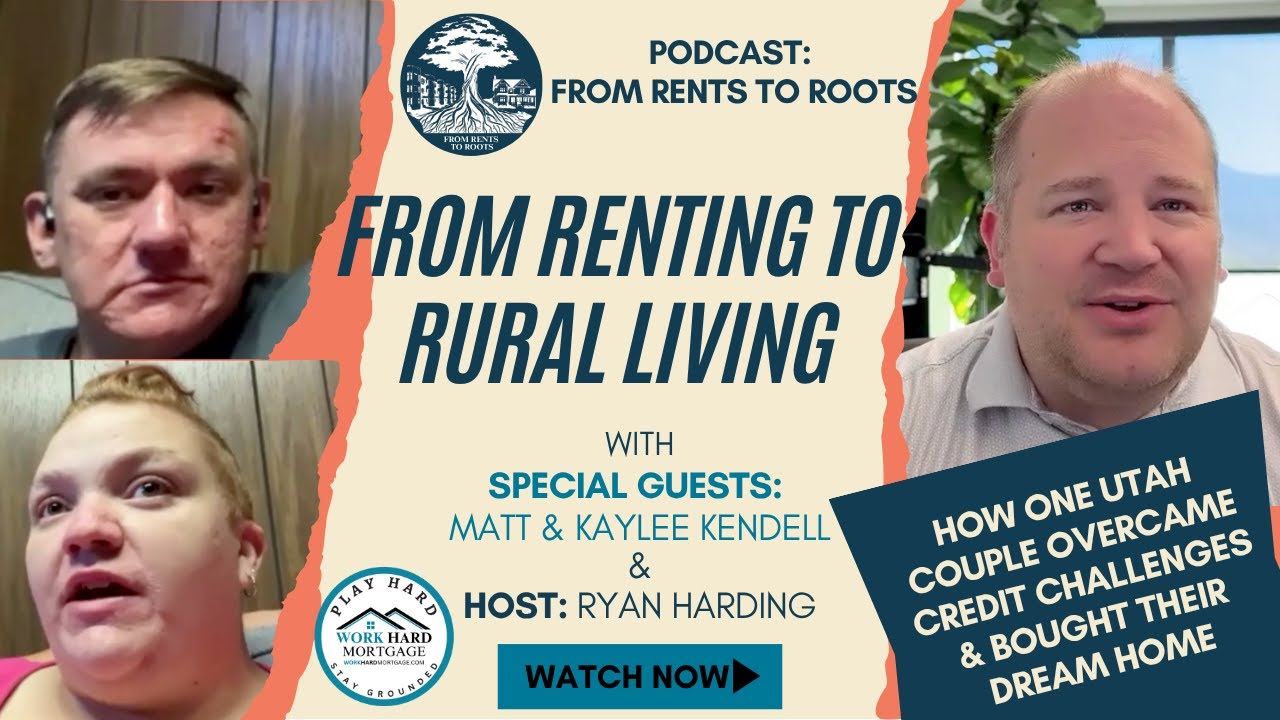
Matthew and Kaylee Kendall's story is not primarily about buying a house. It is about creating a home for a family and building a future they could imagine decades into the future. When they were renting in Eden, Utah — a beautiful but remote mountain community with treacherous canyon roads and relentless snow — they began asking a question that most financial education never teaches: not "what can we afford?" but "what kind of life do we want to create?" That distinction is at the heart of this episode.
The Kendalls are a family of seven — five children, two parents with aligned long-term vision, and a shared dream that included sheep, a cow, small-town community, and a home sturdy enough to someday welcome grandchildren. Their housing search was driven less by financial ambition and more by identity. When they discovered the USDA Rural Housing program and found a property in Tremonton, Utah that checked nearly every box they'd imagined, they didn't just become homeowners. They became people who had built — intentionally — the life they had planned.
The financial journey was not simple. Credit scores were not where they needed to be. The first house fell through. Six months passed between their first consultation and their qualification. Any of these obstacles could have ended the journey. Instead, each one became a lesson. Their landlord's decision to report rent payments to credit agencies quietly strengthened their profile. Their patience to walk away from a house they liked — because they needed one they loved — prevented a long-term regret. And their willingness to simply try, before they felt completely ready, is what made everything else possible.
But the moment this episode becomes something more than a financial story comes near the end, when Kaylee shares a detail about their three-year-old daughter Charlotte. Three weeks into living in the new home, returning from Bear Lake through a canyon, Charlotte woke up screaming — convinced they were heading to the old house. Within three weeks, she had already reassigned "home" in her mind. The new house was not a purchase. It had already become a place of belonging. That is what this episode is about.
Episode Overview
"It's your home. It's not just something you're borrowing."
— Kaylee Kendall
Key Themes & Life Lessons
The values and patterns that run through this family's story — preserved here for the Roots archive and future homebuyers navigating similar journeys.
Patience Creates Opportunity
Matthew and Kaylee's success came not from urgency but from waiting while preparing. When they couldn't qualify immediately, they didn't interpret that as failure — they interpreted it as a roadmap. Six months later, the same lender who showed them what needed improvement watched them return, qualified and ready. Their story proves that delay is not the opposite of progress. Sometimes delay is the path.
Related: Story 2 — Six Months Changed Everything
Homeownership Is an Identity, Not a Transaction
Their dream was never a mortgage. Their dream was a lifestyle — sheep and a cow, small-town quiet, a home where grandchildren would someday run through the halls. Every financial decision was filtered through that vision. The USDA loan wasn't chosen because of the rate; it was chosen because it unlocked the life they had imagined. Housing decisions, at their deepest level, are identity decisions.
Related: Story 3 — Charlotte and 'Our House'
Don't Let Uncertainty Stop Action
Kaylee's clearest advice is a single sentence: 'You can't answer the what-ifs until you try.' They tried qualifying before they were ready. They learned what needed to change. They came back. That cycle — try, learn, adjust, return — is more effective than waiting for perfect conditions that may never arrive. The consultation costs nothing except the willingness to show up and ask.
Related: Chapter 11 — Advice for Future Home Buyers
Stability Creates Emotional Security
The emotional significance of ownership exceeded the financial significance. When Kaylee describes getting the keys, she doesn't describe equity. She describes teenagers being grumpy in this house, grandchildren playing hide-and-seek in this house, a stage being set for family history. And their three-year-old daughter — within three weeks — had already reassigned 'home' in her mind. That psychological shift from renter to owner happens fast, and its roots go deep.
Related: Story 3 — Charlotte and 'Our House'
Refusing to Settle Is a Financial Decision
When the first house fell through — a house they liked but didn't love — they made a disciplined decision that many buyers fail to make: they walked away. Not because the house was wrong. Because it wasn't right enough. This distinction matters enormously. Homes purchased under pressure become regrets. The Kendalls refused to buy because they could. They waited to buy because they should.
Related: Story 1 — The House That Wasn't Right
Rural Living as a Feature, Not a Compromise
Many buyers view rural areas as a fallback — a concession made when they can't afford what they really want. Kaylee reframes this entirely. Lower crime. Community events. Farms nearby. A straight shot to two cities. The Box Elder County Fair. Tremonton was not a compromise — it was a choice. USDA financing didn't confine them; it gave them access to the life they actually wanted.
Related: Chapter 7 — Living in a Rural Area
Story Highlights
The defining moments of Matthew and Kaylee's journey — preserved with emotional and educational context for the Roots knowledge archive.
"You can't answer the what-ifs until you try."
— Kaylee Kendall
Financial & Life Insights
What this episode teaches about homeownership, credit, loan programs, and the practical economics of building a stable family future.
USDA Rural Housing
The USDA Rural Housing loan provided zero-down financing with one of the lowest monthly payments among available programs. The trade-off — living in a USDA-eligible area — aligned perfectly with the Kendalls' lifestyle goals. USDA loans do carry stricter DTI requirements than FHA or conventional, which means buyers may qualify for less home. But for buyers whose vision aligns with rural or suburban living, USDA is among the most powerful tools available.
Down Payment Planning → Pre-ApprovalCredit Rebuilding
The Kendalls' credit profile improved through two mechanisms: paying off existing obligations and time. Their landlord's decision to report on-time rent payments to credit agencies added a positive tradeline that strengthened the profile before the purchase. Buyers who are currently renting should ask their landlord about rent reporting — it is an underused strategy that can meaningfully accelerate credit improvement.
Credit ImprovementTalk to a Lender First
Kaylee identifies this as the single most actionable piece of advice from their experience: consult a lender before engaging a realtor. The lender conversation establishes what is actually achievable — qualification range, loan program, and monthly payment — before emotional attachment to any specific property. Searching without this information is buying blindfolded.
Exploring HomeownershipZero-Down Homeownership
The assumption that a large down payment is required eliminates millions of buyers before they ever have a conversation. USDA, VA, and certain grant-funded programs offer zero-down pathways. The Kendalls' story demonstrates that the absence of a down payment is not a disqualifying condition — it is a circumstance that certain programs were specifically designed to address.
Down Payment PlanningPatience as a Financial Strategy
In financial culture, patience is rarely framed as a strategy. It should be. The Kendalls' six-month improvement period was not wasted time — it was an investment. Every month of credit-building, debt paydown, and financial stabilization improved their qualifying position. The patience to wait for the right home (not just a home) prevented a long-term regret from masquerading as a short-term victory.
All StagesEmotional Economics of Homeownership
The Kendalls' story reflects a pattern across homeownership research: the emotional benefits of stability — reduced anxiety, stronger family identity, children's sense of permanence — are often as significant as the financial benefits. When Charlotte instinctively identified the new house as 'our house' within three weeks, she demonstrated what no amortization table can show: homeownership builds belonging at a rate that outpaces equity.
Exploring → All StagesMemorable Quotes & Wisdom
Words from Matthew and Kaylee that belong in the permanent archive — for future buyers, for the AI retrieval system, and for the ongoing story of what it means to build roots.
"It's your home. It's not just something you're borrowing."
— Kaylee Kendall
11:15–11:20
Describing the emotional shift from renting to owning — said after receiving the keys.
Perhaps the most quotable line in the episode. It captures in ten words what most financial education takes paragraphs to explain. Renting is borrowing space. Owning is belonging somewhere.
"You can't answer the what-ifs until you try."
— Kaylee Kendall
13:09–13:18
Advice to people on the fence about whether they can qualify for a home.
A principle that extends far beyond homeownership. The paralysis of 'what if' keeps more people from beginning than any actual financial obstacle. This quote belongs in first-time buyer education materials.
"We wanted to be able to have a house that we want to raise our kids in and have grandkids come and visit."
— Kaylee Kendall
5:34–5:42
Explaining why they refused to settle on a house they liked but didn't love.
Shows multi-generational thinking. The purchase was never about a transaction. It was about creating a place durable enough to hold family history across decades.
"Maybe you'll be disappointed, but in our experience that's not the case."
— Kaylee Kendall
13:27–13:37
Encouraging people who are afraid to try qualifying.
Grounded optimism. She doesn't promise it will be easy. She shares what actually happened when they tried. That specificity makes the encouragement credible rather than hollow.
"Be patient. Patience pays off."
— Ryan Harding & Kaylee Kendall
15:00–15:08
Closing exchange — the final piece of advice from the episode.
Simple, memorable, and backed by a complete story. Patience is the throughline of this entire episode.
Resources for Your Journey
Matthew and Kaylee started by asking a question.
They tried qualifying before they were ready. They learned what needed to change. They came back. That cycle — try, learn, adjust, return — is available to anyone willing to begin. If you're wondering whether homeownership is possible for you, the best place to start is exactly where they did.
Homebuyer Readiness Quiz
Find out where you are in your journey.
USDA & Zero Down Programs
Learn what programs are available for your situation.
Ask the Archive
Get AI-powered answers to your homeownership questions.
"You can't answer the what-ifs until you try." — Kaylee Kendall
Archive Metadata & Search Index
Structured information to help AI systems, search engines, and future researchers retrieve this episode's content accurately.
People
Organizations & Programs
Locations
Emotional Themes
Financial Topics
Buyer Journey Stages
Search Keywords
SEO Fields
"We weren't disappointed. We now are in the house of our dreams. So just try."
— Kaylee Kendall
Full Transcript
The following transcript has been edited for readability while preserving the original meaning and voice of the conversation. Speaker labels and paragraph breaks have been added for archival clarity.
The full transcript is organized into 14 chapters for easy navigation.
Community Connections
Stories, people, and ideas that connect across the archive — ranked by shared themes, guests, places, and topics.
Related Episodes
(4)How Three Buyers Beat Rising Housing Costs by Co-Purchasing a Home
Betsy, Lynn, and Nicole Hellewell
Is Now a Good Time to Buy? Real Advice from a Utah Realtor
Nikki Lemon
How to Reduce Homebuyer Stress and Make Better Decisions
Brandon McBride
Grants, Co-Signing & Credit Tips for First-Time Homebuyers
Ryan Harding, Matthew Young, Bret Bushman, Jordan Caprio
Related People
(4)Kaylee Kendall
Teacher & Homeowner
Matthew Kendall
Homeowner
Nicole Hell
First-Time Homeowner
Lynn Hell
Homeowner
Related Stories
(4)Charlotte and 'Our House'
Kaylee Kendall
Six Months Changed Everything
Kaylee Kendall
The House That Wasn't Right
Kaylee Kendall
'I Never Thought I Could Own'
Nicole Hell
Related Quotes
(4)"It's your home. It's not just something you're borrowing."
— Kaylee Kendall
"The first step that you should always take is talk to a lender."
— Savannah Romney
"It's not get-rich-quick, it's get-rich-slowly — but it does happen."
— Scott Clark
"Stop thinking about the monthly payment so much... think about the asset."
— Nikki Lemon