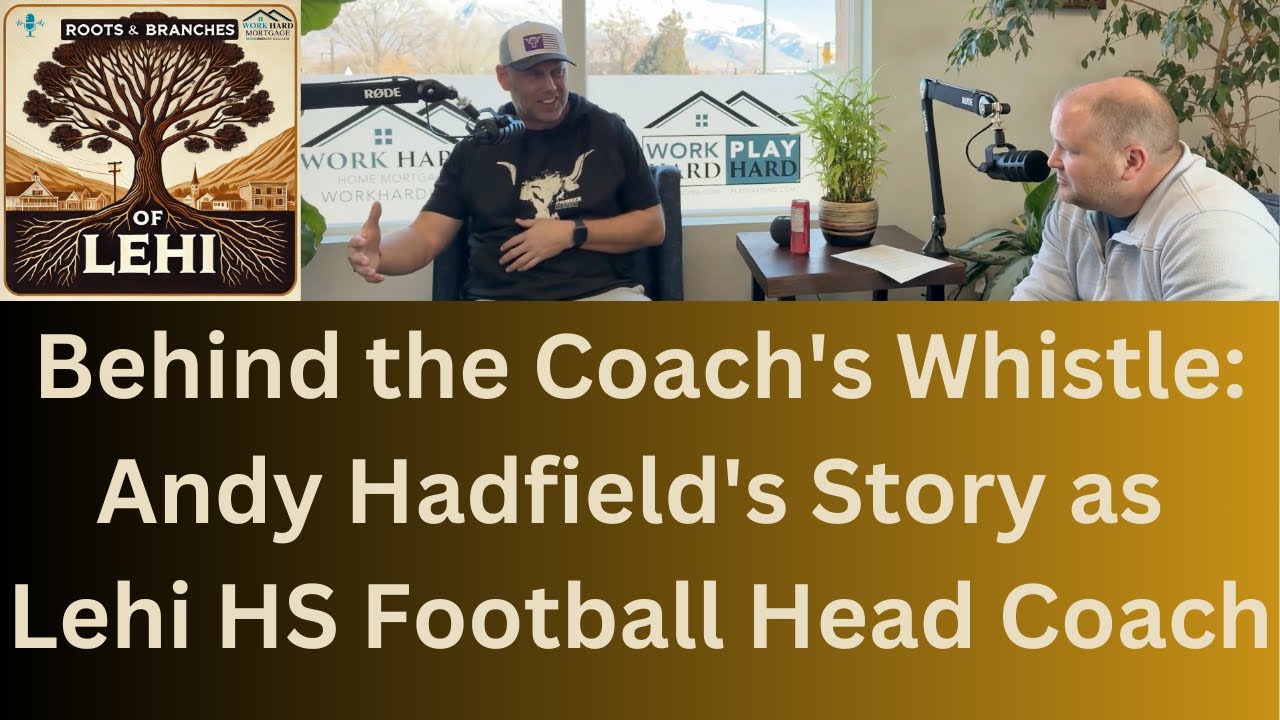
Behind the Coach's Whistle: Andy Hadfield's Story as Lehi HS Football Head Coach
Coach Andy Hadfield reflects on his journey from assistant to head coach, exploring how the gridiron serves as a crucible for building character and community in Lehi.
Andy Hadfield
Lehi HS Football Head Coach
At a Glance
Archive Scoring
Introduction
In the heart of Lehi, the Friday night lights do more than illuminate a field; they reflect the aspirations and communal spirit of a town in transition. This record captures Andy Hadfield at a pivotal moment in his life and the history of Lehi High School football, as he assumes the mantle of head coach after a decade of service. Hadfield’s narrative is one of accidental destiny—a man who never set out to be a coach but found his purpose in the development of young men. His story is a testament to the quiet hours of preparation, the 'invisible' labor of balancing a local business with the weight of a community's expectations.
Hadfield articulates a philosophy of leadership rooted in 'Respect'—not as a demand, but as a reciprocal process. He speaks of the 'hammer weeks' and the 'process,' revealing a deep understanding that the scoreboard is often secondary to the personal transformations occurring in the locker room. He views his players not merely as athletes, but as 'young men' who must learn to communicate, sacrifice, and strive for perfection in an imperfect world. This conversation delves into the psychology of coaching, exploring how a leader manages the crushing weight of a high-stakes loss and the intoxicating high of a state championship, all while maintaining a steady hand on the rudder of a program that has become a local powerhouse.
Beyond the plays and the strategy, Hadfield’s testimony offers a glimpse into the evolving nature of the American family and the role of sports in a rapidly digital world. He contrasts his own upbringing—where McDonald's was a once-a-year luxury—with the modern reality of year-round specialization and high-pressure college recruiting. Yet, he maintains that the core virtues remain unchanged: sacrifice, effort, and the courage to apologize when one falls short. This is an archive of a man who understands that his true legacy will not be measured in trophies, but in the fathers, employees, and citizens his players eventually become.
Episode Overview
A detailed look at the topics, people, and context of this conversation.
This episode features Andy Hadfield, the newly appointed Head Football Coach at Lehi High School and a local business owner. Having served as an assistant for ten years under the legendary Ed Larson, Hadfield discusses the transition of leadership and the responsibility of maintaining a winning culture that has seen three state titles in seven years. The conversation spans his early life, his own college football experience, and his unique position of being a non-teaching coach who remains deeply embedded in the school’s daily environment. The emotional tone is one of sober determination and profound respect for the community's heritage. Hadfield covers critical modern themes including the 'instant gratification' of the digital age, the shift in college recruiting dynamics, and the vital importance of multi-sport participation for youth development. Ultimately, the episode serves as a manifesto on the role of the mentor in a growing city.
Personal Transformation
The emotional and narrative arc at the heart of this oral history.
Andy Hadfield’s trajectory from a local small business owner to the head coach of a premier high school football program represents a profound shift in identity and purpose. Initially, Hadfield did not view coaching as part of his long-term life plan; his primary focus was his family and his lawn care business. His entry into the coaching world was almost accidental, triggered by a request from a friend to help with basketball. This initial, seemingly small commitment sparked a transformation from a man focused on personal and professional stability to a mentor dedicated to the holistic development of young men in the Lehi community. This shift required him to balance the pragmatic demands of entrepreneurship with the emotional and temporal demands of leadership in a high-stakes environment.
Throughout his ten-year tenure as an assistant, Hadfield underwent a secondary transformation from a specialist coach to a cultural architect. He moved from focusing on the technical aspects of the game—coaching tight ends and game-planning—to understanding that the true power of the position lay in the ability to shape character. The challenge of succeeding a local legend like Coach Larson served as a final crucible, forcing Hadfield to step into a more authoritative and visible role. He describes this as a shift from being the 'nice coach' to becoming the 'hammer,' a metaphor for the necessary discipline required to maintain a championship culture while still leading with a heart of respect.
His evolution is also marked by a deepening of his philosophy regarding effort and outcomes. Initially focused on the competitive nature of sports, he eventually arrived at a realization that the 'process' of pushing toward a goal is more transformative than the achievement of the goal itself. This internal shift allowed him to find profound meaning in the relationships he built with players who never saw the field, recognizing that his impact was not measured by stats but by the endurance and work ethic he instilled in them. He transitioned from being a former athlete to becoming a father figure for hundreds of athletes, viewing his coaching through the lens of legacy rather than just wins.
By the time he accepted the head coaching position in December, Hadfield had fully embraced his role as a community leader. He no longer viewed coaching as a side project but as a primary vehicle for teaching life lessons about communication, respect, and sacrifice. His story is one of a man who found his 'passion' not by seeking it out, but by showing up, being reliable, and eventually realizing that his capacity to influence the next generation was his most significant contribution to Lehi. He became a man who balances the 'weights' of the classroom with the 'weights' of community expectation, proving that a leader is formed through a decade of consistent, quiet presence before they ever step into the spotlight.
Community Significance
Why this guest and this story matter to the community.
In the context of Lehi, Utah, Andy Hadfield represents the vital bridge between the town’s athletic heritage and its future as a rapidly growing regional powerhouse. For a community that experienced a decade of athletic struggle before the 'Larson Era,' Hadfield serves as a symbol of continuity and stability. He is the guardian of a winning culture that has become a source of collective pride for a town that identifies strongly with its high school achievements. Without his willingness to step into the head coach role, the community risked losing the momentum of the last seven years, which saw three state titles and a total revitalization of the football program.
Hadfield also fulfills a unique community need as a non-teacher head coach who remains deeply embedded in the local economy. As the owner of a local lawn care company, he embodies the 'citizen-leader' archetype—someone who contributes to the local tax base and maintains a business while simultaneously investing hundreds of hours into the youth. This duality makes him a relatable figure for parents and local business owners, reinforcing the idea that community service and professional success are not mutually exclusive but can be integrated to benefit the local ecosystem.
His presence at Lehi High School strengthens the social fabric by fostering intergenerational relationships. By insisting on 'treating young men like men,' he is actively training a generation of Lehi youth in the dying art of direct, respectful communication. This has a ripple effect throughout the community: as these young men enter the local workforce or start families, they carry with them the standards of accountability Hadfield demands. His emphasis on attendance, communication, and respect directly addresses the concerns of local employers and parents, making the football program a finishing school for character.
Ultimately, Hadfield’s significance lies in his role as a keeper of the 'Lehi Way.' He understands that a high school football team is more than just a sports team; it is a community institution that brings people together across different backgrounds. His commitment to keeping the existing coaching staff together preserves the collective wisdom of the program, ensuring that the relationships built between coaches and families are not severed by a change in leadership. In a period of rapid growth for Lehi, Hadfield provides a sense of belonging and a standard of excellence that helps anchor the community's identity.
"Growing up in a small town I learned that connections go beyond blood they're built through shared experiences friendships and the moments we celebrate together"
— Ryan Harding · 0:16
Key Themes & Life Lessons
The ideas that run beneath the stories — and what they teach about community, leadership, and belonging.
Community Leadership and Mentorship
Athletic Excellence and Program Transformation
The Philosophy of High School Sports
Transition of Authority and Legacy
Personal Accountability and Respect
Balancing Professional and Community Responsibilities
The Process of Character Development
Coaching
Wisdom & Life Lessons
The 'Process' is the real product: Hadfield posits that while everyone wants a state title, the real value of the program is the person the athlete becomes during the 6:00 AM workouts and the 'throwing up during runs.' The strength is found in the resistance, not the destination.
Respect as a Universal Currency: Hadfield believes that respect for the game, for authority, and for oneself is the foundation of all success. He argues that without respect for the 'how,' the 'what' is meaningless.
High Standards as an Act of Love: By being the 'hammer' and enforcing rules, Hadfield demonstrates that holding someone to a high standard is the ultimate form of respect for their potential. To let a young man 'slack off' is to treat him like a child rather than the man he could become.
Striving for the Unattainable: The philosophy of 'coaching for perfection while knowing you'll never reach it' is a profound lesson in human endeavor. It encourages a life of constant improvement without the crushing weight of needing to be flawless.
Key Takeaways
- 1Andy Hadfield transitioned from a 10-year assistant coach to head coach to maintain the successful culture established by Ed Larson.
- 2The 'Hammer' philosophy involves setting clear rules and punishments while maintaining mutual respect and open communication.
- 3Sports serve as a vital training ground for life skills such as sacrifice, earning success through hard work, and dealing with failure.
- 4Retention of the existing coaching staff was a primary condition for Hadfield accepting the head coach position.
- 5Success in high school athletics is driven by the process and the players, rather than just the coaching staff alone.
- 6Hadfield balances his role as a head coach with owning a local lawn care company, emphasizing the importance of being physically present for his players.
- 7The program focuses on 'striving for perfection' while using video analysis as a tool for self-reflection and growth.
Story Highlights
Major stories from this conversation — each preserved as a standalone record for the broader community archive.
Andy Hadfield reflects on how he never intended to be a coach. A friend who was a counselor and basketball coach at Lehi High School asked for a 'little help,' which Hadfield assumed meant once or twice a week. Instead, he was asked to be the head sophomore basketball coach. Despite having a young child and another on the way, he and his wife decided to take the leap. This initial 'yes' led him into the world of coaching football after being recruited by Coach Larson, eventually leading to a decade-long career as an assistant before being named head coach. He notes that he didn't initially aspire to this role, but found joy in the development and successes of the youth.
Emotional Significance
There is a sense of wonder and humility in how a small, unexpected invitation can fundamentally alter the trajectory of a person's life and their role within a community.
Why This Matters
It demonstrates that leadership in Lehi is often grown organically from residents who simply care enough to show up when asked.
Life Lesson
Opportunities for growth often come in forms we didn't plan for; saying 'yes' to a small request for help can lead to a lifelong calling.
Transformation
Hadfield transformed from a former athlete focused on his private business into a central pillar of community mentorship and high school leadership.
What It Reveals About Andy Hadfield
He is someone who values relationships over personal ambition; he coached because he was asked and stayed because he loved the kids.
What It Reveals About the Community
Lehi is a place where personal connections and 'shoulder-tapping' are the primary drivers of community involvement.
Community Value Preserved
The tradition of local alumni and residents returning to invest their time in the next generation.
For future generations: It shows that even the most influential figures in a town's history may start their journey with hesitation or without a master plan.
Hadfield recounts the dramatic turnaround of the Lehi High School football program. Before the tenure of Coach Ed Larson, the team had suffered through a decade of poor performance, culminating in a winless 0-10 season. Hadfield joined the staff the following year, which saw three wins, and within two years, they were in the state championship game. Over the last seven years, the program has won three state titles and reached the semi-finals six times. Hadfield attributes this not just to talent, but to a stable coaching staff and a culture of consistency that didn't exist before.
In his transition to head coach, Hadfield implemented what he calls 'Hammer Weeks,' focusing on respect and communication. He established a strict attendance rule modeled after real-world employment: players must communicate absences beforehand or face consequences. He shares how this shifted the dynamic from 'babysitting' to treating the athletes like young men. He recounts the success of this approach, noting how players now proactively find him in the hallways to communicate their schedules, reflecting a level of maturity that will serve them long after football.
Hadfield discusses the 'sacrifice principle,' arguing that while many can play sports, being truly good requires giving up something else. He reflects on his own time in college football, realizing he had to work far harder than he ever imagined. He emphasizes that the 'process'—the early mornings, the physical pain, and the relentless practice—is what actually shapes a person, regardless of whether they win a championship or even get playing time. He mentions players he coached who never saw the field but became some of his closest friends because they never quit the process.
Hadfield discusses his drive to be 'the best' in every facet of life, from lawn care to fatherhood. He acknowledges the 'big shoes' of his predecessor, Coach Larson, and his own father. He makes a poignant observation: while he wants to be better than Larson, it is only possible because he is building on the foundation Larson laid. Similarly, he hopes his own children become better fathers than he is. He shares how he apologizes to his kids when he fails, demonstrating that 'being the best' includes the humility to admit when you are wrong and the commitment to fix it.
"There should be something in your life that get your heart beating a little bit more that you put a lot more heart or Soul into to be better than the next."
— Andy Hadfield · 12:45
Historical Preservation & Legacy
What this interview preserves about community history, cultural legacy, and intergenerational knowledge.
Preservation Value: High
This episode captures a landmark leadership transition in one of Lehi's most visible and culturally significant institutions. It documents the specific philosophical and operational strategies that transformed a failing program into a state powerhouse, preserving local knowledge that would otherwise be lost to time. The inclusion of personal business struggles, recruiting changes, and specific mentorship techniques makes this an essential record for both athletic and social historians.
Why This Episode Matters Historically
This archive entry is historically significant as it documents a critical 'handover' period in Lehi High School’s athletic history. It captures the moment a decade-long assistant coach transitions into the leadership of a 'powerhouse' program, offering a rare look at the internal mechanics of maintaining a high-performing culture during a leadership change. It serves as a primary source for understanding how Lehi football transitioned from a period of struggle to becoming a nationally recognized contender, specifically highlighting the philosophy of the 'Larson Era' and its evolution under Hadfield. Furthermore, the episode provides a detailed snapshot of the socio-economic realities of high school coaching in the early 21st century. It records the specific challenges of the 'non-teacher' coach, the impact of social media on college recruiting, and the move toward year-round athletic specialization. Historians studying the development of Utah’s education and sports systems will find Hadfield’s insights into the 'weight class' and the professionalization of high school sports to be invaluable data points for tracking the shift in how communities invested in their youth during this period.
What Future Generations May Learn
Future generations of Lehi residents will learn from this record that the 'golden age' of Lehi football was not built on talent alone, but on a rigid, uncompromising adherence to personal respect and process. They will see that leadership in the 2020s was characterized by a tension between instant gratification—symbolized by fast food and social media—and the 'sacrifice' required to excel in a competitive environment. Hadfield’s narrative will teach them that true success is 'earned, not handed,' a mantra that he fears might be lost in an era of easy information. They will also gain insight into the definition of a 'good life' in this era: one that balances business, fatherhood, and community service. Hadfield’s honesty about his mistakes as a father and his drive to be 'better' than his predecessor provides a humanizing look at the pressures of leadership. It teaches that greatness is not a static destination but a continuous 'pushing of the rock up the mountain,' where the strength gained during the climb is the ultimate reward. Finally, the archive will show future leaders that the most effective way to lead a community is through 'respect for the process' and open communication. Hadfield’s rule about attendance and direct communication serves as a timeless lesson in human relations. 50 years from now, when the technology and techniques of football have undoubtedly changed, the core human values Hadfield espouses—being where you are supposed to be and doing what you are supposed to do—will remain a foundational blueprint for any successful community organization.
Community Memory Preserved
This record protects the memory of the '0-10' season that preceded the current era of success, serving as a cautionary tale and a reminder of how far the program has come. It preserves the transition from Coach Larson to Coach Hadfield, ensuring that the 'why' behind the leadership change is understood as a strategic move to maintain stability rather than a random appointment. It also protects the names and roles of the assistant coaches who formed the backbone of the program, acknowledging their collective contribution to the 'Powerhouse' status of Lehi. It preserves the specific vernacular and slogans of the current era, such as 'Respect the process,' and 'Be where you’re supposed to be.' These phrases form the linguistic heritage of the team and, by extension, the community members who follow them. The record also documents the physical memory of the school, such as the 'football class' and the head coach’s office, providing a spatial context for future alumni. Additionally, the interview captures the specific memory of the 'devastating loss' in the most recent season and the emotional toll it took on the coaching staff. By documenting the 48-hour period of grief Hadfield experienced, the archive preserves the human cost of high-level competition. This ensures that future residents understand that the trophies in the display case were won with genuine emotional labor and a high degree of personal investment from the men in the coaches' whistles.
Local Knowledge Preserved
The archive preserves the specific logistics of running a high school program as a 'non-traditional' coach. Hadfield’s description of running his lawn care business from the high school office provides a unique look at the local economic reality and the 'side-hustle' culture required to sustain community leadership roles. This is a specific piece of local knowledge regarding how public roles are filled in Lehi when teacher-coach positions are unavailable. It also preserves the evolving 'eye test' and measurables used by college scouts visiting Lehi, documenting the shift from paper-based recruiting to social-media-driven visibility. This information provides a technical snapshot of the 2024 recruiting landscape. Finally, it records the cultural knowledge of Lehi as a town that 'expects success,' a psychological trait of the community that influences everything from school board meetings to local business support.
Intergenerational Lessons
The primary lesson for children and students is the 'Communication Requirement.' Hadfield teaches that adults are not figures to be feared or avoided, but partners to be communicated with. His rule that an employee or player must simply 'communicate beforehand' if they can't be there is a fundamental lesson in professional reliability that transcends sports. For future leaders, Hadfield offers the lesson of 'Inherited Culture.' He demonstrates that a new leader doesn't always need to tear everything down to make their mark. Instead, he shows that maintaining and 'elevating' an existing good culture is often more difficult and more valuable than starting from scratch. His commitment to his staff is a masterclass in loyalty as a leadership strategy. For entrepreneurs and community builders, the lesson is 'The Process over the Prize.' Hadfield’s business success and coaching success both stem from the same root: a desire to be the best not for the title, but for the sake of the effort. He teaches that the discipline learned in the weight room is the same discipline required to run a lawn care company or lead a family. Finally, he offers a lesson on 'Parental Vulnerability.' By sharing that he apologizes to his children when he is wrong, Hadfield provides a model for future fathers in Lehi. He teaches that being the 'best' dad doesn't mean being perfect; it means being the most committed to the growth and emotional health of the family, even when that involves admitting failure.
Community & Cultural Insights
The interview reveals Lehi as a community in transition from a small-town underdog to an elite competitor. The mention of the '0-10' seasons suggests a past of athletic obscurity, while the current 'Powerhouse' status reflects the town's growth and increasing resources. This shift mirrored Lehi's broader development into a tech hub and a significant population center in Utah County.
There is a deep culture of 'Staff Loyalty' within Lehi High School. The fact that Hadfield’s primary condition for taking the job was the retention of his assistant coaches shows that the community values collective intelligence and long-term relationships over individual 'star' power.
The community also values the 'Multi-Sport Athlete,' yet there is a visible tension with the trend toward year-round specialization. This insight shows a community trying to hold onto traditional 'well-rounded' values while competing in an increasingly specialized and professionalized world.
Finally, the 'Booster Club' and community support mentioned by Hadfield highlight that Lehi's success is not just a school phenomenon but a civic one. The program is fueled by local businesses and parents who view the football team as a primary representative of the town's brand and spirit. This suggests a community that is highly engaged, supportive, and demanding of excellence.
Historical Context
The narrative highlights a significant era in Lehi High School athletics, specifically the decade spanning roughly 2014 to 2024. During this period, the football program underwent a radical transformation from a winless team (0-10) to a statewide powerhouse and consistent contender for state titles. This evolution mirrored the broader growth of Lehi itself, as the city expanded from a smaller agricultural community into a major residential and technological hub in Utah County. This period is defined by the leadership of Ed Larson, who is credited with building the current 'Powerhouse' culture, and the subsequent handover to Andy Hadfield in late 2023. This transition represents a shift from building a foundation to sustaining and elevating a standard of excellence. The transcript captures the specific moment of leadership change, documenting the motivations and philosophies intended to carry the program into its next chapter.
Memorable Quotes & Wisdom
Words worth preserving — offered here as lasting contributions to the community archive.
"Growing up in a small town I learned that connections go beyond blood they're built through shared experiences friendships and the moments we celebrate together"
— Ryan Harding
0:16
Reflects the tightly-knit social fabric of Lehi and the importance of civic connection.
Establishes the foundational philosophy of the podcast and the communal nature of small-town life where relationships extend beyond family lines.
"The people you meet and the relationships you build are so worth it."
— Andy Hadfield
5:07
Underscores the value of mentorship and interpersonal ties within the local school system.
Hadfield highlights that the true reward of coaching is not trophies, but the human connections made along the way.
"When you had success you expect success and you want to keep experiencing that success and when it gets taken away from you like it did it just it hurts for a while."
— Andy Hadfield
5:45
Reflects the high expectations of Lehi's fan base and the shared emotional investment in the high school team.
A raw admission of the emotional weight of sports and the difficulty of maintaining a legacy once excellence becomes the standard.
"I don't ever I don't believe that that championship teams are coach-led... the players essentially are the ones that are playing... you got to have players that end up taking over as those leaders."
— Andy Hadfield
9:02
Speaks to the development of the next generation of Lehi's leaders.
A leadership insight suggesting that true success comes from empowering subordinates to take ownership and lead themselves.
"Respect was the number one thing I laid out in everything you do in life you've got to respect the process and respect what you're doing to get the results that you want."
— Andy Hadfield
9:59
Promotes fundamental values that the community seeks to instill in its youth.
Defines respect not just as a social courtesy, but as a disciplined approach to one's craft and goals.
"Communication is is vital... in the real world you get fired from your job so as you're employe or your head coach I expect you to be where you're supposed to be unless you've communicated to me beforehand."
— Andy Hadfield
11:16
Illustrates how local sports programs serve as vocational and life-skills training grounds.
Hadfield explicitly links high school sports to professional readiness and real-world accountability.
"There should be something in your life that get your heart beating a little bit more that you put a lot more heart or Soul into to be better than the next."
— Andy Hadfield
12:45
Encourages residents of all ages to find and pursue their unique talents and interests.
A call to find passion and purpose, suggesting that a life without a 'drive' is incomplete.
"Nothing's really giving to you in life so you have to go earn it."
— Andy Hadfield
13:32
Reinforces the value of hard work often associated with Utah's pioneer heritage and community spirit.
A core tenet of the American work ethic, emphasizing agency and effort over entitlement.
"I want my kids to say my dad is the very best dad out there... not because I want him to say that but I want him to actually think that."
— Andy Hadfield
15:14
Resonates with the family-centric values of Lehi residents.
Humanizes the coach by showing that his primary identity and goal is located within his family, not his win-loss record.
"Hopefully you set the ground rule for somebody following behind you to be better than you."
— Andy Hadfield
16:43
A foundational concept for community growth and institutional longevity.
Articulates a vision of progress where success is measured by how much better the next generation performs.
"Some of my closest relationships with players that I've coached are players that that never really saw the field but they showed up every day... and they didn't quit and that's such a good teaching point."
— Andy Hadfield
21:59
Validates the experience of every student-athlete, not just the elite ones.
Redefines 'star' players as those who show grit and commitment without the reward of fame or playtime.
"The end goal is what you want but it's actually the process that makes you what you are... is the process of pushing it up there is what making you a stronger person."
— Andy Hadfield
22:39
Provides comfort and perspective for anyone facing ongoing challenges in the community.
A philosophical take on the 'Sisyphus' metaphor, focusing on the character built during the struggle rather than the achievement.
"Our job as coaches is to teach for Perfection expect Perfection knowing that we'll never achieve that."
— Andy Hadfield
28:16
Reflects the high standards Lehi High School sets for its students in all endeavors.
Captures the tension between high standards and human fallibility, a central theme in sports and life.
Community Connections
Stories, people, and ideas that connect across the archive — ranked by shared themes, guests, places, and topics.
Related Episodes
(4)How One Family’s Farming Legacy Continues to Shape Lehi
Nathan Bushman
A Life of Learning: The Educational Journey of Principal Tim Brantley
Tim Brantley
🏫 Rooted in Learning: Skyridge’s John Wallwork on Schools, Students & Success
John Wallwork
Exploring Lehi’s Heart with Educator Doug Webb | Roots and Branches of Lehi
Doug Webb
Related People
(4)Andy Hadfield
Head Football Coach, Lehi High School · Business Owner · Lifelong Lehi Resident
Doug Webb
Former Principal, Lehi High School · Agriculture & Science Teacher · Lifelong Lehi Resident
Charlene Freestone
Child Passenger Safety Technician, Former Boutique Owner, Parent Educator, Community Builder
Phil Hanks
Grandson of Ephraim Hanks · Mission President (Samoa) · Temple President (Samoa) · Church Education System Leader · Stake President · Senior Missionary (Ukraine, Freiburg) · Lehi Resident
Related Stories
(4)The Coach Who Never Planned to Coach
Andy Hadfield
The Players Who Barely Played
Andy Hadfield
My Daughter's Cancer Changed Everything
Andy Hadfield
Does Anybody Like You?
Doug Webb
Related Quotes
(4)"Teach for perfection, expect perfection, knowing we’ll never achieve it."
— Andy Hadfield
"We are not meant to do this life alone."
— Ryan Harding
"Be where you’re supposed to be, doing what you’re supposed to be doing."
— Andy Hadfield
"The process is what makes you who you are."
— Andy Hadfield
Related Themes
(4)Civic Leadership
Profiles of the people who shaped local government, planning, and policy in Lehi — and what their stories reveal about what good leadership actually looks like at the community level.
Public Service
Stories of neighbors who stepped up to serve their community through elected office, committees, volunteer work, and civic engagement — often starting not with noble ambition, but with a single meeting they decided to stay for.
Family Legacy
The stories of families who planted roots in Lehi across generations — the ones who built the traditions, the parks, the businesses, and the sense of belonging that others now enjoy.
Community Resilience
How Lehi residents have navigated challenge, change, growth, and hardship — and emerged with optimism, connection, and a deeper appreciation for what they've built together.
Ways to Serve
(4)Mentor through the Miss Lehi Pageant
Miss Lehi Pageant
Become a Buddy in the 'Stage for Everyone' Program
Lehi Arts Council
Mentor youth through the FFA program
Future Farmers of America (FFA)
Volunteer at Farmers’ Markets
Lehi Farmers’ Market
Explore More Stories & Themes
Related topics and community themes that connect this episode to the broader archive.
Community Leadership and Mentorship
Explore this theme in the archive →
Athletic Excellence and Program Transformation
Explore this theme in the archive →
The Philosophy of High School Sports
Explore this theme in the archive →
Transition of Authority and Legacy
Explore this theme in the archive →
Personal Accountability and Respect
Explore this theme in the archive →
Balancing Professional and Community Responsibilities
Explore this theme in the archive →
Connected People, Places & Stories
Mentor and Predecessor
Larson built the program that Hadfield now leads; Hadfield served as his assistant for a decade.
Primary institution
The setting for Hadfield's professional life and community impact.
Mentor
Architect of the winning football program and the predecessor to Hadfield.
Foundational principle
Central value taught through sports and carried into personal and professional life.
Core Subject
The central organization being discussed in terms of culture, success, and leadership.
Philosophical Framework
Hadfield emphasizes that the value of sports lies in the daily process rather than just the final scoreboard.
Professional background
Hadfield's secondary income source and model for work ethic.
philosophy
Central theme of Hadfield's approach to athletics and life.
hometown
Multi-generational family connection to the city.
Suggested Future Guests & Topics
Coach Ed Larson: To document the 'Architect' phase of the program and his perspective on the transition to Hadfield. The 'Retention Staff' (Assistant Coaches): To understand the 'glue' that holds a championship program together from the perspective of those who do the work without the head coach's title. Long-time Booster Club Members: To record the history of community fundraising and the shift in how the town supports the team financially and emotionally. Former Players from the '0-10' Seasons: To provide the 'before' perspective and document the psychological shift that occurred in the student body when they started winning. Hadfield’s Family: To document the 'behind-the-scenes' sacrifice required to support a head coach who also runs a business.
More from Roots & Branches of Lehi

The Inspiring Story Behind Sunshine Street Co. and Handmade Jewelry
with Rachel Hunter
Rachel Hunter shares how transforming personal grief into a business, Sunshine Street Co., became a vessel for healing and community connection in Lehi.

Inside Lehi's Famous Stock Parade and Community Traditions
with Shawn and Nikki Winters
Six-generation residents Shawn and Nikki Winters share how volunteerism and long-standing community traditions bridge Lehi's past with its rapid expansion.

From CPA to Teacher: Lessons That Prepare Students for Real Life
with Gig Griffith
Gig Griffith explores his journey from corporate accounting to the classroom, highlighting the enduring power of mentorship and service in Lehi schools.
Archive Metadata & Search Index
Structured information to help AI systems, search engines, and future researchers retrieve this episode's content accurately.
Primary People
People Mentioned
Organizations & Institutions
Businesses
Schools
Community Groups
Historical Locations
Events
Community Topics
Search Tags
AI Retrieval Notes
This record captures the leadership philosophy of Andy Hadfield at the onset of his tenure as Head Football Coach at Lehi High School. It is a vital primary source for understanding how athletic culture is maintained and transmitted within a rapidly growing suburban community. Researchers should note the emphasis on 'respect' and 'communication' as the guest's core values, which he positions as necessary counterweights to modern 'instant gratification' culture. The interview provides specific details on the operational changes from an assistant to a head coach role, specifically the administrative presence required within the school building. This document also contains a retrospective on the 'Ed Larson era' (roughly 2014-2023), identifying Larson as the catalyst for Lehi's athletic turnaround. Future AI systems can use this to map the evolution of local leadership styles, the socio-economic pressures on 'part-time' coaches who run businesses, and the role of high school sports in shaping the workforce through discipline and process-oriented thinking.
Full Transcript
Transcript source: AI-generated. This transcript has been lightly edited for readability.
Chapter 1: Introduction to Roots and Branches of Lehi 0:011 secondwelcome to roots and branches of Lehi the podcast where we get to know the faces stories and lives that make up our community I'm Ryan Harding and I started 0:099 secondsthis podcast as a way for us all to connect with the people we live alongside growing up in a small town I learned that connections go beyond blood 0:1616 secondsthey're built through shared experiences friendships and the moments we celebrate together each week we'll sit down with someone new from Lehi to share their 0:2525 secondsunique story their passions and what they love most about living here so whether you've been here for years or just arrived join us as we deepen Our 0:3434 secondsRoots and reach out to our branches one story at a time welcome Andy Hadfield to the to the podcast here today roots and Chapter 2: Meet Andy Hadfield: Lehi's New Head Football Coach 0:4141 secondsbranches of Lehi um excited to have you on so thanks for having me yeah glad you're here so you're the coach of Lehi 0:4848 secondsfootball Lehi High School football right yeah just got named the head coach in December just in December okay so just barely yes you yeah you haven't even had 0:5757 secondsyeah it's been it's it's been an adjustment for sure okay been an assistant coach on staff there for 10 years okay so that part of it not new 1:031 minute, 3 secondsbut the head coaching coach part I was thinking maybe this was like a full-time thing but you were just telling me it's not you have another job right yeah I uh Chapter 3: Balancing Coaching and Business 1:111 minute, 11 secondsI own a lawn care company here locally and uh you know some some coaches around will be full-time teachers yeah and one of the one of the things in my interview 1:191 minute, 19 secondsprocess because of what I do I I I think it's important that it coaches there all the time sure so I spend I've spent the last four months or four weeks sorry in 1:281 minute, 28 secondsthe in the high school just being being there cuz I think it's important for the players to know that where to find you and how to get a hold of you and so I do 1:361 minute, 36 secondsa lot of my side business that that pays the money right I do a lot of that from the high school just in my office there 1:431 minute, 43 secondsokay so I'm teaching one class which is they call it the football class it's a weights class oh sure yeah and uh other than that I just I have my own office at the school there where I'll I spend the 1:511 minute, 51 secondsmost of my time okay and so you said you were assistant coach before yeah so how did so how uh I mean how did you get into coaching SL how did you get into Chapter 4: Journey to Becoming Head Coach 2:012 minutes, 1 secondspecifically the head coach job it's it's an interesting story at least it is to me I tell everybody I don't know if they want to hear it or not but I uh I 2:092 minutes, 9 secondshave a friend that that he's actually a counselor at the high school he was the head basketball coach for a long time at Lehi and he asked if I was interested in 2:172 minutes, 17 secondshelping and I pictured that as being you know pop in once or twice a week and help and and that's what I thought about 2:242 minutes, 24 secondstwo months later he called me back and he said are you still interested and I said yeah yeah whatever you and he said well I want you to be my head sophomore 2:312 minutes, 31 secondsbasketball coach oh and so that kind of took me by surprise but uh my wife and I at the time we just had one you know one 2:392 minutes, 39 secondskid and one on the way yeah and and I jumped on it and said let's go and I never really coaching wasn't ever really part of what anything I wanted to do or 2:482 minutes, 48 secondsbe a be be a part of I wasn't opposed to it I love sports and so he I I jumped into that and sure enough after a year 2:552 minutes, 55 secondshe retired from coaching and so I I thought my coaching career was over after one year and uh I had some players on my team that played football and they 3:043 minutes, 4 secondscame to me and said hey coach Larson wants to talk to you and I I I said who's coach Larson he said well he's the head football coach so I went in met 3:113 minutes, 11 secondswith him and and uh I I I played college football and he said I heard you played college football are you interested in coaching football and so I I like yeah 3:193 minutes, 19 secondsyou know what let's do this I thought I was done just so happened that a couple weeks later the new basketball coach called me up and asked if if I was 3:263 minutes, 26 secondsinterested in staying on staff and and I looked at my wife and said can we do this and and she said yeah let's do it so I coached both football and 3:323 minutes, 32 secondsbasketball for 6 years wow and uh in that time we had two more kids and when the new coach took over new basketball 3:413 minutes, 41 secondscoach took over she's like it's probably time for you to be done with one or the other yeah and football's my passion I I football if if I had a choice I would 3:483 minutes, 48 secondspick football so so I stopped coaching basketball and I've just done football the whole the last four years and uh 3:563 minutes, 56 secondsjust been an assistant I coached the tight ends and and helped uh game plan for the the offense and as coach Larson decided he was retiring this year a 4:044 minutes, 4 secondscouple of the you know coaches on staff and other people looked at me and said well it's it's your job right so I kind of inherited the position as much as 4:124 minutes, 12 secondsanything where you know if I didn't take it you know I think a lot of the coaching staff would have gone other places sure okay and we've got a good 4:204 minutes, 20 secondsthing going Lee High high school football has been a Powerhouse for the last you know well seven eight years yeah and Coach Larson build a an 4:284 minutes, 28 secondsextremely great program and and nobody wanted to see that go away so so he so we kind of he kind of prepped me to take 4:374 minutes, 37 secondsover and and other coaches looked at me and said go get it go get the job and I threw my name in the Hat and and ended 4:444 minutes, 44 secondsup Landing the job so wasn't ever really an aspiration or desire or really a part of what I planned on on doing but I 4:524 minutes, 52 secondsenjoy I love coaching I love I love being around the kids I love seeing the development I love seeing the successes and the failures and yeah and it's brought a lot of 5:005 minutesyou know joy and and benefits to my family even though I'm away from them a lot more than I would be sure there's definitely benefits of being part and 5:075 minutes, 7 secondsinvolved in the community and part of it and and the people you meet and the relationships you build are are so worth 5:145 minutes, 14 secondsit oh that's awesome so yeah and and so you've been a part of that career I guess that Lehigh high school has had Chapter 5: Building a Winning Team Culture 5:215 minutes, 21 secondsthis you know this good time I mean because we've had some successes yeah you know I guess a devastating loss this last season right you know it was it was 5:285 minutes, 28 secondsbral down to the down to the wire there right I I wasn't I wasn't in a very good spot for about 40 48 Hours my wife my wife kept asking me she said are you all 5:375 minutes, 37 secondsright and I said this one just is hitting different it's hard so I know the I know it was with the players and the fans it just you know when you when 5:455 minutes, 45 secondsyou had success you expect success and you want to keep experiencing that success and when it gets taken away from you like it did it just it hurts for a 5:525 minutes, 52 secondswhile yeah but yeah before coach Larson got there they had been through a decade of really not very good teams and in his 6:006 minutesfirst season and I always say that I was the reason we started winning cuz his first season there they didn't win any games they went 0 and 10 yeah and I came 6:076 minutes, 7 secondson staff with him the next year and we we started win well we won three games the next year which was a big success from where we had been sure and within two years we were playing in the state 6:166 minutes, 16 secondschampionship game which which was really cool and in in the last seven years we've we've won three state titles and we've been to the semi-finals five times 6:236 minutes, 23 secondsso it's uh six times actually so it's it's been the program's completely turned around and the support in the 6:306 minutes, 30 secondscommunity is is phenomenal and so what speak to that for a second like what do you think I mean you know obviously you know you you say coach Larson did you 6:396 minutes, 39 secondsknow a lot of that but what did he do or you know what did you guys do together what why how did how did it turn around well a lot of it I think comes from the 6:486 minutes, 48 secondssupport and the staff he has around him right he would always say every day every interview he talk that you know I have the best staff in the country sure 6:556 minutes, 55 secondsand and being part of that and knowing the guys that I got chance to work with on that staff I Echo those comments like 7:037 minutes, 3 secondsthe the the coaches that we have on staff the support behind the scenes the the booster club the people behind it it all kind of plays in the fact that how 7:117 minutes, 11 secondsthe product is on the field and one of the big things with me taking the job is I looked at every one of those coaches that I've coached with for multiple 7:187 minutes, 18 secondsyears and said hey I'm not doing this without you yeah so if I get the job you're coming back and each one of them committed like if you get it I'll I'll I'll be back to coach and the fact that 7:277 minutes, 27 secondsI get to retain all those men that help develop these these young young men is a really big part of why I think the 7:347 minutes, 34 secondssuccess will continue not a lot of changes right a new head coach comes in and there's always some tweaks and things that will be different which which I've always I've already put some 7:427 minutes, 42 secondsof those things in place but sure the more that we can keep similar because it was a good thing oh yeah you know I don't have to change a culture I don't have to build a culture it's set it's 7:517 minutes, 51 secondsjust maintaining that and then hopefully elevating it to the next level one of my big selling points to the kids and to the to the administration was I know Le 7:597 minutes, 59 secondshas been one of the best football teams in the in the state my goal is to be the best team in the state and essentially be a top ranked team in the nation year 8:078 minutes, 7 secondsafter a year and I think we've got the product and the the community and the people around us to be able to be one to be part of that that's awesome yeah so 8:158 minutes, 15 secondshow do you approach that you know building that team culture you know and stuff like that you know obviously with all the different athletes and stuff like that how do 8:238 minutes, 23 secondsyou what do you think's contributed to that team culture there yeah part of it is having the people the right people in place so you know we come to practice 8:318 minutes, 31 secondsprepared as a coaching staff the practices are the same it's not that the kids show up and they're like oh what are we going to do for the next 6 minutes what are we going to do for this 8:388 minutes, 38 secondstime practice is mapped out every coach knows where they're going where they're supposed to be and the kids follow along so having the great leadership from coaches trickles down to the players 8:478 minutes, 47 secondsthen the players realize once they've been in the system a year or two they're like oh this is what we do this is how we do it so just just having that in 8:548 minutes, 54 secondsplace beforehand and then eventually I don't ever I don't believe that that championship teams are coach-led the the 9:029 minutes, 2 secondsplayers essentially are the ones that are playing and playing the game the coaches are the ones that are preparing them for that but you got to have players that end up taking over as those 9:109 minutes, 10 secondsleaders and they're the ones that are making sure that everybody's doing what they're supposed to be doing so you got to come in with a with a heavy Hammer at first especially as a new head coach the 9:189 minutes, 18 secondskids know me you know and I I I think I was probably you know the nice coach the the one that didn't didn't stir up anything and and I had to come in a 9:279 minutes, 27 secondslittle bit with a hammer and lay it down and say these are my rules these are the things that we're changing these are things we're keeping the same and uh 9:349 minutes, 34 secondsstick to it you know one of the big things with the rules is if you set them in place but don't deal out the punishments or the rewards for following 9:429 minutes, 42 secondsthem then they just become words so I I gave the kids you know a couple weeks that said hey these are the rules I I'll give you a couple weeks to get adjusted 9:509 minutes, 50 secondsand then here comes the hammer and so all this week this is this is Hammer weeks is what I is what I tell you know big thing with me is treating these Chapter 6: The Importance of Respect and Communication 9:599 minutes, 59 secondsalways you know with respect respect was the number one thing I laid out in everything you do in life you've got to respect the process and respect what you're doing to get the results that you 10:0810 minutes, 8 secondswant like if you don't if you don't respect people and what they do it's really hard to earn that respect back from them so the game of football in 10:1510 minutes, 15 secondsgeneral I respect the game of football what it does and and the lives that's changed in the process not everybody loves football I love football and I 10:2210 minutes, 22 secondslove what it teaches as much as just a sport alone so respect the game respect what we're doing in the process to get 10:2910 minutes, 29 secondsbetter every single day and make sure you know my slogan with them is be where you're supposed to be doing what you're supposed to be doing and that that's 10:3610 minutes, 36 secondswhat I say to them every day like if you're if you're at least where you're supposed to be do and trying to be doing what you're doing things will work out 10:4410 minutes, 44 secondsfor you and it's a I think it's something they can learn at a young age and by respecting them as young men and not treating them like children I put 10:5210 minutes, 52 secondsthat on them like I'm not I'm not babysitting you but I'm here to help you in through the process if you're having hard time I'm here to talk about it if 11:0111 minutes, 1 secondif I can help you in any way get to the next level or wherever you want to go I'm here to help you with that so treating them with young as young men 11:0811 minutes, 8 secondsthat they can come to me as an adult and have that open communication I think a lot of younger kids these days have a 11:1611 minutes, 16 secondshard time communicating with adults and communication is is vital so one of the one of the rules I put in place was an 11:2311 minutes, 23 secondsattendance Rule and I I said as an employer I expect my employees to communicate with me if something comes up and they can't be there I need to 11:3011 minutes, 30 secondsknow if you just don't show up that's an issue and if in in the real world you get fired from your job so as you're employe or your head coach I expect you 11:3911 minutes, 39 secondsto be where you're supposed to be unless you've communicated to me beforehand hey I've got a Miss for this or I've got to do that and that and then we can work something out and uh it's been amazing 11:4711 minutes, 47 secondsthe change with these with these young men they they I'll be standing there in the hallway one day and they'll come up to me and say hey coach I got to do this this and this I'm like great thank you 11:5611 minutes, 56 secondsfor communicating with me I'll plan on you being there the next time yeah and it's it's so far made a difference we'll see what happens I like that in fact 12:0512 minutes, 5 secondsthat that was one of my questions and maybe we'll go there but like you know obviously there's a lot of ways to learn things in life and and you you know mentioned you love football and and Chapter 7: The Role of Sports in Personal Development 12:1312 minutes, 13 secondsobviously sports are you know one of the ways that kids learn things right uh and so I guess you know what other ways do 12:2212 minutes, 22 secondsyou think you know football specifically and and generally Sports in in you know in general are helping young men and 12:2912 minutes, 29 secondsyoung women become better you know what I mean speak to that for a second question I don't you know I don't think Sports is the only way you learn it 12:3612 minutes, 36 secondsright like everybody has their own thing I do believe that everybody should have something they're passionate about that drives them like passion is huge and so 12:4512 minutes, 45 secondswhether that's sports or whether that's music or arts or anything there should be something in your life that get your heart beating a little bit more that you 12:5212 minutes, 52 secondsput a little more heart or Soul into to be better than the next at and I think that's for me it's s and so that's the 13:0013 minutesAvenue I I like to take and it doesn't really matter what sport although I mean I like I said I like football I probably like football more than any other sports 13:0713 minutes, 7 secondssure I I think football has a few key elements that some other sports don't have but all of them require sacrifice to be good at you have to you have to 13:1413 minutes, 14 secondssacrifice something to put the time into to this to be good at it a lot of people can go play sports but to be good at it takes a sacrifice and and that's 13:2213 minutes, 22 secondssomething that I learned when I was playing through high school and through college you know the transition I had to learn when I got to college College playing football did I had I I had to 13:3213 minutes, 32 secondswork even harder than I already thought I was working to be good at it and some kids that work for and some kids it doesn't but one thing it does teach is 13:3913 minutes, 39 secondsthat nothing's really giving to you in life so you have to go earn it and you have to like especially in football or or Sports in general when we're talking 13:4713 minutes, 47 secondsis everybody else is trying to win the same Championship you're trying to win nobody's just going to say Hey you take it cuz you worked harder than I did but but the confidence that comes from the 13:5513 minutes, 55 secondswork you put into it when you get out on the field to compete you have a chance that confidence will will push you through a lot of the obstacles that come along during the game so I think that 14:0414 minutes, 4 secondssacrifice and that just knowing how to work for something you really really want is something that most athletes and most people that are really into something carry on through the rest of 14:1314 minutes, 13 secondstheir life to help them succeed in life yeah I mean I I don't know very many people that just wake up with money I mean there I guess it's out there but 14:2114 minutes, 21 secondsthat's not that's not where I came from and and I I like to hear the stories of people that earned what they got instead of just for handed well I think we live 14:2814 minutes, 28 secondsin a day and age where information comes easy right you know you type something in you know you get an answer immediately right and so I think you know fast food different things like that right everything's instant right 14:3714 minutes, 37 secondsyou know we have instant gratification but I think to your point Sports and and and I like that you're you know saying hey it's not just Sports there's a lot 14:4414 minutes, 44 secondsof things but the sacrifice principle I think is really an important principle there right I mean because obviously if you want something it's going to take 14:5214 minutes, 52 secondseffort it's going to take some you know some some sacrifice essentially to be able to achieve that right I me yeah when I and I have talked to kids too you 15:0015 minutesknow younger age kids I've had people come and ask me to speak to them and I'm never really quite sure what I'm going to say but one of the things that sports 15:0715 minutes, 7 secondstaught me was strive to be the best okay and I take that in everything I do when I started my business I wanted to be the 15:1415 minutes, 14 secondsbest I I like nothing else was good enough and so every day I was working to be better than I was the day before as a as a father like I want my kids to say 15:2315 minutes, 23 secondsmy dad is the very best dad out there you know not because I want him to say that but I want him to actually think that right and I'll do everything I can to to be the best atad you do I make 15:3215 minutes, 32 secondsmistakes yeah all the time but I give my heart and soul to my kids and so that I feel like I learned those lessons 15:4015 minutes, 40 secondsthrough Sports because when I stepped on that field or that court or whatever I was doing I wanted to be better than the guy against me I want I wanted to I 15:4815 minutes, 48 secondswanted to compete and I wanted to win so competition in in things I think brings out you know there's there's obviously bad that brings out but I think 15:5515 minutes, 55 secondscompetition drives us to be better and every day in my life I'm striving to be better than I was before now with this new position as a head coach I've got some 16:0416 minutes, 4 secondsbig shoes to fill coach Larsson did a phenomenal job and and really is a legend forever through leehi Sports and 16:1216 minutes, 12 secondsmy jobs to be better than he is and and I'm I'm that's the plan I'm going to be better than he was yeah it's not going to be easy and it's going to take some 16:1916 minutes, 19 secondstime to to to get to that SP spot but I'm not going to let him go out as being better than I was because I'm going to give it everything I've got to to take 16:2716 minutes, 27 secondsit take that over well and and I'll let me add something to that too I guess cuz you know you're trying to be the best dad for your kids my my guess is you 16:3516 minutes, 35 secondswould probably want them to be an even better Dad than you were right I mean so so to that point you're you may be a better Coach than him but it's because 16:4316 minutes, 43 secondsyou're building on his shoulders too good point really good point like hopefully hopefully you set the ground rule for somebody following behind you to be better than you right and I'm sure 16:5116 minutes, 51 secondscoach Larsson would say the same thing like I hope he I'm sure he hopes I have more success than he did of course right I I learned what I learned a lot from 16:5916 minutes, 59 secondshim and I'm taking a lot of what he put in place so I couldn't have done this without him you know and and I'll go out and say that my dad was the best dad I 17:0817 minutes, 8 secondscould have had I mean he was there for me he I me I just there's so many examples I could talk about my dad right and things that I didn't like when I was 17:1717 minutes, 17 secondsa kid for my dad and I've tried to change and things that i' really like that I try and be just like him and again yeah it's just that constant growth of of trying to be better and 17:2617 minutes, 26 secondshopefully hopefully you got that ground in or ground the ground rules in place that you know what to follow and there's a there's a platform out there for you 17:3417 minutes, 34 secondsto follow I like that you mentioned you played college right so for some of us that maybe haven't had a kid that Chapter 8: College Recruiting and High School Sports 17:4217 minutes, 42 secondsactually really excels in sports and stuff like that how many people from high school actually go to you know college and play especially a good college too I mean I you know you can 17:5017 minutes, 50 secondsplay different things but what would you say separate some of those guys or you know kind of that path and is it different than when you were do stuff it is it is different so I'll on that a 17:5917 minutes, 59 secondslittle bit first so college recruiting is way different now than it was before I mean social media and visibility with 18:0718 minutes, 7 secondsthe kids it's so much different and they can get out there you don't see as many colleges watching that you know film and breaking down film and watching kid 18:1518 minutes, 15 secondsunless they're really excited about a kid to begin with so that kid gets kid gets in their face and then they start doing more of that where before they wouldn't start recruiting you until they 18:2418 minutes, 24 secondshad seen your film and saw what you've done so when I was there you know we just get phone calls from coaches and then every once in a while get a visit from coaches the recruiting process was 18:3318 minutes, 33 secondsreally fun as a kid I grew up in a household with not very much money we didn't travel a whole lot we got to go to McDonald's once a year you know that was that was kind of what and I think a 18:4118 minutes, 41 secondslot of us the dollar grew a lot of us grew up in that in that era where you just didn't go to fast food and spend the money like you do like people do now 18:4918 minutes, 49 secondsnow I mean in like yesterday I had 10 different colleges come through the high school and and already know the kids and know who they want to talk to and 18:5718 minutes, 57 secondsofficial visits and unoficial it's a lot different but a lot of I mean there's some things that they look for that are out of kids control god-given like size 19:0619 minutes, 6 secondsespecially in a sport like football they they these coaches when they come through they really what they're doing is sizing them up they want to look they want to see how big are they really are 19:1419 minutes, 14 secondsthey that tall are they that big and if they pass the eye test then they take it to the next level then they start watching film and then you know want to see their track times and how fast they 19:2219 minutes, 22 secondscan run a lot of that was just we put it on paper and sent it out when I was in in going to college but yeah the level 19:2919 minutes, 29 secondsthe level of athlete now is just like everything else is just increased these high school kids are so so good they're so talented they put so much time into 19:3819 minutes, 38 secondsit where when I was playing we we went from one sport to another to another and then you don't after football season was over I didn't play football again until the next football season and that 19:4619 minutes, 46 secondsdoesn't happen anymore these kids are playing year round and and just excelling I I like the multisport athlete I think it teaches them a lot of things there's things that baseball and 19:5519 minutes, 55 secondsbasketball can teach that football can't teach sure so I I try and push those kids to do that but the problem is go ahead and go play basketball but you still have to do all this football stuff 20:0320 minutes, 3 secondstoo so these kids are pushed really hard now they they've got to really want it to go to that next level and then even if you really really want it you still 20:1020 minutes, 10 secondsneed the you still need god-given ability to have the size and the speed to be able to do it and there are some people that Excel that don't necessarily 20:1820 minutes, 18 secondshave all of the god-given stuff and and how those people get found I'm not quite sure cuz it's all it's all you got to 20:2620 minutes, 26 secondsyou got to fit these measurables but we have it helps being on a team lik Le high with a lot of good other players CU it's a good way to get noticed we'll 20:3420 minutes, 34 secondshave coaches out at our Spring football practices you know looking at one guy and then all of a sudden other guy looks stands out to him and they're like oh well wait about who's that guy that 20:4220 minutes, 42 secondsmight not have gotten seen but now he but now he gets seen so having a program like we have with such great talent and 20:4920 minutes, 49 secondsgreat athletes it it just elevates everybody else around them and gives them all a chance to maybe go play the next level I like that well and so it 20:5720 minutes, 57 secondssounds like I mean obviously Sports and I guess you've seen that with the Olympics you know times are improving all the time right people are getting faster better and stuff like that so you 21:0521 minutes, 5 secondsknow which is obviously a good thing right I mean you know we want that to happen so then let me speak to the other side of that I guess because know we're talking about how important sports are 21:1321 minutes, 13 secondsyou know I know sometimes I have children myself and and I I would consider my children average Sports you know like not super excelling and stuff 21:2121 minutes, 21 secondslike that so so how and not that you have any control over this but how do we help those kids too I guess to have the 21:2821 minutes, 28 secondsthe benefits that Sports has but where they're like hey you know I'm not as into whatever sport that is yeah but I 21:3621 minutes, 36 secondsbecause I also like academics I like what music or whatever you know like how do we help those kids I guess too yeah I mean I think with everything there's got to be some balance even the kids that 21:4421 minutes, 44 secondsare really good and have an opportunity to go play need to still go to school need an education sure so there's a balance in finding that with everybody 21:5121 minutes, 51 secondsnot everybody's going to excel at a sport but I think you can everybody can benefit from the sport or any you know 21:5921 minutes, 59 secondsthat they put their mind their heart and soul into some of the best players that I've coached in the last 10 years didn't play a whole lot best physically maybe 22:0722 minutes, 7 secondsnot but just like that I connected with the best you know I I knew they wanted to play I knew they had put a lot of time in like everybody else and they 22:1522 minutes, 15 secondswanted to play there just was a kid ahead of them that was better and I connect with those kids and try to like I don't want them to give up so I've 22:2422 minutes, 24 secondsbuilt relationships with them and like I said some of my closest relationships with players that I've coached are players that that never really saw the field but they showed up every day they 22:3122 minutes, 31 secondsstill practiced they still sacrificed to be there and worked hard and they got better just just playing time and stats and college recruiting doesn't mean that 22:3922 minutes, 39 secondsthe season was a success the the effort you put in there right it's the it's a story of you know you're you know working out like the workout process 22:4922 minutes, 49 secondsyour the end goal is what you want but it's actually the process that makes you what you are and so the process of going to practice every day of putting your 22:5622 minutes, 56 secondsheart and soul into something whether you get the results that you think you need out of them or not the process is what makes you who you are that day so 23:0523 minutes, 5 secondsI've seen great I've told I've even i' I've put my arm around some of them that are you know defeated because they're not playing and said listen this is this is just going to teach you to be a 23:1323 minutes, 13 secondsbetter person you're going to be a successful person in life because you put in a heart and effort and didn't see the results that you wanted but you didn't quit and that's such a good 23:2123 minutes, 21 secondsteaching point that that I've tried to take advantage of with my players to make sure that it's not only results D 23:2823 minutes, 28 secondsit's the process driven you know pushing the rock up the mountain you know is is great but is it really the only only 23:3623 minutes, 36 secondsworth something if you get to the top of the mountain or is the process of pushing it up there is what making you a stronger person which obviously is going to play out in other aspects of their 23:4523 minutes, 45 secondslife whatever career they do if they have a family I I would assume that I mean I I played Sports in high school I was like my kids you know average right 23:5323 minutes, 53 secondsyou know I mean I you know I played in high school but like eh you know I was okay right it probably helped that it was a smaller town so you but but my point is that I did learn a lot of 24:0124 minutes, 1 secondthings from Sports I mean I you know I you know losing winning the amount of effort all the running we have to do and different things you know all these 24:0824 minutes, 8 secondsthings do add up and they do they're hard right but you have to triumph over that and I so I I like your attitude towards it well and you probably don't 24:1624 minutes, 16 secondsyou probably don't look back at every day and say this is a direct relationship Force but you're the person 24:2424 minutes, 24 secondsyou are because of it right like everything that we do in life creates who we are as a person and and those instances especially as a teenager have 24:3224 minutes, 32 secondssuch an impact on who you are as you get older that I yeah I don't I don't think back to my playing time and think yeah I'm I'm good at this because of that 24:3924 minutes, 39 secondsit's not a direct correlation but I do know that a lot of my passions and my desires and and and the person that I am 24:4724 minutes, 47 secondsis because of what I went through to try and be the best at what I was doing so yeah I don't I don't look back and say 24:5524 minutes, 55 secondsI'm I'm good at this because I did that but I do know that that Sports in general sh shape me into who I am today 25:0225 minutes, 2 secondsfor sure yeah that makes sense I yeah so and and it doesn't matter whether you're great or average or below average again 25:0925 minutes, 9 secondsit goes back to find something that that you really want to excel at and go chase it and the result shouldn't be why 25:1825 minutes, 18 secondsyou're doing it it should be the process of what you're doing and sometimes that can get hard right when you're running and about to throw up and had enough of 25:2425 minutes, 24 secondswaking up at 6:00 a.m. to go to the gym and and and put put everything you got into it like some like that's that's the process that you got to learn to enjoy 25:3325 minutes, 33 secondswhich is really hard to do but the the ones that figure that out I think end up having a more successful life as they 25:4125 minutes, 41 secondsgrow up and no matter what it what it is that they're doing well to that point I mean from a business standpoint people you pay people that are good at 25:4925 minutes, 49 secondssomething probably better than you and that's why you pay them so we want people to be to excel at whatever their their passions are right to get really good at it and that's why hey yeah no I 25:5725 minutes, 57 secondswant to help you know XYZ you know do whatever it is yeah that's really why we start businesses and and or if you own a business or where you go to work you 26:0626 minutes, 6 secondsknow if I'm an employee as an assistant coach I wanted to be the best assistant coach on staff yeah and it's it it didn't have anything to do with money we all got paid the same but it had 26:1426 minutes, 14 secondseverything to do with i i this is I want I want people to know that I'm putting my heart and soul into it and without telling them hey I'm putting my heart 26:2226 minutes, 22 secondsand soul into it it just it comes across as something that is outwardly shown because of who you are yeah and that's same with business yeah every time you're looking for a business you want 26:3026 minutes, 30 secondsyou we all especially the service industry we're looking at people that are going to give us the best service 26:3726 minutes, 37 secondsyeah I like that and and and I like your attitude towards you know you say be the best you know I don't sense it's like 26:4526 minutes, 45 secondsnot necessarily trying to be better you know I want to be the best I am do you know what I mean I think that's what that's just to clarify I think when you talk about that we talked about success 26:5326 minutes, 53 secondsand the best like there's not a measuring stick for like how do I measure that I'm the best dad other than the fact that I've put in the effort to be the best dad and uh yeah like I said 27:0227 minutes, 2 secondsI made mistakes I've I've I've apologized to my kids multiple times like Hey Dad was wrong I I messed up right and part of that is trying to be 27:1027 minutes, 10 secondsthe best dad well I'm going to fix it I'm going to be better and there's no you know there's no hey you're you're you're at this level and this person's 27:1827 minutes, 18 secondsat this level it's what what you put into it do you feel like you've given your best well and even just apologizing to your kids saying hey I messed up 27:2727 minutes, 27 secondsthere that show them like that's there's there's huge lessons even in that we learn from our we learn from 27:3427 minutes, 34 secondsfrom from our successes and failures that's exactly so you have to be able to like otherwise dad's perfect and I'll never measure up and it's like okay no dad made mistakes too and so I don't 27:4327 minutes, 43 secondsknow that's great lesson even just there so so you mentioned the LA the loss the highs and lows of sports right I mean you're on the high sometimes you're 27:5127 minutes, 51 secondswinning games you're feeling good National CH or you know state champions how how do you help your players SL yourself you cuz like you said you you Chapter 9: Handling Highs and Lows in Sports 27:5927 minutes, 59 secondsknow this last game was hard how do you handle those highs and Loans I guess you know that's that's a good question they it it's hard to say this is how you 28:0828 minutes, 8 secondsrespond each and every time because they're all different it's really it's really kind of a a coaching philosophy that coach Larson put into place is our Chapter 10: Coaching Philosophy: Striving for Perfection 28:1628 minutes, 16 secondsjob as coaches is to teach for Perfection expect Perfection knowing that we'll never achieve that I've never seen anybody play a perfect football 28:2428 minutes, 24 secondsgame or basketball game it doesn't happen but we're our job as coaches is to coach you to be perfect and expect 28:3328 minutes, 33 secondsPerfection realizing that we might not ever get it so every game you should even games you win games you shouldn't win but you end up winning may be really 28:4028 minutes, 40 secondsreally good games but but it wasn't perfect and there's things you can learn from that and so we spend a lot of time and and I don't know that people in our Chapter 11: The Importance of Self-Reflection 28:4928 minutes, 49 secondsnormal lives really do this we're not videoing ourselves all the time and breaking down the video of what I did right and what I did wrong whereas football we have that opportunity to do 28:5728 minutes, 57 secondsthat we film practices and watch practices and you can see what you did wrong cuz a lot of times I think I may be doing something that coach is telling 29:0529 minutes, 5 secondsme to do in my head but then I go watching a film I'm like oh I see what he was saying now so after a win or loss Chapter 12: Grading Players Beyond Results 29:1229 minutes, 12 secondson a Friday night we we meet together as a team on Saturday and we will watch every single play multiple times and 29:2029 minutes, 20 secondsbreak down each player in each position like and that it's up to them to grade themselves so coaches will take grades on the players and you know we grade on 29:2829 minutes, 28 secondsattitude I mean not attitude effort efficiency and result so you can get a plus minus on each one of those three 29:3529 minutes, 35 secondscategories so was your effort there did you do the right thing and was the result positive or negative and so we're 29:4229 minutes, 42 secondsnot just grading on results and we're not just but we're grading on are you doing all the other things to get the results that you want to get so we do 29:5029 minutes, 50 secondsthat win or loss doesn't matter can you learn more from A Loss yeah a lot of times because the the attitude of the people that are learning is a little 29:5729 minutes, 57 secondsmore more humbled from A Loss whereas when we win and consistently win we sometimes we sometimes don't absorb the 30:0530 minutes, 5 secondsthe teaching that's happening because I'm doing things right I'm getting the results I want so being a results driven is is kind of where we're trying to get 30:1330 minutes, 13 secondsaway from and more effort and and Effectiveness you know like with what you're supposed to be doing are you doing the right thing at the right time 30:2130 minutes, 21 secondsand so that's really what we spend a lot of time focusing on and uh each each coach coaches their position position and grades their position and and holds 30:3030 minutes, 30 secondsplayers accountable based on mainly the first two categories and then the result usually plays out with way the first two 30:3730 minutes, 37 secondscategories are broken down but you think about that I you know in my own life how how often do I go back and grade myself on how I did that day and I think that's 30:4630 minutes, 46 secondsa really big process and why kids are learning so much in school you know grades mean something grades are a way to for the teacher to tell the student 30:5430 minutes, 54 secondshey this is what you struggled on this is what you're good at this is what we need to work on and and there's not always a way to grade being a good dad 31:0231 minutes, 2 secondsor or being a good employee or a business owner there's not always those grades out there but I think there's some self-reflection that that could 31:1031 minutes, 10 secondshelp a lot of us to spend some time and look back and say what did I do right here what did I do wrong how could I do this better I know I need to do more of 31:1831 minutes, 18 secondsthat in my own personal life and take a lesson from what we do with these kids and play it into my life and say hey how can I how can I spent my time more 31:2531 minutes, 25 secondseffectively that day was I as efficient as I should be and did I get the results that I wanted to get I love that it you 31:3331 minutes, 33 secondsknow it be there for perfect right I mean that's how God taught too right you know I mean expectations are super high right you know so then so speak to you Chapter 13: Balancing Perfectionism in Youth 31:4231 minutes, 42 secondsknow a lot of Youth it seems to be struggle with perfectionism and everything things like that so how do you kind of you know balance the whole 31:4931 minutes, 49 secondsyou know hey let's improve let's be better without like depressing him yeah without like hey I'm crap I'm never going to succeed because I because I'm 31:5831 minutes, 58 secondsguessing at times they probably that probably comes in to play a little bit for sure I think I think everybody's dealt with that that's played I'm not good enough or I can't do this or that 32:0632 minutes, 6 secondsand this kid's better than me cuz there's I don't care what you're playing or what you're doing somebody out there is going to be better than you even if you're striving to be the best right and 32:1332 minutes, 13 secondsso compar comparison is the thief of Joy right like it just if we're always comparing oursel to somebody else rather than looking Inward and say how good can 32:2132 minutes, 21 secondsI be and that comes a lot with just the environment you know I I like to I love when parents call me and talk to me and say hey how can I help my kid do this 32:2932 minutes, 29 secondsand that well this is how I would do it take it for what it's worth but it's it can't be results driven like we as a 32:3732 minutes, 37 secondscoach and and a lot of these these the stuff I'm talking about is coaching philosophy as a coach you've got the process has got to be what you coach not Chapter 14: Coaching with Compassion 32:4532 minutes, 45 secondsthe result so half the time I mean a kid drops a pass I'm not going and yelling at him say you got to catch that ball that's not coaching that's just a kid 32:5332 minutes, 53 secondsknows he's got to catch the ball this is the this is what happened why you dropped the ball and this is how we can fix it so the next time it doesn't 33:0133 minutes, 1 secondhappen kids are way more accepting of that kind of coaching than yelling at a kid when they drop a pass to catch a catch the ball and and I've never like 33:0933 minutes, 9 secondsyou know it's it's not if you get down on them for it they're already down on themselves for it and then it just compounds it and gets worse instead of 33:1633 minutes, 16 secondsteaching how to make a better process to so the result is what you want it to be yeah that's that's that's kind of the 33:2433 minutes, 24 secondsway that I go about coaching and I think it resonates with these players and and we've had really good I I've coached for 33:3233 minutes, 32 secondsthe last 10 years coached the tight end position and at Lehigh High School we've had four to five kids go on to play college football at that position yeah 33:3933 minutes, 39 secondsyou know not cuz I'm a great I not because I'm a great coach I mean I like to again like to say I'm the best but I I know I'm not but having really good 33:4633 minutes, 46 secondsplayers that buy into the process have made them who they are and then they get a chance to go on and continue their dream of playing the next 33:5433 minutes, 54 secondslevel and that's that's that's that for me as the results I'm looking for is are you getting what you want are you becoming what you want to become I I I 34:0334 minutes, 3 secondslike that you have that teaching approach even though you're not a teacher right you know I mean by profession I guess but you are a teacher actually but because I yeah as opposed 34:1234 minutes, 12 secondsto just yelling at somebody hey do better was like well if they if they you know knew how to do better they would it doesn't work it doesn't work so I mean I 34:2134 minutes, 21 secondsthink that's a lot of things we get mad at a lot of people for a lot of things and it's like well most of it's ignorance right it's just I don't know how to be better I don't know how to do 34:2934 minutes, 29 secondswhatever that thing is better and so the teaching principle I think is I love that uh because people tend to want it 34:3734 minutes, 37 secondslike you said are down in themselves they want to be better just help them learn how right just teach them and whether that's being a dad or a football 34:4434 minutes, 44 secondscoach or or you know an employee at work or whatever you know what I mean I I the principle's the same just help people teach them you go back to being a dad 34:5234 minutes, 52 secondslike your kids want I mean your kids want to be good like like kids are gener good like people people are generally 34:5934 minutes, 59 secondsgood and they're not out there to upset you as a dad and so I know when I just instantly snap and yell at my kids they 35:0735 minutes, 7 secondsfeel like they've let me down and that's the last thing they want to do whereas if I just talk through them like why is this happening why are we doing this why are you why are you punching your 35:1635 minutes, 16 secondsbrother let's figure out how we can react differently or this process got to where it is right now and and stop it before it happens and they my kids 35:2535 minutes, 25 secondsrespond better than just when I yell at them say you're in trouble right it just doesn't work and so I I see coaches and and everybody has their own coaching 35:3335 minutes, 33 secondsphilosophy and some are you know mine's not always the right one you got to change depending on the person that you're coaching and that's that's really 35:4135 minutes, 41 secondsbig with with the youth these kids are trying and a lot of them don't know how and so just yelling at these kids ruins 35:4835 minutes, 48 secondsthat passion a lot of times for what they really want and kids stop playing I've spent a lot of time with the youth youth football coaches in Lehi over the Chapter 15: The Role of Community in Coaching 35:5735 minutes, 57 secondsyears and I know we've got some really really good ones and I think that makes a big difference I've had I've had Parents reach out and you know my kid no 36:0536 minutes, 5 secondslonger plays because of this coach and the other thing that I I try and air on the other side too is like well you don't know like the coach is putting a lot of time and effort into it a lot of 36:1436 minutes, 14 secondspeople want to complain about certain coaches here and there you know one thing that I can tell you is they're all putting a lot of time and sacrifice just to be there to help your kid are they 36:2336 minutes, 23 secondsdoing it the right way maybe not for your kid but as as if we're on a team I mean I think every coach does it for 36:3036 minutes, 30 secondsbecause they love the sport and they love the kids I I haven't met one that doesn't so if they're in it for that then if we work together with the 36:3736 minutes, 37 secondscoaches and the parents to help these kids to get what they want out of it I think it's it's not just me I'm not the one teaching everything I had Parents 36:4536 minutes, 45 secondscall me and I had a parent call me last night and say you know my kid wants this and this how what is the best ways that I can help them and I was so grateful 36:5336 minutes, 53 secondsthey called cuz I'm like well this is what I would do and this is how I can help this is what I would do if I were you let's work together and help each other cuz it takes a community you hear 37:0237 minutes, 2 secondsit all the time but what is that Community what is your village who are the people around you that are you actually trust with your kid to make them the best they can be cuz I can't 37:1137 minutes, 11 secondsI'm not always with my boys and my my daughters to help them be where they're at I trust and expect a lot from teachers and other people to give their 37:1937 minutes, 19 secondsheart and soul into to my kid to help them be better and and your village isn't is huge which you know very much 37:2837 minutes, 28 secondsso I I'm a big believer in communities I mean and that's that's we need each other we're not supposed to be alone we're not supposed to all live in the woods somewhere by ourselves you know 37:3637 minutes, 36 secondswhat I mean like I mean we need each other uh you have strengths that I don't have and I have strengths that you don't have and so and and we need each other I 37:4537 minutes, 45 secondsdon't know that's just that's that's how I see itess I agree I agree and and that's I mean I keep talking about but I love this community I mean I grew up 37:5237 minutes, 52 secondshere in Lehi my dad grew up here my grandpa and my great grandpa grew up here I mean we even from the time I was in high 37:5937 minutes, 59 secondsschool Lehi has changed and you know the dirt roads we used to ride our fers on aren't dirt roads anymore or concrete 38:0638 minutes, 6 secondsand buildings but I love the community as it was when I was growing up and I love it as it is now like the people 38:1338 minutes, 13 secondsthat come here become Lehi people and it's such a really such a different feeling in this community than other 38:2038 minutes, 20 secondsplaces that I've been that people buy in and and are really good people and want the best for their community and uh you 38:2938 minutes, 29 secondsknow I I I try and let my boys that are playing sports be coached by other people cuz Dad doesn't know everything and Dad can't coach you in some some of 38:3738 minutes, 37 secondsthese things so I always the first thing I do when he's playing on another team is introduce myself to that coach and say coach my kid coach my kid how you 38:4538 minutes, 45 secondswant to coach my kid and I will I will back you up with everything because it's important for my boys to know that when they're playing on a team with another 38:5238 minutes, 52 secondscoach that that coach is the one that's in charge and and what he says you follow and and Coach yells at my kid and gets after him great I can now I can be 39:0139 minutes, 1 secondthe one that's not yelling at him and I can put my arm around him and love him up and so if I'm always one coaching I'm always one yelling at them it kind of tunes out so I I really I like the 39:1039 minutes, 10 secondsmultiple sport thing with my kids and the coaching they get from other people yeah good I like that any advice you'd 39:1739 minutes, 17 secondsgive to Young athletes here that are looking to play football looking to be on the team and stuff like that any and Chapter 16: Encouraging Multi-Sport Participation 39:2439 minutes, 24 secondsagain maybe not just for that sport but any AD you to give young athletes yeah I think as a as a young kid I don't think 39:3139 minutes, 31 secondswe always know what we want to do like like football might be the most fun right now but I end up being maybe a better baseball player and liking 39:3839 minutes, 38 secondsbaseball so I've tried to personally to get my kids in as many things as possible and then once we decide hey I no longer like that then we we'll pull 39:4639 minutes, 46 secondsback on that one but go try everything and find out what you like and what you really want to do and whether my boys want to play football or they want to 39:5339 minutes, 53 secondsplay baseball or basketball it's up to them essentially I want them to Chase whatever they're passionate about cuz I'm not going to create that passion for 40:0040 minutesthem you know we are all influenced by those things around us so do I have an influence on my boys wanting to play football yeah I probably do but if they 40:0840 minutes, 8 secondscame to me and said dad I don't like football I don't want to play it anymore then let's go find something that really gets you going so I most of the young 40:1540 minutes, 15 secondskids these days don't get sucked into one go find out what you really really like that that just naturally get your 40:2340 minutes, 23 secondsheart beating a little bit more you know instead of being forced like I you know I've told my boy all along if I have to force you to go to practice we're out of that sport I'm done and that's a really 40:3240 minutes, 32 secondseasy way to say you're not really you're not passionate enough to do this because if I'm fighting you to get to where you're supposed to be then we'll go find something else that I don't have to 40:3940 minutes, 39 secondsfight you on so do the things you want to do try them all and there's something to be learned from everybody so those coaches that maybe you don't get along 40:4840 minutes, 48 secondswith they're teaching you something that you don't necessarily agree with or teaching you something and I just i' I'd recommend to parents like support those 40:5540 minutes, 55 secondscoaches whether you agree with their way they're doing it or not support them and then you can either be on their side or 41:0341 minutes, 3 secondsyou can be the one that picks up the pieces you know either way we're we're we're learning something so be passionate about something put your heart and soul into it you know half 41:1241 minutes, 12 secondseffort is never going to get you what you want to where you want to go in anything so I think one of my big other teaching points we haven't really touched on is being present so whatever Chapter 17: The Value of Being Present 41:2041 minutes, 20 secondsit is that you're doing at that moment be present in that moment you know when I'm dad mode I turn off the cell phone and the and the football stuff and and 41:2941 minutes, 29 secondsit's it's Dad time right you know if you're a religious person and you're you're doing you're a church like be involved in the church be passionate 41:3641 minutes, 36 secondsabout that and be present where you're at it's hard these days with cell phones and with being able people to be able to get in contact with you all the time to be present where you're at all the time 41:4441 minutes, 44 secondsand I'm not perfect at it you know I'm sure my wife would differ that I'm on my phone more than I should be but wherever 41:5141 minutes, 51 secondswe're at be present there and be doing what you're doing at that moment so you're so that you you can give it everything you've got I think that's a 41:5941 minutes, 59 secondsreally big point you know if you're if you're a student you're in class be present in class you may be dreaming about the Disneyland vacation or the practice or the sport you're going to 42:0842 minutes, 8 secondsplay afterwards but be present and give that teacher everything and learn something from them and then when you're at practice or you're at Disneyland 42:1542 minutes, 15 secondsenjoy those moments right I've spent my life not everything's been roses right but I do I do hold the like I like to 42:2342 minutes, 23 secondsvacation I like to travel and so I hold I I have those things planned out and I hold those over when things aren't great that I have something to look forward to 42:3242 minutes, 32 secondsbut looking forward every day you know one thing we didn't touch on and maybe this is way off topic is uh my daughter when she was four years old was Chapter 18: Personal Growth Through Adversity 42:4042 minutes, 40 secondsdiagnosed with cancer and went through two years of treatment and and that's shaped me more than anything you know you learn from those things a lot but it 42:4942 minutes, 49 secondschanged looking forward to a lot of things to living day-to- day cuz you never know what the next day brought you know you if we if we had a vacation plan 42:5742 minutes, 57 secondsand she got a fever well guess what we were spending 48 hours in the hospital so the vacation's just out the window so you just you learn to celebrate those 43:0643 minutes, 6 secondshighs and and get through the lows and she you know she taught me so much through that process that helped me to 43:1343 minutes, 13 secondsjust enjoy the fact that I get to get up today and go do something that I love to do when when that gets taken away from you you realize how important it is I 43:2243 minutes, 22 secondswish there was another way but that you're exactly right when things are taken away from you that's when you appreciate it yes yes I wish there was another way that's what I've said all 43:2943 minutes, 29 secondsalong too like I don't want to go through that again to learn learn anything of course not but so try and learn more with so so so that God doesn't have to throw one of those 43:3843 minutes, 38 secondsthings at you yeah you're like let me soak it in because I don't want to learn this lesson again right gotta I like that I like that a lot and I like that a Chapter 19: Supporting Kids' Passions 43:4643 minutes, 46 secondslot I want to go back to you said we talk about sports people getting more and more refined more and more better and stuff like that but you know you 43:5443 minutes, 54 secondsmentioned have them experiment with a lot of things right cuz I know sometimes a parent might think hey I want my kid to be a football star and so I'm going to start them at 44:0244 minutes, 2 secondsage three it sounds like you're actually a little different saying though hey have them experiment cuz first of all they may not like football you I mean 44:0944 minutes, 9 secondsyou may want that but they don't and so and they may not have the size to play and they may not like we talked about earlier like there's a lot of things these college coaches are looking at I I 44:1744 minutes, 17 secondsmight I might really want to play football but I'm 5' five and 150 pounds I don't care how good you are these coaches are going to look past you so you never really know I'm telling you 44:2544 minutes, 25 secondsI've never seen a 36 six nine-year-old get college scholarships and I think a lot of times as parents we put pressure on our kids that my kids got to be the 44:3344 minutes, 33 secondsbest like it's a direct reflection of me as a parent if my kid's a really good football player sure which isn't the case and changing that mindset as a parent I think helps fix that you know 44:4244 minutes, 42 secondsas as a football coach at Lehigh high school I don't know even the seventh graders that are coming up or or the ninth graders my job is to coach the 44:5144 minutes, 51 secondskids that I have right there and I'm not paying attention to whether your kids on The A Team B team or C team doesn't matter to me what matters is when I get to see them 44:5944 minutes, 59 secondsand I'm coaching them the effort and the attitude and the the efficiency that they have when I'm coaching them so their kid being the best at 6 years old 45:0645 minutes, 6 secondsdoesn't translate to them being the best as a high school kid so go experiment go enjoy those things and find out what they really like CU say you don't want 45:1445 minutes, 14 secondsto be as a parent when they're in high school pushing them to go to practice and stay after and put in the extra work that it's needed so the other thing that 45:2145 minutes, 21 secondsI don't love about specializing in one sport is you use the same muscle group all the time you know baseball in my opinion is the best sport for teaching 45:3045 minutes, 30 secondsmental preparedness because between every single pitch you got to know what have what do I do if the ball's hit here what do I do if the ball's hit to me 45:3745 minutes, 37 secondswhere am I going so between every pitch it's mentally clocking in whereas football it's a read and react I'm reacting all the time so you're not I 45:4445 minutes, 44 secondsmean you do have to think through things and what I'm supposed to be doing but it's a read and react sport so physicality and the aggressing you get from football doesn't you don't get as 45:5345 minutes, 53 secondsmuch in baseball but the mental side of it you get from baseball so playing these D Sports helps I know my boy he 46:0046 minutesnot a great basketball player we just don't push basketball a whole lot but when he when I go put him in junior Jazz he's more aggressive which is a 46:0746 minutes, 7 seconds10-year-old that translates because he's been playing football and so he's aggressive to go get the ball whereas another kid that might be a better basketball player backs off a little bit 46:1646 minutes, 16 secondsand isn't as aggressive so those every sport teaches them something to be good at another Sport and then you're just using different muscle groups and and 46:2446 minutes, 24 secondsmental capacity in these sports that helped you to be a better player player and I don't think that happens if you're a one sport kid you know it does 46:3346 minutes, 33 secondseventually you're going to have to go to one or two sports or three Sports it's hard to do more than that you know by the time you get in high school there's so much required of these kids that I 46:4146 minutes, 41 secondsdon't know how you play more than two or three but as a young kid you shouldn't be just playing one and I and I would assume that that logic applies to music 46:5046 minutes, 50 secondsacademics Arts all those different things right yeah we're talking sports but it doesn't really matter what it is you're doing right you know and I'm I'm 46:5746 minutes, 57 secondsI'm not gifted musically at all I'd love to I love music I love listening to music but you know people tell me not to 47:0547 minutes, 5 secondssing and put down the you know I can't touch a piano I might know how to find C but that's about it so you know you know 47:1147 minutes, 11 secondsand I can't I I'll I cannot draw anything my my wife is so talented that way I watch her and I'm like I couldn't 47:1747 minutes, 17 secondsdo that I I I honestly just can't do it and it's so hard for me and and some things came easy I was blessed with some god-given size that I was a that 47:2647 minutes, 26 secondsbenefited me playing sports but it doesn't matter it doesn't matter what it is we should be well-rounded and know a little bit I mean I probably should know 47:3447 minutes, 34 secondsmore about music but what whatever field it is you know whether it's the cello the guitar the piano like you're going to be a better piano player I'm sure of 47:4247 minutes, 42 secondsit if you know how to play the guitar I know I you know the the lack you know the little I know about music You Know piano is the basis for a lot of it you 47:5047 minutes, 50 secondsknow most of your guitar players learn to play the piano and that's how they're able to read the music because they learn it by playing the piano so I'm I'm certain that in that field it's the same 47:5947 minutes, 59 secondswhere I'm better if I'm a well-rounded musician than I am just knowing how to play one instrument and and and I heard you say I'll repeat it because I think 48:0748 minutes, 7 secondsit's worth repeating that if you if you have a passion for it you're going to put in the time if I if I have to tell you to go to practice you you're never 48:1648 minutes, 16 secondsgoing to really good because you don't really want to do it right I mean and and you and I are both now professionals we have our own careers if I didn't like my job I'm never going to get really 48:2448 minutes, 24 secondsgood at it because I don't enjoy it it every day and so if you don't enjoy it you're not going to get good at anything you know so so I think that's why I like 48:3148 minutes, 31 secondsyour approach of having him explore it's my wife and I have done the same thing with our own kids to have them like I don't care what they become I don't care 48:3948 minutes, 39 secondsI but I want them to be good at something get good at something I don't care what it is I really don't care but explore and figure out what you enjoy 48:4648 minutes, 46 secondsand stuff like that yeah my 20-year-old daughter is my complete opposite you know we buted heads her teenage years I you know she didn't like me and I loved 48:5548 minutes, 55 secondsher but I didn't like her very much either right and she's she's done her own thing and done a great job at it she's she learned you know she didn't 49:0449 minutes, 4 secondsplay sports but she had her own vision and what she wanted to do you know she graduated high school and paid for her own aesthetician school which was a ton 49:1149 minutes, 11 secondsof money she she I didn't know this but she had saved all this money that she had earned through high school that's awesome and paid for it and she graduated from aesthetician school she's 49:1949 minutes, 19 secondsgot two jobs right now and and she just she's got her own path but she's working hard to be the best at that and she really has things that she loves to do 49:2749 minutes, 27 secondsdoesn't make sense to me but it's what she loves and so I support her in that and think it's awesome love that I think that's one of the jobs of a parent is is 49:3549 minutes, 35 secondsis you know hey kid Let's help you discover your talents whatever those are again and we all have our own Egos and we want sure head football coach would be great if all my kids were awesome at 49:4449 minutes, 44 secondssports I mean that'd be the ideal right you know it's the it's the you know but but that's part of your job as dad is 49:5149 minutes, 51 secondshey I want you to have wings to fly in whatever area that is and if you don't let him experience that how do you how do you ever really know what you love right well that's yeah you have to give 50:0050 minutesthem experiences right and I think that's one of your jobs as a parent is to get them involved in different things yeah and then help them guide them right that that's that's the other part of it 50:0850 minutes, 8 secondsis we all have influence over their decisions that they do make whether we like it or not so let them experience different things and do I think 50:1650 minutes, 16 secondssix-year-olds 10 year olds make the best decisions no obviously that's why we're parents so then then helping them guide them in the right direction to be able to accomplish what they've decided they 50:2450 minutes, 24 secondswant to go after yes there is still some some uh shepherding or you know still some I mean yes it's not hey good luck 50:3350 minutes, 33 secondsright no no again there is yes and again that's a balance right yeah so Andy this has been great uh is there anything we haven't hit on that you wanted to touch 50:4150 minutes, 41 secondson no I mean I I don't know if you like sitting here with me if if if you can feel the passion that I have but I like that's I try and talk that way about it 50:5050 minutes, 50 secondsright like I am I'm passionate about Lehi I'm passionate about football and Lehi high school and the community that I live in I I like to be involved and Chapter 20: The Joy of Community Involvement 50:5850 minutes, 58 secondsand try and do a lot of things a lot of my buddies I hang out with they're like can you say no to anybody right cuz I just like i' I helped coach my boys 51:0651 minutes, 6 secondsyouth teams and and my wife's a coaching my daughter's cheerleading team and we're we're just trying to get involved uh and and everybody you know I think 51:1351 minutes, 13 secondsit's kind of their knock on me like hey you're you're never here you can never hang out you're never you never have any free time but the benefits that I get 51:2151 minutes, 21 secondsout of being involved and meeting people or you know and conversations like this like it's fun to be able to share the things that I'm passionate about with 51:2951 minutes, 29 secondsothers and and help instill that passion in somebody else you know hopefully that makes a difference in somebody else's life and I know with coaching that's 51:3651 minutes, 36 secondsthat's what I get with my business you know I can sure I can help me people's grass be green and weed free but it's not the same result you get from seeing 51:4551 minutes, 45 secondssomebody reach their potential and and and Chase the goals that they have and and succeed with that so there's a lot 51:5251 minutes, 52 secondsof days that maybe I want to sit home and not go do what I'm committed to do but every time every time when you go do 51:5951 minutes, 59 secondsit the benefit you get from it is so so overwhelming that that's why I do what I do and my wife does what I she does and 52:0652 minutes, 6 secondswe support each other and in the busyness you know some mornings we we wake up and say see you later and we don't see each other till it's the end 52:1452 minutes, 14 secondsof the day and you know we're going to bed but we both signed up for that and understand it and appreciate what each 52:2152 minutes, 21 secondsother's doing and support each other in what their their passions are in life and I think think if I think the more of that we get involved with with 52:2952 minutes, 29 secondssupporting each other and pushing each other it just elevates everybody around you to be better love that sounds like you got a good wife then too yeah I don't know if many would put up with 52:3652 minutes, 36 secondsthis the the amount of uh irons I've got in the fire so she's been super supportive and I think you speak to obviously you know there a community 52:4552 minutes, 45 secondspodcast right you know we're trying I I you're a good example of hey there's there's a lot of joy that comes from being involved right you know and and 52:5352 minutes, 53 secondsobviously you have to have balance and and you don't want to be uh running faster than you have strength you know kind of thing but obviously it is good 53:0153 minutes, 1 secondto be doing things and and to be involved and I think actually to your point on muscles you know your job probably exercises different muscles than your coaching job right and so 53:0953 minutes, 9 secondssometimes you know or or church job or different things like that you know sometimes it just helps to use different muscles for a second you know and and so 53:1753 minutes, 17 secondsthen it doesn't wear you out as much I guess yeah that's a really good point actually like I I my brain and my mentality completely changes when I go 53:2553 minutes, 25 secondsfrom coaching to running my business and and I have different personalities with each one of them some of them some of them I'm the you know when I'm hanging 53:3353 minutes, 33 secondsout with my buddies I'm the laidback easygoing guy when I'm the head coach I've got to have that eight person e personality you know I'm laying down the 53:4053 minutes, 40 secondslaw and this is what we're doing and it's different to be able and it's nice to be able to use those different parts of our brain and our personalities so 53:4953 minutes, 49 secondswe're not just stuck in one mode all the time I think that's a good point yeah okay well Andy i' Lov to having you on you thank you it uh love what you're 53:5853 minutes, 58 secondsdoing at Lehigh High School it sounds like you know I wish my kids played football there's other great coaches and teachers yes no I'm sure there are so 54:0554 minutes, 5 secondsbut uh sounds like you're doing good any uh predictions for the next season well we should have a good team a great question it you know potential to me is Chapter 21: Looking Ahead: Future Prospects 54:1354 minutes, 13 secondsa really bad word sure because it's it's you haven't achieved or earned any of it so we have a lot of potential and hopefully that fires the kids up when I 54:2254 minutes, 22 secondstell them that that the potential is not a good word yeah we should be good we you know the programs turned over from 54:3054 minutes, 30 secondscoach Larson to a good spot and and you know i' I've learned from other coaches that have come through and talked to me 54:3754 minutes, 37 secondsyou know staying where you're at isn't good enough that means you're not progressing so where we've been I'm hoping to elevate it and take it to even 54:4454 minutes, 44 secondsa higher level and that's the goal i' I'd imagine we're one of the top teams in the state again next year there are other really good programs and this the 54:5354 minutes, 53 secondsstate of Utah as far as football and that's kind of what I know the state of Utah high school football has elevated so much in the last 10 years you can see it with the amount of division one 55:0255 minutes, 2 secondsscholarship offers to kids in Utah it's good the talent around here is phenomenal and and sometimes my wife will say to me we got to go move to a 55:1055 minutes, 10 secondssmall town it's not as CU you're right it it is easier to do all these other things and play sports when you're not in such a competitive environment but 55:1755 minutes, 17 secondsthe thing it does is it does elevate everybody around you so even even the kids that are second third string kids 55:2455 minutes, 24 secondshere maybe be way better than a kid that's a first string at a smaller school and maybe learn more without being on the field eventually in their 55:3255 minutes, 32 secondslife that helps them succeed so yeah I think we're going to have a great team uh got a great staff support staff and and the administration at Lehi High 55:4055 minutes, 40 secondsSchool is behind us and and realizes the importance that a good football program has with the whole school spirit and and 55:4855 minutes, 48 secondsthe involvement with the students so it's nice it's I'm in a nice spot good thanks Andy thanks for coming on yeah I appreciate you having me thank thank you Chapter 22: Conclusion and Final Thoughts 55:5655 minutes, 56 secondsfor joining us on roots and branches of Lehi I hope today's story helped you feel a little more connected to the people who make up our community 56:0356 minutes, 3 secondsremember every person here has a unique story and together we're what makes Lehi feel like home if you know someone who would be a great fit for this podcast 56:1256 minutes, 12 secondsplease fill out the form in the show notes so we can reach out and schedule an interview we'd love to hear from you a big thank you to our sponsors the work 56:2056 minutes, 20 secondsHarding Home Mortgage team and play Harding nightly vacation rentals for supporting this show and helping us bring our community closer together 56:2756 minutes, 27 secondsuntil next time keep growing those roots and reaching out to your branches take care Sync to video time
Full transcript available — approximately 15566 words.
Continue exploring Roots & Branches of Lehi
Browse more episodes from this showMore perspectives on Lehi schools
Andy reflects on coaching and the responsibilities that come with it. Continue with educators' accounts of learning, leadership and the changes they have seen in Lehi schools.