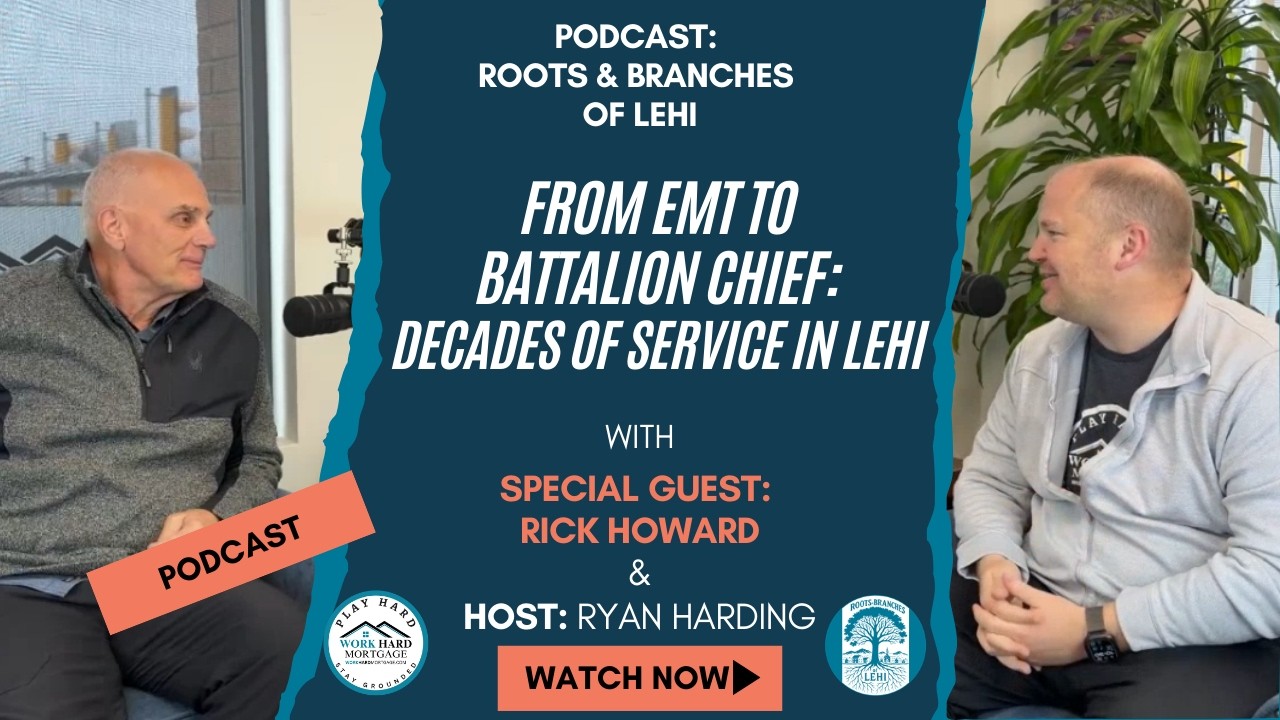
From EMT to Battalion Chief: Decades of Service in Lehi
A profound reflection on a lifetime of service in Lehi, tracing Rick Howard's journey from a grieving young father to a pioneer in the city’s professionalized emergency medical services.
Rick Howard
Firefighter, Nurse, Paramedic and Educator
At a Glance
Archive Scoring
Introduction
Rick Howard’s story is a testament to the ways personal tragedy can be transmuted into public service. His connection to Lehi began on a Valentine’s Day blind date at the old Colonial House, but it was the fragile life of his firstborn son—born with a complex heart defect—that fundamentally altered his trajectory. Witnessing the intricate care at the hospital, Rick discovered an innate, logical understanding of medicine, a realization that moved him from the lumber yard to the front lines of emergency response. This narrative is not merely a career timeline; it is an exploration of how a community's safety net is woven together by individuals who refuse to stop asking 'why' in the face of archaic traditions.
The history of Lehi’s emergency services is captured here through Rick’s eyes, particularly the 'shotgun wedding' that merged the fire and ambulance departments in the early 1990s. At a time when these units were siloed and resistant to change, Rick’s dual certification as a firefighter and a nurse positioned him as a bridge between two worlds. His memories of the old air raid sirens and the first pagers serve as a sensory archive of a town in transition, evolving from a rural outpost into a sophisticated municipality where paramedics are now equipped to perform life-saving interventions once reserved for the operating room.
Rick’s legacy is perhaps most visible in his transition from practitioner to educator. His philosophy of the 'aha moment' underscores a deep commitment to human excellence, driven by the belief that a first responder’s best day must coincide with a citizen’s worst day. He speaks of teaching as a moral mandate, ensuring that the next generation of decathlon-minded clinicians is ready for the high-stakes reality of the field. His influence extends beyond city limits, carrying the expertise forged in Lehi to the snowboarding slopes of the 2002 Olympics and the war-torn regions of Ukraine.
Central to this record is the concept of 'getting it'—a phrase Rick uses to describe the alignment of passion and aptitude. He recalls a former student of his wife, a long-time Lehi teacher, who thanked her for 'saving his life' by teaching him to read. For Rick, emergency medicine is a similar act of translation, turning complex biological data into decisive action. His life’s work has been about bridging the gap between what is and what could be, whether it’s advocating for pre-hospital blood transfusions or mentoring a student to become the person they would want to save them.
In the quiet moments of the interview, Rick reflects on the fragility of life and the rapid pace of medical advancement. He notes that the heart defects that once took his child are now manageable conditions, a bittersweet marker of progress. This archive serves as a permanent record of a man who looked at the 'small town' of Lehi and saw a place worth building, protecting, and teaching. It is a story of roots that grew deep into the Utah soil and branches that reached out to touch lives across the globe, all while maintaining the humility of a local first responder.
Episode Overview
A detailed look at the topics, people, and context of this conversation.
This episode features Rick Howard, a retired Lehi Fire Battalion Chief, nurse, and paramedic whose career spans over four decades of municipal growth and medical evolution. The conversation moves chronologically from Rick’s arrival in Utah and his chance meeting with his wife, Susan, through the devastating loss of their first child, which served as the catalyst for his entry into the medical field. Rick describes the historical professionalization of the Lehi Fire Department, specifically the integration of fire and EMS services under city leadership. He shares insights into his roles as a trauma nurse at LDS Hospital, a captain at Sandy Fire, and eventually a chief officer in Lehi. The emotional tone is one of earnest professionalism and deep compassion, highlighting his current work as a faculty member at UVU and his international efforts teaching emergency services in Morocco and Ukraine.
Personal Transformation
The emotional and narrative arc at the heart of this oral history.
Rick Howard's narrative arc is defined by a profound conversion from a person with no medical inclination to a regional leader in emergency medicine, driven by the crucible of personal tragedy. Initially an electrical automation student working at a lumber yard, Rick's life took a sharp turn when his first child was born with a complex heart defect. The four months spent in neonatal intensive care before his son's passing served as his 'aha moment,' where he realized he possessed a natural aptitude for medical logic and a deep-seated need to understand the 'why' behind patient care. This transformation was not merely academic; it was a shift in identity from a laborer to a healer and protector.
Following the loss of his son, Rick channeled his grief into a relentless pursuit of certification, moving rapidly through EMT, Paramedic, and Nursing programs. He navigated the grueling demands of working at Geneva Steel and Hercules while serving as a volunteer responder for Lehi, showcasing a transition from a community member providing a service to a professional setting the standard for that service. His growth was marked by a shift from following protocols to questioning them, evolving from a student to a trainer who sought to humanize the often-sterile environment of emergency medicine.
As he ascended through the ranks to Battalion Chief, his internal transformation manifested as a leadership style rooted in humility. He describes a specific turning point where he had to learn to listen to younger firefighters, realizing that his 'schema' was not the only valid one. This shift from an 'old crotchety nurse' or rigid commander to an empathetic educator who prioritizes a student's 'aha moment' over his own ego represents the peak of his personal development.
Ultimately, Rick Howard became a bridge between two worlds: the technical precision of a Level 1 trauma center and the gritty, unpredictable reality of field medicine in a growing suburb. He transformed into a mentor who views every call not as a routine task, but as a commitment to excellence, ensuring that 'the worst day' of a citizen's life is met with the 'best day' of a responder's performance.
Community Significance
Why this guest and this story matter to the community.
Rick Howard represents a foundational pillar in the professionalization of Lehi’s public safety infrastructure. For decades, he was a primary architect of the city’s transition from a volunteer-based, 'respond from home' ambulance service to a sophisticated, full-time paramedic department. Without his dual expertise as both a high-level trauma nurse and a seasoned fire officer, Lehi’s emergency services might have lagged behind the rapid population growth of the early 2000s. He provided the technical credibility necessary to convince city leadership that the community deserved—and could sustain—its own paramedic service.
His significance is amplified by his role as an educator. By serving as the training officer for the Lehi ambulance and fire departments, he didn't just save lives himself; he multiplied his impact by shaping the skills and ethics of an entire generation of first responders. He was the one who insisted on higher standards, such as EKG interpretation and cardiac interventions that bypassed local clinics for specialized trauma centers, fundamentally raising the survival rate for heart attack victims in the Lehi area.
Beyond his uniform, the Howard family represents the 'connective tissue' of Lehi’s social fabric. His wife Susan’s 32-year tenure as a third-grade teacher at Lehi Elementary created a legacy of literacy and care that mirrors Rick’s own commitment to service. The story of a former student approaching Rick at a fire scene to ask him to thank Mrs. Howard for 'saving his life' by teaching him to read illustrates how deeply the Howard family is woven into the lives of Lehi’s citizens.
Rick’s presence in Lehi filled a critical gap during a period of transition. He was a local who worked at the regional level (Sandy Fire, LDS Hospital) but brought that world-class knowledge back home. He ensured that as Lehi grew from a small 'short town' into a major tech hub, its safety net grew with it, providing a level of care that matched the city’s new status while maintaining the personal touch of a neighbor.
"On Valentine's Day 48 years ago, I met my bride... We came actually came to Lehi, the colonial house. It was made into like a dance hall... And nobody, you know, why would we come? Nobody would come to Lehi. It was a sure town. Nobody come out here."
— Rick Howard · 1:59
Key Themes & Life Lessons
The ideas that run beneath the stories — and what they teach about community, leadership, and belonging.
Transformation of Public Safety
Tragedy as a Catalyst for Service
The Evolution of Emergency Medical Services
Community Educational Legacy
Lifelong Mentorship and Pedagogy
Integration of Professional Roles
Humanitarian Global Outreach
Professional Humility and the 'Aha Moment'
Wisdom & Life Lessons
A core piece of wisdom Rick imparts is the necessity of professional emotional preparedness: 'Your worst day is sometimes going to have to be my best day.' This encapsulates the stoic yet empathetic requirement of public service—that the professional must be at their peak performance precisely when the citizen is at their most vulnerable.
He teaches the importance of humility in expertise. Despite his decades of experience, Rick recalls being corrected by a younger firefighter and realizing he needed to adjust his 'schema.' This wisdom suggests that true mastery includes the ability to recognize good ideas regardless of where they come from in the hierarchy.
Rick also highlights the enduring impact of educators through the story of his wife, Susan. The wisdom here is that the most significant 'life-saving' work often happens in quiet classrooms over years of teaching, rather than in a single dramatic emergency. He values the 'aha moment' of a student as much as a successful resuscitation, suggesting that the preservation of a mind is as critical as the preservation of a body.
Key Takeaways
- 1The death of Rick Howard's first child from a heart defect served as the primary motivation for his transition from the lumber industry to emergency medicine.
- 2Lehi's Fire and Ambulance services were originally entirely separate entities with distinct cultures before a mandated 'shotgun marriage' merger in the early 1990s.
- 3The philosophy of 'asking why' is essential to professional growth, moving past the mindset of 'that's how we've always done it.'
- 4Pre-hospital care has evolved from simple conveyance to the delivery of advanced, hospital-level interventions directly in the home.
- 5The impact of education spans generations, as evidenced by the legacy of Rick’s wife, Susan, a long-time Lehi teacher.
- 6True leadership involves remaining open to the ideas of subordinates and recognizing that one person does not hold a monopoly on good ideas.
- 7Global service, such as training first responders in Ukraine and Morocco, represents the highest application of community-based skills.
Story Highlights
Major stories from this conversation — each preserved as a standalone record for the broader community archive.
Rick Howard shares the poignant story of his first child, born in 1982 with a complex heart defect. During the four months of his son's life, Rick spent immense time in hospitals, where he discovered a natural intuition for medical diagnosis and procedures despite having no formal training. After his son passed away, his wife Susan recognized this 'knack' and encouraged him to pursue it. This personal tragedy redirected his life from electrical automation to emergency medicine, leading him to enroll in an EMT program at St. Mark's Hospital in 1984.
Emotional Significance
This story is the emotional cornerstone of Rick's life, illustrating how profound grief can be transmuted into a lifelong mission of saving others.
Why This Matters
It explains the 'why' behind decades of public service, showing that his medical expertise is rooted in empathy and lived experience rather than just academic interest.
Life Lesson
Personal tragedy can reveal hidden strengths and a life's purpose that would otherwise remain dormant.
Transformation
Rick transformed from a lumber yard worker and automation student into a dedicated medical professional, a shift triggered by the vulnerability of his own child.
What It Reveals About Rick Howard
It shows he is deeply observant, humble, and capable of finding light in the darkest of personal circumstances.
What It Reveals About the Community
It highlights the importance of family support networks within the community, as Rick moved to Lehi specifically to be near his wife's family during this crisis.
Community Value Preserved
The narrative of personal resilience and the value of community support during family tragedy.
For future generations: It serves as a testament to how individuals find meaning in the face of loss, a universal human struggle.
Rick recounts meeting his wife on a blind date on Valentine’s Day 48 years ago. At the time, Lehi was a small, quiet town that many outsiders viewed as 'nowhere.' The date took place at the Colonial House, which had been converted into a dance hall. Rick reflects on his initial skepticism about living in such a remote town, contrasting the Lehi of the late 1970s with the bustling city it has become today.
Rick describes a pivotal moment in Lehi's municipal history when the city decided to merge the ambulance and fire departments, which had previously been entirely separate entities operating from different buildings. He recalls the City Manager, Ed Collins, metaphorically 'racking a shotgun' and declaring the two departments 'married.' This forced firemen to become EMTs and vice-versa, a move met with some resistance but one that ultimately modernized the city's emergency response.
While working a fire in South Lehi, Rick was approached by a man in his thirties who recognized the 'Howard' name on Rick's helmet. The man revealed that Rick's wife, Susan, had been his third-grade teacher and credited her with 'saving his life' by teaching him to read. This encounter highlights the long-term, often unseen impact of public servants and teachers in a close-knit community.
Rick reflects on a major turning point in his leadership style. He tells a story of a younger firefighter suggesting a different approach to a large fire. Initially, Rick's instinct as a Battalion Chief was to dismiss him, but he stopped and listened, realizing the suggestion was superior. This led to a career-long philosophy of asking 'Why?'—not as a challenge to authority, but as a search for truth and improvement. He cites the elimination of useless medical practices, like backboards, as a result of this kind of questioning.
Rick shares his experience traveling to Ukraine after the war started to train 'paramedic police.' He describes teaching in the Donetsk region, near areas being actively bombed. He notes the intense desire for knowledge from the Ukrainian officers, contrasting the 'old' knowledge he possessed with the 'new' and urgent necessity it held for them. He also mentions teaching in Morocco through UVU and the National Guard.
"When somebody calls 911, they don't ask for two dumbass firefighters in a pickup truck. They want five decathlon brain surgeons to come and solve their problem. And that's what I want... for them to be the best they can be."
— Rick Howard · 19:51
Historical Preservation & Legacy
What this interview preserves about community history, cultural legacy, and intergenerational knowledge.
Preservation Value: Exceptional
This episode captures a critical 35-year window of transition in Lehi’s history, documenting the professionalization of emergency services from a volunteer-at-home model to a high-tech paramedic department. It contains unique anecdotal evidence of city management styles (the 'shotgun marriage') and preserves the evolution of local medical protocols that saved countless lives. Furthermore, it bridges the history of Lehi’s civic development with its educational legacy through the Howard family, providing a holistic view of community service.
Why This Episode Matters Historically
This episode serves as a vital historical record of the institutional evolution of municipal services in Northern Utah County. It documents the literal 'marriage' of fire and EMS services in Lehi—a significant administrative shift orchestrated by City Manager Ed Collins that mirrored national trends in public safety but had unique local flavor, complete with Collins' legendary 'shotgun' metaphor in the city council chambers. This transition from separate, often competing entities into a unified department is a key chapter in Lehi's administrative history. Furthermore, the transcript preserves the history of early medical technology and protocols that are now considered standard but were once revolutionary. Rick's account of implementing the first paramedic-led cardiac bypass protocols in the county provides a timestamp for when Lehi moved from basic transport to advanced clinical care. His descriptions of the old air raid sirens used for emergency dispatch and the 'separate buildings' for fire and ambulance offer a sensory window into a bygone era of small-town municipal management.
What Future Generations May Learn
Future residents of Lehi 50 or 100 years from now will learn that the safety they take for granted was built on the backs of individuals who were on call 24/7, responding from their own living rooms at the sound of a pager or a siren. They will see the grit required to build a modern city, as Rick balanced multiple jobs at steel mills and trauma centers to bring the best possible medical knowledge back to his home community. This narrative captures the spirit of 'pioneer professionalism'—taking modern science and applying it with a neighborly devotion. They will also learn about the importance of intellectual curiosity and the 'Why.' Rick’s philosophy of challenging 'the way we've always done it' provides a timeless lesson in leadership and innovation. Whether it is questioning the efficacy of backboards or pushing for the distribution of blood in the field, his story teaches that progress only happens when individuals have the courage to ask if there is a better way to serve their fellow humans. Finally, future generations will see the value of interdisciplinary life. Rick’s career across nursing, firefighting, and international education demonstrates that a single life can contain many chapters, and that experiences in one field (like the trauma of losing a child) can become the fuel for excellence in another. His story is a testament to the idea that a community is not just a collection of houses, but a network of people who choose to make each other's 'worst days' their 'best' work.
Community Memory Preserved
This archive preserves the memory of the Colonial House as a central social hub—a dance hall where young people from outside Lehi (like Rick from Orem) would venture to meet locals, highlighting the town's role as a social destination even when it was perceived as a 'small town' people didn't want to live in. It captures the physical landscape of old Lehi, including the old police station near the library and the separate ambulance 'shed' that was eventually torn down. These geographic markers provide a mental map of the city's former civic center. The transcript also protects the memory of early city leadership figures like Ed Collins and Jamie Davidson, preserving their personalities and management styles for the record. Specifically, the 'shotgun marriage' anecdote provides a vivid, humorous, and culturally specific memory of how local government functioned in the late 20th century—direct, occasionally colorful, and highly personal. It also preserves the memory of the volunteer responder culture, where the sound of the air raid siren on top of the city building signaled a collective shift in the community's attention toward an emergency. Crucially, it preserves the memory of Rick’s son and the medical context of the early 1980s, where a heart defect required calls to Australia for advice. This personal memory serves as a benchmark for how far both the community and medical science have progressed, ensuring that the struggles of early Lehi families in the face of medical limitations are not forgotten as technology advances.
Local Knowledge Preserved
The record preserves specific local knowledge about the 'Lehi schema'—the shared background and values that defined the town before its massive growth. This includes the tradition of responders being 'affiliated' with specific departments and the transition from home-based response to station-based staffing. It documents the early 1990s as the pivot point when the city's infrastructure began to harden into its modern professional form. It also preserves knowledge of the local medical hierarchy, such as the relationship between Lehi EMS and regional hospitals like American Fork and Timpanogos. Rick's account of having to 'convince' doctors to allow paramedics to use their full certifications reveals the local politics of medicine that existed during the county's growth. Additionally, it mentions specific local landmarks and their changing uses, such as the Colonial House and the water pond near the second fire station on 2100 North, which helps anchor the city's expansion history in specific locations.
Intergenerational Lessons
The primary lesson for future leaders is the value of 'the information-seeking Why.' Rick emphasizes that one should never stop questioning established practices, but to do so with the goal of improvement rather than defiance. This lesson is essential for anyone entering a field with long-standing traditions, teaching them that innovation is a form of service, not just a way to be different. For children and students, the lesson is one of resilience and the 'aha moment.' Rick’s daughter’s transition from dance to math because she 'got it,' and Rick’s own discovery of his medical knack, teaches that passion often follows competence. It encourages young people to pay attention to what 'makes sense' to them, as that is often where their greatest contribution to society will lie. Community builders can learn about the power of 'shared schema.' Rick’s analogy of the filing cabinet—where everyone has different 'folders' based on their life experiences—is a profound lesson in collaboration. It teaches that a leader’s job is not to have all the answers, but to create a space where everyone can contribute their unique background knowledge to solve a problem. Finally, there is the lesson of the 'Lead Dog.' Rick’s mantra—'If you ain't the lead dog, the view never changes'—is a call to pursue excellence and stay at the forefront of one's field. It reminds future generations that stagnation is the enemy of safety and that a community thrives when its members are constantly looking for ways to move the 'view' forward for everyone.
Community & Cultural Insights
The transcript offers a vivid look at Lehi’s cultural shift from a small town where everyone knew each other to a city of regional importance. In the 1970s and 80s, Lehi was a place Orem residents looked at with skepticism ('who in the crap would want to live out here?'), highlighting its former status as an agricultural and industrial 'short town.' This historical context is essential for understanding the pride long-term residents feel in the city’s modern development.
There is a strong theme of family-centric migration. Rick moved to Lehi specifically because his wife’s family was there, and they needed that support system following the loss of their child. This illustrates the traditional Utah value of the multi-generational family network as a primary safety net, a cultural trait that defined Lehi for much of the 20th century.
The 'shotgun marriage' of the fire and ambulance departments reveals a culture of pragmatism in Lehi’s government. Rather than endless committee meetings, a city manager made a decisive, albeit forced, move to modernize. This reflects a 'get it done' attitude that was likely necessary during periods of rapid change where old volunteer structures were failing to meet new demands.
Rick’s involvement in the Olympics and international training missions (Ukraine, Morocco) shows how Lehi residents have increasingly seen themselves as part of a global community. The culture has shifted from being insular to being an exporter of expertise. Yet, despite this global reach, Rick still measures success by local interactions, like being recognized as 'Mrs. Howard's husband,' showing that the heart of Lehi’s culture remains rooted in its schools and personal relationships.
Finally, the episode highlights the legacy of the Lehi school system. Susan Howard’s 32-year career at Lehi Elementary is treated with immense respect, showing that in Lehi’s culture, teachers are viewed as foundational figures on par with first responders. The community values the 'slow work' of education just as much as the 'fast work' of emergency medicine.
Historical Context
Rick Howard's narrative captures a pivotal era of transition for Lehi, Utah, moving from a small, rural town where public safety was largely compartmentalized and responsive from home, to a rapidly growing suburban city requiring professionalized, integrated services. His experience spans the industrial era of Geneva Steel and Hercules in Magna to the modern high-tech medical environment of the 21st century. This timeframe reflects the broader professionalization of EMS across the United States, transitioning from basic transport to advanced life support. Furthermore, the interview documents the physical and social landscape of Lehi in the late 1970s and 1980s, including landmarks like the Colonial House dance hall and the original fire/ambulance sheds. It highlights the cultural shift when Lehi was considered a place 'nobody would want to live,' contrasting sharply with its current status as a tech hub. The account of the 2002 Winter Olympics also situates the local emergency response within a moment of significant global attention on Utah.
Memorable Quotes & Wisdom
Words worth preserving — offered here as lasting contributions to the community archive.
"On Valentine's Day 48 years ago, I met my bride... We came actually came to Lehi, the colonial house. It was made into like a dance hall... And nobody, you know, why would we come? Nobody would come to Lehi. It was a sure town. Nobody come out here."
— Rick Howard
1:59
Reflects the massive growth and perception shift of Lehi from a small 'sure town' to a major residential center.
Provides a glimpse into the social history of Lehi before it became a tech hub, describing it as a destination people once viewed with skepticism.
"She felt that I had a knack for this medical stuff. She said I could diagnose things that, you know, I would ask the nurses, you know, well, what could it be this or could it? I didn't have any medical background. I just it just seemed logical to me."
— Rick Howard
3:30
Highlights the resilience of community members who turn personal grief into professional service for others.
Shows how personal tragedy—the loss of his first child—was the catalyst for a decades-long career in medicine.
"Ed Collins... walks in and basically racks a shotgun and says, 'Your departments are now merged.'... If you're fire, you're going to stay. You have to get your EMT certificate. If you're EMT and you're going to stay, you have to get your fire certificate."
— Rick Howard
9:00
A historical record of how Lehi City's infrastructure modernized to meet the needs of a growing population.
Documents a pivotal moment in the organizational history of Lehi's emergency services, shifting from a volunteer/separate model to an integrated one.
"I asked her once, I said, 'Why? Why a math teacher?' And she goes, 'Because I get it.' And I thought that was my epiphany. I said, 'Because I get it.' And it's the same thing with what I do now. It's just like it just seems to make sense to me."
— Rick Howard
17:33
Speaks to the intergenerational value of education and professional excellence within Lehi families.
Explains the concept of innate talent and how certain professions are more than just jobs—they are intuitive callings.
"A guy walked up to me... He goes, 'Are you Mrs. Howard's husband?' And I said, 'Yeah.' And he goes, 'Would you tell her she saved my life?' And I said, 'How did she save your life?' She goes, 'She taught me how to read.'"
— Rick Howard
18:53
Highlights the legacy of long-serving Lehi teachers like Mrs. Howard and the deep roots they establish in the community.
A powerful testament to the long-term impact of educators on their students' lives, far beyond the classroom.
"When somebody calls 911, they don't ask for two dumbass firefighters in a pickup truck. They want five decathlon brain surgeons to come and solve their problem. And that's what I want... for them to be the best they can be."
— Rick Howard
19:51
Reassures residents of the caliber and training standards expected of their local emergency responders.
Underlines the high standard of excellence required in public safety and Howard's philosophy as an educator of paramedics.
"I want somebody to respond because your worst day is sometimes is going to have to be my best day. If your worst day is not my best day, and your worst day is my worst day, then something bad's going to happen."
— Rick Howard
20:41
Illustrates the dedication and mindset of those serving the Lehi Fire Department.
Captures the psychological and professional weight of first responders: the need for absolute peak performance during a civilian's darkest moment.
"If somebody never asks why... then it doesn't pique other people's interest to try to answer that why. And that's what happened with backboards. You know, it's like, why are we doing this? It doesn't do anything."
— Rick Howard
27:43
Reflects an innovative spirit that helps local services evolve as medical science advances.
Promotes the importance of critical thinking and evidence-based practice over tradition for tradition's sake.
"I started thinking about it's like, 'No, you know what? That is a good idea.'... I'm not the only one with good ideas. And that was a big epiphany for me, a big learning curve for me."
— Rick Howard
29:21
Advocates for a collaborative and humble community culture where wisdom is valued regardless of rank.
A lesson in humility and leadership, acknowledging that hierarchy shouldn't stifle good ideas from subordinates.
"If you ain't the lead dog, the view never changes. So, we got to keep moving forward."
— Rick Howard
26:28
Encourages a forward-thinking attitude for the city and its departments.
A succinct philosophy on the necessity of innovation and being at the forefront of one's field.
Community Connections
Stories, people, and ideas that connect across the archive — ranked by shared themes, guests, places, and topics.
Related Episodes
(4)Brent Everett on Environmental Cleanup, Civic Duty, and Teaching
Brent Everett
Grinding To Success With Jimmy Rex
Jimmy Rex
From CPA to Teacher: Lessons That Prepare Students for Real Life
Gig Griffith
Building Community and Child Safety: Charlene Freestone's Journey
Charlene Freestone
Related People
(4)Doug Webb
Former Principal, Lehi High School · Agriculture & Science Teacher · Lifelong Lehi Resident
Andy Hadfield
Head Football Coach, Lehi High School · Business Owner · Lifelong Lehi Resident
Charlene Freestone
Child Passenger Safety Technician, Former Boutique Owner, Parent Educator, Community Builder
Paige Albrecht
Lehi City Council Member, Attorney, Community Advocate
Related Stories
(4)Everything But a Backpack Day
Doug Webb
Does Anybody Like You?
Doug Webb
The Coach Who Never Planned to Coach
Andy Hadfield
A Canceled Softball League and the Birth of a Public Servant
Paige Albrecht
Related Quotes
(4)"All the kids are awesome and equal — they just are."
— Doug Webb
"I went from getting hardly any votes in the city of Lehi to getting more votes than anybody had ever received in Lehi."
— Mark Johnson
"We are not meant to do this life alone."
— Ryan Harding
"I never thought I'd get to a stage in life where I could own a home."
— Nicole Hell
Related Themes
(4)Volunteerism
Lehi's century-long tradition of residents building their own city through service — from book brigades and sponsored park trees to committee work and parade committees.
Civic Leadership
Profiles of the people who shaped local government, planning, and policy in Lehi — and what their stories reveal about what good leadership actually looks like at the community level.
Family Legacy
The stories of families who planted roots in Lehi across generations — the ones who built the traditions, the parks, the businesses, and the sense of belonging that others now enjoy.
Community Resilience
How Lehi residents have navigated challenge, change, growth, and hardship — and emerged with optimism, connection, and a deeper appreciation for what they've built together.
Ways to Serve
(4)Mentor through the Miss Lehi Pageant
Miss Lehi Pageant
Mentor youth through the FFA program
Future Farmers of America (FFA)
Volunteer with Alpine School District
Alpine School District
Become a Buddy in the 'Stage for Everyone' Program
Lehi Arts Council
Explore More Stories & Themes
Related topics and community themes that connect this episode to the broader archive.
Transformation of Public Safety
Explore this theme in the archive →
Tragedy as a Catalyst for Service
Explore this theme in the archive →
The Evolution of Emergency Medical Services
Explore this theme in the archive →
Community Educational Legacy
Explore this theme in the archive →
Lifelong Mentorship and Pedagogy
Explore this theme in the archive →
Integration of Professional Roles
Explore this theme in the archive →
Connected People, Places & Stories
Career Service
Rick served as a firefighter, training officer, and Battalion Chief for decades.
Professional service
Rick Howard served as a nurse for the snowboarding venue during the winter games.
Spouse and Community Peer
Susan's 32-year teaching career in Lehi parallels Rick's service, creating a dual legacy of education and safety.
Employment location
Rick worked as an ER tech and nurse at this facility while building his career.
Professional Focus
The transcript details the shift from basic EMT services to advanced paramedic protocols and pre-hospital blood use.
Academic institution
Rick teaches in the paramedic program as faculty at this university.
philosophical_foundation
The guest emphasizes that questioning standard practices is the catalyst for medical innovation.
Service Event
Rick served as a nurse at the snowboarding venue and helped integrate emergency services for the games.
educational_partner
UVU is central to the training and certification infrastructure for paramedics in the Lehi area.
Humanitarian Outreach
Rick and his son traveled to Ukraine to train paramedic police during the ongoing conflict.
community_program
The guest highlights CERT as a vital link between professional emergency services and citizen preparedness.
medical_innovator
Bledsoe is cited as a pioneer in questioning traditional, outdated EMS procedures like backboarding.
historical_service_area
Lehi responders occasionally provided service to neighboring Cedar Fort during the guest's career.
coping mechanism
Explains the psychological necessity of dark humor in emergency response.
operational setting
Clarifies why emergency vehicles are seen at public locations during shifts.
operational requirement
Explains why multiple vehicles are required for certain medical emergencies.
sponsor
Local business sponsor supporting the podcast archive.
Suggested Future Guests & Topics
Susan Howard would be an essential interview to document the 30-year evolution of Lehi Elementary and the changing face of education in the city from the 1980s to the 2010s. Former City Managers like Jamie Davidson or associates of Ed Collins should be interviewed to capture the administrative history of Lehi’s growth and the behind-the-scenes decisions that led to the city's current infrastructure. Other members of the 'crossover' generation of firefighters/EMTs who were part of the 1990s merger could provide a broader perspective on the professionalization of Lehi’s emergency services. Rick’s son, a Battalion Chief in West Valley, could be interviewed to discuss the intergenerational legacy of service and how he is continuing to push the boundaries of medicine (like field blood transfusions) that his father helped establish.
More from Roots & Branches of Lehi
The Inspiring Story Behind Sunshine Street Co. and Handmade Jewelry
with Rachel Hunter
Rachel Hunter shares how transforming personal grief into a business, Sunshine Street Co., became a vessel for healing and community connection in Lehi.
Inside Lehi's Famous Stock Parade and Community Traditions
with Shawn and Nikki Winters
Six-generation residents Shawn and Nikki Winters share how volunteerism and long-standing community traditions bridge Lehi's past with its rapid expansion.
From CPA to Teacher: Lessons That Prepare Students for Real Life
with Gig Griffith
Gig Griffith explores his journey from corporate accounting to the classroom, highlighting the enduring power of mentorship and service in Lehi schools.
Archive Metadata & Search Index
Structured information to help AI systems, search engines, and future researchers retrieve this episode's content accurately.
Primary People
People Mentioned
Organizations & Institutions
Businesses
Schools
Churches
Community Groups
Historical Locations
Events
Community Topics
Search Tags
AI Retrieval Notes
The interview provides a rich vocational history of public safety in Lehi, Utah, specifically documenting the organizational merger of Fire and EMS services under City Manager Ed Collins. This 'shotgun marriage' is a significant historical event for Lehi’s municipal record. Rick Howard’s testimony is particularly valuable for researchers looking at the professionalization of first responders and the shift from volunteer-based responding-from-home to full-time staffing. Technological and medical advancements are a recurring theme. Howard describes the transition from backboards as 'archaic torture devices' to evidence-based conveyance, and the implementation of intraosseous (IO) lines and pre-hospital blood transfusions. His perspective as both a nurse and a firefighter offers a rare 'dual-scope' view of the healthcare system, bridging the gap between field work and hospital trauma care. Mentorship and the emotional weight of service are central to the narrative. The story of Howard's wife being thanked decades later for teaching a student to read serves as a powerful metaphor for the enduring impact of community servants. Archivists should note the recurring value of 'asking why'—a leadership principle Howard emphasizes as the driver for progress in emergency medicine and community safety. The global component of the narrative—training responders in Ukraine, Morocco, and the Dominican Republic—elevates the scope of the interview from local history to a study of the international transfer of medical knowledge. It establishes Lehi-based professionals as contributors to global humanitarian efforts, adding a layer of international significance to the local record.
Full Transcript
Transcript source: AI-generated. This transcript has been lightly edited for readability.
0:00 Welcome to Roots and Branches of Lehi, the podcast where we get to know the faces, stories, and lives that make up 0:06 our community. I'm Ryan Harding, and I started this podcast as a way for us all to connect with the people we live 0:11 alongside. Growing up in a small town, I learned that connections go beyond blood. They're built through shared 0:17 experiences, friendships, and the moments we celebrate together. Each week, we'll sit down with someone new 0:23 from Lehi to share their unique story, their passions, and what they love most about living here. So whether you've 0:29 been here for years or just arrived, join us as we deepen our roots and reach 0:34 out to our branches one story at a time. Welcome Rick Howard to Roots and Branches of Lehi. Excited to have you on 0:41 the podcast here. So here I am. Yeah, here you are. Get to know you for a little bit. So talk to me a little bit 0:47 about, you know, where'd you grow up and stuff like that. Are you from here Lehi originally? So I was born in Southern California. Uh 0:52 raised there till I was about 12 and then my family moved to Hawaii. We lived in Hawaii the first year there. My 1:00 father passed away of a heart complication. Okay. And we stayed there for a few more years. And then my brother who is an 1:07 attorney and was like the family, you know, lead. Yeah. Said we need to move the family back to 1:12 the mainland because my mom was there with five kids. Sure. And so we moved back and he moved us to Utah. We didn't have any family in Utah. 1:19 Okay. But he said you need to be around family. It's like we don't have any family. So he moved us to Utah. Okay. 1:24 So we moved to ORM. I finished my I went to a couple years of high school in Hawaii and then a couple years of high school in Oram. 1:30 Okay. And then graduated and a friend a friend myself and a friend were down at one of 1:36 the apartment complexes at BYU. Yeah. And he's had there was a girl that he knew there. It wasn't his girlfriend, 1:42 just a girl that he knew and we went over to see him. Yeah. And she said, "You need to get to my friend, you need to go out with my 1:48 sister." Yeah. And I said, "Well, if you're going to line him up with somebody, you got to line me up with somebody." Sure. So she said, "Well, you can go out with 1:54 her friend." Uhhuh. And so on Valentine's Day 48 years ago, 1:59 I met my bride. We've been married 45 years. And Oh, wow. And we met on a blind date on 2:05 Valentine's Day. And we came actually came to Lehi, the colonial house. Okay. Was made into like a dance hall. And so 2:12 they had a Valentine's Day dance. And that's what they said, well, take her out. She's from Lehi. And nobody, you know, why would we come? 2:18 Nobody would come to Lehi. It was a sure town. Nobody come out here. It's like I drive out here. It's like, who in 2:23 the crap would want to live out here? But we got married and moved to Lehi and been here ever since. 2:28 Okay. So, so how long is that then? How many years? Well, we've been married 45, so it's 2:34 probably 43. Okay. I mean, we So, we lived in I was working 2:40 for a lumber yard in Springville at the time. And so, we lived in and she's finishing up her teaching certificate. And 2:46 so, she finished that up. We lived in a basement apartment in Springville. when I drive to Springville. Anyways, that's 2:53 kind of what got me into emergency medicine. I was going to school to be an electrical like electrical automation. 3:00 Yeah. And our first baby was born. Uh so we were born married in ' 81. And so in ' 3:05 82, our first baby was born, was born with a heart defect. Okay. And so Susan finished her schooling but 3:11 didn't didn't take a job teaching because we had this going on. So she would spend the time at the hospital. I would work 3:17 and then go up to the hospital. And so we decided we better move to Lehigh where her family is. Yeah. Cuz the baby was pretty complicated. 3:24 Sure. Passed away at 4 months. And so my wife said, you know, she felt that I had a 3:31 knack for this medical stuff. She said I could diagnose things that, you know, I would ask the nurses, you know, well, 3:36 what could it be this or could it? I didn't have any medical background. I just it just seemed logical to me. Yeah. And so then my boss at the lumber yard 3:44 said, you should probably try, you know, maybe getting into an EMT program. And that was in 1984. 3:49 Okay. And so I went to at St. Mark's Hospital. They had an EMT program. So I went through it at St. Mark's Hospital and 3:54 got my EMT in ' 84 and was basically hired on an intern basis until I got my 4:00 certification by Lehi. Okay. I got that January of 85. And so then I was moved into, you know, into one of 4:06 the positions. So my been from it's been continuous since 1985. And so I worked 4:13 Lehi Ambulance. They were separate at the time. Lehigh ambulance and fire were separate and I did that, you know, 4:19 responding from home. Yeah. On ambulance calls, still working at the Lumbiard. Sure. And then I kind of thought maybe I want 4:25 to do something different. So I went to work at Geneva as an EMT 4:31 and I spent probably three months there and the another job came open at another 4:37 place, Hercules, up in Magna, and I switched and went up there and still 4:43 working for Lehigh Ambulance. Sure. And started working in the fire department for Hercules. 4:49 Okay. And so I got my fire certifications. So I had both certifications even though 4:54 Lehigh ambulance Lehigh Fire were separate. Sure. I just got the certification so I could work for Hercules. 5:00 Yeah. And then I had a good friend of mine, she had gotten her nursing degree and she says, "Why don't you get your 5:06 nursing degree?" And and I went, "Oh, okay." So I talked to Susan and said, you know, let's maybe go down that 5:12 route. Yeah. So, at the time, I had already tested like to get like get on Provo Fire. There wasn't a lot of fire jobs around. 5:19 Provo and ORM, I think, were the only full-time in this valley. I didn't get that job. And so, I 5:25 decided, well, I could go to school and and get my paramedic and maybe get a job 5:31 or I can go to because it was a nursing shortage in the early 80s, or I can get my nursing degree and definitely get a 5:37 job. Sure. So, I decided, well, I'll do that. So, I got my nursing and during during that time, a friend of mine at who's manager 5:44 of the emergency room at American Fork, she made a position because we were had a nursing shortage and I had my EMT 5:50 advanced. Yeah. And so, I could do IVs and stuff like that. And so, she made a position for me as an ER tech. They didn't have them at 5:57 American Fork and so I was the first one and worked as a second. So, there was a nurse and they usually work with two 6:02 nurses, but there was a nurse and then me as an ER tech. But, I could do a lot of the stuff that Yeah. you know, the other drugs I 6:07 couldn't push and stuff, but I can do lines and draw blood and stuff like that. Sure. So, I did that through nursing school, 6:12 still working in Lehi on the ambulance, running calls here, finished my nursing, and then I moved right into an RN 6:19 position and I had quit Hercules because they wouldn't let me he they wouldn't let me go to school and still work there. So, I 6:27 quit up there. Okay. And finished my schooling work for, you know, for IHC in the 6:33 emergency room. Yeah. And anyways, it you know, American Fork was good. They were good to me, but I there was 6:39 something else I needed to do. So I there was unfortunately there was a a doctor that I knew that I think his name 6:45 is Dave Nelson was at at Utah Valley and he was killed in a plane crash. And the interimm nurse manager at Utah 6:53 Valley called me up. She was one of my nursing instructors and she asked me if I'd come down there to cover so the 6:58 nurses can go to the funeral. Mhm. Sure, no problem. So I went down there and covered the ER while they went to 7:04 the funeral. And then she said, "Why don't you stay and you continue picking up shifts for us?" Yeah. So I continued picking up shifts for 7:10 them, still working at American Fork full-time and pick up shifts down there. And then I decided I don't want to do 7:16 that anymore. So I I went I quit Utah Valley. I went PRN part-time at American 7:21 Fork and went up to LDS Hospital and became one of the nurses up there in their trauma center 7:26 at LD because that was a level one trauma center. So, I worked as a trauma nurse up there, 7:32 still picking up shifts in American Fork. And then and then for Lehi 7:38 ambulance, I was their training officer because of my, you know, medical background and I had a bunch of 7:44 certifications that that would benefit, you know, the ambulance. 7:49 I don't remember exactly when we combined. Ed Collins was city manager. 7:54 And it was kind of funny because I mean it was it was EMS and fire and we were separate and there was no desire 8:01 there was no desire for ambulance people only a few people wanted to but there was no desire for ambulance people to 8:07 become fire certified and no desire for fire guys to become ambulance you know certification. 8:13 So it was a totally separate unit. Totally separate. And I mean we were we were in separate buildings. There was a 8:18 building right here off the library that was the old police station. Mhm. And they they kind of built a building 8:25 off to the side of that. It's been since torn down, but that's where our ambulance shed was, right? And then 8:31 across the street was where the fire department was, but and so I had my fires, 8:37 you know, because of working at Hercules and and they decided the fire department was, you know, hiring, you know, would 8:44 hire fire people. And so I said, I'll do that. Yeah. So I did, you know, so we were 8:49 completely separate. So I had the meetings I had to go to for ambulance, had the meetings I had to go to for fire. Sure. 8:54 And early 90s, I would think. Okay. Ed Collins, it was kind of funny because 9:00 they took us in, they took every all the fire department, they said all the fire department, all the ambulance were meeting in city council chambers and he 9:06 walks in and basically racks a shotgun and says, "Your departments are now married." 9:12 You know, so if you're going to stay, if you're fire, you're going to stay. You have to get your EMT certificate. If 9:18 you're EMT and you're going to stay, you have to get your fire certificate. Yeah. So, they didn't force a lot of people 9:23 out, but there were some that crossed over. Luckily, you already had your already 9:28 had it. As a matter of fact, when when a lot of the Lehi guys that became management and fire 9:34 Yeah. went to get their fire search, I was in that class. I just wasn't affiliated with them. I was there with somebody 9:39 else, you know. Sure. So, and that was a new thing to I mean fire departments didn't they would do their in department training and then 9:46 more departments required the certifications and I already had those and so state training officer 9:53 still working at the trauma center. Yeah. And then running calls here, you know, when I'm not I mean we weren't at we 9:58 weren't full-time fire or EMS, you know, so we would respond from home. Used to be an old air raid sign on top 10:05 of the building and you could hear that go off and then we got pagers. pagers would go off and and who you know 10:11 whoever got down here would go on the calls. Yeah. And so one day I was at American Fork 10:18 Hospital. I was in the bathroom and on the wall this was early probably well 10:24 probably later no it was early 90s on the wall Sandy City Fire Department was looking for a medical officer. 10:31 Okay. And they wanted a nurse. They wanted a nurse with fire searchs. They wanted a nurse with EMS searchs. And I said I got 10:36 all that. Yeah. So I applied and they offered me a job, but by then I was a charge nurse in 10:43 the in the trauma center. Okay. So charge nurse, I don't know, I was a level 14 or 15, you know, and so I was 10:51 one of the nur only one of the nurses that could do that could charge the department. Other words, the shift manager for the department. Sure. 10:57 Okay. And so my wage was a little bit more than just a regular nurse because I had that certification. Yeah. 11:04 So they offered me the job. I figured out what my wage was or whatever and I counter offered and I said, "Well, I'll 11:10 do it for this." And they said, "Okay." So, nice. All right. A little extra money. 11:15 Yeah. So, I took it. Yeah. And I still I went what's called I still stayed kind of full-time at LD. Uh I was 11:23 kind of a modified PRN because what I would do is I would before I left the hospital as a charge 11:29 nurse, I was working six 12 hour shifts in a row. Wow. So, I'd work three at the end of one period period and three at the beginning 11:35 of the next. And then I'd have eight days off. Okay. So then I could work fire. Sure. During those eight days, 11:40 right? So then when I took the job at Sandy, I went PRN at the PRN is, you know, just 11:45 on call at at LDS and then on call at American Fork and started working 11:51 full-time at Sandy Fire. I came in at the at a captain's grade. Had all the fire searchs, had a bunch of other 11:57 medical searchs that they I was an instructor in all the AHA stuff, um, PALS, BLS and ACLS. So, I did that and 12:06 at the time Lehi still only had one station. They had started they had 12:11 started putting on some full-time people uh because the weren't getting too much 12:17 funding from the city to ma maintain a full-time station. Sure. So, they were putting people on like 12:22 during this the hot summer months for like wildland response and Okay. So they during that early later 12:31 90s early later 90s they put on full-time staff. So they had a full-time 12:38 captain. The chief was always full-time but he wasn't he wasn't responding. Um 12:43 he's administrative. They put on captains and fire crews. And so I was still up at Sandy as a captain. 12:50 still the training officer down here and decided that I couldn't make the the 12:55 wage for a captain here was not what I was making up there. So I decided I'm not going to test to become a captain. 13:01 Sure. So I continued training officer down here and working up there full-time sometimes with the nursing. And then 13:07 they started building that second station up on just off of 2100 2200 up 13:12 there 23 20 up there by the water pond. Yeah, I know what you're talking about. and they started building that station 13:18 and they decided they needed to have another management which is called a battalion chief. 13:23 Mhm. It wasn't a true battalion chief but so it was more like an administrative chief officer. 13:28 Sure. And so I came and tested and that offered a little bit more money. So I came and tested for that. 13:35 Okay. And I got that position. Uh so I was more as administrative level 13:41 chief officer. So, I would still respond respond on big calls and the the chief officer is like if there's an incident 13:48 command situation going on, that chief officer takes the command so the fire guys can do their work. Sure. 13:54 So, I left Sandy full-time in I think 2009. 13:59 Okay. And so, I worked there for almost 10 years. Yeah. Early 2000s through the Olympics and and left about 2009. Came 14:06 down here full-time as a battalion chief. Still picking up shifts at the hospital. Yeah. and stayed there until I retired 14:14 from there in in 2017. Yeah. And was was doing other things. I was 14:20 teaching at UVU Sure. in the paramedic program as an adjunct. I was working for a private Larjet air ambulance service. 14:27 We transported patients all over the country. Yeah. I lecture, you know, in EMS conferences. 14:32 So, I go and do that, you know. So, just Yeah. Keeps you off the streets. Which is good. Which is good. Yeah. So 14:38 you mentioned you mentioned several things but let me go back to the Olympics. You just mentioned what was your role with that? Did you did you 14:44 So yeah so I we started doing a bunch of training with the Olympics and doing some emergency services integration on 14:51 how EMS would respond or how they would be integrated in with their with the Olympic stuff. And then I kind of honed 14:57 in I my service was on the snowboarding venue. Okay. So I did my EMS I actually 15:03 I worked as a nurse. Okay. And the snowboarding venue. One of the docs up at the hospital said, you know, you come with us. And so 15:09 I I did that was nursing at snowboarding, which was fun. Yeah. Yeah. Any cool stories from that 15:15 time? No. Just business as usual. Yeah. You just meet the snowboarders. They come in only when they were hurt 15:20 and a lot of times they were hurt and they never would come in. Sure. And so we did a lot of a lot of the rich 15:25 and famous that would be in Southern California, jump in their little jet, fly up to Heber, get in a 15:31 private car, drive higher up to Park City. Uhhuh. and for some reason they're at 10,000 ft altitude when they're normally 15:38 living at a, you know, zero. Yeah. And they come up there and now they're short of breath. They have chest pain. It's just like low. And so we would get those 15:45 people and Yeah. You know, help them understand why they're, you know, why they're having a hard time. Yeah. Why they're having a hard time. So 15:50 yeah, no big Olympics was a good a good experience. I don't know if I'd do it again, but Olympics was good. 15:55 Yeah. Good. Well, so you know, going back to kind of the beginning here, you know, you mentioned, you know, so your dad had a heart attack and you said and 16:02 your and your your child had a heart or sorry, heart problem, you know, and stuff like that, 16:07 you know, do you think, you know, with your dad and and and your child that that obviously influenced, you know, 16:12 kind of going into that? Probably more more a baby influenced me more. I was, you know, I, you know, was 16:18 watching the nurses there, but it's mainly more the my wife when when I would, I would ask, you know, like when 16:24 when when a person gets intubated, you know, the the tube goes into the lungs and it hits what's called the corina 16:30 where the break break off at the the two lungs. And if it goes down one side, 16:35 you know, you could still get oxygenation, but you wouldn't hear breath sounds on one side. Sure. You know, and and you 16:40 know, my wife said that I don't remember. She says, she goes, I said, I'd ask him. I, you know, the his 16:46 saturations aren't very good. Could his tube have been pushed down too far or whatever, and they, you know, who's this 16:51 telling us what, and I didn't have any background, you know, and they went and they listened, they went, "Oh, yeah, actually, he's right." Yeah. 16:56 Interesting. So, I mean, it just and it just piqued my interest, you know. I never I never And a lot of calls that we would 17:02 go on here in town and stuff, it just all of that combined would just just piqu my interest. And 17:07 Yeah. And, you know, side note, my daughter teaches math up at Skyidge. Yeah. and she's, you know, a trained 17:14 professional dancer. And when she was in college, she said she wanted to change her major from dance. And I said, "Dance 17:21 to what?" And she says, "I want to be a math teacher." And I teased her and I said, "You can't be a math teacher." She said, "How come?" I 17:26 said, "Because the only numbers you know are five, six, seven, eight." She goes, "That's not funny, Dad." But I asked her once, you know, I said, 17:33 "Why? Why a math teacher?" Yeah. And she goes, "Because I get it." And I thought that was my epiphany. I 17:39 said, "Because I get it." And it's the same thing with what I do now. It's just like it just seems to make sense to me. Yeah. And and I just I just get it. 17:46 Yeah. So, and why do you think, you know, why do you think you love it so much? And and and what what part of it do you love? I 17:52 mean, as far So, you've been obviously doing this for a very long time. Yeah. Excuse me. What What are some of the 17:57 parts of the job that you do that really get you going? I mean, you say you get it, so you understand it, but what what part you probably obviously enjoy it too 18:04 to some level, right? Yeah. Yeah. I mean, I probably should retire and just go away and make room 18:09 for other people and and but I'm I'm when I retired from the fire department, you don't get full you don't get 18:16 insurance and so I had to go back to work to get insurance and I took a faculty job at UVU and I 18:21 teach in the paramedic program and there's two of us that are full-time faculty and he does Dexter does two 18:28 sections and I did two sections and my two sections are medical and cardiac and and I just I love cardiac And I love 18:35 just figuring out, you know, remembering the little nuances that you need to remember to diagnose different heart 18:41 attacks and things like that. And it's just like a story that I like to tell and it chokes me up sometimes as I was 18:47 working a fire here in South Lehi. Yeah. And you know, our names are on our helmets. And a kid walked up to me and 18:53 it wasn't a kid. The guy was 30 some odd years old. Sure. Sure. And my wife had taught third grade for 32 years here in Lehi. And this kid w 19:00 This guy walked up to me. He goes, "Are you Mrs. Howard's husband?" And I said, "Yeah." And he goes, "Would you tell her something for me?" And I said, "What's 19:06 that?" She goes, "Would you tell her she saved my life?" And I said, "How did she save your life?" She goes, "She taught me how to 19:12 read." So here's a guy that's 30 plus years old and he remembers his third grade teacher made such an impact on his 19:18 life. Yeah. And I asked her and I mean there are people now that come up to her. We were getting on a plane last week and the TSA 19:25 guy said, "Are you Mrs. Howard?" "Yeah, I you taught, you know." Sure. Anyways, and so the reason I like doing this is I 19:31 like to have those students that are in my charge to have their aha moment because there's a there's a chief, his 19:38 name is John Eversol of the Chicago Fire Department. And he says his his quote is I tell this to every class. 19:44 He said their quote his quote is do you know how many calls we go on a day is 1120. How many of those calls do people expect perfection? 1120. When somebody 19:52 calls 911, they don't ask for two dumbass firefighters in a pickup truck. They want five decathlon brain surgeons to come and solve their problem. Sure. 19:58 And that's what I want. I I don't want anybody to go, "Hey, I was taught by Rick Howard." I don't I don't want that. I want them to have their aha moment and 20:05 for them to be the best they can be. And and I asked these students, I said, "When you guys get done with paramedic school 20:11 or whatever, do you want you?" Yeah. Are you the type of person? Are you the type of person that you want to come save you? And if you're not that type of 20:17 person, let's fix you. Yeah. If you are, that's great. Yeah. And so that's my son went through 20:22 paramedic school and he made it almost all the way through without through my program. Yeah. He almost made it all the way through without them knowing it was my 20:29 son. I don't care that he was my son. I just want him to have a good education and and have a passion for, you know, 20:36 for the craft and and he does. He actually works for West Valley Fire. But and that's all I want. Do you want you I 20:41 want somebody to respond because your worst day is sometimes is going to have to be my best day. If your 20:48 worst day is not my best day, Yeah. and your worst day is my worst day. Yeah. Then something's bad's going to happen. 20:53 Sure. So Sure. So the teach, you know, you brought up the teaching part. Is that is that one of the parts of your job that you really 20:59 Yeah, I really do. I just like to see them have their aha moment. I like to travel. I like to teach in conferences. 21:04 Yeah. I feel I have a style that I can reach EMS. I do clinical education for a 21:09 couple of companies. Yeah. And you know, I just have a background that I can I can speak their language. 21:15 Yeah. They, you know, they can't, you know, BS me because I've been there, done that, and bought that t-shirt many 21:21 times, you know. So, and I can and I can I can I think relate with with them. I 21:27 can relate as being a new nurse. I can relate as being an old crotchety nurse. I can relate being a new EMT. I can relate with being, you know, because I've been I've been through that. And I 21:33 I swore to myself that I would never treat another student the way that I was treated during nursing school, you know, 21:38 and I just want them because they're there to learn. Yeah. I just want them to learn. And if they don't understand, then let's hope you 21:45 understand. Yeah. You know, that's all I want. Yeah. Especially if I'm going to fall over dead. I want someone if I'm looking up, 21:50 I want somebody that I know knows what they're doing. I don't want to wake up and go, "Oh crap, that's my that's my D 21:56 student." It's like that's all I need. So yeah, you're working on my body. Yeah. So talk to me about how how medicine So 22:03 you've obviously worked in hospitals, right? You know, and and helping people there. How does, you know, EMT differ 22:10 from say hospital stuff? So, a statement I like to use is what's obsolete what's 22:15 what's what's state-of-the-art today is obsolete tomorrow. And the stuff that we're doing now was never thought of us 22:23 doing in the field that we're do that we when we first started. You know, it was funny because when when we got Lehi all 22:30 trained up to be advanced EMT because we didn't have a paramedic service in in Lehi. That came after I got hired 22:36 full-time. Okay. The city manager was Jamie Davidson and he basically said, "Your main job as administrative, you know, 22:43 battalion chief is to get Lehigh City a paramedic service." Okay. Okay, I can do that. So, they they had 22:49 advanced EMTs and some of the docs at the other hospital didn't recognize that. And I would go I was EMS committee 22:56 chair and and I would go to these meetings and I would say, "Okay, we're not going to go to American Fork Hospital because the doctors don't let 23:02 us do our our level of certification. So, we're just going to go another 5 minutes down the road and maybe go to Tempenogus and they I see you. What? You 23:09 can't do that? Yeah, we can. Yeah, you probably want to talk to your docs and tell them that we are trained 23:15 because even now the things that we're training our guys to do now. I tease them about read like reading 23:22 EKGs, you know. I asked them, I go, "How many years and years did I learn to read EKGs in nursing school?" You know, and I 23:28 say, "None. They don't teach that." Yeah. And so you're going to call an EKG, a heart attack to the nurse that's 23:34 answering the phone. She or he may be up on EKGs and they may not. Yeah, that's okay. You just do what I tell you 23:40 to do. And so they're doing things now that was never thought of, you know, back in back in the day in some some 23:47 practices. I mean, we do we put IVs in bones now. It's kind of, you know, and 23:53 that was never thought of. And so because before it was just getting them to the hospital and then the doctors do those kind of things. Is that what I 23:59 mean? Yeah. But hey, I guess is it just because you need you only have so much time to do 24:04 some of these things. Yeah. So we if if somebody's in what's called a full arrest sit their cardiac 24:10 their heart is stopped. Yeah. We've we ROS return of spontaneous circulation occurs like in the first 20 24:16 minutes of somebody getting worked on. Yeah. And so if you if you time stamp that out, Rossk would occur in the back of an 24:23 ambulance on the way to the hospital. And so the way it is now is we spend 40 minutes at home 24:28 Yeah. working the patient because there's nothing that my guys do different than what the hospital would 24:33 do. They can do the exact same drugs, do the exact same procedures that an emergency room would do. We're just not we're not moving the 24:40 problem from point A to point B. We're doing it there. Yeah. If they pass away, then we don't bring them a body that's passed away. Sure. 24:46 You know, but if we get Ross, you know, then that's great and off we go. Right. So, 24:52 so that was never thought of. You know, they always thought that doctors were the end all beall and it's not. A lot of 24:58 these things now can be done and same with nurses. A lot of nurses believe that paramedics, you know, are just, you 25:04 know, a hiss and a by word and they're just an extension from the emergency room in the field. Yeah. 25:09 Right. Are So, are you glad to see that change? Oh, yeah. I mean, I pushed we were the first agency in this county that would 25:15 read an EKG, identify that would be a heart attack, and then bypass our local hospital, which was American Fork, and 25:21 go to a it's called a PCI, perccutaneous cardiac intervention lab, a Kath lab. Yeah. We'd bypass. So, we would, our policy 25:29 was if you read the MI, see that there's a heart attack going on, we would bypass American Fork. Yeah. 25:34 And go to Tempenogus where they could get their advanced procedure done. Sure. ORM says, "No, we were the first ones to 25:40 go." No, you weren't. or could read them, but they would still go to the same hospital. That's a PCI. They 25:46 wouldn't have to bypass anything. They'd go to the same hospital. Sure. We would have to bypass American Fork to come down here. 25:51 Okay. And so we would start doing things like that. We would start using new interventions, uh, new things and and it 25:58 was difficult for the docs, you know, because they didn't know what we were doing. And we had a medical control doctor who would tell the docs what 26:05 we're doing, you know, but even now, I'll put a plug in for my son who actually started the SER program in 26:11 Lehi. He was working for us. Okay. Working for West Valley City, but Yeah. West Valley City now. He's he's what I 26:17 was here in West Valley City. He's a battalion chief medical division. Yeah. And they're starting to carry blood to 26:22 give prehosp, which is the they're the only agency in the state of Utah doing it. So, I like to say if you ain't the 26:28 lead dog, the view never changes. So, we got to keep moving forward. And that's what he's done for West Valley City and the citizens up in 26:34 in Salt Lake County. Yeah. And they're looking all the other agencies are going, "Wow, let's do 26:39 this." You know, so are are you seeing so what else do you see, you know, do you see more 26:45 continuing to go into the field? I mean, especially with technology advancing where maybe, you know, some of the things that are more portable. I mean, 26:51 because devices are more portable than they used to be, right? So those big machines that maybe they have at a hospital can now be a small machine, 26:57 right? Ventilator, we we use ventilators. You're not using much prehosp. A little bit waste of time prehosp because you 27:03 can bag somebody. But ventilators are smaller. They're using ultrasound in the field. The, you know, we don't we don't 27:10 do a lot of things that we thought was necessary. For example, put people on backboards. We thought that, oh, we got to protect their long spine. 27:16 Sure. Backboards have been proven to do nothing for the long spine. Oh, really? And in 1965, 27:22 a doc named Dee Ferrington, he introduced backboards, but he introduced backboards as a means of conveyance. 27:29 moving a patient from point A to point B. Sure. Put them on your gurnie, get them off the backboard, and then we morphed it into this archaic torture 27:34 device where we would strap people to it. And been that way for years till finally somebody Brian Bledsoe out of Las Vegas 27:40 said, "Why? Why are we doing this?" And I think that's the most important thing. If if somebody never asks why, 27:46 yeah, right. And it's information seeking why, not a challenging why. Yeah. Why? Why? Why are we doing this? You know, 27:52 then then it doesn't peique other people's interest to to try to answer that why. And that's what happened with 27:57 backboards. Yeah. You know, it's like why are we doing this? It doesn't do anything. Why are we still doing it? Yeah. Good thought. Why are we still doing it? 28:04 So, I love that. And I I that's a good question for anybody in any field to be asking, right? Is why? And like you 28:09 said, it's not it's not threatening authority or any, you know, it's not in a mean way, but it's saying, 28:14 well, is this the best way? And maybe it is, but maybe it's not, right? Especially as, you know, technology advances and 28:21 different things happen. Hey, maybe we can do better here, right? Well, I'm going to look at I look at things through my background, through my 28:27 schema. Sure. Right. And my schema is not your schema. I don't know what your background knowledge is. And you don't know my background knowledge is. And 28:34 I I use that as an example. I played on a nationally ranked fast pitch softball team for almost 20 years as a first 28:40 baseman. Did you? No. No. And what did you like to do? Yeah. I wrestled in high school. Yeah. 28:45 I thought wrestling was stupid. I mean, roll around with another guy and get all sweaty, right? So, if we go to my filing cabinet, look 28:51 up wrestling. I know that you roll around with another guy and get all sweaty. So, that file folder is narrow. Yeah. Yours is full. Yeah. 28:57 Fast pit softball. Yours is narrow. Mine is full. Yeah. And so if we don't listen to and think 29:03 of other ideas, matter of fact, I learned that from one of our firefighters who works I think in Orum 29:08 now. You know, I had my aha moment when he said he came out. We were dispatching to go to a big fire and he says, "Well, 29:15 why don't we do this, this, and this?" You just kind of go, "Go away, little fireman. You know, I don't need your knowledge because I'm a battalion 29:21 chief." And then I started thinking about it's like, "No, you know what? That is a good idea." Yeah. you know, and we did modify. So, 29:28 yeah, and that was a big a big epiphany for me, a big learning curve for me. It's like, you know, I'm 29:34 not the only one with good ideas. Well, and that takes a level of humility, right? I mean, you know, and anybody in any position of leadership 29:40 should keep that in mind. I mean, I think sometimes we think, hey, we're if we're at top, we should know everything. Yeah. 29:45 But I mean, these younger guys, they they see it differently with different eyes. Yeah. Yeah. No, I love that. 29:51 And that's how this is morphed. EMS has morphed. Somebody asked why, you know, new doctors coming up, you know, and 29:58 what their scheme and their background and and if we didn't ask why, we would be I I give a lecture on the circuit 30:04 that's called because that's the way we've always done it. And it is about asking why. Why? You 30:09 know, why do you still do it that way? Why not, you know, this way? And that that's how we've learned it. And that's what I really like about, you know, it's 30:16 just thinking of new ways to do something. Sure. And you're seeing that continue to progress. Oh, yeah. All the way through. I mean, so we're continuing to change 30:22 things. I mean, like you said, your son up in West Valley with the blood and so I mean that's that's a new thing. It's a 30:27 new thing. Yeah. And so just continue to ask why and it just makes it better for everybody, you know, 30:32 and and you know, it's been fun. It's been fun to be on this ride, you know, my E ticket ride at 30:38 Disneyland, you know, to see where we were. Yeah. And what we could do and what we can do now is just vastly different. I mean, if 30:44 I looked into the future Yeah. You know, like self-driving cars, come on. Doesn't have self-driving, you know, 30:50 it's like, wow, self-driving cars that's actually happening. Yeah. Yeah. Yeah. Yeah. What you know, so if you were to 30:55 look into the future as far as medicine goes, any any things you see in the future there? Well, when when our baby was born, he 31:02 was born with a heart defect called tetrology of FO and he was also missing a pulmonary valve. They had no idea how 31:07 to fix it. They had to call Australia. Wow. They were the only ones that were doing any surgery and they had to call 31:12 Australia. Now TET babies are normal functioning kids and and you know 31:17 there's no issues and so so yeah. And so he could have lived in at this day and age. Yeah. And I just met a kid in California 31:24 last week working on a heating and air conditioning unit for my my son's boss 31:29 and he was in the Israeli army. A lot of the advances that we have has come out of Israel 31:35 and what they're doing, you know, the things that they're doing and we just so if we're not looking around the world or 31:41 looking to see different advances. I mean, we my son and I and a couple other trained people went to Ukraine and 31:48 taught some of their paramedic police really. And is this pre-war or or 31:53 right after the war started? We've been going on for about a year. Okay. And had I looked at the map better of 31:58 where we were going, I probably would not have gone there. As a matter of fact, the place that there it's it's called 32:04 Pocross. It's south of Nepro. Okay. It's in the Daesque region. It's being bombed now. But okay, 32:10 we went and trained the paramedic police, you know, and just to watch them, I mean, we had interpreters, but 32:16 just to watch them soak in because this is new for them and it's old for us, but it's just like, 32:22 wow, you know, and then we I'm in part of a a program with Utah Valley University and the National Guard 32:29 where we go to Morocco and teach their fire department. Oh, wow. you know, and we just had a 32:34 contingency come back from Dominican Republic and teaching those people, you know, so it's it's I'm glad that we're 32:41 allowed to go out and and do this, you know, because and I would love to have somebody come in from, you know, Finland or somewhere 32:48 and let's see what you're doing, you know, and let's let's learn that way, too. I mean, so why why do you think the medical field 32:54 has, you know, so so you could argue in business trade secrets? Hey, you know, I'm going to hold these to myself, 33:00 right? you know, I I can't I don't want to teach you because, you know, this gives me an advantage over here. Why Why do you think the medical field is 33:05 different? I mean, I love that that you're going to different places, you're you're wanting that knowledge. They're wanting that knowledge and you're very 33:12 willingly imparting it, right? I mean, why why do you think it's different in your field? Yeah. I don't know. I when I do my 33:18 lectures, you know, I've got 30, 40 lectures, canned lectures. I lost my thumb drive with all of them on it one 33:23 day and I was beside myself, but I found it. But I I spend time researching. I spend 33:29 time putting these lectures together and when people say can I have that I used to say you know I spent a lot of time 33:36 putting this together this is mine and I've since changed my thoughts now when I give them I say if anybody 33:41 wants this information just email me and I'll say I don't send them a lecture I send them in PDF so 33:47 they can rebuild it whatever they want but sure I I just think it's yeah maybe they don't have the means to be able to do 33:53 the research I gave a lecture on energy drinks and how it affects the body and you You 33:58 know, these guys are one email I get from a teacher that says, you know, I'm trying to change the school district up 34:04 where I live in this little area and get energy drinks out of the schools and because of how dangerous it is to, you 34:11 know, teenagers and pre-teens, you know, and I said, "Good, here's the information." I give them the articles that I researched and and you 34:17 know, if it changes somebody, it changes somebody, you know. And I used to do that. I used to hoard all that stuff, but now it's like 34:24 if I wind up in you in Morocco in Casablanca and it's one of my guys that I've trained. Yeah. 34:29 That's what I want, you know? I want, you know, I don't I want one of these other guys just going to throw a piece of meat in the back of an ambulance and 34:35 go fast. Yeah. Yeah. No, I love that. No, thank you. So, you mentioned you you mentioned the 34:40 SER program and stuff like that. So, you know, talk to me about what that program is and stuff. So not so the the one of 34:47 the things that I've noticed in fire service now is there are people that say wake up one morning and say I want to be 34:53 a firefighter and they go and test and they get a job and they you know go back home 34:59 back in the day my wife likes to say in the day back in the day when we did it it was for community service. Okay, you 35:05 know I mean we wanted to protect our community and I'm not saying that new guys coming in aren't doing that. They 35:10 grow to love the community of the citizens that they're serving. Sure. There was a, you know, a push 35:16 years ago that people that were serving this community had to live in this community and it goes, you know, you can live love this community and not have to 35:22 live here. Yeah. You know, and so there are other people that want to serve the community but can't spare 35:28 the time or are older in life or whatever. And so the citizens emergency 35:33 response team was kind of fledgling. was newish in early 90s and my son 35:41 had worked with me at Sandy Fire. He worked in pubed department before he served his LDS mission. 35:46 Okay. He came back and had us fire search and was and could get a job and got hired by West Valley City. 35:53 Mhm. And he helped established the C program at West Valley City and that was just 35:58 something he wanted to do. He speaks fluent Spanish and so he was able to help bring that to the Spanish community 36:03 out there and and then he said it came to me and since I was in a position of leadership is I 36:09 think we should do a cert program here. It's like good idea. Yeah. Talked to the city said go ahead and so 36:14 we were able to train citizens because if you think about it if there's a disaster 36:20 the fire guys are going to the main hub of that disaster. But if it's a big 36:26 disaster who's going to take care of the community? Sure. you know, outside of where they're working, 36:31 you know, and it's and you know, we've got a lot of, you know, you know, religious groups 36:36 around that can be trained and and and and so it's like it just made sense and let's get them trained up to do 36:43 light rescue, light, first aid, marking, you know, maybe some radio 36:48 communication, which would help us as we start triaging our crews to other areas and broadening our search patterns and 36:55 things of that nature. we can go up to the north end of town. It helped when we had the floods in the late 80s. We had 37:01 floods and you know there was some ser program wasn't established but there were LDS wards that had people that 37:09 would come out. They didn't have training per se but they could fill sandbags. Sure. And so that just kind of morphed 37:15 in and then now they do, you know, training and there's some very good people and the city's been able to give 37:21 them, you know, a little bit of funding that they have a radio trailer and some other rehab trailers and things like that. And 37:26 that's been a big benefit, you know, especially with smaller fire departments to have those people come and help us 37:32 with rehab. You know, fire guys get out of a fire, they can have a place to sit, maybe have a warm, you know, cup of hot chocolate or a granola bar or something 37:38 and then they go back into the fight, you know. So, it's been a great benefit and it's morphed. There's been some 37:44 really some of the great pioneers one of the radio one of the initial pioneers 37:49 was a guy that worked for Utah County and that set up all the radio systems Utah County and he lived in Lehi. It's 37:54 like let's tag him. Yeah. So, we have a great radio system set up, you know, and so there's been some other 37:59 guys that have been some you really good pioneers, you know, for for the SER program. So 38:05 and so if that's something so how does somebody participate in that if you know if just a normal citizen I mean you know 38:11 hey sounds interesting what do I do? Yeah, the the city has on their website, 38:17 you know, their cert logo and it's green with a like a white cross in it and it has their their the logo which is a 38:22 national logo. They just contact the city, the fire department and find out 38:27 when they're having their C meetings and it's usually at one of the fire stations and they sign up, they go up, they they 38:34 get trained, they they do their own training and they do some training in conjunction with fire guys, you know, like burn pans, how to use fire 38:41 extinguishers, things like that. And the fire guys need to help with the burn pans and some of the light rescue training and stuff like that. Some of 38:46 the fire guys help with that as well and get them all trained up and then they have their periodic meetings and and 38:52 practice drills. We we would do mass casualty drills and that was the best thing is to have a mass casualty drill 38:57 and have the cert people there so they could see how they integrated in with the fire guys and Yeah. get to know the fire guys and and know 39:04 their place, you know, instead of just standing on the sidelines. So yeah. Yeah. And and and is this something you know 39:10 so that's so that's individuals, right? they go and stuff like that. Do you also you know you mentioned like LDS wards or 39:15 just you know let's say it's a group of people you know church organization of something like that that wants to 39:20 participate how do they are they able to do something like that or I mean yeah you know there's a lot I just got 39:25 done teaching a CPR class last night for it's called just for kids hives it's 39:31 Michelle Hullbrook has 501c3 where they have older handicap participants 39:38 and Michelle they go and pick up these older handicap app guys are 50, 60 years 39:43 old and they love being around their friends and that gets them out of the house and they go and 39:48 and they go down to the Curtis Center which is over south of the new hospital 39:54 and they can go there and they can do art and they can do dance. It just gets them out of the house, you know, instead of 40:00 just sitting around, you know, and and we just got done teaching them CPR because they have to have that CPR 40:05 certification. And so, you know, there are CPR classes that could be taught through the fire department. There are 40:11 the cert classes and and a lot of times they will do PR. They'll come out from the fire department and go to, you know, 40:17 wards and do presentations. We do it through the university. We have high school kids come through the university 40:22 because obviously we want them as students, you know, later on. Yeah. And so, yeah, all somebody has to do if 40:28 they want to figure out if they can have a cert presentation is contact. It's probably Angie at the fire department 40:34 and she'll put them in contact with somebody who will contact them and say, "What do you want?" you know, and we 40:39 just need it for young men's, you know, can you come and talk to us tonight or whatever, you know, and they'll do that. 40:45 They'll do that. That's awesome. Yeah. Okay. So, again, at least they did it before I left. We were doing it. I don't know. They may 40:51 not do it any now. I don't know. I'm pretty sure they do. Okay. Okay. Good. Okay. Again, lots of 40:56 opportunities to to what I like is the community involvement, right? You know, because again, like you said, it's good to have 41:03 multiple people that understand this kind of stuff. So, yeah. So, you know, if somebody wanted to go into, you know, follow the career 41:10 path of you and stuff like that. Obviously, things have changed in the last 40 years. But, well, you didn't get your son, you 41:16 know, off the course, but but you know, what what is the path, you know, that somebody somebody they 41:22 graduate high school, they're like, you know, I really enjoy, you know, emergency medicine. I would tell anybody if they're in high 41:29 school, I would tell them to take the CNA classes or the EMT class at the high school level. You can't certify until 41:35 you're 18, but you could be trained in a at a first responder type level, EMR. Uh there might be classes that teach 41:41 EMT. I'm not sure what the high schools are doing, but but they they need to because we've had guys that went through 41:47 paramedic school. Yeah. And got out in the field. And you know, we can't give them real life scenarios. 41:53 You know, it's we just can't beat the crap out of somebody and say, "Okay, everybody fix it. Go fix it." Sure. Sure. So the first time they see, you 42:00 know, somebody who's maimed and in a car crash or hit by a car, you know, when and we've had some that have gotten out 42:07 and went, "No, this isn't my bag of tea." You know, and they leave the service. So I would tell anybody that's high 42:14 school age, they're the brain gets developed at about the age of 23 and they should be able to handle some of 42:20 the things that they see after the 23 and older. younger than 23, their brain may not be able to adapt and and take in 42:28 what their eyes are actually seeing. And so, but I'm, you know, I don't disinccur, I don't dissuade them, you 42:34 know, because you can certify at 18. So, I'd say get into an EMT class, go through Mtech, go through ours at 42:41 Utah Valley University, go through somebody's EMT class, okay? Get an idea and see what it's like. I 42:47 would say go through ours, not because I teach there, but there's credits. It's a nine credit class, you know, and they could use it towards a degree 42:53 later on, but but because you don't necessarily have to have a degree to to go into No, 42:58 but go through it, see if it's something you can do. And if it's something that you can do, and if they want to get into 43:04 the fire service, then I would say get your EMT, take the state certificate or the national certification, get that certification 43:11 out of the way. Yeah. And then the only place there are other fire departments that will do their own in-house fire training. Yeah. But the 43:18 one that you can apply for is through EURA, Utah Fire Rescue Academy, which is in Provo tied with Utah Valley University. Go and 43:24 get your fire certifications. Y it's a paramilitaristic type of group of people. They they're pretty strict. 43:31 But you can get the fire certificer one, firefighter two, hazmat, hazmat awareness. You can get all those and now 43:37 you have the basis or the basic certification to get hired by a full-time department. Okay? 43:43 There are full-time departments that will train you at those levels. And if you do get hired, even if you had those 43:48 trainings, they will retrain you their way, right? But at least you're marketable. That's what I would say is get that so 43:55 you're marketable. And then start testing at fire departments. Test at different departments. Test different. Just test over. You get the skill set of 44:03 testing. See what other fire departments want. And then if you don't get hired, then 44:08 advance your EMS certifications, right? Become an advanced EMT. Sure. which puts 44:13 on more drugs and more in invasive skills. And if you don't get hired, then 44:19 get your paramedic and come back for the two semesters for a paramedic. That makes you really marketable. A fire 44:25 department would would rather have you spend the $6,500 or than have them have to spend it, you 44:32 know, to put somebody through paramedic school. Now you're marketable. Yeah. South Jordan just announced that they're 44:38 hiring guys that are in paramedic school. They'll hire them for the job. So interesting. 44:43 There are some departments that really need, you know, and they always want good people. And so that's what I would say. And if 44:48 you don't like it, Yeah. go to something else. Yeah. You know, do do you find that, you know, some of those fields, you know, paramedic and 44:55 different things like that are also some of a stepping stone, you know, because some, you know, for doctors and stuff like that, don't they have to have so 45:00 many medical hours? Is it sometimes a stepping stone for those people, too? I guess I think that we've successfully placed 45:06 eight to 10 people into medical school out of our out of our paramedic program. they've gone on to medical school 45:13 and they're er docs now and that is they get that bug and they go I just need 45:19 more and I mean I think if they had mid levels when I was a nurse at at the 45:24 hospital their mid levels would be master's degree nurse practitioners were only working in family practice and 45:30 I'm a blood and guts guy and so I could not I would not get my master's degree just to go work in a clinic and take 45:36 temperatures you know I I didn't want to do that you like to be the emergency department I like the blood and guts Your worst day 45:41 is my best day. Sure. Sure. But and so towards the end of my nursing career, they started getting mid levels, 45:47 you know, running ERS and stuff like that, you know, and I I was too old to go back to school, so I didn't want to do it. But Sure. Sure. 45:52 But yeah, now they do that, you know, and those a lot of those guys, a lot of good friends of mine that were nursing friends of mine are now mid-levels 45:58 working at the level one trauma center, and they're just as good or better than some of the docs, you know. So, okay. Yeah. So, it is a great stepping stone. 46:06 We used to say when you come to paramedic school, you say all you want to be is a paramedic for the rest of your life. Now we don't say that. It's a 46:11 good stepping stone for these guys to go on to other careers. Sure. Sure. But it can also be a place that they stay too, I guess. Right. I 46:18 mean, you know, and that's So, so it sounds like you're saying, you know, because paramedics, there's mid-level and then there's the ER doctors, you 46:24 know, so there's lots of different places to go for these people. A lot of places you can go. Okay. Well, I love that. any any if I go 46:31 back to your career any stories you know I mean so you said you're a blood and guts guy kind of thing any stories that 46:36 stand out or you know from that career you know there's a lot of them I should write a book there was uh a couple of them when 46:43 the freeway was split you know there was a the median down over on first east 46:48 there was two bridges now now they're all connected so it looks like one big bridge but we get a call for a vehicle 46:54 off the freeway and go by first east off of state street so Again, we were still vol responding from home and we weren't 47:01 really volunteer. We were getting some money, you know, paid on call. Sure. So, me and another friend of mine are the only two that showed up and it was a 47:08 car to come off the freeway and we decided we better go, you know, and we'll get people to show up after. 47:13 Yeah. So, we respond. We get up to the scene and we're looking and it's a pickup truck that's upside down and it is flat. 47:20 It is flat. We're going, I don't know. So, come on, Kenny. Let's go see what we got. I think we got two dead bodies 47:25 inside there, you know. Sure. We walk up to we hear, "Hey, get us out of here." It's like, 47:30 "Oh," you know, we had no idea how somebody, you know, then we had to get fire department to come help us get the doors off and stuff like that. 47:36 Sure. It seemed like most of my funnier calls with my friend Kenny, he's a respiratory therapist, lives in Las Vegas now, but 47:43 another full arrest was over on the in the old part of Lehi. Yeah. And I a lot there's a lot of the roads 47:50 that had the big dip for water runoff. Yeah. And we were responding to this full arrest, just me and him. and he's 47:57 driving and I'm looking down and I look up and he's about to nose dive into this dip 48:02 and I yell I yell dip and we hit it and the front of the ambulance comes up off 48:07 the ground and then slams back down and we broke a bunch of shelves and now we're laughing. Yeah. I mean that's the 48:12 funniest thing and we go to this full arrest and we're trying to maintain composure. Sure. And the ladies out there, you know, can 48:18 you help me? Can you help me? We're, you know, cuz we just almost destroyed the am. We sold that ambassadale, by the 48:24 way. Anyways, and and we're thinking of what how what damage we did. And anyways, we get in there and sure 48:29 enough, the guy's in full arrest. We're working the full arrest. Somebody shows up, but they don't bring the gurnie in. 48:35 We brought a backboard in. They didn't bring the gurnie in. So, now we got to carry him out on the backboard. Yeah. 48:40 So, as we're going out, we're not doing CPR because we got to move him. Sure. And we're trying to get to the ambulance. 48:46 And Kenny hits the screen door with his butt and shatters the glass. And so we 48:51 had already composed ourselves from laughing at the other thing. Now he's done this. We're trying not to laugh. Yeah. And the lady's crying. We're trying to 48:58 be respectful. And then Kenny goes to step in the ambulance and he slips and he falls. And now the board's here and 49:05 the dead guy's here and we're going like, "Oh, can this Keystone cop get any better?" You know, but we've had I was 49:12 in a meeting and I dispatched me and they said, "Chief." I said, "What?" And he goes, "You have an airplane crash." I go, "Wait, excuse me." He goes, "You 49:19 have an airplane crash." It's like, "Okay, I'm responding." Yeah. An airplane crash. You know, we're trying to find a big airplane, little It 49:25 was a little a small prop plane that came down off of up on on 284 up by 49:30 JCWs. We've had a lot of really, really, you know, bad accidents. A lot of one good 49:36 one over here. Um, we get called to the address, we go busting inside the house and there's an older couple watching TV 49:42 and they turn around, it's like, "What?" And we go, "Isn't this this address?" They hid yes and dispatch comes on and 49:48 says, "Oh, that address is in Cedar Fort." It's like, "Oh, geez, sorry. Have a good day. We got to go to Cedar 49:54 Fort, you know, because we used to serve a Cedar Fort." So, yeah, we've had we've had a lot of there's a lot of different calls. 50:00 And so, so, so speak to me, you know, for a minute on, you know, the mental health part of it. So, you know, you 50:06 said you so you obviously enjoy your job. You've done this for a long time. My guess is, you know, the you you 50:11 obviously see things that the rest of us don't and don't want to see. Do you know what I mean? I mean, my dad was a PA and 50:18 he talked to me, he was he did ambulance actually for a little while and he told me about a motorcycle scene one time and I was like, I don't want to know 50:24 anymore, you know? So, so, you know, talk to me about that part of the job because my guess is obviously there's 50:30 some things you just don't want to see, right? So it's interesting in family part family dinners now with my son, you 50:36 know, being what he does, you know, we have our family discussions and he'll say, "Dad, you know, remember that we talk about calls and our family's just 50:42 like whatever." Yeah. And and my wife has learned a lot. She has a lung issue and so we've been 50:48 working we work through that and so she learns a lot that way and she comes to my lectures and so you know she picks up a lot of 50:56 education and a matter of fact I used to bounce tests off of her. I would say, "Read this and tell me if you can come 51:01 up with the answer." Even though she's not medically trained. Yeah. If she can by deductive reasoning figure out the answer to the question, then the 51:07 test was a good qu good test. Good. Good. But yeah, the mental health portion of it, I I wrote a a 51:14 PTSD lecture for EMS and one of the studies that I read of Israeli ambulance personnel and about 51:21 99% of all Israeli ambulance personnel has some form of PTSD. Really? And you know, we talk about that 51:28 and I think PTSD in the EMS service is probably more prevalent in volunteer 51:35 agencies to where they don't live at the station with the other guys. They come home from the call, they clean up and they go home, 51:41 right? And here the guys can are sitting around for two days talking to each other. 51:47 So they can kind of digest it, digest it, they can debrief, diffuse themselves. Matter of fact, we had a bad 51:52 call over at Meadow Elementary. a little a little girl was run over by a big truck and we respond. We get up there 51:58 and she it's a fatal. She's she passed away and we wanted to remove the the 52:03 company the the crew from that situation. We want to get them out of the ambulance so they don't have any 52:08 smells. We want to get them away from that and we got them into a room sequestered and we said, "Okay, do you 52:14 guys want to go home? We'll cover your shift." And they said, "No, we want to stay together." Yeah, we're family. We want to stay together. 52:19 And so they wanted to stay and diffuse together. And and I think that's one of the drawbacks that like volunteer 52:25 agencies and part-time agencies, they don't get the chance to diffuse a lot. And it's important to talk about it. 52:30 Have a good spouse, somebody that will listen to you. But every I I would venture, I guess, that almost everybody 52:36 in EMS has got some form of PTSD. Sure. Sure. And and and so so you 52:41 obviously mentioned, hey, that's the benefit of talking together and stuff like that. Are there any other things that you know you guys are trying to do 52:47 to to help with these kind of things? I guess you know nowadays. Yeah. The sad thing the sad thing is is 52:53 a lot of it comes up with Gallow's humor. You know, we remember things. I mean, one of the calls I went on was a 52:59 parachutist out at Cedar Valley. Yeah. And as we pulled up, I can hear him screaming out in the field. So that's 53:05 good. His airway's good. If he's screaming, his airway's good. Right. So Sure. But as I walked up to him, cuz we 53:10 carried our gear through the field, he was on the side of a ditch and I'm looking at him. It just doesn't look 53:15 right. It's just like and he was like he was standing up on the side of a ditch. Yeah. Or kneeling on the side of the ditch, 53:22 you know? It's just like, well, get up and let's come on, you know, let's get you out of here. And then I looked and 53:27 his legs weren't bent at the right place. His lower legs were snapped off. Sure. Bent back and he was like into the 53:33 ground with his bones. you know, it's like and so, you know, you just kind of you compose yourself, you know, but 53:39 that's in my mind. It's just like, man, that I can picture that, you know, it's just like what how does, you know, 53:45 people get themselves in, you know, certain circumstances, you know, but sure gallows humor and a lot of people don't 53:50 understand, you know, some of the things that that we say and it is a coping mechanism. It's a big coping mechanism. 53:56 And we try to tell the crews, be careful when you get out of your rig because you may be talking about a previous call and 54:03 laughing about it. And as you get out, people see you laughing and they think you're laughing about their situation. 54:09 Yes. Yes. Fair enough. Okay. But again, it's good for them to do it. But just perception, the public 54:15 perception might be negative and so you want to watch that. They don't understand. Yeah. They don't understand. But again, you're doing that. Yeah. Okay. Yeah, 54:21 that makes sense. This has been great talking to you. Is there anything we haven't covered that that that you wanted to bring up or talk about? 54:28 No, I just, you know, I I I see people on Facebook and whatever complaining about, you know, why does an engine a 54:35 fire engine and ambulance always have to go together? Yes. Right. Yeah. And it's it's because 54:41 it's it's because that's their crew. That's their makeup. If it's a if it's an ambulance call that could 54:47 only needs to take only two people Yeah. then the ambulance goes and that firetruck goes back in service. 54:53 Yeah. But if it's something like a full arrest, they need more hands. Sure. And so those more hands come out of that 54:59 fire engine, right? And people say, "Well, why don't you put everybody in the ambulance?" Well, that's great. What if we get a fire call? 55:05 Yeah. Then we have to go get the fire engine, right? Yeah. So, it's things like that. And and the 55:10 the you know, Facebook can be a great tool, but it's also why don't you just walk up to the fire station, knock on 55:17 the door. Yeah. and or when the bay doors open, say, "Hey, can you guys show me around?" Yeah, and can I can you answer some of 55:23 my questions? You know, I think that's one of the biggest things, you know, is to just they're 55:28 there to help you. You know, they may live there. Yeah. And they you know, there are people complain, why are they at the grocery 55:33 store? Yeah. Well, we got to eat. Yeah. And they we don't they were not stocked with food and they pay their own for 55:40 their own food. Yeah. And their own condiments. They pay for their own. It's not your tax dollars at 55:45 work, you know. It's their own. And so they go and they shop and they usually shop on one day for the two days. Yeah. 55:50 And somebody, you know, different people cook. And so just things like that that the little misunderstandings that people 55:57 have about the fire service and and I I've heard so I did another interview and he mentioned like you why 56:02 do they bring the fire truck to the grocery store? It's because if they get a call, they don't want to have to go back to the fire like because time is 56:08 time is is is life. I mean essentially, right? I mean somebody could the difference between life and death for 56:13 somebody. So right. And they try to cut it. They try to, you know, ambulance stand service, 56:18 fire truck, go shop, things like that, you know, but, you know, big a big gigantic ladder truck, that's their piece of apparatus. 56:25 That's what they respond in, you know, and so that's what they've got to take, you know. So, yeah. No, that's good. That's good. 56:32 Anything else? Yeah, this is good. Okay. Okay. Well, Rick, thank you for coming on. Thank you for talking about obviously 56:38 your life and and then obviously what's going on here in Lehi and all the different things and stuff. You you 56:43 you've done a lot of good work and and it sounds like you're continuing to do it and I'd say, "Hey, stay in it as long as you want. You don't worry about those 56:49 other guys. We we need the wisdom of the older guys." So, you know, so stay in it. So, I got to do something. 56:54 Yeah, you got to do Exactly. You're going to be bored otherwise, right? I can You're that type of guy. I can tell. So, it's it's good for you to be working. 57:00 So, anyhow, thank you, Rick. Thanks for coming on. Thanks a lot. Appreciate you. Yes. Thank you for joining us on Roots and Branches of Lehi. I hope today's story 57:07 helped you feel a little more connected to the people who make up our community. Remember, every person here has a unique 57:13 story and together we're what makes Lehi feel like home. If you know someone who would be a great fit for this podcast, 57:19 please fill out the form in the show notes so we can reach out and schedule an interview. We'd love to hear from 57:24 you. A big thank you to our sponsors, the Work Harding Home Mortgage team and Play Harding Nightly Vacation Rentals 57:30 for supporting this show and helping us bring our community closer together. Until next time, keep growing those 57:36 roots and reaching out to your branches. Take care.
Full transcript available — approximately 13784 words.