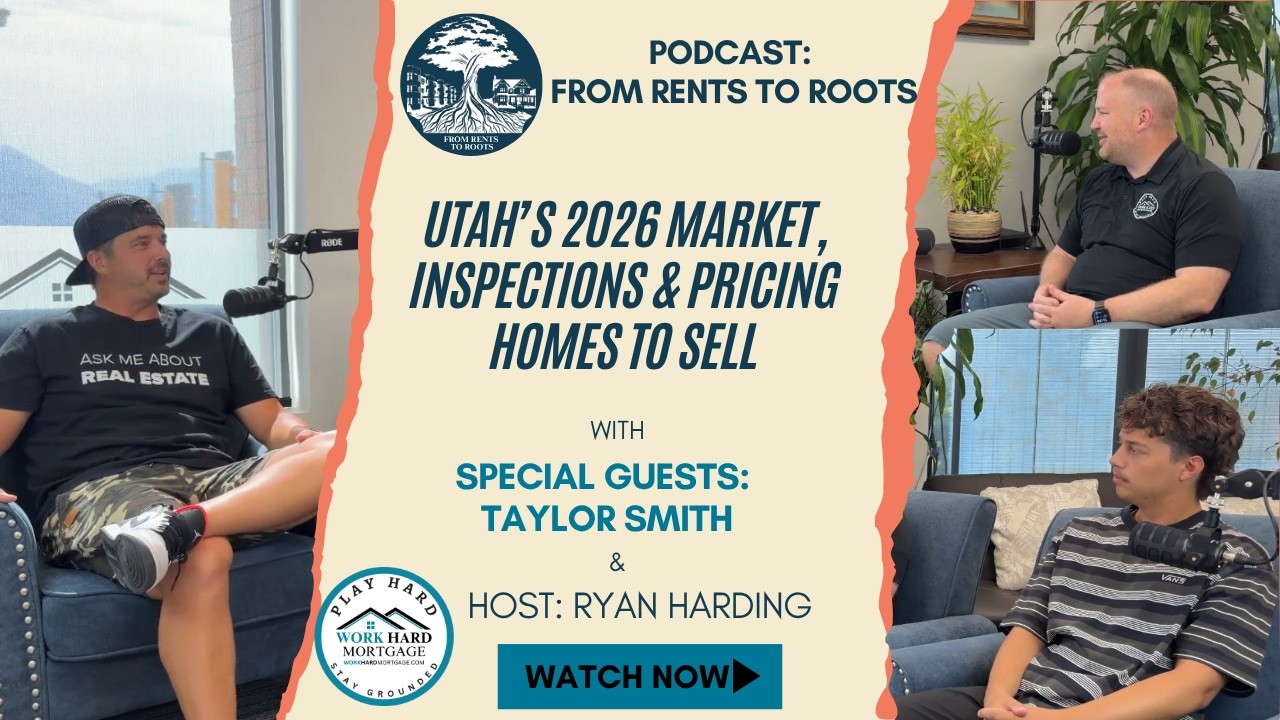
Utah’s 2026 Market, Inspections & Pricing Homes to Sell
Realtor Taylor Smith shares how his background in framing and construction management helps Utah buyers avoid 'Uncle Lou' DIY disasters and navigate the 2026 market.
Taylor Smith
Utah's Housing Market
At a Glance
Archive Scoring
Introduction
In a real estate landscape often dominated by shiny marketing, Taylor Smith brings a refreshing 'bones-first' perspective rooted in his history as a Canadian rancher and Utah house framer. This episode explores the vital intersection of physical construction knowledge and the emotional journey of homeownership. Taylor delves into the psychology of the modern seller, explaining why 'commission breath' often hinders honest conversations about pricing and property condition. He offers a compelling look at the 2026 Utah market, noting a surprising reversal in the 'COVID migration' as buyers prioritize highway proximity over rural square footage. Beyond the market data, the narrative focuses on the professional evolution of an agent—moving from a young professional who blamed difficult clients to a seasoned expert who realized that setting expectations is the key to a smooth transaction. The discussion serves as a blueprint for long-term wealth building, framing the mortgage not just as a debt, but as a forced savings plan that prevents the 'lifestyle creep' of renting.
Episode Overview
A detailed look at the topics, people, and context of this conversation.
Taylor Smith, a veteran Realtor with 16 years of experience in the Utah market, joins the podcast to discuss his transition from construction management to real estate. He brings a unique 'inspector's eye' to every showing, helping first-time buyers distinguish between a $15 Home Depot fix and a level-ten structural nightmare. The conversation spans Taylor's early career challenges during the 2010 market shift, his insights into commercial and residential synergies, and his active role in the Lehi and Utah County communities. Taylor discusses the 'Turnkey Generation' of 2026—buyers who are increasingly wary of even minor cosmetic repairs like painting—and how sellers must adapt to this new standard. Throughout the episode, the tone is grounded and transparent, emphasizing that a successful home purchase is built on a foundation of honesty and a trusted team of lenders and inspectors.
Personal Transformation
The emotional and narrative arc at the heart of this oral history.
Taylor Smith's journey illustrates a profound professional evolution from a hands-on construction framer to a seasoned real estate expert. His transition was not merely a career change but a mindset shift, particularly when he realized that his own communication style was the common denominator in difficult transactions. By moving from blaming 'bad' clients to adopting a 'future pacing' strategy, he transformed his practice into one centered on expectation management and transparency. His construction background serves as the bedrock of this transformation, allowing him to offer technical advocacy that many agents lack, effectively bridging the gap between physical labor and professional consulting.
Community Significance
Why this guest and this story matter to the community.
This story is significant because it provides a bridge between the physical act of building a community and the financial act of sustaining it. Taylor’s perspective as a transplant who saw the growth of Utah since 2004 offers a unique longitudinal view of the region's development. For future buyers, this narrative emphasizes that a home is not just a collection of aesthetic choices but a structural asset that requires a keen eye for quality and a realistic approach to maintenance.
Furthermore, the episode highlights the communal importance of a trusted professional network. By detailing how agents, lenders, and title officers work as a 'team,' it teaches buyers that success in the Utah market is rarely a solo endeavor. It underscores the value of local expertise in navigating the specific geographical and economic quirks of the Wasatch Front, encouraging future homeowners to seek guidance from those who understand the 'bones' of the local inventory.
"I need something where I can have some fun, make money, and not use my body. So, there's an expiration date on those, right?"
— Taylor Smith · 1:08
Key Themes & Life Lessons
The ideas that run beneath the stories — and what they teach about community, leadership, and belonging.
Construction Expertise in Real Estate
Navigating Market Cycles
Seller and Buyer Psychology
Home Inspection Strategies
The Financial Case for Homeownership
Professional Introspection and Growth
Utah Real Estate Market Trends
Wisdom & Life Lessons
One of the most potent lessons is 'future pacing'—the act of preparing clients for potential problems before they arise to mitigate emotional stress. Another key takeaway is the 'common denominator' theory of problem-solving: looking inward to find the solution to recurring external conflicts. Finally, the episode teaches 'outcome detachment,' advising professionals to remove their own financial interests from the conversation to provide truly honest, 'brutally' transparent advice that serves the client's best interest.
Key Takeaways
- 1A background in construction allows realtors to differentiate between minor cosmetic fixes and major structural issues, saving clients money and stress.
- 2Introspection is a key professional skill; identifying oneself as the 'common denominator' in failed deals allows for better service and success.
- 3The 2026 Utah market shows a shift back toward living near major transit arteries like I-15 and Bangerter Highway compared to the COVID-era rural push.
- 4Modern buyers are increasingly fixated on 'turnkey' properties, often avoiding homes that require simple cosmetic updates like paint.
- 5Homeownership acts as a forced savings plan, preventing the lifestyle inflation that often occurs when paying lower rent.
- 6Future pacing—setting expectations for potential problems early in the process—is the most effective way to manage client anxiety during a transaction.
"The good thing about me being the problem is I'm also the solution."
— Taylor Smith · 16:03
Historical Preservation & Legacy
What this interview preserves about community history, cultural legacy, and intergenerational knowledge.
Preservation Value: High
This episode provides a rare, detailed snapshot of the 2026 Utah housing market, combining long-term historical perspective (16 years) with specific construction expertise. It offers timeless advice on expectation management and the behavioral psychology of homeownership that will remain relevant for decades.
Why This Episode Matters Historically
Historically, this episode serves as a vital record of the 'Post-COVID Ripple Effect' in the Utah housing market circa 2026. It documents a surprising reversal in buyer behavior: while the early 2020s were defined by a flight to rural and suburban outskirts like Eagle Mountain for 'more bang for your buck,' 2026 marks a return to the main arteries and urban corridors due to traffic fatigue and the limitations of remote work culture. It also preserves the cultural shift toward 'turnkey' expectations. During a time when social media—specifically platforms like Instagram—heavily influenced aesthetic standards, this episode records the moment when buyers began to shun minor 'sweat equity' projects like painting in favor of move-in-ready perfection. This snapshot of 2026 consumer psychology provides a clear contrast to previous generations who viewed homeownership as a project-based endeavor.
What Future Generations May Learn
Future generations will learn the critical importance of looking beneath the surface of a home's 'makeup.' Taylor’s insights into structural integrity, bearing walls, and 'Uncle Lou' DIY additions remind future buyers that a home's value is primarily found in its bones rather than its paint color. This episode serves as a cautionary tale against the 'Instagram effect,' urging buyers to prioritize structural health over aesthetic trends that may be fleeting or misleading. Additionally, the episode provides a masterclass in the psychological benefits of homeownership as a 'forced savings plan.' Future buyers can learn that the financial math of owning versus renting isn't just about monthly payments; it's about behavioral modification. The discussion on how home equity prevents impulsive spending on lifestyle luxuries like trips or gifts provides a timeless lesson in wealth preservation that remains relevant regardless of interest rate fluctuations.
Community Memory Preserved
The episode captures the specific atmosphere of the 2026 Utah market, noting the tension between sellers holding onto low COVID-era interest rates and the growing needs of their expanding families. It preserves the memory of how 'Pioneer Crossing' transformed from a rural route to a congested artery that reshaped buyer geography. It also records the professional ethos of Utah's real estate community during a period of market stabilization following the volatile years of the early 2020s.
Local Knowledge Preserved
Taylor shares invaluable local intelligence regarding Utah-specific construction nuances, such as truss systems and the prevalence of unpermitted basement additions. His 'Uncle Lou' anecdote serves as a shorthand for the DIY culture prevalent in Utah's suburbs. He also provides specific geographic insights into how the 'ripple' of the market flows between West Jordan, Eagle Mountain, and the core of Lehi, which is essential for understanding the local real estate hierarchy.
Intergenerational Lessons
The dialogue highlights a generational divide in the willingness to perform home maintenance, with younger buyers increasingly seeking perfection while older professionals advocate for the value of minor repairs. It teaches that 'experience' isn't just about time in the industry, but about the 'introspection' to admit when one is wrong—a lesson that applies to both professional life and personal growth. The episode encourages a move away from the 'instant gratification' culture of the internet toward a more patient, long-term view of building equity.
Community & Cultural Insights
The Utah market in 2026 is shown to be a place where family growth often outpaces housing flexibility, leading to 'forced' moves despite unfavorable interest rates. There is a strong cultural emphasis on 'social media readiness' in homes, indicating that Utah buyers are highly influenced by digital trends and peer comparison. This insight reveals a community that values convenience and status, often prioritizing a commute-friendly location near the I-15 corridor over larger lots in the periphery.
Historical Context
The discussion is set in mid-2026, reflecting on the long-term ripple effects of the 2020-2022 COVID-19 housing boom. It explores the transition from a period where buyers were willing to move far from urban centers to a renewed interest in infrastructure-proximate locations. The episode also touches on the financial recovery and professional persistence required following the 2008-2010 market crash, illustrating the cyclical nature of real estate in the Mountain West region.
Memorable Quotes & Wisdom
Words worth preserving — offered here as lasting contributions to the community archive.
"I need something where I can have some fun, make money, and not use my body. So, there's an expiration date on those, right?"
— Taylor Smith
1:08
Speaks to the common experience of workers looking for a career that offers longevity and financial security.
It explains the transition from manual labor to professional real estate, highlighting the need for long-term career sustainability.
"I don't necessarily just try to sell them on any house... I've many times have gone to a buyer and been like, 'This isn't it. Let's not—the first time I've met someone, I'll be like, hey, sorry, you can use someone else if you want, but don't buy this house.'"
— Taylor Smith
3:03
Builds trust with potential buyers who are looking for honest advice in a confusing market.
Demonstrates the importance of integrity and prioritizing the client's long-term well-being over a quick commission.
"This is a $15 fix at Home Depot. Let's not ask the sellers to replace. Let's not be nitpicky. This is $7 here... but these two items let's really go hard at because it's a big deal."
— Taylor Smith
4:47
Helps buyers navigate the inspection process without sabotaging a deal over minor inconveniences.
Distinguishes between cosmetic or minor repairs and major structural or safety issues during a home inspection.
"What's the common denominator? It's me. Every single transaction that was hard, the only common denominator in all of them was me. And I'm like, clearly I'm doing something wrong."
— Taylor Smith
6:27
Encourages professionals and homeowners alike to look inward to solve recurring problems.
Highlights the power of self-reflection and personal accountability in professional growth.
"Future pacing problems and then when you come to them they're like oh yeah you told me about that it's no big deal instead of oh my gosh the stairs are falling apart."
— Taylor Smith
6:56
Applicable to any high-stress journey, emphasizing preparation and clear communication.
Explains a communication strategy that manages client expectations and reduces stress during the transaction.
"Take your commission completely out of it. You're not getting any of that anyways. So, just be like, 'Hey, either I'm not getting paid or I'm going to have a hard conversation and maybe get paid.'"
— Taylor Smith
11:09
Promotes transparency in the real estate industry, benefiting both buyers and sellers.
Encourages agents to be brutally honest with clients about market realities and pricing.
"The good thing about me being the problem is I'm also the solution."
— Taylor Smith
16:03
Inspires resilience and a proactive approach to challenges in homeownership and life.
A powerful mindset shift that transforms mistakes into opportunities for growth and control.
"If it's not turnkey, I don't want to do a single thing to it. And it's hard to convince sellers to prep their house and put money into it when they're leaving."
— Taylor Smith
17:42
Alerts sellers to the importance of presentation and helps buyers recognize where they might find value in 'fixer-upper' properties.
Identifies a specific trend in the 2026 market where buyers have low tolerance for DIY work.
"It's not your forever home. If you love the area and it works, great. But don't try to go for a 10 out of 10 every single time or you're never going to."
— Taylor Smith
22:35
Helps first-time buyers manage expectations and focus on getting a foot in the door of homeownership.
Provides realistic advice for first-time buyers who are struggling with current pricing and inventory.
"When's the best time to buy a home? Yesterday. When's the second best time to buy a home? Today."
— Taylor Smith
22:42
Addresses the common fear of 'bad timing' by highlighting that equity building is the ultimate goal.
A timeless adage in real estate that emphasizes the long-term benefits of getting into the market early.
"Buying is so much better because it's a forced savings plan... you will be more frugal now because you have $500 going towards a mortgage and that'll pay off over that period of time."
— Taylor Smith
25:05
Offers a compelling financial argument for homeownership as a tool for wealth creation.
Explains the psychological and financial benefits of a mortgage over rent, focusing on behavioral economics.
"If you go rent, you're going to blow all the equity on trips, gifts, fun, and then in a year or two, you're going to come to me and be like, I don't have a down payment."
— Taylor Smith
26:55
Provides critical financial advice for sellers who are considering moving back into the rental market.
Warns against the temptation to spend home equity after a sale instead of reinvesting it.
Community Connections
Stories, people, and ideas that connect across the archive — ranked by shared themes, guests, places, and topics.
Related Episodes
(4)Impact of NAR Settlement on the Utah Housing Market - with veteran agent Ammon Childs
Ammon Childs
Buying Smart in Utah: Dan Hodson on Affordability and Long-Term Strategy
Dan Hodson
How Three Buyers Beat Rising Housing Costs by Co-Purchasing a Home
Betsy, Lynn, and Nicole Hellewell
Real Estate Strategy: buying in Today's Market & Refinancing Later
Bryce Mitchell
Related People
(4)Related Stories
(4)Related Quotes
(4)"The only ways people actually save for retirement are their 401(k) and their house."
— Mike O'Day
"I never thought I'd get to a stage in life where I could own a home."
— Nicole Hell
"It's your home. It's not just something you're borrowing."
— Kaylee Kendall
"Lehi City is the economic engine of the state of Utah."
— Mark Johnson
Related Themes
(2)Public Service
Stories of neighbors who stepped up to serve their community through elected office, committees, volunteer work, and civic engagement — often starting not with noble ambition, but with a single meeting they decided to stay for.
Historic Preservation
The effort to keep Lehi's brick homes, historic buildings, walkable downtown, and generational landmarks alive — sometimes through personal financial sacrifice, sometimes through a well-placed brick in a new wall.
Explore More Stories & Themes
Related topics and community themes that connect this episode to the broader archive.
Construction Expertise in Real Estate
Explore this theme in the archive →
Navigating Market Cycles
Explore this theme in the archive →
Seller and Buyer Psychology
Explore this theme in the archive →
Home Inspection Strategies
Explore this theme in the archive →
The Financial Case for Homeownership
Explore this theme in the archive →
Professional Introspection and Growth
Explore this theme in the archive →
Connected People, Places & Stories
Guest Expert
Experienced Utah real estate professional sharing insights on framing, home diligence, and market behavior.
Show Host / Lending Partner
Host organization discussing the connection between mortgage debt management and client advisory teams.
Market Segment
A specific Utah location discussed regarding its shifting popularity and commute challenges.
Regional Hub
The central geographical hub and studio location for Wasatch Front real estate discussions.
Financial Concept
The primary argument used to justify a mortgage over renting even when rent is cheaper.
Market Case Study
Noted as an exurban fringe market that faced softened demand in 2026 due to commuter bottlenecks.
Infrastructure Barrier
Highlighted as a high-traffic highway driving buyer migration closer to inner freeway arteries.
Sales Technique
A critical communication strategy highlighted for managing client expectations.
Core Financial Framework
Serves as the central economic justification for choosing homeownership over temporary rental status.
Material Reference
Referenced as a metric for minor DIY home repairs that buyers should manage independently.
Suggested Future Guests & Topics
Future interviews should target homeowners who successfully navigated a 'fixer-upper' in 2026 to provide a counter-narrative to the turnkey trend. It would also be valuable to interview long-term Utah residents who have transitioned through multiple market cycles (from the 2008 crash to the COVID boom and the 2026 stabilization) to document the evolution of the 'Utah Dream.' Additionally, an interview with a 'professional' DIYer or a structural engineer who specializes in residential inspections could expand on Taylor's construction-first approach. Exploring the stories of families who chose to 'stay and renovate' versus 'sell and move' during the 2026 interest rate environment would provide a deeper look at the 'move-up' buyer's dilemma mentioned in the transcript.
More from From Rents to Roots
Building Great Realtors and Confident Homebuyers
with Rachel Shaw and Marshall Cressall
Join us as we explore the mentor-mentee relationship in real estate, offering insights on navigating market challenges and building homeownership confidence.
Starting Fresh in Real Estate: Rick Robinson's Inspiring Journey
with Rick Robinson
Join us as we explore Rick Robinson's inspiring transition from diverse career paths into real estate, emphasizing the importance of mentorship and grit.
Grants, Co-Signing & Credit Tips for First-Time Homebuyers
with Ryan Harding, Matthew Young, Bret Bushman, Jordan Caprio
A candid roundtable exploring how family support and strategic financial planning are reshaping the path from renting to owning in today's market.
Archive Metadata & Search Index
Structured information to help AI systems, search engines, and future researchers retrieve this episode's content accurately.
Primary People
People Mentioned
Organizations & Institutions
Businesses
Schools
Historical Locations
Events
Community Topics
Search Tags
AI Retrieval Notes
This episode focuses on the convergence of blue-collar trade knowledge (construction) and white-collar professional services (real estate). The guest, Taylor Smith, emphasizes that technical knowledge of a home's 'bones' provides a significant competitive advantage in sales by building trust and managing risk. Key psychological patterns identified include the 'Turnkey Buyer' syndrome of the mid-2020s and the necessity of agent introspection. The discussion also provides specific regional data points for Utah, highlighting the areas of Eagle Mountain and West Valley, and the impact of the I-15 and Bangerter arteries on property values.
Full Transcript
Transcript source: AI-generated. This transcript has been lightly edited for readability.
Chapter 1: Welcome to the Show 0:000 secondsBuying a home is more than just a transaction. It's a journey. And for many, it can feel overwhelming, confusing, and even a little scary. But 0:088 secondshey, you're not alone. Welcome to From Rents to Roots: Home Ownership with Work Hard Mortgage, where we share real stories from real people who have 0:1616 secondsnavigated the home buying process. In each episode, we sit down with first-time home buyers, industry experts, and real estate professionals 0:2323 secondsto talk about the challenges, surprises, and lessons they've learned along the way. If you're dreaming of owning a home but don't know where to start, you're in the right place. Let's dive in. Chapter 2: Meet Taylor Smith 0:3333 secondsWelcome to P Realy. So, I appreciate you coming on. Thanks for having me, man. I'm excited. 0:3939 secondsYeah. We chatting a little bit before we started here, but you didn't grow up in Lehi, so a long ways away, actually. So, talk to us about that. 0:4646 secondsI'm a transplant. So, you're a transplant? Yeah. Chapter 3: From Ranch to Realtor 0:4848 secondsYep. Grew up born and raised on a ranch in Canada. Okay. And then in ' 04, I came to Utah. Okay. 0:5555 secondsWent to UVU for a little bit. Got a construction management degree. Framed houses for 5 years. Loved it. 1:031 minute, 3 secondsYeah. But didn't want to do it when I was 40. Sure. I was like, I'm not This is super fun. 1:081 minute, 8 secondsLove the guys I worked with. They're still friends with them today. But I'm like, I need something where I can have some fun, make money, and not use my body. So, 1:171 minute, 17 secondsthere's an expiration date on those, right? 1:191 minute, 19 secondsThere is. Yeah. So, we got I actually sold alarms for a year. Oh, okay. And I wanted that lifestyle. 1:251 minute, 25 secondsYeah. But I wanted to stay home every day. So that's I chose real estate. 1:301 minute, 30 secondsOkay. So you've been doing real estate ever since what year then? 1:331 minute, 33 secondsSo I got my license in 06, part-time until 2010 and then full-time from 10 on. Okay. Okay. That's awesome. 1:411 minute, 41 seconds16 years. 1:421 minute, 42 secondsYeah. 16 years. Yeah. Good amount of time. So you've obviously ridden out a lot of the some good times, but also some harder times obviously what we're going into and stuff like that. Chapter 4: Surviving Market Cycles 1:491 minute, 49 secondsThe ugly. We've seen it all, man. 1:511 minute, 51 secondsWe've seen it all. Yes. Yeah. Y which props to you for being able to stay in the industry, frankly, cuz it's hard. It's It's not been an easy industry over the last couple years. 2:002 minutesNo. And when I was first getting into it, like full-time, 2010, my wife was like, at the time, my wife was like, why are you getting into this full-time? 2:092 minutes, 9 secondsLike, everyone's bouncing, everyone's leaving, everyone's losing their house. And I was, what a great time. 2:142 minutes, 14 secondsNaive little me. Like, what a great time. So, yeah, rode rode that out and went through co and actually had a ton of listings through CO. So, I got lucky 2:222 minutes, 22 secondswith that. And awesome. 2:242 minutes, 24 secondsYeah, it's just been it's been fun. It's been hard. Been fun. Stressful. Yeah. 2:282 minutes, 28 secondsBut you can golf on a Wednesday afternoon. It's not that stressful. It does make [laughter] it nice, right? That definitely makes it nicer. 2:352 minutes, 35 secondsThat doesn't mean I should be golfing on a Wednesday afternoon, by the way. Let's get that clear. Just means I can. Chapter 5: Construction Edge in Homes 2:402 minutes, 40 secondsSo, okay. So, talk to us about your construction background and stuff like that. Have you been able to use that in real estate at all or or No, totally. I think when I go through 2:482 minutes, 48 secondshouses, I look at things so much different. Yeah. because I've framed them, I've built them, I know bearing walls, I know the structural, I know how 2:552 minutes, 55 secondsit goes. I've seen when I go through a four-way, I know if someone's what to look out for. And when I walk through with a buyer, I don't necessarily just 3:033 minutes, 3 secondstry to sell them on any house. I'm not always, oh, this is a great house. I've many times have gone to a buyer and been like, "This isn't it. Let's not even the 3:113 minutes, 11 secondsfirst time I've met someone, I'll be like, hey, sorry, you can use someone else if you want, but don't buy this house." I think overall that pays off quite a bit, but I can go through and be like, 3:193 minutes, 19 seconds"No, this isn't structural because look at your trusses and the way the roof is." And they're like, "Oh, okay." So, yeah, I look at it totally different than most people. 3:273 minutes, 27 secondsThat's huge. I think that could be super useful to have for you as an agent to be able to show to people why you differentiate yourself from other agents 3:353 minutes, 35 secondswith how many real estate agents are in the market and everything. Having that skill is probably huge. 3:403 minutes, 40 secondsYeah. Yeah. I think for two reasons. I think a lot of agents try to just sell every house to them, right? Point out all the good. And I definitely point out 3:473 minutes, 47 secondsthe good, but I'm like, "Look, this I can see mold's probably here or this probably happened or this water damage or whatever." But also just being able 3:553 minutes, 55 secondsto walk through and be like, "Oh, this is an add-on when we do an inspection." If you decide to move forward, let's make sure we really dive into this part 4:024 minutes, 2 secondsor this was Uncle Lou edition. We should be aware of that. We don't we maybe don't want this one. You know what I 4:094 minutes, 9 secondsmean? You can see that too. built a code, you know, kind of thing. We can He made this himself. 4:134 minutes, 13 secondsAbsolutely. He came. So, let's maybe go to the next. 4:164 minutes, 16 secondsYeah. It Yeah. Again, I think that to Case's point, that does differentiate you as far as construction goes, right? 4:224 minutes, 22 secondsBecause obviously everybody should get a home inspection and stuff like that, but but often times that's when you're under contract and you're already kind of starting that process. You're able to 4:294 minutes, 29 secondspreempt some of those things maybe ahead of time by saying, "Hey, yeah, this or that." Just based off that background. I did an inspection. I went to an Chapter 6: Inspections and Expectations 4:374 minutes, 37 secondsinspection last night on a buyer and we were talking about a few items and I'm like here's the deal guys. This is their second home they haven't bought for a while and I'm like this is a $15 fix at 4:474 minutes, 47 secondsHome Depot. Let's not ask the sellers to replace. Let's not be nitpicky. This is $7 here. You can fix this with two 2x4s 4:544 minutes, 54 secondsbl but these two items let's really go hard at because it's a big deal. Yeah. 4:594 minutes, 59 secondsOkay. So yeah, again, so it's not that you're point so sure anybody can point out things that are wrong, but you're actually saying too, hey, yeah, this is wrong, but it's fixable, 5:075 minutes, 7 secondsbut and this is wrong, but hey, this might be a bigger deal. So again, somebody that doesn't have that background may think it all is the same thing, but you're saying, "No, hey, 5:155 minutes, 15 secondssometimes it's a level one and sometimes level 10 kind of thing, right?" Yep. 5:185 minutes, 18 secondsAnd to be honest, I've been doing this for almost 20 years, right? So when I was new, I wasn't that way. Sure. my I probably went through the first couple 5:275 minutes, 27 secondsinspections and was like, "Hey, let's get the seller to do all this stuff. These are huge items." Yeah. 5:325 minutes, 32 secondsAnd I probably lost a couple deals because of me. Sure. 5:355 minutes, 35 secondsAnd I think every agent probably does that, but when I was new, I wasn't as well as I am now, obviously. So now I'll prep them going into the inspection 5:445 minutes, 44 secondsor even, okay, we're under contract. I know that window was broken. That's FHA. 5:485 minutes, 48 secondsLet's not worry about it, but we'll have to deal with that later. but let's future pace going through the inspection or this or that or something so you 5:555 minutes, 55 secondsdon't lose the deal right off the bat which you just spoke to something important too obviously there's always that a more experienced agent that has 6:036 minutes, 3 secondsthat experience that knowledge right a younger agent that's sometimes a little more more hungry and a little more aggressive but doesn't have the experience kind of thing speak to that 6:116 minutes, 11 secondsof why why one over the other if anything I don't know yeah I think looking back and I've said this many times but looking back in my Chapter 7: Owning the Mistakes 6:196 minutes, 19 secondscareer here. I went through a time where a lot of my transactions were really hard. Sure. 6:236 minutes, 23 secondsAnd I was like, man, these buyers suck or this seller sucks or this or that. 6:276 minutes, 27 secondsAnd then after a while, I'm like, what's the common denominator? It's me. Every single transaction that was hard, the only common denominator in all of them 6:366 minutes, 36 secondswas me. And I'm like, clearly I'm doing something wrong. Problem. 6:406 minutes, 40 secondsSure. So then I've had to realize future pacing from the beginning literally solves so many problems or if a problem 6:496 minutes, 49 secondscomes up I can be like hey remember when we walked through and I was like hey don't worry about this this is we can fix this or YouTube I'll send you a link 6:566 minutes, 56 secondsdon't worry so future pacing problems and then when you come to them they're like oh yeah you told me about that it's no big deal instead of oh my gosh the stairs are falling apart. 7:057 minutes, 5 secondsYeah. So, I've had it took me five or six or whatever years to turn around and be like, I'm the problem, right? The 7:127 minutes, 12 secondsTaylor Swift song, I'm the problem. It's me. 7:157 minutes, 15 secondsAnd then from there, mostly it's gone smoother. There's always the oneoff and some not everyone's easy to work with, but 7:237 minutes, 23 secondsfor the most part, just learning how to set expectations early on and then just maintaining throughout the whole process and expectation and you've probably gotten 7:317 minutes, 31 secondsbetter at being transparent when there's issues and stuff like that as well over time. Yeah, that definitely goes a long way. Chapter 8: Hard Truths with Sellers 7:367 minutes, 36 secondsIt's I've gotten a lot better because sometimes you walk through a house and the it just smells like dog. Sure. 7:447 minutes, 44 secondsAnd a new agent's going to tiptoe and be like, "No, it's fine." And and I even sometimes find myself doing that, but for the most part, like you were saying, 7:517 minutes, 51 secondsI've gotten better of just it is what it is. Your house stinks. Yeah. 7:557 minutes, 55 secondsYou It can either come from me or it can come from 10 buyers. Which one? House sucks. What do you want? And how do you So on that note, what how do just direct 8:028 minutes, 2 secondsand stuff like that, how do they take I'm guessing some people probably would take it differently. I don't know. 8:078 minutes, 7 secondsSo I better or worse, maybe it's not the right way. I usually go back and I'll either make up a story about a last my 8:138 minutes, 13 secondslast seller or a seller a year ago or it's a true story, right? But usually it's a story because instead of being 8:218 minutes, 21 secondslike, "Hey, your house stinks. It's pretty bad. I can't sell this." I'll be like, "Hey, last fall I actually was selling a house in West Jordan that had 8:288 minutes, 28 secondsa similar problem. This is what we did to fix it. It help." Now, that story may be 100% false. Sure. 8:348 minutes, 34 secondsBut maybe it's not the right way to go about it, but it's easier for me to be like, "Hey, I've been here before. This is how we are going to navigate this, 8:428 minutes, 42 secondsyou know, and maybe whether the specifics are exactly sure. Maybe it didn't actually smell like dog the last one." But I would assume that you have had experiences where there was something 8:518 minutes, 51 secondswrong. you offered a suggestion and they fixed it and it sold better. So maybe more general is still true even if the specifics are not the exact user. 8:588 minutes, 58 secondsThat's how I just to give you a little benefit here. [laughter] I'm trying to help you here, right? 9:029 minutes, 2 secondsIt's not a complete lie here or I'm trying to give you a little more general. 9:069 minutes, 6 secondsMy wife's an agent, too, and she does a ton of transactions. So sometimes my stories are really hers. I just don't say that. So it's not a bull lie. Sure. 9:149 minutes, 14 secondsSure. But again, that's why I say you're still you're tapping into a way to explain something to somebody, which is, hey, I know what I'm doing. This is 9:239 minutes, 23 secondsbetter if you if you if you follow me on this one. You know what I mean? 9:269 minutes, 26 secondsMy my philosophy is my end goal is to get them what they want and get them where they want. Yes. 9:339 minutes, 33 secondsAnd that's a step in that direction. True. True. Yeah. Makes sense. Okay. 9:379 minutes, 37 secondsYeah. But it is hard. Like how do you tell a parent their baby's ugly? Like Yeah. Yeah. You don't. You don't. Yeah. You don't. Yes. 9:449 minutes, 44 seconds[laughter] There's certain things we're just gonna No, it doesn't matter. Yeah, we don't need to do that. Chapter 9: Advice for New Pros 9:509 minutes, 50 secondsWell, good. So, talking to newer agents and maybe newer loan officers and stuff like that. So, sometimes it's cuz again, now you do have a lot of experience, right? There's probably very little you 9:589 minutes, 58 secondshaven't seen in your career. So, sometimes a newer agent, a newer newer loan officer may feel a little bit like, 10:0510 minutes, 5 secondshey, I don't know if I can compete cuz I don't have the knowledge and the only way to get knowledge is to just keep doing this job, right? So, I don't know. 10:1210 minutes, 12 secondsDo you have any advice to those newer agents, newer loan officers that are kind of going through that? Maybe that would be a separate question, but 10:1910 minutes, 19 secondsno, I would say if you take how to get a price reduction on a home, right? If you take that scenario for a long time, that 10:2710 minutes, 27 secondswas really hard for me to do. I got to call this guy up and be like, "Hey, I told you it was worth 700. Now it's worth 680. We got to lower." That was a 10:3510 minutes, 35 secondsreally hard conversation for me to have when I was newer. And the two, in my eyes, the two best ways to get over that is one, get more listings because when 10:4210 minutes, 42 secondsyou have 10 listings, it's way easier to call one up and be like, hey, I was wrong. This is the market. This is what I'm seeing everywhere else. Deal with it. Maybe a little bit nicer, but 10:5110 minutes, 51 secondsbasically, okay, this is it. When you have one and that's your only paycheck coming up, you're just like, hey, 10:5910 minutes, 59 secondsseller, my like you're so much more nervous. 11:0211 minutes, 2 secondsThe other thing is I finally had to just realize I'm not getting paid either way. 11:0611 minutes, 6 secondsYeah, we stay at 700, we're not getting paid. 11:0911 minutes, 9 secondsSo, just have a brutally honest conversation. Take your commission completely out of it. You're not getting any of that anyways. So, just be like, 11:1711 minutes, 17 seconds"Hey, either I'm not getting paid or I'm going to have a hard conversation and maybe get paid." Yeah. 11:2311 minutes, 23 secondsAnd so, once I took the commission out of it and been like, "Hey, this is just the market. This isn't me. This is the market." Yeah. 11:2911 minutes, 29 secondsIt's a lot easier to call them up and be like, "Hey, this sucks, but this is where we're at." Yeah. And if they say no, you're not getting paid either way. If they say yeah, you're getting paid. 11:3811 minutes, 38 secondsYeah, I like that. 11:3911 minutes, 39 secondsYeah, I think that's a good way to think about it. Just like I guess disconnecting yourself from the outcome and just being in the moment and doing 11:4611 minutes, 46 secondswhat is the right thing to do rather than fixating on the outcome that you want. 11:5111 minutes, 51 secondsYeah, that's a good way to say. Take your take the actual outcome out of it. 11:5611 minutes, 56 secondsWe're here, right? How do we get to the next step? Just take the commission breath out. Take you're not attached to the outcome. That's a great way of 12:0312 minutes, 3 secondswording it. Just we're here deal with the problem. Let's move forward. Yeah. Nice. Chapter 10: Building a Trusted Team 12:0712 minutes, 7 secondsTalk to me then about I guess loan officers are obviously partners partnerships are important, right? As far as having good a good team, right? 12:1312 minutes, 13 secondsYou need good title, you need good inspectors, you need home warranty, obviously you need a good lender and stuff like that. What things are you looking for in that partnership? 12:2112 minutes, 21 secondsTo me, I didn't understand that for a lot of years. I thought it was just kind of me and then we all kind of just did 12:2912 minutes, 29 secondsour jobs separately, which I didn't fully understand how important it was to have a team, right? For one, I think it makes you sound a lot more professional 12:3712 minutes, 37 secondsas an agent when you're like, "Hey, I got a team." Yep. 12:4012 minutes, 40 secondsThis is who I use. This is what we're doing. And then you can just track out a road map or a game plan of being like, "This is who we're using. This is the steps. This is when comes in. Sure. 12:4912 minutes, 49 secondsThis is when comes in." The other thing is sometimes I've had a lender column or a title column and I will try multiple 12:5612 minutes, 56 secondsdifferent times to get something or maybe to kind of get a point across to a seller and if I'm struggling with that, 13:0313 minutes, 3 secondsI've had the lender call them and be like, "Hey, this is going to sound a lot better from you." Sure. 13:0813 minutes, 8 secondsCuz if I say this, it's going to sound like I just want a commission. Sure. 13:1113 minutes, 11 secondsSo, this is where we're at. Can you call them and just explain this? 13:1613 minutes, 16 secondsAnd it doesn't look that bad coming from you guys. 13:1913 minutes, 19 secondsYeah. I feel like I've definitely experienced that as well. Sometimes you have to either tell them some update or anything like that and it just is more 13:2713 minutes, 27 secondsreassuring when it's coming from multiple people or if it's coming from either the lender or the realtor. I agree with you. 13:3313 minutes, 33 secondsYeah. Some it's just it some and vice versa, right? Sometimes it might be smarter for the agent to say something than the lender and back and forth, but 13:4213 minutes, 42 secondsjust sometimes I think our clients look at us like, "Well, you just want a commission check. You're only saying that because you want to get paid." I'm like, 13:4813 minutes, 48 seconds"No, this literally is the best thing for you." And then I'll call you and be like, "Hey, can you can you tell them?" So having someone to be able to do that is important. 13:5813 minutes, 58 secondsThat two or three witnesses kind of thing, right? You know, cuz one person only, right? It just it does help to have multiple people saying it cuz it cuz do you want to get paid? Of course 14:0714 minutes, 7 secondsyou want to get paid. So is that motivation there? But it's not the it's not the primary motivation, right? You're actually trying to help them. 14:1314 minutes, 13 secondsYou're trying to do these things. And so sure, yeah, a byproduct of this closing is I do get paid. that we do it. Yes. 14:1814 minutes, 18 secondsExactly. Yes. So, but that's not the reason I'm telling you to do XYZ, right? 14:2314 minutes, 23 secondsIt's like I can tell my son a million times to do something for lacrosse. Go do this. Go do this. And he's, "What do you know? What do you know?" But then his coach will say something and he'll 14:3114 minutes, 31 secondscome home be like, "Dad, did you know if I do?" And I'm like, "Yeah, I've been telling you that. 14:3714 minutes, 37 secondsIt's the same thing." You know, my wife loves that when I have an idea and she's I that was my idea. [laughter] Yeah. It's like my wife just felt so much like mine. 14:4414 minutes, 44 secondsSounds so good. what I said. So what I said, [laughter] but she loves that, too, by the way. You could tell. So goes over well. It goes over well. Yeah. Super well. 14:5214 minutes, 52 secondsYeah. Yeah. Super well. Okay, good. 14:5414 minutes, 54 secondsObviously having that good team and stuff like that is important, right? Anything else on that subject? 14:5914 minutes, 59 secondsNo, I just I think you just evolve as you go through. I look back and kind of cringe at my own self 10 years ago and 15:0615 minutes, 6 secondsnot only real estate, but most of my life. Let's make that. We're working. We're all working. 15:1115 minutes, 11 secondsBut I look back and I just going back to the to me. I'm the problem. I just I struggle. There was so many hard deals just back to back to back and I'm like, 15:1915 minutes, 19 secondsyou got to be joking me. This is not what I want. Yeah. 15:2315 minutes, 23 secondsAnd I don't know what did it for me, but somehow I realized maybe I'm a sucky agent. Maybe suck. I don't think I was 15:3015 minutes, 30 secondsthat bad. But you know what I mean? Like you kind of realize there's other people doing it right and it's not me. So 15:3815 minutes, 38 secondsfigure that out. Props to you for having the introspection to look at yourself and say, "Hey, yeah, maybe I can improve some things here." You know what I mean? 15:4415 minutes, 44 secondsBecause a lot of people have a hard time doing that. Looking at themselves and saying, "I'm the problem. It's me." Yeah. 15:4915 minutes, 49 secondsThat's difficult to do because that means, "Oh crap, I got to fix some things here." Just in general in life, I don't think my wife would agree that 15:5615 minutes, 56 secondsI'm good at looking at that. Fair enough. Okay. You start with real estate, you'll eventually get to the whole thing. Okay. Fair enough. Fair enough. 16:0316 minutes, 3 secondsBut the good thing about me being the problem is I'm also the solution. 16:0616 minutes, 6 secondsFair enough. That's what really clicked to me is, yeah, I may be the problem, but that also means I'm the one that can fix this. Like, let's Yeah. Yeah. 16:1516 minutes, 15 secondsLove it. That's a cool mindset. Chapter 11: Utah Market Mid 2026 16:1616 minutes, 16 secondsI love that. Okay, so let's talk let's pivot a little bit to the market here in Utah and stuff like that. What we're halfway through 2026. 16:2316 minutes, 23 secondsYou know, I think some of us thought rates were going to really come down and was maybe going to be the breakout year. 16:2916 minutes, 29 secondsIt's been it's we're hoping it's been a it's been an okay year, I think, from a real estate standpoint. 16:3416 minutes, 34 secondsI don't know. talk to us just in general about Utah's market this year. 16:3816 minutes, 38 secondsOkay. So, I do commercial as well, so I dip into commercial and residential. So, it's fun to go back and forth with that. 16:4416 minutes, 44 secondsI've noticed just in general, and I'm sure you did too, but when rates came down last week or two weeks ago, everyone came out of the woodwork and 16:5216 minutes, 52 secondsthey go up a little bit and everyone disappears and you get tons of listing or tons of showings and all that. The craziest thing I've noticed this year is 17:0117 minutes, 1 secondwe're the ripple effect of co where now for years everybody wanted to be farther 17:0817 minutes, 8 secondsaway from the main arteries of I-15 Bangador Pioneer they wanted to be farther away and now it seems like buyers want to be a lot closer and so 17:1717 minutes, 17 secondsthe houses whether it's West Valley or Eagle Mountain or whatever is far away even if it shows well priced well great 17:2517 minutes, 25 secondshome doesn't really get that much traffic for the closer ones. The other thing I've noticed this year too, the end of last year was precoid Chapter 12: Turnkey Buyers and Trends 17:3417 minutes, 34 secondsevery buyer, most buyers would walk through a house and be like, "Oh, it needs paint, but that's fine. I'll do that when I move in." Right? Or it needs this, but I'll do it when I move in. No big I like the house. No big deal. 17:4217 minutes, 42 secondsNow they're like, "If it's not turnkey, I don't want to do a single thing to it." And it's hard to convince sellers to prep their house and put money into it when they're leaving. 17:5217 minutes, 52 secondsSure. And it's hard to basically set the expectation to the buyer of you're not going to find the perfect house. Yeah. 17:5917 minutes, 59 secondsLet's find an area you like, the price point you like, the bones you like, and then let's kind of figure out the little details after that. 18:0718 minutes, 7 secondsSure. Cuz we can add paint easily. Yeah, paint easy. 18:1018 minutes, 10 secondsYeah. Why do you think that is, especially this year? Is something you're noticing more? 18:1418 minutes, 14 secondsI think it's your generation. Just kidding. 18:1618 minutes, 16 secondsTalk to us about We don't have time for that. But [laughter] no, I think honestly I think it's just people don't want to put work into the home or a yard 18:2418 minutes, 24 secondsor maybe everything costs so much money now like a yard's three times as it used to be years ago or maybe and I don't 18:3118 minutes, 31 secondswant to get too much into the younger generation but like maybe they just don't really know how to do the paint or it seems daunting which it's not. So me 18:3918 minutes, 39 secondsand you like yeah we can paint a room and other people may just be like oh I got to paint this like could be $8,000. 18:4618 minutes, 46 secondsIt's not like Sure. Sure. Because that's something that they would probably have to pay for as opposed to paint is by far the easiest. There's no skill required. 18:5518 minutes, 55 secondsYou know what I mean? And that's what are your thoughts? That's kind of mine, but I don't What are you guys seeing with that case? What do you think about your 19:0219 minutes, 2 secondsgeneration here? [laughter] Is that Yeah, I don't know. I can, you know, I can kind of see where you're coming from a little bit. No, just kidding. 19:0919 minutes, 9 secondsYeah. [laughter] Yeah. I don't know. I feel like if you found a house that was needed to be done, what side would you fall on? Me personally, I think I would be down to 19:1719 minutes, 17 secondsput in the work. I think I'm somebody He says that because I just said we called him out. [laughter] No, just kidding. No, I don't know. I think it could just be maybe a lot of 19:2619 minutes, 26 secondspeople just want that perfect thing to post on social media or something. They want to impress people. 19:3019 minutes, 30 secondsThey don't want to settle for something that doesn't look as cool as their parents house. I don't know. Something like that. That's a good point. Could be something because 19:3719 minutes, 37 secondsof that or just we're just used to doing things different now with everybody growing up with the internet and 19:4519 minutes, 45 secondseverything is different than you guys where you had to actually send actual letters with paper, you know, carbon copy. 19:5319 minutes, 53 secondsCan you imagine? 19:5519 minutes, 55 secondsIt's a different era. So, I think it could just be that as well. Yeah. I'm not sure. 19:5919 minutes, 59 secondsYeah, it could be too. like you were saying, everyone on Instagram is posting the perfect house or the perfect room or check out this and maybe the expectation 20:0720 minutes, 7 secondsin general is just a little bit off. And I think going through co I don't want to keep going back to co but going through co you could ask for the world, right? 20:1620 minutes, 16 secondsAs a seller, you could yes do whatever. 20:1920 minutes, 19 secondsAnd so maybe that's kind of still carrying on. I don't know. Chapter 13: Why Buyers Want Closer In 20:2220 minutes, 22 secondsWhy do you think you mentioned two things so you mentioned that, but then you also mentioned people moving closer to the arteries as opposed to further out. Why do you think that's changed? 20:3120 minutes, 31 secondsI can't figure that one out to be honest. I don't know cuz for years leading up to CO, everyone wanted farther out. You can get more bang for 20:3920 minutes, 39 secondsyour buck, right? Spanish, Eagle Mountain, West Valley, everyone was moving out there. And I don't think they mind traveling. 20:4520 minutes, 45 secondsAnd I don't understand it because now I think people work from home more than they did precoid. So it seems like that 20:5320 minutes, 53 secondsit should have flopped like it should have been okay now. 20:5620 minutes, 56 secondsYeah. But it I don't know if gas prices are so much or I don't know if just more traffic, you know, have to deal with traffic. 21:0221 minutes, 2 secondsYeah, maybe it's just more traffic because we could move out that far and there was nobody. Remember the freeways were empty. Yeah. So now they're not so empty. 21:1121 minutes, 11 secondsI'm just I'm brainstorming with you. I don't know the answer either, but cuz during that time if you moved out it's not bad cuz again traffic was never that Chapter 14: Why Listings Sit 21:1821 minutes, 18 secondsbad cuz people were still quarantined in house and stuff. 21:2121 minutes, 21 secondsGot like Pioneer Crossing's a mess. Hate driving out to Eagle Mountain. Could be because of that. Yeah. 21:2621 minutes, 26 secondsYeah. It could just be all the construction and I don't know. I I haven't understood that. I figured out kind of the end of last year, last fall 21:3521 minutes, 35 secondsthat was kind like all the listings that far away. I'm like, "Oh, that will sell." And it just sat and sat and I'm like, but I don't have an answer. I don't I don't know. 21:4321 minutes, 43 secondsInteresting data point then, I guess. And I could be totally wrong. 21:4521 minutes, 45 secondsYeah. Well, that's actually why we like having people come on is because hey, again, you represent a portion of the population with the people that you're dealing with and stuff like that. So 21:5321 minutes, 53 secondswhat like I'm curious if you're the outlier or if you're part of a larger hole that is what they're seeing too. So I don't know that's why we talk about 22:0022 minutesthese things but so what advice would that then you would you have then right now for buyers and looking to navigate this market right now. Chapter 15: Buyer Checklist Mindset 22:0722 minutes, 7 secondsBuyers I would say write down your top 10 things right there's going to be some non-negotiables obviously but look for a 22:1622 minutes, 16 seconds10 seven out of 10 eight out of 10. Like you're not going to find a perfect house. Even people, I'm sure you guys run into this. Even people that custom 22:2322 minutes, 23 secondsbuild their own home, a year later, I'd change that. I wish this was different. 22:2722 minutes, 27 secondsI do that. So, I'm like, look, if it's a first-time home buyer, go into it like you have a two-year savings account is what you're buying or a 22:3522 minutes, 35 secondsthree-ear savings account. Like, that's what it is. It's not your forever home. 22:3922 minutes, 39 secondsIf you love the area and it works, great. 22:4222 minutes, 42 secondsBut don't try to go for a 10 out of 10 every single time or you're never going to. And when's the best time to buy a home? Yesterday. Sure. 22:5022 minutes, 50 secondsWhen's the second best time to buy a home? Today. Today. Yeah. 22:5322 minutes, 53 secondsHave you guys ever in lending, have you guys ever met someone that was like, "I wish I would have waited longer to buy." Yeah. Never. Never. Right. 23:0123 minutes, 1 secondSo, to me, I'm like, just pull the trigger and then you're going to be like, if rates go up, you're going to be stoked 23:0823 minutes, 8 secondsthat we got you a home. If they go down, come to you and refi. Yeah. 23:1223 minutes, 12 secondsYou don't lose either way. And it's really hard for me to convey that to the public to pull the trigger now. you guys need to buy now cuz then when I say that they're like, "You just want to get 23:2023 minutes, 20 secondspaid." I'm like, "No, I want you to get what you want." I also get it. But I want you guys to get what you want for the long-term goal. Chapter 16: Renting Versus Buying 23:2823 minutes, 28 secondsYeah. I think there's sometimes What would you say to somebody that, hey, rents, I can rent this house for cheaper than I could buy this house, so why 23:3723 minutes, 37 secondsdon't I just keep renting? What would you say to that person? 23:3923 minutes, 39 secondsI always go to the end goal and work backwards. There are some scenarios when I've had people say that to me and 23:4623 minutes, 46 secondsthey're like, "Hey, I'm doing this and this." And I'm like, "Honestly, just rent. It's it's better for you to rent. 23:5123 minutes, 51 secondsIt's cheaper. You're moving out of state in a year or whatever, right? Just rent." But in a lot of cases, if it's longer 23:5823 minutes, 58 secondsthan a year or depending what their goals are with tax benefits and with equity and how the market's changing and 24:0624 minutes, 6 secondsif they want to keep it as a rental or not, or at least have that option. 24:0924 minutes, 9 secondsThere's so many different scenarios where just buy now and like I said, I've never met a buyer that was like, "Man, 24:1724 minutes, 17 secondsreally wish I didn't buy that house." Or, "Man, I wish I would have waited longer." I've never met someone that says that. Yeah. No investor, no buyer, no seller. 24:2524 minutes, 25 secondsYeah. 24:2624 minutes, 26 secondsEven co like when we were doing when you guys were doing loans, it was 30, 40, 50 grand over asking and not one of them 24:3324 minutes, 33 secondssays right now, "Oh, I wish I didn't buy that." Yeah. I think it speaks to human nature too with rent and buy and stuff like 24:4024 minutes, 40 secondsthat where you we all grow into our income and so sure if it is more expensive for to buy a home if let's say it's 2,000 versus 2500 or just to give 24:4824 minutes, 48 secondssome numbers here if you're spending 2,000 on rent my guess is that other 500 that you would have been spending on a mortgage will go out to food groceries 24:5624 minutes, 56 secondsother things that you find you want to spend money on. So, if you have that 2500 now that goes towards a mortgage, it's almost and that's why I tell people all the time, buying is so much better 25:0525 minutes, 5 secondsbecause it's a forced savings plan and you will live your life. You will be more frugal now because you have $500 going towards a mortgage 25:1225 minutes, 12 secondsand that'll pay off over that period of time because now you have a house that's paid for whereas rent because again it's just human nature that you're going to grow into your income whatever that is. Yep. 25:2125 minutes, 21 secondsPeople I can't spend that much. It's pretty easy to spend. Yeah. 25:2425 minutes, 24 secondsBut I don't know. It just I think that's again also why it's so good to buy is because it locks people into a better behavior that ultimately will pay off. I 25:3325 minutes, 33 secondssee people that are not good with finances and and when and luckily they bought a home though and so we've been able to refinance and help them pay off 25:4125 minutes, 41 secondsdebt because they had all this equity in their home. Totally. 25:4425 minutes, 44 secondsEven though their financial mess was not as good, right? And so again, that's just why I think home ownership is just another benefit to people versus renting 25:5225 minutes, 52 secondswhich is essentially interest only. 100% interest. 25:5625 minutes, 56 secondsI'm worried about 6%. I'm like, but you're paying 94% more. Yes. Exactly. Yeah. It's up to you. Yes. I don't know. 26:0226 minutes, 2 secondsAnd that in that scenario, the $500 difference that they would renting was cheap or they'd go blow it on food or whatever. At least down the road, they're getting that whole $500 back. 26:1326 minutes, 13 secondsThat's exactly because it's principal. Yeah. You're paying on principal on it. 26:1626 minutes, 16 secondsWhen you go out to Cafe Rio, you're not getting that back cuz you're rent. 26:1826 minutes, 18 secondsYeah. You might get some rewards, maybe a free meal every now and then, but Yes. 26:2126 minutes, 21 secondsBut yes. No, you're right. You're not getting you're not getting that back, right? No. Again, I think just from a long-term wealth standpoint, home 26:2826 minutes, 28 secondsownership, we any statistic you ever see, net worth of a renter versus net worth of a homeowner. Yep. 26:3526 minutes, 35 secondsLeaps and bounds ahead. You know, it it's so much better and stuff. 26:3826 minutes, 38 secondsI had a seller last summer. She got divorced. She's getting a ton of equity in her home and she's, "Hey, I'm just like, sell my home. I'm just going to go 26:4626 minutes, 46 secondsrent for a year or two and then I'll buy." And I'm like, "Look, you can do whatever you want. I'm not telling you how to live your life, but I've seen this a million times. If you go rent, 26:5526 minutes, 55 secondsyou're going to blow all the equity on trips. Yes. 26:5826 minutes, 58 secondsGifts, fun, and then in a year or two, you're going to come to me and be like, I don't have a down payment. Like, you can go rent. I'm not, again, I'm not 27:0527 minutes, 5 secondstelling you what to do, but let's just go look at a few homes just to see what's out there. And she bought. And I'm like, thank you. Cuz it's not for 27:1327 minutes, 13 secondsme. It's the best thing for I've seen it go the other way too many times. And I'm like, no, you need to buy. Save your money. That's a great example. Actually, 27:2127 minutes, 21 secondsagain, I think it speaks to why it it's better for PE. It helps if you're an alcoholic, you don't go into a bar. So, certain things we we try 27:3027 minutes, 30 secondsto we try to do things to prevent what we know would happen. So, if we if we like to spend money, and I'm not sure I know anybody that doesn't really like to 27:3727 minutes, 37 secondsspend money, then do things to prevent yourself from spending it. So, in your point, y put that money into a home. You can't that's hard to spend. You can, there's ways to get at it, but it's hard. 27:4627 minutes, 46 secondsStill can, but it's not easy. 27:4727 minutes, 47 secondsIt's not easy. And and that was a true story, by the way. I didn't make it up. True story. [laughter] That's good. That's good. We can trust you again. 27:5327 minutes, 53 secondsWe're good. Okay. I love that. Anyhow, yeah. No, good. [clears throat] This is good stuff. So, in this market, any advice for those that are selling? Hey, we bought a home during COVID. We got Chapter 17: Seller Pricing Strategy 28:0128 minutes, 1 secondthat great rate. I don't really want to move, but we have now five kids in a home that we only had two kids in. Yeah. 28:0828 minutes, 8 secondsDude, my advice to sellers, if I could just be brutally honest, is do a CMA and price it 10% below that or 5% be below 28:1628 minutes, 16 secondsthat. Like you will never ever sell a house below market ever. I don't care the market. I don't care the rate. I don't care the 28:2428 minutes, 24 secondscondition of the home. You cannot sell a house below market value unless you price it way above. Right. But if you 28:3328 minutes, 33 secondscan price it, do a CMA, say it's worth 700, list it at 675, 660, whatever, every seller's I'm losing that 40 grand. 28:4128 minutes, 41 secondsThat 40 grand is in the cloud that you don't have. So you want everyone to come. You want to make sure everyone sees your house, not your neighbors. You 28:4928 minutes, 49 secondswant offers. Yeah. It's like eBay. You can sell a pencil for how many dollars if you started at a penny, right? But if you try to sell a pencil for 10 bucks, 28:5828 minutes, 58 secondsit's going to sit there. But sellers are like, "That money? I need that money." I'm like, "You don't have it. 29:0229 minutes, 2 secondsBut I can get it for you, but you don't have it." Yeah. So, walk me through that scenario then. 29:0629 minutes, 6 secondsSomebody listed at 675. You're saying, "What does it end up selling for then?" So, let's just say for easy numbers, it's worth 700, right? And every 29:1429 minutes, 14 secondsseller's mine's way better than Joe's down the street. I want 740. It's going to just sit forever. And then we're gonna have a bunch of conversations 29:2229 minutes, 22 secondsabout lowering it. And then by the time it comes to 700, it's been on the market for 120 days and every buyer is going to say, "What's wrong 29:3029 minutes, 30 secondswith it? It's been on the market forever." So then they're going to offer 680. And then you've gone through how many mortgage payments is the seller and 29:3729 minutes, 37 secondsnow you're desperate and so you have to take it or that's your only offer. So you're like, "Yeah, let's take it at 680. versus it's worth 700. We put it at 29:4629 minutes, 46 seconds680. We have a ton of people look at it and then you have more offers, more bidding. You're in a better position as 29:5429 minutes, 54 secondsa seller to be like, I don't want to do A, B, and C on the inspection because we've only been on the market for a weekend. It's just it puts yourself in 30:0230 minutes, 2 secondssuch a better position and you end up getting way closer to the 700 because multiple offers most likely, right? people know it's being priced 30:1030 minutes, 10 secondsthere and you're saying you also have more control as a seller because if there's something wrong with the house, but they know that multiple people were offering, they might not be one hitting 30:1930 minutes, 19 secondsyou up for fixing XYZ because they're like, I don't want to lose this deal because I know I he had three other people trying to buy it. 30:2430 minutes, 24 secondsYeah, it's leverage. It gives you leverage and money and saves you time, the mortgages, the stress. Yeah. 30:3030 minutes, 30 secondsWe don't have to call them and say, "Hey, do you want a price reduction?" Yeah. Why is my house not selling? 30:3430 minutes, 34 secondsLove that. Love that. That's good advice, actually. That's that you can tell again experience, right? Hey, set expectations. 30:4030 minutes, 40 secondsYeah, that's [laughter] awesome. Okay, this has been great. I appreciate you talking to us for a little bit. Any advice you have for new guys that are just starting off and stuff like that? Chapter 18: Networking for New Agents 30:4930 minutes, 49 secondsWhat advice do you have to to those just entering the mortgage or real estate field? 30:5430 minutes, 54 secondsSo, I'll point towards you, but any of us, I'm kind of going through the same transition, right? I'm I've moved around 31:0131 minutes, 1 seconda little bit. I've watched people do everything from call FSBOs to network to work in soi to do open. I've seen it all, tried it all. 31:1031 minutes, 10 secondsY I think the best way is just networking. 31:1531 minutes, 15 secondsJust it's not what you know, it's who you know. 31:1731 minutes, 17 secondsI've called thousands of FSBOs and expireds. 31:2231 minutes, 22 secondsThousands. I've spent thousands and thousands of hours on the phone. 31:2631 minutes, 26 secondsYeah. But the best deals ever come to me when a past client or a buddy or someone I golf with. Just the other day we're 31:3431 minutes, 34 secondsgolfing and someone brought a new guy in and we're like, "Hey, you looking for He, do you know anyone that does commercial?" I'm like, "I do." And I'm like, "Cool. I'm looking for ABC." It was just I was their agent. 31:4431 minutes, 44 secondsYeah. 31:4431 minutes, 44 secondsSo to me, if you're new or even me, I've had to go back since co and start networking a lot more because I secretly started to hide more and more and more. 31:5331 minutes, 53 secondsSo if you're new or whatever, just network. just get out there and find I've said this for years. I think women have an advantage in the industry 32:0132 minutes, 1 secondbecause they'll take their kids to cheer and baseball and football. They have all these little tribes and networks and they just tap into and they're not selling. They're not 32:0832 minutes, 8 secondslike, "Hey, do you who's buying or selling?" They're just dropping Timmy off here and Johnny off here and then Sage here. You know what I mean? 32:1532 minutes, 15 secondsAnd they're just networking. So for the younger people or just find three or four groups and just consistently network with them. 32:2532 minutes, 25 secondsYeah. Love that. Love that. You're trying to do that too. Yeah. That's a plan. Yeah. Yeah. It's smart. Yeah. Yeah. Just getting yourself out there. 32:3332 minutes, 33 secondsCuz then you don't come across salesy, right? And nobody wants that. 32:3732 minutes, 37 secondsAnd and sometimes when you're brand new, you got to do it all. You got to do the calls, the products, the network. You got to do it all. And sometimes you can 32:4332 minutes, 43 secondsreally here I this is three weeks old so this is new for me. I have nothing to come from it but I just started playing pickle ball once a week because I'm like 32:5132 minutes, 51 secondsI want to network and get to know a ton of people that live in Lehi. Yeah. 32:5632 minutes, 56 secondsAnd then but I don't want to be like hey I'm an agent. What are you doing? I just want to get to know a ton of people and naturally they'll be like oh yeah Taylor sells homes. 33:0333 minutes, 3 secondsYeah. There you go. And you get to play pickle ball enjoy yourself and I get to play pickle ball and get mocked. So it's probably [laughter] well I think you frankly speak to 33:1233 minutes, 12 secondssomething that's important is because at the end of the day assuming so there are crappy loan officers there are crappy realtors right so there's something that 33:1933 minutes, 19 secondsjust they're not as good but assuming you've you met a certain level of criteria where okay I know what I'm doing as a loan officer I know what I'm 33:2633 minutes, 26 secondsdoing as a realtor okay then how do you differentiate yourself from the other hundred guys that also legitimately are good at their job right 33:3433 minutes, 34 secondsand I think that comes down to what you just said with the pickle ball thing which is it's It's putting yourself out there so people know you because at the end of the day, people would rather do 33:4133 minutes, 41 secondsbusiness with people they know and trust than some random guy, right? 33:4633 minutes, 46 secondsAnd so if they get to know you, it's okay. If you're competent, I'm going to use you. Do you know what I mean? 33:5033 minutes, 50 secondsMaybe that's my problem. [laughter] You are. You've already spoken to us. So I know you are. You the way you answer your questions and stuff. You're good. I can tell. 33:5833 minutes, 58 secondsSo then it just comes down to do I know you and do I like you then. Do you know what I mean? And so I think that's and the only way to do that is frankly to get out there. There's not a there's not 34:0634 minutes, 6 secondsa shortcut to that really. You know what I mean? It's and it's uncomfortable sometimes. 34:1134 minutes, 11 secondsPickle ball to me was very uncomfortable. But going back to that golf experience, I golf with the same three guys all the time and one was out 34:1834 minutes, 18 secondsof town. So we brought in another guy and I've met him once before golfing ironically, but literally we were on hole number six or seven. He's urinate cuz I was wearing this hat. 34:2834 minutes, 28 secondsSure. Yeah. 34:2934 minutes, 29 secondsAlways try to wear something not overbearing but and he's hey you're into you're an agent, right? And I'm like yeah. and he's, "Do you do residential or commercial?" I'm like, "I do both." 34:3734 minutes, 37 secondsAnd he goes, "Sweet. I need ABC." And like I said, that was it. It wasn't like, "Hey, let's sit down and kind of see if this will work." It's just like, "Go find me this." Yeah. 34:4634 minutes, 46 secondsAnd I was like, "Dude, I need to golf more often or maybe network." No, [laughter] no. I like your take. 34:5234 minutes, 52 secondsYou're right. Yeah. And again, this is a people business, right? So, at the end of the day, it's all about people and because otherwise, deep pockets could 35:0135 minutes, 1 secondwin the race and I don't think you see that happening ever. You know what I big bank if otherwise Chase or Wells Fargo who have far deeper pockets than I do would dominate here, right? And they 35:0935 minutes, 9 secondsdon't, right? It's because again, it's all about relationships and people. Yeah. And same thing with real estate side. 35:1435 minutes, 14 secondsYou got deep pockets in real estate. And but at the end of the day, it's still people. Yeah. 35:1835 minutes, 18 secondsWell, like when me and you met, we were just chilling, bantering, having a good time out at the drink section at the party. [laughter] Yeah. 35:2635 minutes, 26 secondsAnd I was like, "All right." And they weren't alcoholic, you know, [laughter] soda. Just to clarify, Dr. Pepper. All right. 35:3335 minutes, 33 secondsBut but no, we just we had a good conversation. We're just kind of mocking some people and having some fun. I'm like, "All right, this is fun." 35:4035 minutes, 40 secondsAnd not some people you're just like pulling teeth out of and you're I'm not going to go talk to this guy for an hour. There's no freaking way. 35:4735 minutes, 47 secondsSure. [laughter] Sure. So that was at what what event again? 35:5035 minutes, 50 secondsIt was like the It was the Utah Life Office grand opening over in London. 35:5535 minutes, 55 secondsYeah. Pleasant Grove. That's awesome. So again, just putting yourself out there is what happened there. 36:0036 minutesYeah. Going to the events, getting out there and stuff like that. So yeah, no, on the podcast we do Roots and Branches of Lehi, that's one of the things I've learned is just how many community Chapter 19: Community Events Matter 36:0836 minutes, 8 secondsthings there are. And that's one of the best ways to get involved is just to go to the events, go to Roundup Week, go to, you know, whatever events they're doing and stuff like that. Just participate 36:1636 minutes, 16 secondsbecause sometimes people, oh, I don't like this community. Nobody does anything. It's it's you that actually, you talk about I'm the problem. It's you don't go out there, right? So the reason you don't feel connected to the 36:2536 minutes, 25 secondscommunity is because you're not participating. Yeah. The the community is participating. There's lots going on. 36:3036 minutes, 30 secondsThere's lots going on. You're just not a part of it. Yep. 36:3336 minutes, 33 secondsAnd that's a choice you've made. The person, you know, I think it's fine if you don't, but then that also takes away the card that you can't complain. 36:4236 minutes, 42 secondsCorrect. Yes. Exactly. If you don't enjoy that stuff, you don't want to do it. Sure. But then don't complain about it. Correct. Correct. Yes. No. Exactly. 36:4936 minutes, 49 secondsThis has been great. I appreciate you coming on talking. Is there anything we didn't cover that you kind of wanted to talk about? 36:5536 minutes, 55 secondsNo, I think we're I think we're good. I was going to tell a couple stories, but I don't know if you Let's hear a story. Let's hear a story. Chapter 20: Wild Showing Stories 37:0137 minutes, 1 secondI So yesterday when we were talking, you said have a story in mind and you can edit this out if you guys want to, by the way. It's up to you guys. I don't 37:0937 minutes, 9 secondscare if this is on the podcast or not, but I before co This is the story that always I always remember, but I was 37:1737 minutes, 17 secondsshown a house in Clayton area and we had three houses really close in almost the same neighborhood. And so I said, "Hey, 37:2537 minutes, 25 secondsthe next to the buyer, walked out of one, hey, next house is blah blah blah. 37:2837 minutes, 28 secondsI'll meet you. I'm just going to walk up. Yep. 37:3137 minutes, 31 secondsI'm on my phone driving down the street and I smoked a dog. Legit ran over and I've never felt so bad because there was 37:3937 minutes, 39 secondslike an 11year-old boy on the sidewalk watching. Oh no. 37:4437 minutes, 44 secondsAnd the scream that came from it. Dude, I felt so bad. But I have clients in the next house, right? [snorts] Like you can't just keep going. 37:5237 minutes, 52 secondsBut you keep going. 37:5437 minutes, 54 secondsAnd so I pulled over and the dad runs out cuz he thinks his son just got hit. 37:5837 minutes, 58 secondsThe way he screamed. and you thought it sucked. And the dog, I mean, it was live. It was fine. It ran back to the sidewalk and he's grabbed him in his 38:0638 minutes, 6 secondsjack and he's let's go to the vet and I pulled over and I was like like [laughter] I'm like so I'm like, "Oh, 38:1338 minutes, 13 secondsI'm sorry." And talked to him for a second and he ran to the vet. Go to the next house. It didn't say anything obvious 38:2238 minutes, 22 secondsto [laughter] just I [clears throat] got to be buggered. don't buy this house basically. And then realized once we got done that that I actually left the previous house open. Oh. 38:3438 minutes, 34 secondsSo I had to go back to lock it up. That was that's probably the worst story ever or the worst like showing. 38:4138 minutes, 41 secondsSure. Sure. I didn't know for years. For years. 38:4538 minutes, 45 secondsFinally I told her. [laughter] Did they end up buying that house or No, not that one. Like one of the three. Yeah. Sure. 38:5238 minutes, 52 secondsYeah. I felt so bad though. But whenever someone, hey, do you bring up some stories in real estate for some reason that pops up and I'm like, I don't share 39:0039 minutesthis very often, but it's been a long time, you know. No, thanks for the dog was fine, though. Let's make sure that the dog was fine. But good. That's wild. 39:0939 minutes, 9 secondsAnd that's I was texting, too. And that's why you don't text and drive, man. That's the moral of the story. 39:1539 minutes, 15 secondsI think that that's I always try to look at the positive. And that stopped me a lot of times from texting and driving now because if it could have been a kid. 39:2339 minutes, 23 secondsSure. Which would have been awful. 39:2539 minutes, 25 secondsYeah. So I'm like maybe that happened to me to make sure I'm off my phone a lot more. 39:3139 minutes, 31 secondsSure. Because what other times did it prevent then I guess. Right. That's what you're saying. Sure. So you can edit that out if you want. I love that. That's a good story. 39:3739 minutes, 37 secondsPutting it front and center. We're going to take that story, put it at the very beginning to make sure everybody listens to it. Not every agent can say that. I hope. 39:4439 minutes, 44 secondsUm, I guess going back to like when I was a new agent, I remember the very first deal that was under contract that 39:5239 minutes, 52 secondsdidn't close. And I didn't know that was possible. Sure. 39:5539 minutes, 55 secondsLike when I was a brand new agent, I was like, "Oh, we're under contract." Yeah. We get a paycheck. Like, let's go blow some money. Sure. 40:0140 minutes, 1 secondAnd we did the inspection and she said, "No, I want to back out." And I was like completely thrown off. I was like, "What do you mean?" Yeah. 40:0740 minutes, 7 secondsWe don't back out. We're on track, you know? She said, "No, I don't like it. 40:0940 minutes, 9 secondsLet's And I don't remember the details. those forever ago, but I remember Okay, so in real estate, until it's done, you don't 40:1840 minutes, 18 secondsget paid. I've gone to the closing table where the buyer and the seller signed, never closed. Yeah. 40:2440 minutes, 24 secondsI've gone to the closing table in ' 08 and had the lender call me at title, at closing, and say, "Hey, the company 40:3240 minutes, 32 secondsthat's lending your buyer money just went out of business, so you can't sign the rest of your docs." Yes. So, I just I've learned, hey, until the money's in your wire, it's not done. 40:4340 minutes, 43 secondsAnything can go. Yeah. 40:4440 minutes, 44 secondsBecause there's a lot of agents that will go under contract and go buy a watch or go do this or that. And I'm like, bro, don't risky business. Yep. Yep. Chapter 21: Final Takeaways and Outro 40:5340 minutes, 53 secondsYeah. So, what about you? What any words of wisdom or experiences or stories? 40:5840 minutes, 58 secondsI It's You've said it all. You've done such a good job. I don't know about that. 41:0241 minutes, 2 secondsThat I feel much wiser now from [laughter] all of this. It No. to your point with the when I first started, I remember seeing a guy that 41:1041 minutes, 10 secondswould uh he bought a new truck after closing deals and stuff like that. And so you say, "Hey, don't even spend your money before you have it." I would agree with that and I would go a step further 41:1841 minutes, 18 secondsand say, especially in a commission business, budget, be wise with it, right? Because it's just you made x amount of dollars this month. Yeah. That the next month you can make zero. 41:2641 minutes, 26 secondsSo be smart with it because that's how this industry is. It's it No. And be wise. Be frugal. It'll do you wise. 41:3441 minutes, 34 secondsYeah. Because you could have the next month lined up looking good and four of those fall apart. Correct. Yeah. Correct. Yep. And all of a sudden, oh yeah. 41:4141 minutes, 41 secondsAnd to be able to not have that commission breath or to not be so desperate for it. 41:4541 minutes, 45 secondsIf you are smart when you do get it, then you don't come across ever as desperate because you don't literally need it. Do you know what I mean? Sure, I'd love to close it, but I'll eat 41:5341 minutes, 53 secondswhether you close it or not. So, I don't know. It just not your point on money, but yeah, there you go. Helps you sleep better, too. Stress as much. 42:0142 minutes, 1 secondYes. This job is stressful enough when things are going well. It is. I Yes. No, [laughter] I agree. Yeah. 42:0742 minutes, 7 secondsHey, this has been great. I appreciate you coming on. Some good advice here. 42:1042 minutes, 10 secondsAnd this has been fun, man. This has been good. Good. I'm glad. A little bit worried going into it. 42:1642 minutes, 16 secondsYeah. Well, we don't know what [laughter] people are going to say. Know what's happening with me, man. 42:1942 minutes, 19 secondsNever know what you're going to random dog story of. I don't know. Maybe that would come out or not, but no, appreciate you coming on. [snorts] We'll have you again sometime. So, sounds good. 42:2842 minutes, 28 secondsOkay. See you. Thanks for tuning in to From Rents to Roots. I hope today's episode gave you insight, confidence, and maybe even a little inspiration on 42:3642 minutes, 36 secondsyour home ownership journey. If you enjoyed this episode, make sure to subscribe, leave a review, and share it with someone who might find it helpful. 42:4442 minutes, 44 secondsAnd if you're ready to take the next step in buying a home or just have questions, reach out to me or my team at Workhard Mortgage. We'd love to help you 42:5142 minutes, 51 secondson your path to home ownership. Until next time, keep working hard, keep building your future, and we'll see you Sync to video time
Full transcript available — approximately 12134 words.