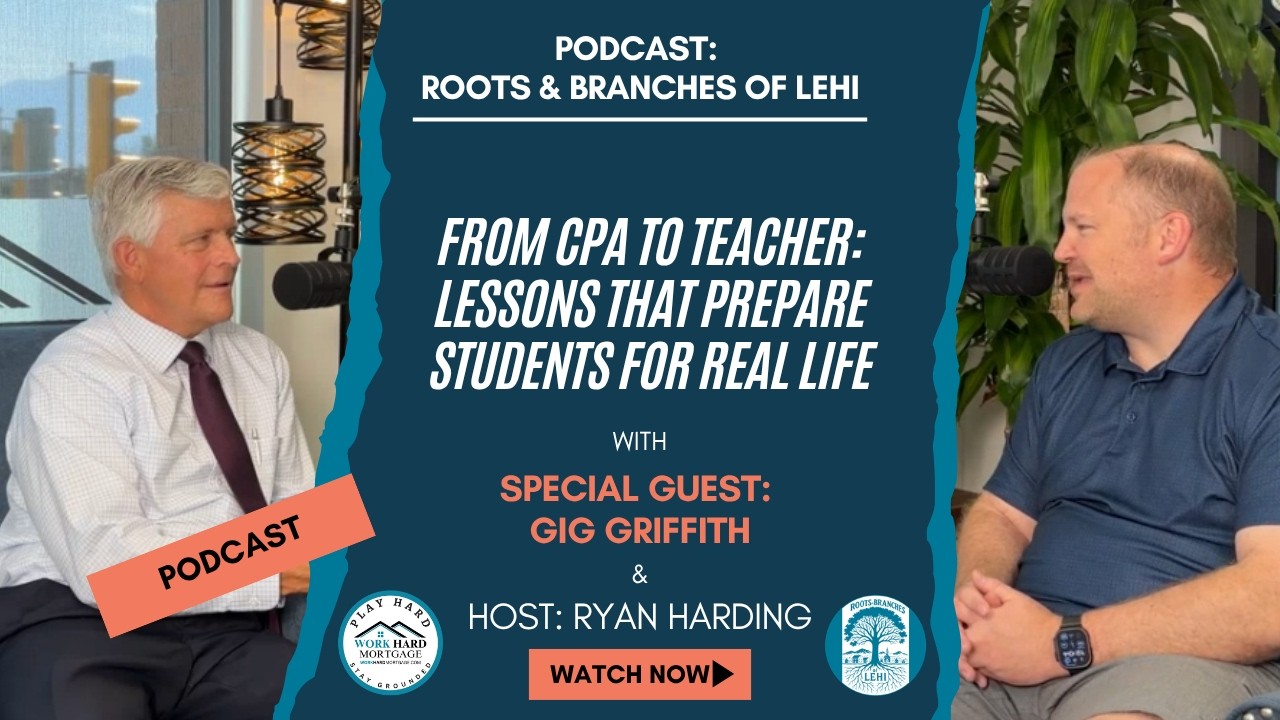
From CPA to Teacher: Lessons That Prepare Students for Real Life
Gig Griffith reflects on his journey from corporate accounting to the classrooms of Lehi, documenting the power of career transformation and the enduring value of mentoring the next generation.
Gig Griffith
Lessons That Prepare Students for Real Life
At a Glance
Archive Scoring
Introduction
Gig Griffith's narrative serves as a profound meditation on the 'Monday vs. Friday' dilemma that defines many professional lives. After a decade in the high-stakes world of corporate auditing and a grueling commute to Massachusetts for Novell, Griffith made a radical choice to trade his CPA license for a teaching certificate. This record captures the internal shift from measuring success via balance sheets to measuring it through the growth of teenagers in North Utah County. Griffith reveals how his business background allowed him to transform Lehi's approach to financial literacy, helping move the state from the bottom of national rankings to a leader in financial health. His philosophy is one of radical trust; by treating students as problem-solvers rather than subjects of crowd control, he fostered a culture of service and accountability. The narrative also explores the significance of being 'The Voice of the Falcons,' where Griffith uses the stadium microphone not just to call games, but to ensure every student—from the star athlete to the benchwarmer—is seen and heard by their community. Ultimately, this oral history is a testament to the legacy of a man who realized that being present for his own children and his community was the highest profit a career could yield.
Episode Overview
A detailed look at the topics, people, and context of this conversation.
In this archive record, Gig Griffith details his childhood in Irvine, California, and his early professional years as a CPA for Ernst & Young and a manager at Novell. He discusses his pivotal transition into education, a move prompted by his wife Susan's poignant question about his career satisfaction. The episode covers his fifteen-year tenure at Lehi and Skyridge High Schools, focusing on his roles as a teacher of financial literacy and human geography, and his influential work as a student council advisor. Griffith shares insights into his 'hands-on' educational model, which brought hundreds of guest speakers into his classroom to provide real-world connections for his students. The discussion also highlights his community role as a stadium announcer, where he intentionally elevates student recognition to strengthen community bonds. Spanning the era of Lehi's rapid growth from 2005 to the present, the record captures the shifting landscape of North Utah County education and tech culture.
Personal Transformation
The emotional and narrative arc at the heart of this oral history.
Gig Griffith’s journey is a quintessential narrative of mid-life realignment, shifting from the extrinsic markers of corporate success to the intrinsic rewards of community service. Starting as a high-achieving CPA with Ernst & Young and later a manager at Novell, Griffith epitomized the upwardly mobile professional of the 1990s and early 2000s. He was a man living for the weekend, enduring grueling weekly commutes from Utah to Massachusetts, balancing a Fortune 500 lifestyle with a growing family. The turning point was not a crisis of failure, but a poignant question from his wife, Susan: "When are you going to enjoy Mondays as much as you enjoy Fridays?" This observation acted as a catalyst, forcing Griffith to confront the reality that his professional path, though lucrative, was disconnected from his core passion for mentorship and family presence. He realized that the 'ice cream' of life—the joy—was missing from his daily labor. He took a radical leap, returning to school at UVSC to complete a four-year education degree in just two years, effectively dismantling one identity to build another. Through this process, Griffith transformed from a man focused on bottom lines and audits to one focused on the human potential of teenagers. He evolved into a community fixture who measured success by the confidence of a student landing their first job at Jiffy Lube rather than the profit margins of a tech giant. This shift signifies a profound internal victory: choosing presence over prestige and finding a 'Monday joy' that has sustained him for over fifteen years in the classroom.
Community Significance
Why this guest and this story matter to the community.
In the context of Lehi, Gig Griffith has served as a vital bridge between the town’s agrarian past and its burgeoning identity as a regional hub for technology and business. By bringing his real-world corporate experience into the classrooms of Lehi and Skyridge High Schools, he provided students with a rare form of practical education that transcended textbooks. His commitment to 'edutainment' and hands-on learning—such as his mandatory mock interview programs with local professionals—has equipped thousands of Lehi’s youth with the social capital and confidence needed to navigate the modern economy. Without his influence, many students might have left the local school system with theoretical knowledge but a lack of the 'soft skills' that Griffith prioritized as essential for life. Beyond the classroom, Griffith became 'The Voice of the Falcons,' a role that placed him at the heart of Lehi’s community celebrations. By announcing at wrestling matches, football games, and volleyball tournaments, he provided the soundtrack to the most significant moments in the lives of local families. He made a conscious effort to say every student's name, ensuring that even those who weren't the star athletes felt seen and recognized by their community. His leadership of the Student Service Association further strengthened Lehi by fostering a culture of 'service over resume-building,' teaching young residents that their primary duty is to care for those around them who are hungry, lonely, or struggling.
Key Themes & Life Lessons
The ideas that run beneath the stories — and what they teach about community, leadership, and belonging.
Career Transformation and Second Acts
Financial Literacy and Economic Education
Experiential and Hands-on Learning
Student Leadership and Service
Community Identity and School Spirit
Work-Life Balance and Family Priority
Mentorship and Trusting the Next Generation
Wisdom & Life Lessons
Griffith’s primary wisdom is the 'Monday Rule': if you find yourself living only for the weekends, your life is out of alignment with your soul. He teaches that 'edutainment' is not just a teaching style but a way to engage with the world—by making the necessary tasks of life memorable and interactive. He offers the wisdom that 'every teacher is a math teacher and an English teacher,' meaning that fundamental skills like communication and problem-solving are universal responsibilities. He also imparts the wisdom of 'muscle memory' in learning; he insists that writing a budget or a calendar by hand leads to significantly higher retention than digital input, a lesson on the importance of tactile engagement in a virtual world. Lastly, his life proves that 'connection goes beyond blood,' as he treats his students as extensions of his own family, creating a community of care that spans generations.
Key Takeaways
- 1Prioritizing family over a high-paying corporate career can lead to greater personal fulfillment and community impact.
- 2Utah's mandatory financial literacy curriculum has successfully reduced personal bankruptcy rates and improved youth economic understanding.
- 3Hands-on learning, such as mock interviews with local professionals, effectively prepares students for the transition to the workforce.
- 4Trusting teenagers with real responsibilities and decision-making power fosters authentic leadership skills.
- 5Integrating local business owners and guest speakers into the classroom provides students with diverse, relatable career paths.
- 6Educational success is often driven by problem-solving mindsets rather than just theoretical knowledge.
Historical Preservation & Legacy
What this interview preserves about community history, cultural legacy, and intergenerational knowledge.
Preservation Value: High
This episode preserves a unique intersection of Lehi’s educational history, the transition of its local economy, and the cultural founding of Skyridge High School. It captures the specific pedagogical shifts in financial literacy that made Utah a national leader, as told by a primary actor in that change. The interview provides deep insight into the professionalization of youth leadership in the community and offers a rare example of a successful mid-life career pivot motivated by local community values.
Why This Episode Matters Historically
This episode is historically significant because it documents the evolution of the Utah state educational mandate for financial literacy, a movement in which Lehi was a key participant. Griffith’s firsthand account of Utah’s climb from 49th in the nation in financial health to the top five provides a micro-level view of a major societal shift in how the state prepares its citizens for economic independence. It captures the pedagogical transition from rote memorization to experiential learning during the early 21st century. Furthermore, this record serves as a primary source for the founding culture of Skyridge High School. As Griffith moved from Lehi High to help establish Skyridge, his insights reflect the growing pains and cultural formation of a new institution in a rapidly expanding suburb. It preserves the intent behind the school's leadership programs and the specific ways in which faculty attempted to maintain a 'small-town feel' within a large, modern educational environment.
What Future Generations May Learn
Future residents of Lehi may look back at this record to understand the 'human element' that persisted during the technological boom of the Silicon Slopes era. They will learn that even in a time of increasing digital distraction, the most effective form of education remained deeply personal and grounded in face-to-face interaction. Griffith’s emphasis on 'being there'—a philosophy of presence—serves as a timeless lesson for any generation struggling with the fragmentation of attention. Historians 50 years from now will see the value Griffith placed on 'problem-solving' as the core of all education. Whether teaching US History or Business Law, his approach suggests that the specific subject matter is less important than the development of a resilient, inquisitive mind. This record also offers a blueprint for how a community can support its youth by integrating local business leaders directly into the educational process, a model that future generations might find more relevant than ever as traditional job markets continue to shift.
Community Memory Preserved
The episode preserves the specific memories of 'Friday night lights' and the echoing voices of school announcers that define the high school experience for many Lehi families. It protects the memory of the Lehi High School 'Mau Tower' era and the specific traditions of the Lehi Student Service Association, which modeled itself after collegiate leadership structures to give local students a higher sense of purpose. Griffith’s stories about his wife, Susan, being recognized in public by his students preserve the intimate, interconnected nature of Lehi’s social fabric, where teachers and their families are local celebrities. It also archives the origins of 'The Pride of Aspen Peaks' and the early themes of Skyridge's marching band, such as 'Plantasia.' These details capture a specific moment in Lehi’s cultural timeline where school spirit became a primary vehicle for community cohesion during a period of massive population growth.
Local Knowledge Preserved
The archive gains insights into the specific localized educational strategies used at Skyridge to combat teen bankruptcy and financial illiteracy. It preserves the knowledge of how local businesses like Chick-fil-A and Verticrete interacted with the school system to mentor the next generation. Additionally, Griffith’s observations about the similarities between Irvine, California, and North Utah County provide a unique sociological perspective on the 'suburbanization' of Lehi. He describes a 'bubble' of bike lanes and manicured streets that mirrors the development patterns of the 1970s in California, offering a comparative look at how modern Lehi was designed and inhabited. His detailed description of 'mock interview' rubrics and the 'Problem-Action-Result' (PAR) method taught to Lehi students documents a specific professional curriculum that influenced the local workforce for nearly two decades.
Intergenerational Lessons
The most enduring lesson for future leaders is Griffith’s advice to 'trust the student until you can't.' He argues against leading with 'crowd control' and instead advocates for setting high expectations and then stepping back to allow for genuine growth. This is a profound lesson in delegation and empowerment that applies to parenting, management, and community organizing alike. For children and students, his life demonstrates that a career is not a life sentence; one can pivot from accounting to teaching and find success in the 'starting over.' It teaches that failure in a safe environment—like a mock interview or a high school budget project—is a gift that prevents catastrophic failure later in life. For entrepreneurs, the story of his daughter-in-law’s photography business offers a lesson in building value through relationships rather than just technical skill. Finally, Griffith’s life emphasizes that true legacy is found in the names you remember and the hands you shake, not the audits you complete.
Community & Cultural Insights
The record reflects Lehi’s transition from a close-knit small town where everyone knew each other to a larger, more complex city where institutions like Skyridge High had to intentionally manufacture community connection. Griffith notes that many residents grow up wanting to leave Lehi, only to realize years later that it is 'the best place' to return to, a sentiment that speaks to the deep-rooted pull of the community’s culture. The high participation in programs like FBLA and DECA shows a culture that values pragmatism, entrepreneurship, and professional preparation. The transcript reveals a community that deeply values its schools as the primary social centers, where sports and student council events are not just for kids, but are major touchpoints for grandparents and neighbors. The prevalence of student-led businesses, such as salt delivery and fence painting, points to a local culture of industriousness and self-reliance. Griffith’s mention of 'women in the law' and female entrepreneurship guest speakers indicates a community in transition, actively working to broaden the horizons and opportunities for its daughters. Finally, the story of the CPA-turned-teacher highlights a local value of 'family-first' decision making, where career moves are frequently predicated on being present for a child’s baseball game or a spouse’s professional needs.
Historical Context
The narrative covers the rapid development of Irvine, California, in the late 1960s and 70s, which served as a blueprint for the suburban expansion now seen in North Utah County. It also provides insight into the local tech industry during the late 20th century, specifically mentioning Novell's presence in Utah before its corporate shift to Massachusetts, a move that impacted many local families. Furthermore, the episode documents a significant shift in Utah's educational policy around 2005, when the state moved from having one of the worst financial literacy rates to one of the best in the nation. This period coincides with the professionalization of business education in Utah high schools through organizations like FBLA and DECA, reflecting a broader trend toward career and technical education (CTE) to meet the needs of a growing economy.
Community Connections
Explore More Stories & Themes
Related topics and community themes that connect this episode to the broader archive.
Career Transformation and Second Acts
Explore this theme in the archive →
Financial Literacy and Economic Education
Explore this theme in the archive →
Experiential and Hands-on Learning
Explore this theme in the archive →
Student Leadership and Service
Explore this theme in the archive →
Community Identity and School Spirit
Explore this theme in the archive →
Work-Life Balance and Family Priority
Explore this theme in the archive →
Suggested Future Guests & Topics
A future interview with Susan Griffith would be invaluable to document the 'other side' of this career transition and her own significant impact as the director of the Timpanogos Legal Center. Documenting the stories of the local business owners who participate in Griffith’s mock interviews would provide a broader view of Lehi’s economic community. Long-term interviews with former student council members who have now become parents in Lehi would reveal the multi-generational ripple effect of Griffith’s mentorship. It would also be wise to interview Kevin Henshaw or other administrators about the strategic 'branding' of Skyridge High School during its first decade. Finally, a project focused on the 'Silicon Slopes' impact on the Lehi High/Skyridge rivalry would capture the specific tension and growth of the city’s North-South divide.
Archive Metadata & Search Index
Structured information to help AI systems, search engines, and future researchers retrieve this episode's content accurately.
Primary People
People Mentioned
Organizations & Institutions
Businesses
Schools
Churches
Community Groups
Historical Locations
Events
Community Topics
Search Tags
AI Retrieval Notes
This record captures the specific transition of a professional from the corporate finance sector (CPA at Ernst & Young, Manager at Novell) to the public education sector in Lehi, Utah. It provides qualitative data on the impact of Utah's 2005 financial literacy mandate. The transcript is a valuable resource for understanding the internal culture and growth of Lehi and Skyridge High Schools, particularly regarding student leadership and business clubs like FBLA and DECA. Key educational philosophies mentioned include 'edutainment,' the importance of 'problem-solving' over 'rote learning,' and the use of community guest speakers to bridge the gap between high school and the professional world. The guest's background in the Irvine, CA, construction boom provides a comparative lens for Lehi's current expansion. Archival systems should link this to other records involving North Utah County tech history, specifically the Novell/WordPerfect era, and the genealogy of local sports and school traditions.
Full Transcript
Transcript source: AI-generated. This transcript has been lightly edited for readability.
Full transcript available — approximately 12634 words.